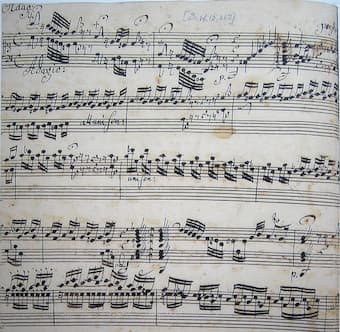
Bach’s Toccata in D minor 18th century copy by Johannes Ringk
Sometimes, I really don’t understand the descriptions assigned to particular keys. When it comes to D minor, we can read that it represents “dejected womanhood which broods on notions and illusions.” I guess it’s a pretty fancy and period description of a scorned woman in love? Others have said that D minor “expresses a subdued feeling of melancholy, grief, anxiety, and solemnity.” Whatever the case may be, some of the most famous and popular classical pieces ever are written in D minor. And here is my list of personal bests.
Bach: Toccata and Fugue in D minor
I can tell you that it was not a very easy choice because of all the gorgeous compositions in D minor that I have to leave out. However, for me it’s all starting with the Toccata and Fugue in D minor by Johann Sebastian Bach. Today that song is used in a variety of popular media, ranging from film, video games and ringtones. But the association today is not melancholy or a scorned woman in love, but sheer terror. This association with horror and Halloween first appeared in a 1962 film adaptation of “The Phantom of the Opera.” It just goes to show that specific associations are easily formed in connection with visual media, but the D minor Toccata and Fugue is still a most powerful composition, and certainly one of the best songs in D minor.
Mendelssohn: Piano Trio No. 1 in D minor
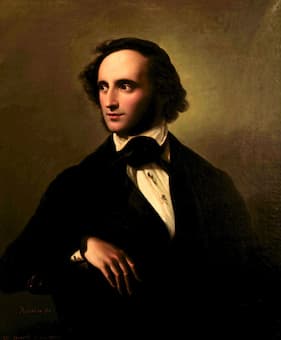
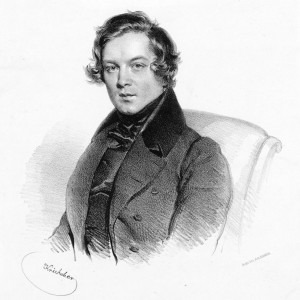
Portrait of Felix Mendelssohn by Wilhelm Hensel, 1847
Felix Mendelssohn learned a lot from the music of Bach. In fact, he was responsible that the music of Bach found its rightful place on the world’s concert stages. Mendelssohn looked at the styles and compositional techniques of the past and developed a highly personalized music style. Not everybody was enthusiastic for Mendelssohn to go back in time, and Berlioz once said, “Mendelssohn paid too much attention to the music of the dead.” And the always-punchy critic and playwright George Bernard Shaw compared Mendelssohn to a senile academy professor whose exercises in a dead musical language “are as trivial as they are tedious.” Then as now, it’s difficult to please the critics. Mendelssohn complete his piano trio in D minor in 1839, and Robert Schumann wrote in his review that “Mendelssohn is the Mozart of the 19th century, the most illuminating of musicians.” There is a good bit of melancholy yearning in the opening movement, and the slow “Andante” is actually a song without words that turns to passion. The scherzo is light and airy, and it all ends with a passionate rondo. For me personally, this is one of the most powerful and best songs in D minor ever.
Mozart: Requiem
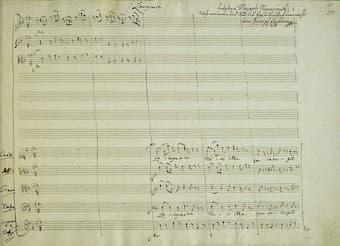
Mozart’s Requiem
Since the key of D minor is supposed to express grief and solemnity, it’s not surprising to find a good number of Requiems in that category. Composers who have written Requiems include Bruckner, Reger, Fauré, and probably most famously, Wolfgang Amadeus Mozart. The passionate lover of music, Count Franz von Walsegg commissioned the work for his twenty-year old wife Anna, who had sadly passed away.
The Count was a fellow Freemason, but as we all know, Mozart himself died before he could complete the composition. Sorry to disappoint all fans of the movie Amadeus, but Salieri had nothing to do with the Requiem or with Mozart’s death. Mozart’s wife Constanze hired several composers to finish the piece and deliver it to the Count. Constanze did suggest that her husband actually believed that he was writing the requiem for his own funeral. Whatever the case may be, it is one of the most powerful classical compositions I know, and it certainly is one of the best songs in D minor.
Haydn: Symphony No. 80 in D minor
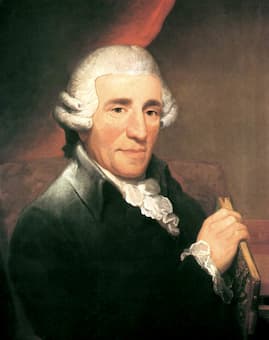
Portrait of Joseph Haydn by Thomas Hardy, 1791
D minor seemed to have been a highly popular key for composing large-scale symphonies. We have symphonies No. 1 by Dohnányi, Ives, Rachmaninoff and Richard Strauss. Prokofiev and Balakirev wrote their 2nd symphonies in D minor, the same key used by Bruckner in his symphonies No. 3 and No. 9. Dvořák composed his symphonies No. 4 and No. 7 in D minor, and there are also symphonies by Schumann, Shostakovich, Sibelius, Vaughan Williams, Glazunov, and of course the monumental symphony No. 9 by Beethoven. Which one is actually my favorite? To tell the truth, I really can’t decide. So I went back to the father of the symphony, Joseph Haydn, and I found a delightful storm and stress symphony in D minor. His 80th symphony probably dates from 1784, and for some reason it does not have a nickname. However, it is a symphonic gem and Haydn showed everybody coming after him what was actually possible in a symphony. And it is for that particular reason that Haydn’s 80th is my representative for symphonies in D minor.
Rachmaninoff: Piano Concerto No. 3 in D minor, Op. 30
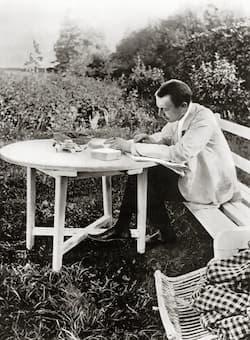
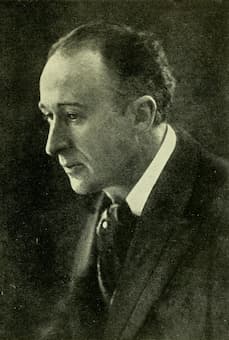
Rachmaninoff proofing a manuscript
Some composers are actually rather difficult to read. Sergei Rachmaninoff was clearly one of the last great pianist-composers in a long tradition stretching back to Mozart, Beethoven, Liszt and Brahms. He proudly suggested that “a composer’s music should express the country of his birth, his love affairs, his religion, the books which have influenced him, and the pictures he loves… My music is the product of my temperament…” Rachmaninoff was fiercely egotistic in artistic matters, but also frequently depressed without any specific cause. Very few people ever heard him laugh, and only occasionally did he crack a rare smile. He was often grave in expression and mannerism, and seemed to have been stuck in prolonged periods of philosophical longing and melancholy. Almost sounds like Rachmaninoff could be considered the poster child for D minor. And wouldn’t you know it, he did write a great number of works in that particular key, including the fabulous 3rd piano concerto. It is without doubt one of the all-time best songs in D minor. As you can tell, the key of D minor was really popular with composers, and I have tried to find my favorite songs; what is yours? Next time, I will take a look at the best songs in the cheerful key of B-flat major.