Total Pageviews

Friday, March 6, 2026

The Best Waltzes by the Great Composers

by Emily E. Hogstad  March 2nd, 2026


Using just three beats per bar, the waltz can suggest intimacy, seduction, nostalgia, aristocratic splendour, demonic frenzy, or even civilizational collapse.

best waltzes in classical music

The following ten works trace the evolution of the waltz from Schubert’s salon to Ravel’s catastrophic whirl and beyond. Together, they show how composers transformed a simple dance into one of classical music’s most versatile and revealing genres.

Franz Schubert – Valses nobles, D. 969   

Schubert wrote hundreds of dances – waltzes, Ländler, etc. – for domestic music-making in Vienna. But the Valses nobles, D. 969, written in the final year of his life, are something finer.

These aren’t ballroom miniatures; they’re personal statements. Harmonies turn unexpectedly inward; phrases stretch and sigh. Each is fleeting.

Their interiority and small scale make them an intriguing early evolution of the genre. They mark one of the first moments when the waltz became something to listen to, rather than something to dance.

Frédéric Chopin – Waltz in C-sharp minor, Op. 64, No. 2   

Chopin rarely intended his waltzes for dancing; they’re more psychological studies disguised as salon music.

His Waltz in C-sharp minor, Op. 64 No. 2, alternates between elegant charm and darker introspection.

Its shifting moods and subtle rubato transform the triple meter into something fluid and conversational. At times, it gets sarcastic or even acerbic, due in part to its minor key and unstable middle section.

Franz Liszt – Mephisto Waltz No. 1   

Liszt’s Mephisto Waltz No. 1 was not a waltz written for polite society.

Inspired by a scene from Nikolaus Lenau’s verse drama Faust, the Devil interrupts a village wedding and seduces the dancers into frenzy. The music is dazzling, demonic, virtuosic beyond reason.

Here, the waltz becomes temptation itself: it’s seductive, theatrical, dangerous.

Johann Strauss II – The Blue Danube, Op. 314   

If one piece defines the Viennese waltz, it is The Blue Danube.

Over the course of his career, Strauss perfected the formula: a graceful introduction, a sequence of unforgettable melodies, and then a glowing coda.

The rhythmic lilt feels effortless, as though the orchestra itself is gliding. This is the traditional Viennese waltz at its most radiant: aristocratic, irresistible, and intoxicating.

Johannes Brahms – Waltz in A-flat major, Op. 39, No. 15   

Brahms was a huge admirer of Strauss’s work, but his own waltzes are more private.

The A-flat major Waltz, Op. 39, No. 15, is brief and tender. Its warm harmonies and gentle phrasing feel nostalgic, or even autumnal.

Brahms distills the Viennese dance into something intimate and reflective. It’s a waltz meant for a quiet room, not a grand ballroom like Strauss’s.   

Pyotr Ilyich Tchaikovsky – Waltz from Swan Lake    

In Tchaikovsky’s hands, the waltz became a theatrical spectacle.

The Act I Waltz from his ballet Swan Lake is sweeping and luminous, filled with expansive melodies and rich orchestration.

It evokes aristocratic celebration, but Tchaikovsky’s gift for bittersweet harmonies also lends it an undercurrent of melancholy longing.

Claude Debussy – La plus que lente    

By 1910, almost a century after the genre’s ascendance, some waltzes had become nostalgic, even ironic.

Debussy’s “La plus que lente” (“slower than slow”) is both affectionate and gently mocking. The harmonies drift, colours blur, and the musical gestures seem to sigh.

This is a waltz that is filtered through French aesthetics and weary Belle Epoque sophistication.

Maurice Ravel – La valse   

Ravel’s La valse begins in a murky haze. Gradually, fragments of rhythm emerge from darkness, eventually coalescing into a glittering Viennese dance.

But then the elegance grows distorted. The orchestration becomes violent, grotesque, even unhinged.

Ravel always claimed that La valse wasn’t meant to be a portrait of the collapse of Europe after World War I. But it still feels like an autopsy of the collapse: the waltz falling victim to its own sophistication and grandeur.

Sergei Prokofiev – Waltz from Cinderella        

After Ravel’s shattering waltz, Prokofiev restores glamour to it – but with a similar edge.

The grand waltz from his ballet Cinderella is lush yet harmonically angular. The melodies shimmer, but the harmonies and rhythms here carry a modern bite.

This is fairy-tale elegance viewed through the darker, more jaded lens of the turbulent 20th century.

Dmitri Shostakovich – Waltz No. 2 (Suite for Variety Orchestra)    

By mid-century, the waltz had become a vehicle for irony as much as elegance.

Shostakovich’s Waltz No. 2 sounds charming at first, almost kitschy. But the sweetness is slightly exaggerated, the orchestration a touch garish. There’s something theatrical and faintly tragic beneath the surface.

This waltz music is smiling through clenched teeth.

Conclusion

From Schubert’s Viennese miniatures to Shostakovich’s Soviet irony, the waltz has proved remarkably adaptable.

It can whisper or seduce. It can glitter. It can burn the ballroom to the ground…all in ¾ time.

If you had to choose a favourite, which waltz would it be?

Frédéric Chopin’s 10 “Easy” Piano Pieces

 by Hermione Lai  March 1st, 2026


The music can be fragile, dance-like or fleeting, and infused with a sense of great nostalgia or melancholy. And then there is this emotional fragility, like emotions changing in mid-sentence. Chopin’s music feels so vulnerable, seemingly confiding in the listener. It’s emotion in its purest form.

Rudolf Schuster: Fryderyk Chopin in the salon of prince Antoni Radziwiłł

Rudolf Schuster: Fryderyk Chopin in the salon of prince Antoni Radziwiłł

Yet we all know that his music is famously challenging to play. In the hands of experts, it sounds effortless, floating through the air with a passion that’s always under control. But if you have been studying the piano, you know that the technical challenges of playing Chopin are substantial.

For Chopin’s birthday on 1 March 1810, let’s do something special by presenting 10 of his easiest piano pieces. In their original scoring, there are none for complete beginners, sorry. But if you are an intermediate pianist, here are 10 pieces that are surprisingly approachable.

On the top of my list of approachable Chopin piano pieces is the Prelude in E minor, from the Op. 28 set. This piece even looks approachable on paper. No glittering runs or thundering octaves, and no crazy fast arpeggios.

To be sure, the slow tempo and simple left-hand accompaniment are immediately inviting. No violent leaps or intricate crossings, with chords unfolding regularly. Of course, it’s all about the weight of each chord and how one harmony resolves into the next.

The melody is pure simplicity, essentially an expressive sigh that hovers above the broken chords. You will be able to learn the notes of both hands relatively quickly, but can you make the piano sing? Technically, it is approachable, but to convey the emotions is much more difficult. 

The set of 24 Preludes in Op. 28 contains some wonderful pieces for intermediate pianists. Take the A Major Prelude, Op. 28, No. 7, as an example. It’s one of the shortest piano pieces Chopin ever wrote, and it feels like a fleeting smile.

While the left hand keeps a steady and lilting accompaniment, the right hand sings a folk-like melody. No wild leaps or complicated passagework in the left hand, and a very pianistically unfolding melody in the right hand. No acrobatics here at all.

The notes should come to you rather easily, but can you find the elegance demanded from this small dance? It should never sound mechanical, with the left hand breathing softly. But don’t slip into sentimentality, as it is naturally beautiful.     A number of Chopin waltzes are glittering showpieces, but Op. 34, No. 2 is different. This one is a far gentler affair. And it’s difficult not to be swept up in the flowing rhythm of the dance.

What makes waltzes difficult to play on occasion are extreme jumps and brutal stretches. In Op. 34, No. 2, the familiar waltz pattern is, of course, present, but the technical demands here are not punishing. There are some ornaments in the right hand, but like much of Chopin, the entire melody lies comfortably under the fingers.

Did you notice that this waltz is scored in the minor key? There is a celebration for sure, but it feels more like a memory than an actual celebration. Passion is everywhere, but it is all viewed through a veil.

Mazurka in A minor, Op. 17, No. 4   

Let’s stay with the dance idiom for a bit, although the Mazurka in A Minor, Op. 17, No. 4 is slightly more challenging. Still, it isn’t a showpiece that glitters and sparkles, but another deep personal recollection.

There are some broken patterns in the left hand, but with the unhurried tempo, an intermediate pianist can learn the notes. Chopin opens up a sparse texture, with the left hand always supporting the melody, not battling it. And what a fantastic piece to learn all about rubato.

Technically, it gets a bit more challenging in the middle section. However, it all feels rather introspective. The gently swaying rhythm carries you away to the Polish homeland Chopin missed so much. Whatever you do, don’t try to overpower this emotionally very fragile music.

Prelude in B minor, Op. 28, No. 6   

Technically speaking, we should count the Prelude in B minor, Op. 28, No. 6 among the 10 easiest Chopin pieces. And on the surface, that is certainly true. It all seems rather simple, with the left hand playing marching chords while the right hand quietly presents a fragile melody.

What might be technically simple is frequently emotionally challenging. This particular prelude is pure melancholy. The weight of each chord should never destroy the sense of fragility, and it’s easy to get carried away with the rubato.

A great pianist once said that by listening to Chopin, audiences should feel as if the composer is confiding in them. And that’s the melody in this prelude. Every single note is a secret, whispered to you in great confidence. And it is never ashamed to do so.

Frédéric Chopin: Waltz in B minor, Op. 69, No. 2   

For another approachable piece in B minor, let’s turn to the Waltz Op. 69, No. 2. It is approachable for an intermediate pianist as the technical challenges are manageable, but the music just sounds deceptively easy.

We do find the gentle waltz pattern in the accompaniment, and the melody offers flowing phrases and lyrical lines. Yet, there are plenty of subtle shifts in dynamic, in delicate accents, and the rubato simply has to sound like natural breathing.

If you play this mechanically, it will immediately lose all charm. There is so much restraint and intimate tenderness that is incredibly difficult to express. While the notes might be suitable for young fingers, the emotional content certainly isn’t.

Mazurka in G minor, Op. 67, No. 2    

The Chopin Mazurkas are never really that easy to play, but technically, some are accessible to intermediate pianists. These Polish dances are at the heart of Chopin’s piano music, and they always carry a sense of melancholy and longing.

The mazurka rhythm flows gently and steadily throughout, with the lyrical melody clearly written by an expert pianist. There are no uncomfortable leaps and jumps, and no blazing runs from the top to the bottom of the keyboard. The notes can be learned.

The most challenging part of this piece is that the pianist has to shape the mood. The phrases must breathe, and the off-beat accents gently navigate you between a memory of joy and a sigh of sorrow. You won’t be successful if you only think of virtuosity and speed.   

Every aspiring pianist wants to play a Chopin Nocturne, and the C-sharp minor is probably one of his most approachable. Steady arpeggios won’t kill your hands if you know how to rotate your wrist, and the melody is one of the most natural creations ever written by Chopin.

The melody is delicately emerging over the accompaniment, and it needs very careful attention. The real difficulty comes from shaping that melody. Everything relies on expressive timing and gentle dynamic nuance. And don’t let that rubato run away with you.

There is plenty of passion in the opening section, and some real drama in the central part. Each change of harmony and turn of melody becomes a reflection or unspoken emotion that can be felt immediately.   

Since Chopin died at such an early age, a number of pieces were never prepared for publication by himself. They were discovered among his manuscripts and shared with publishers later.

One such treasure is a gentle waltz in A minor, featuring a steady accompaniment and a naturally flowing lyrical melody. This gem is entirely approachable for intermediate pianists, and it carries all the expected emotional intensity.

There is nothing dazzling in this dance. Rather, Chopin almost shyly immerses us in a melancholic quality that feels entirely personal. Since it was discovered only after Chopin’s death, it carries an extra sense of quiet mystery.

Prelude in C minor, Op. 28, No. 20    

Sometimes, the Prelude in C minor, Op. 28, No. 20 is nicknamed “Chordal Prelude.” And that pretty much describes the technical aspects. Thick chords carry the melody, and it is very manageable for intermediate pianists.

Yet, this quietly powerful miniature carries immense emotional depth. It feels like a march, maybe even a procession of memory. Emotion is contained in every single chord, and also in the silences between them.

You need more than technical proficiency to play this one. You need great sensitivity, a sense of patience, and empathy. It’s like a moment of reflection that has been suspended in time.

Bonus Time

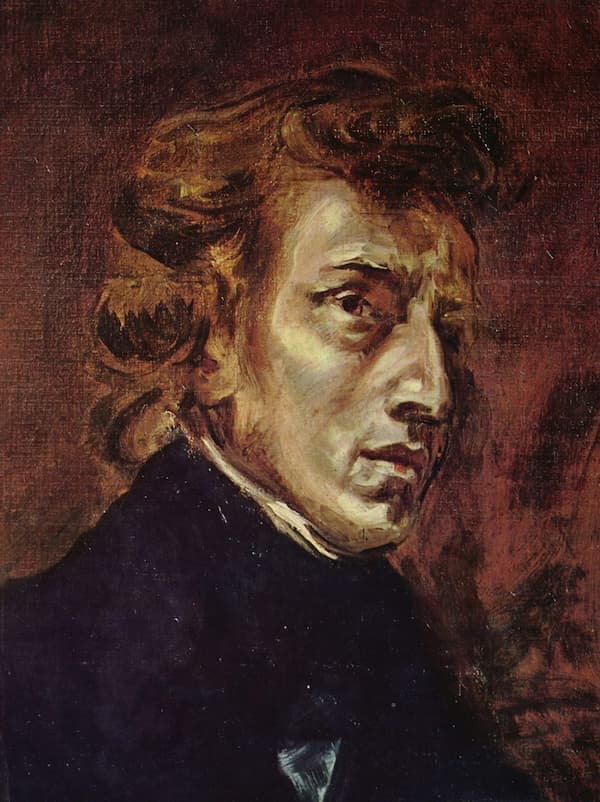
Portrait of Frédéric Chopin by Eugène Delacroix, 1838

Portrait of Frédéric Chopin by Eugène Delacroix, 1838

Here then is a little bonus selection, the famous “Raindrop” prelude. Every aspiring pianist is eager to play this little gem. And you already know about that hypnotic A-flat in the left hand.

It gets a bit stormier in the middle section, but the raindrops need to be soft and consistent. As soon as you start to force this repetition, the entire mood will be lost. Everything must sound as natural as possible.

I am sure you have already noticed the Chopin paradox in 10 of his easiest piano pieces. They are technically approachable and relatively simple, yet deeply emotional and profound. These might be playable by young fingers, but it will take an entire lifetime to probe their emotional depth.