Total Pageviews

Friday, February 6, 2026

Playing the Cello: The Best Icebreaker

You’ve probably heard the cello on numerous occasions either because you love its deep baritone sounds or because the cello is used whenever someone dies in a movie. The cello—its vibrant sounds so close to the human voice—is the perfect instrument to portray a melancholy or heartfelt or gripping mood.

What if I told you the cello is the best icebreaker too?  

We cellists never get used to the endless quips, (Don’t’cha wish you played the flute?) and the original jibes (that’s bigger than you are!)
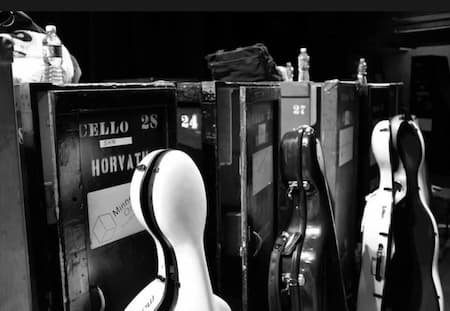
cello trunks for music tour travelling

Large trunk for cellos

Traveling with a cello is never without issues. When you’re a member of an orchestra and you go on tour, large trunks—coffins we call them—house two cellos in their cases. Loading them into the trunk before the stage managers wheel the trunks onto trucks, or locating the trunks in the maze of the venue backstage to retrieve your cello in time for the rehearsal or concert can be challenging.

If you travel as a soloist you must buy a seat on the airplane to ensure its not broken into pieces in baggage. But going through security can cause extreme anxiety. The last time I traveled with my cello the security agent pulled the cello from my arms claiming it wouldn’t fit in the x-ray machine and wielding it above his head he disappeared, taking it to examine at some inaccessible cubicle. “Waaaiiittt!” I cried, “it’s way older and more valuable than the average home.” My distress went unanswered.

Struggling to squeeze into a toilet stall at airports with a cello is a constant source of mirth to those who observe you. “I bet it really had to go?”
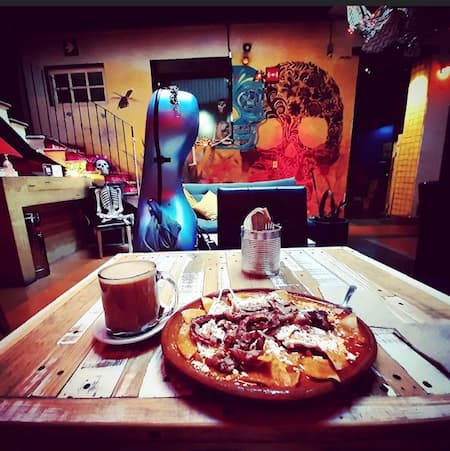
Eating out with cello

Eating is always a problem whether we are going to or from a performance or rehearsal by car or train, cab or bus. Even when we walk to a gig. Dinner, lunch, brunch, afternoon tea the cello has the best seat at the table in the restaurant.
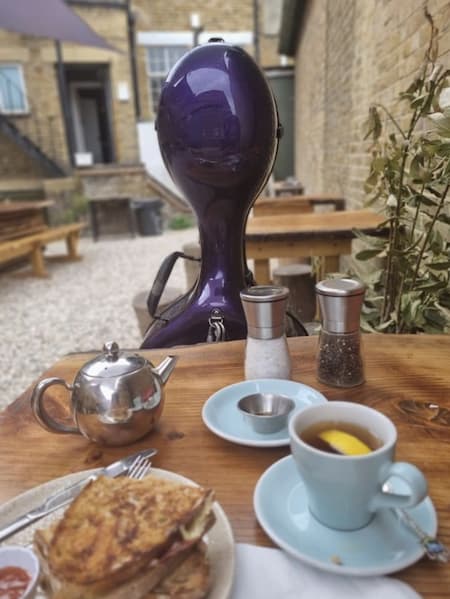
Having afternoon tea date with a cello

I’ll often position the cello facing the table. Invariably someone will quip, “How’s the conversation going? I’ll sometimes respond. “Fine. It doesn’t say much, or eat much.”
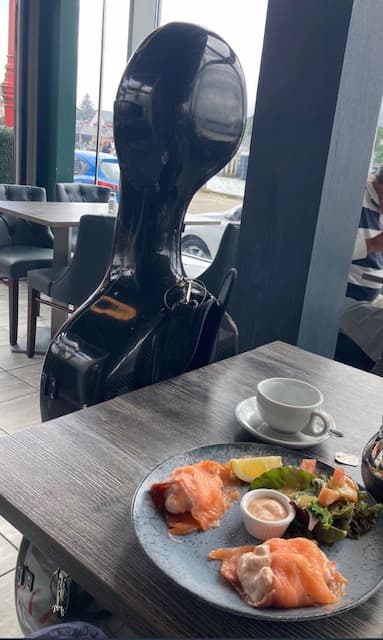
Cello in front of the dining table

When the cello is turned to face away from the table the comments range from, “What! The cello doesn’t like the food?” “Was it something you said?” “It’s obviously offended.”
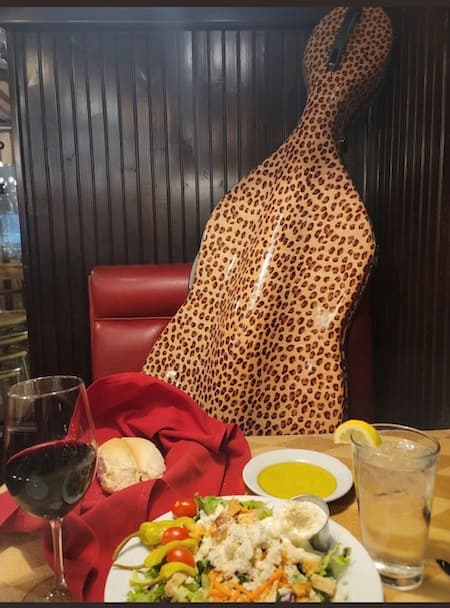
orchestra cellists problem

Some cellists name their instruments. Perhaps they go out together behind our backs: a cello twosome as it were?
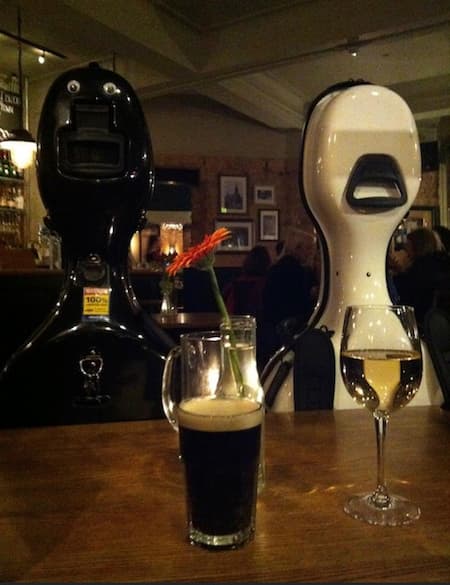
Having a drink with two cellos

Even in an intimate setting when the cello can be placed in a way that it isn’t crammed against the table in the room, perhaps even lying on its side so the cellist doesn’t worry it might topple over, someone will say, “When are you going to play us a tune?”   

Cello on a motorbike

Cello on a motorbike

You would be amazed how creative we can be when we maneuver a cello and passengers into a small car. And no, if you see the neck of the cello out the open window it’s not to experience the breeze. Some cellists might hitch their instrument onto a motorbike or bicycle. In fact, I know of a few cellists who have set off on long routes with their cellos, playing in small towns along the way and bringing music to the people.

Cellist Kenneth Wilson, from Renwick, Cumbria, travelling with his cello in his bike ride

Kenneth Wilson, from Renwick, Cumbria, travelling with his cello in a bike ride © BBC

Matt Haimovitz has toured for three decades, traveling by bus and bicycle taking BachBrittenPoulenc, and contemporary works such as the solo piece Beyond the Order of Things by Missy Mazzoli and Jennifer Jolley’s Compulsive Bloom to nightclubs, taverns, restaurants, and bars. As recently reported by the BBC, Kenneth Wilson, a former vicar, began his 5-week trip in May 2022 riding and playing along the 2,000-mile route from Carlisle to Rome.

As a cellist, staying in town also has its issues. What do we do when we have to stop for groceries on the way home from a concert? Our cellos are our best friends, and lifelong companions. They are also fragile. Made by hand, some date from the eighteenth or ninetieth century. A cellist will never leave their best friend in the car not even to run into the corner store for a quart of milk. Recently, a colleague took her cello into Costco and put it in the cart. Someone roared, “Why didn’t you get a six-pack?”
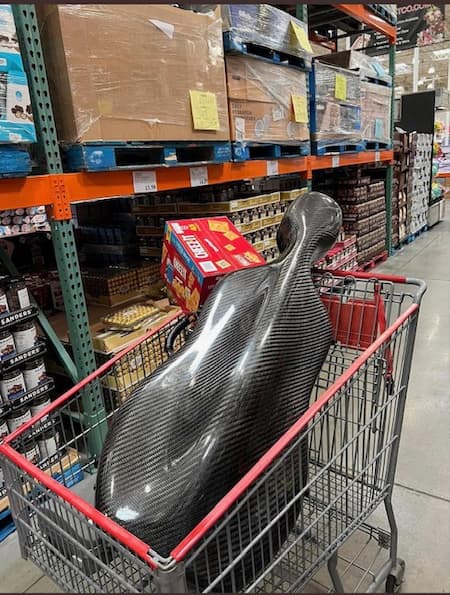
Doing grocery shopping with a cello

Doing grocery shopping with a cello

All this said, after a concert when we bring the cello in to a reception or gathering, it’s a terrific icebreaker. Before we can even get a drink, the questions start,
“When do you rehearse?” (Anytime; all the time.)
“How long have you been playing?” (All my life.)
“What is your day job?” (This IS my day job and night job and all- the-time job.)
“How heavy is it? Can I try?” (NO!)
And my favorite
“Do you get turned on when you play?” (no comment…)

The queries may even get into diplomatically sensitive territory:
“Do you like the conductor?” (depends on the person and the repertoire.)
“Why do you play so much contemporary music?” (All music was once modern. If we don’t support living composers there may not be great masterworks in 100 years.)
“Who’s your favorite cellist?” (Any number of great players can fit the bill from hither and yon and depends on what they are playing:
StarkerYo Yo MaRostropovichPiatigorskyJacqueline du PréSteven Isserlis, Gautier Capuçon, Pierre Fournier and one of my classmates Gary Hoffman.)

When hungry pangs strike and I’m ready to get to the food table, I’ll resort to rapid retorts:

No it’s not my boyfriend.
No it’s not a dead body.
No I can’t get it under my chin.
No I’m not playing a tune. I just played a symphony.
No it’s not a guitar.
No I don’t brandish the endpin if I’m angry at a colleague.

You see our problem I’m sure.

Sometimes we retaliate with our own cello gags.
Up a creek without a paddle? My teacher János Starker reacts!

The Enduring Melody: The Significance of Childhood Piano Memories

 by Frances Wilson  February 4th, 2026


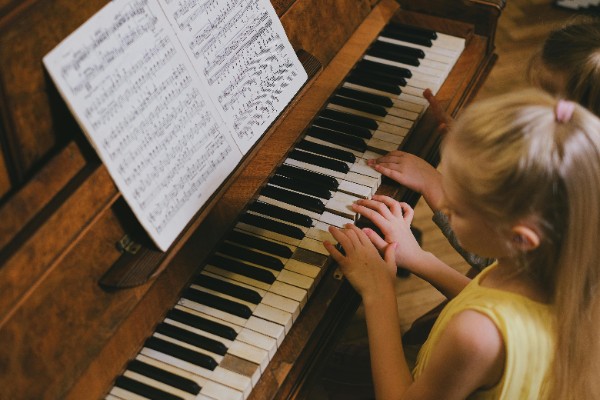
Girl playing the piano

Girl playing the piano

The journey of learning to play the piano is a great deal more than the acquisition of a skill; it’s a wonderful voyage of memory and emotion. The memories of piano pieces learned during childhood or as students often linger in our minds – and indeed our fingers – creating a mosaic of experiences and memories that extend far beyond the piano keyboard.

As musicians, we can easily relate to this – the memories of those pieces – where we learned them, with whom, and who taught us – and these memories only deepen with time.

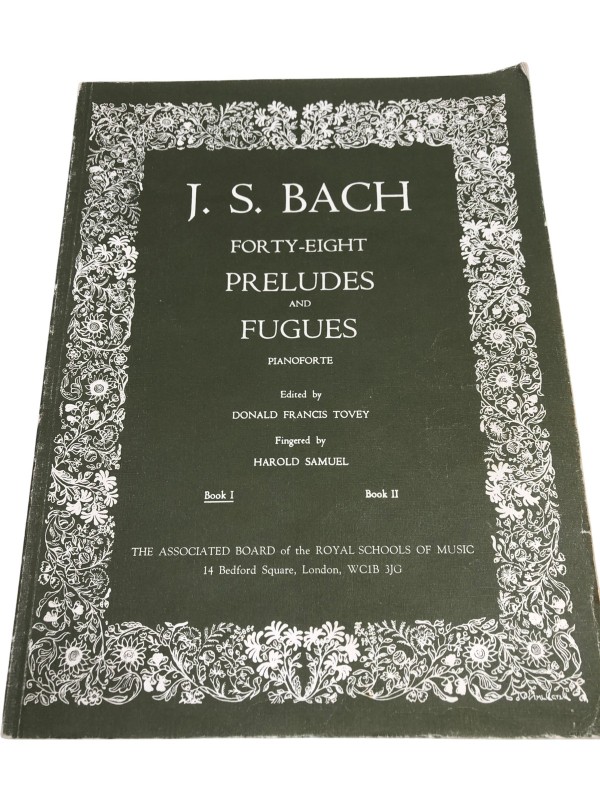
Music learned in our formative years often carries an emotional resonance that transcends the notes and rhythms. The melodies become intertwined with the memories of our youth, evoking nostalgia. These pieces serve as sonic bookmarks in the chapters of our lives, preserving the emotions felt during each practice session and performance. Looking back through old scores can create a “Proustian rush” of memories: my old ABRSM edition of Bach’s ‘48’, replete with my then teacher’s annotations, takes me back to piano lessons in the early 1980s, when I was an eager, precocious teenager. My then teacher had a big black Steinway grand in her living room, and her two dogs, a shaggy, rather smelly Old English Sheepdog, and a ginger spaniel, would sit under the piano’s belly as I played.


The process of learning and memorising piano pieces demands a high level of cognitive engagement. The brain forms intricate connections between motor skills, auditory processing, and memory recall during the practice and repetition required to master a piece. These cognitive networks established in childhood persist into adulthood, contributing to enhanced cognitive abilities, including improved memory, attention, and spatial-temporal skills. The act of memorisation itself becomes a mental exercise that strengthens neural pathways, leaving an indelible mark on our cognitive development.

Learning music involves acquiring a unique musical language. The ability to interpret and reproduce intricate patterns of sound develops a deep understanding of musical structures, harmonies, and phrasing. This early exposure to the language of music lays a foundation for future musical endeavours. Whether one continues to pursue a musical career or simply enjoys music as a listener, the memories of piano pieces learned in youth contribute to a lifelong appreciation and fluency in the language of music.

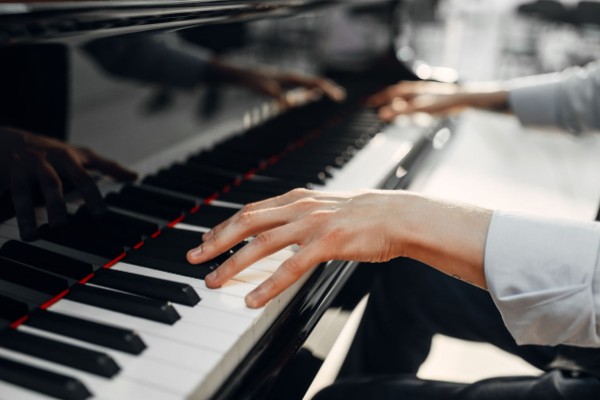
An adult playing the piano

Piano pieces often serve as gateways to cultural and artistic heritage. Many students are introduced to classical compositions that have withstood the test of time, and which form what is known as the “core canon” of classical piano. The ability to play and internalise these timeless pieces connects one to a broader cultural context and fosters a sense of continuity with the past. These musical memories become part of one’s artistic identity, influencing not only how one perceives and engages with music but also how one expresses oneself creatively across various aspects of life.

The memories of piano pieces learned in childhood or as students persist not only as musical recollections but also as integral components of our cognitive, emotional, and creative selves. Woven into the fabric of our formative years, these memories accompany us through life, resonating with music’s unique ability to evoke emotions, enhance cognitive abilities, and contribute to our cultural and artistic identity.

As we navigate the symphony of life, the enduring melodies of our piano memories serve as a constant reminder of music’s transformative power.

The Most Passionate Composer Love Letters of All Time, Part 1


Today, we’re looking at love letters from ten composers, including Mozart being very saucy on a business trip, Brahms pining over Clara Schumann, and Haydn making a shocking confession to his mistress.

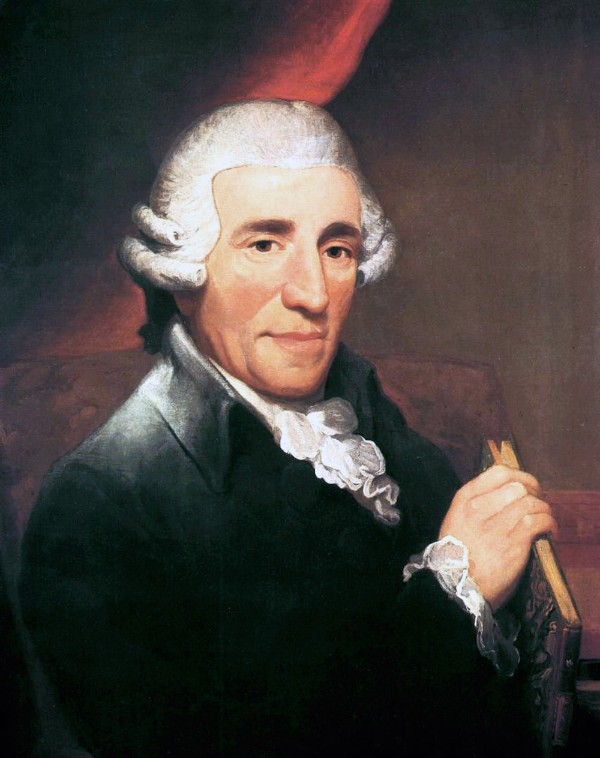
Joseph Haydn, 1791

Joseph Haydn

Joseph Haydn

In these two love letters to his mistress, singer Luigia Polzelli, Haydn writes about her husband’s fatal illness…and longs for “four eyes [to] be closed”, a reference to his hope that his own wife will die, too!

London, 14th March 1791

Most esteemed Polzelli,

I am very sorry for you in your present circumstances, and I hope that your poor husband will die at any moment; you did well to put him in the hospital, to keep him alive…

London, 4th August 1791

Dear Polzelli!

…As far as your husband is concerned, I tell you that Providence has done well to liberate you from this heavy yoke, and for him, too, it is better to be in another world than to remain useless in this one. The poor man has suffered enough. Dear Polzelli, perhaps, perhaps the time will come, when we both so often dreamt of, when four eyes shall be closed. Two are closed, but the other two – enough of all this, it shall be as God wills.

Learn more about why Haydn hated his wife so much.

Ludwig van Beethoven, 1812

Beethoven’s Seventh Symphony, finished in 1812   

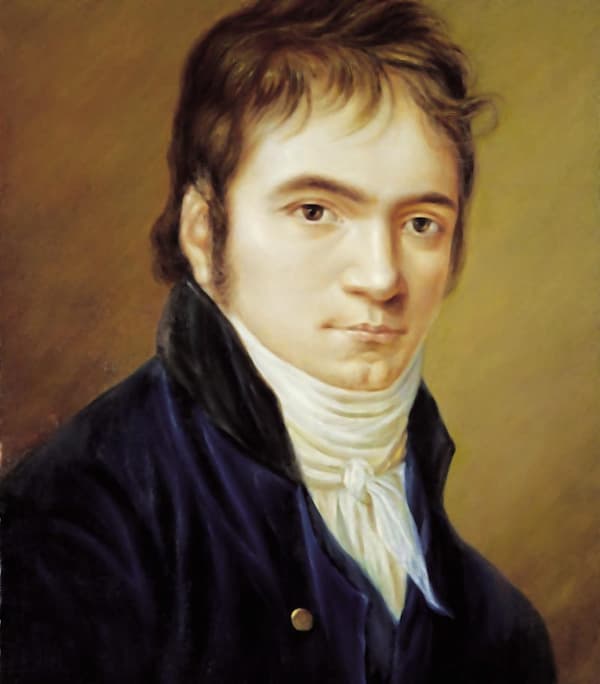
In 1812, Beethoven wrote an impassioned love letter to an unknown woman. This letter has come to be known as the letter to the Immortal Beloved.

Beethoven in 1803

Beethoven in 1803

Though still in bed, my thoughts go out to you, my Immortal Beloved, now and then joyfully, then sadly, waiting to learn whether or not fate will hear us – I can live only wholly with you or not at all – Yes, I am resolved to wander so long away from you until I can fly to your arms and say that I am really at home with you, and can send my soul enwrapped in you into the land of spirits – Yes, unhappily it must be so – You will be the more contained since you know my fidelity to you. No one else can ever possess my heart – never – never – Oh God, why must one be parted from one whom one so loves. And yet my life in V is now a wretched life – Your love makes me at once the happiest and the unhappiest of men – At my age I need a steady, quiet life – can that be so in our connection? My angel, I have just been told that the mail coach goes every day – therefore I must close at once so that you may receive the letter at once – Be calm, only by a calm consideration of our existence can we achieve our purpose to live together – Be calm – love me – today – yesterday – what tearful longings for you – you – you – my life – my all – farewell. Oh continue to love me – never misjudge the most faithful heart of your beloved. ever thine, ever mine, ever ours…

Read more about Who was the Immortal Beloved?

Wolfgang Amadeus Mozart, 1783

Mozart’s Die Entführung aus dem Serail overture   

Here’s a suggestive love letter from Wolfgang Amadeus Mozart to his wife Constanze, written in 1783 when he was about to return home to Vienna after overseeing a production of his opera Die Entführung aus dem Serail in Prague.

On June 1st I’ll sleep in Prague, and on the 4th – the 4th? – I’ll be sleeping with my dear little wife; – Spruce up your sweet little nest because my little rascal here really deserves it, he has been very well behaved, but now he’s itching to possess your sweet [word erased by some unknown hand]. Just imagine that little sneak, while I am writing, he has secretly crept up on the table and now looks at me questioningly; but I, without much ado, give him a little slap – but now he is even more [word erased by some unknown hand]; well, he is almost out of control, the scoundrel.

Find out what life was like with the Mozarts in the 1780s.

Hector Berlioz, 1832

Berlioz’s Symphonie Fantastique   

Berlioz wrote this letter to actress Harriet Smithson, a woman whom he had been obsessed over and stalking for years, for whom he had composed the Symphonie fantastique and Lélio. He was begging her to return his letter:

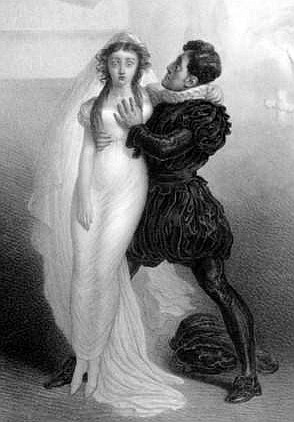
Harriet Smithson in Romeo and Juliet

Harriet Smithson in Romeo and Juliet

If you do not desire my death, in the name of pity (I dare not say of love) let me know when I can see you. I cry mercy, pardon on my knees, between my sobs!!! Oh, wretch that I am, I did not think I deserved all that I suffer, but I bless the blows that come from your hand, await your reply like the sentence of my judge.

Learn more about the insane love story between Hector and Harriet.

Franz Liszt, 1834

Liszt’s Liebestraum No. 3  

In 1834, Franz Liszt wrote this to his new mistress, Countess Marie d’Agoult:

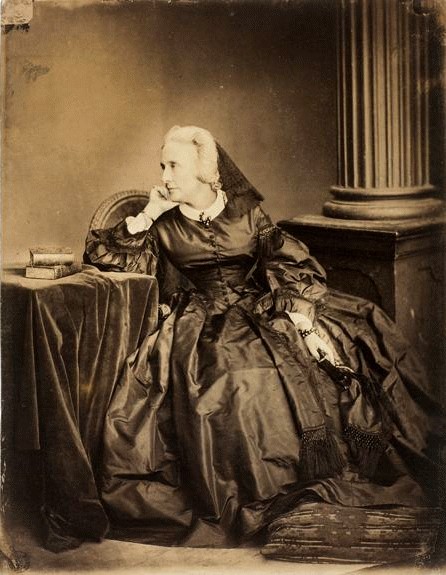
Marie d'Agoult in 1861

Marie d’Agoult in 1861

My heart overflows with emotion and joy! I do not know what heavenly languor, what infinite pleasure, permeates it and burns me up. It is as if I had never loved!!! Tell me whence these uncanny disturbances spring, these inexpressible foretastes of delight, these divine tremors of love. Oh! All this can only spring from you, sister, angel, woman, Marie! All this can only be, is surely nothing less than a gentle ray streaming from your fiery soul, or else some secret poignant teardrop which you have long since left in my breast.

Learn more about the passionate nature of Liszt and Marie d’Agoult’s early relationship.

Robert Schumann, 1837

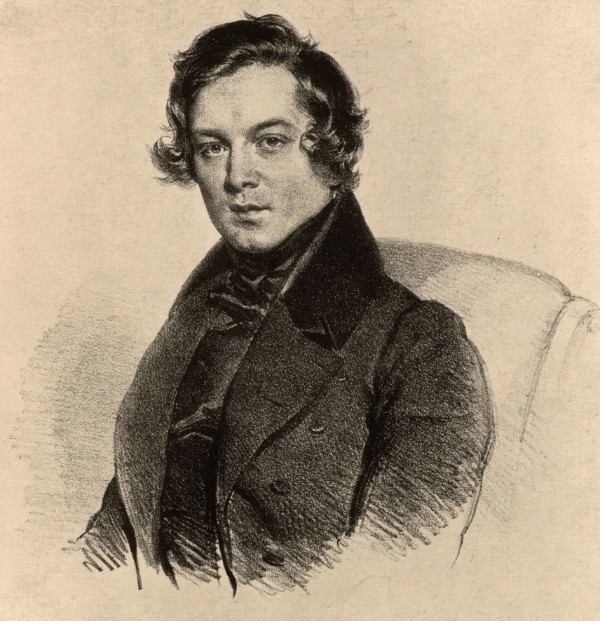
Robert Schumann

Robert Schumann

In December 1837, composer Robert Schumann was in love with virtuoso pianist Clara Wieck. They’d gotten engaged a few months earlier and were doing their best to navigate their relationship, given that Clara’s father didn’t approve of their romance.

New Year’s Eve, 1837, after 11 p.m.

I have been sitting here for a whole hour. Indeed, I meant to spend the whole evening writing to you, but no words would come. Sit down beside me now, slip your arm round me, and let us gaze peacefully, blissfully, into each other’s eyes…

How happy we are, Clara! Let us kneel together, Clara, my Clara, so close that I can touch you, in this solemn hour.

On the morning of the 1st, 1838.

What a heavenly morning! All the bells are ringing; the sky is so golden and blue and clear – and before me lies your letter. I send you my first kiss, beloved.

Learn more about the brutal court case between Robert, Clara, and her father.

Johannes Brahms, 1858

Brahms’s Piano Concerto No. 1, Movement 2 (he once told Clara this was a portrait of her)    

Brahms had complicated feelings for his mentor and dear friend Clara Wieck Schumann.

In 1858, her husband Robert had died two years earlier, and Clara was on tour in the Netherlands to make money to support her family. Brahms came to her home in Düsseldorf, in part to help watch her children. He wrote to her during her tour:

My beloved friend,

Night has come on again, and it is already late, but I can do nothing but think of you and am constantly looking at your dear letter and portrait. What have you done to me? Can’t you remove the spell you have cast over me? …

How are you? I did not want to ask you to write, but do so long for letters from you. Besides, I know only too well how you are – you are holding your head up. So just write me a word or two occasionally, and I shall be happy – just a friendly greeting to say that you are keeping well and that you will be back in 14, 13, 12, 11, 10, 9, 8, 7, 6, 5, 4, 3, 2 days!…

Do cheer me with writing me a few lines. I want them so badly, but above all, I want you.

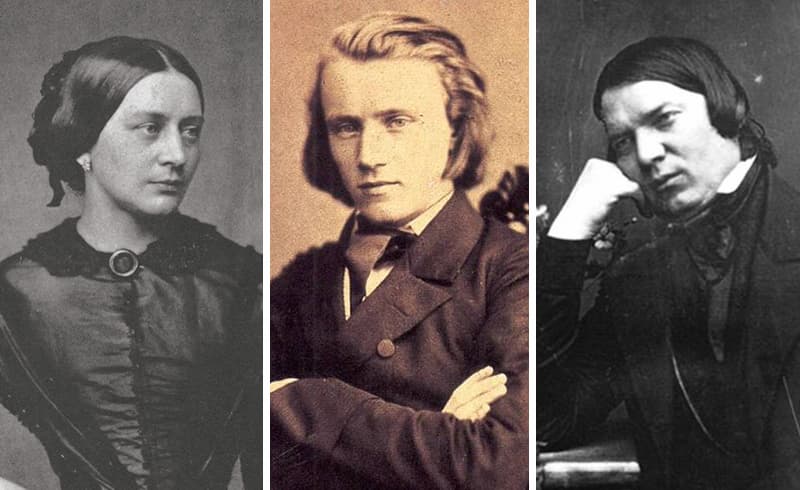
Brahms and the Schumanns

Brahms and the Schumanns

Learn more about the friendship and love triangle between Robert, Clara, and Johannes.

Richard Wagner, 1863

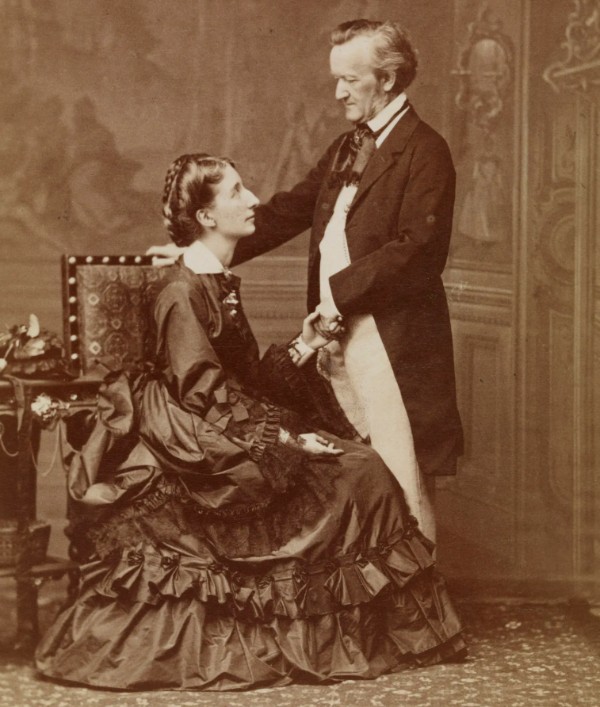
Richard Wagner and Cosima Liszt von Bülow

Richard Wagner and Cosima Wagner

Richard Wagner and Cosima Wagner’s marriage became one of the most influential in music history. However, the relationship had an inauspicious start. Richard wrote this letter to his mistress Maria Volkl shortly after first declaring his love to Cosima (!):

Now, my darling, prepare the house for my return, so that I can relax there in comfort, as I very much long to do… And plenty of perfume: buy the best bottles, so that it smells really sweet. Heavens! How I’m looking forward to relaxing with you again at last. (I hope the pink drawers are ready, too???) – Yes, indeed! Just be nice and gentle, I deserve to be well looked after for a change.

Gustav Mahler

During their engagement, Gustav Mahler wrote this letter to his fiancée Alma, to let her know she must decide between becoming his wife or pursuing her passion for composing music.

Almschi, I beg you, read this letter carefully. Our relationship must not degenerate into a mere flirt. Before we speak again, we must have clarified everything, you must know what I demand and expect of you, and what I can give in return – what you must be for me. You must “renounce” (your word) everything superficial and conventional, all vanity and outward show (concerning your individuality and your work) – you must surrender yourself to me unconditionally… in return you must wish for nothing except my love! And what that is, Alma, I cannot tell you – I have already spoken too much about it. But let me tell you just this: for someone I love the way I would love you if you were to become my wife, I can forfeit all my life and all my happiness.

Learn more about the beautiful Alma Schindler’s background, her marriage to Gustav, and why he wrote this letter.

Jean Sibelius, 1891   

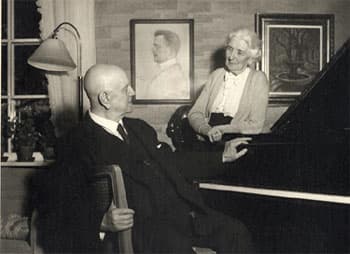
Sibelius wrote this letter to his fiancée Aino in early January 1891:

My own Aino darling,

Thank you for your letter and your Christmas cards. Your relatives have all been very kind to me. Please give them my respects and thank them most warmly, won’t you. But it is you who loves me more than anyone else has done, and I want you to be sure that I love you and belong to you with all my heart. Every time you write to me, I discover some new aspect of your personality. It makes me feel as if you are a store of treasures to which only I have the key, and you can imagine how proud I am to own it. You are so natural and sincere, which I like. When in the future we have a home of our own and are together alone, we must never be anything other than wholly ourselves, natural, tender towards each other, and devoted. I think and hope that you will be content with me in this respect. It is perhaps unmanly to say so, but you know, Aino, that I have always wanted to be caressed and have always missed its absence. At home, I was the only one who was demonstrative, and this in spite of the fact that I was basically very shy. But up to now, only you have caressed me, and perhaps you have thought it tiresome of me to ask you often to do this, my darling. This could well have remained unwritten, but as I am writing as quickly as I am thinking (hence my superb handwriting!), and this came into my head, it can just as well go into the letter. I sometimes cannot believe that a person like you loves me, for you are a wonderful woman.

Aino and Jean Sibelius

Aino and Jean Sibelius