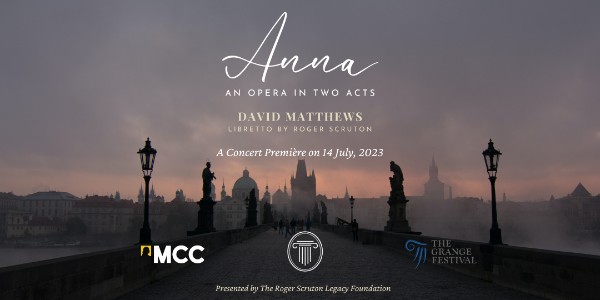
David Matthews’s opera Anna
Anna, the opera, looks at the personal implications of the 1989 revolutions in Central Europe. Whole countries were freed, but when the countries started looking at how the previous regimes were so successful, stories of betrayal and bravery stood side-by-side. Anna and her brother Peter are orphans. When Anna falls in love with Miro, he eventually must tell them that it was his work with the secret police that caused their father’s arrest and subsequent death. Anna wishes to forgive him, but Peter confronts Miro with a gun, and, in the ensuing struggle, it is Anna who is killed. The death unites the two men, and the opera ends in a general chorus for forgiveness. The ending lines of the chorus: ‘She paid the price of our bitterness. For love of her, we must forgive’, could be true in so many situations today.
The orchestral reduction consists of a diptych: Anna in Love and Lament for Anna, starting with her emotional happiness and ending with the two men’s realisation that they have killed the one person they both loved.
Matthews was encouraged to make his Anna reduction by Jac van Steen, the conductor of The Grange Hampshire performance, following the example of Richard Strauss and his own reductions of Intermezzo and Die Frau ohne Schatten.

David Matthews
The single-movement Symphony No. 11, Op. 168 follows. The composer says it was inspired by such diverse things as Schoenberg’s First String Quartet and Sibelius’ Symphony No. 7, a trumpet player he heard at a festival in 2022, and Lord of the Rings’ description of the woods of Lórien. There are calls to battle and a chaconne; the horn of Rohan has a part as well.
The final work on the recording is his Flute Concerto, Op. 166. It rests on the melodic aspect of the flute, and the composer says, ‘My Concerto alternates between song and dance’. He uses a small ‘Haydn-sized’ orchestra (strings plus 2 oboes, 2 bassoons, and 2 horns), and takes a page from Nielsen’s Flute concerto and the comments that its first movement ‘spends all its time looking for a key’. Accordingly, the movement begins in E flat major and moves through a descending line of F, G, A, B flat, C, D before returning to E flat major for the recapitulation. The coda starts the key search again, and the movement ends in D major. The flute line throughout is glorious.
David Matthews: Flute Concerto, Op. 166 – I. Allegretto
Movement II, Lento, moves down a half step and starts in D flat major. The slower outer sections frame a quicker allegretto middle section, which I thought of as a dance to celebrate Pan with panpipes, and which is mostly pentatonic.
The final movement, with a somewhat Irish flavour, is based on a melody the composer wrote for his wife, Jennifer, for Christmas in 2016. More dances liven the movement.
The music is filled with a wealth of invention and successfully integrates the modern lack of a tonal centre with traditional forms and constructs. In the Symphony No. 11, the recapitulation section does land us back at our starting key of E flat major, but that is not the key destined to end the piece; it is, however, the key that ends the last piece on the recording, to bring everything around full circle. Matthews’ music, in this expansive presentation by the Ulster Orchestra, brings us a composer we may not have been familiar with and gives us the opportunity to hear parts of his recent opera.
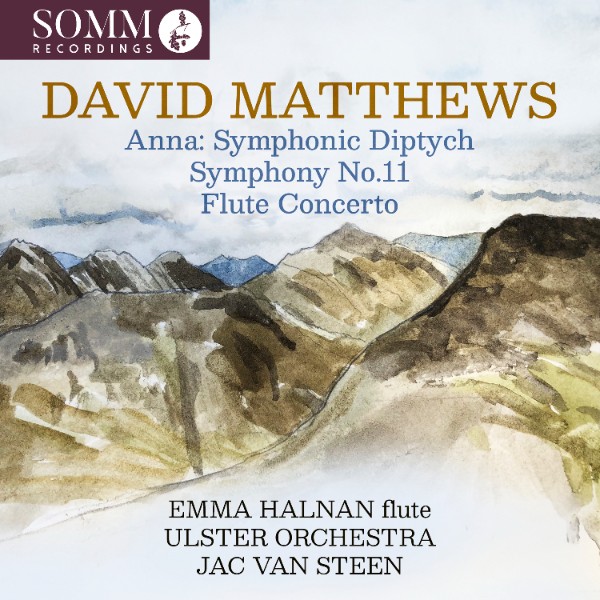
David Matthews: Anna: Symphonic Diptych; Symphony No. 11, Flute Concerto
Emma Halnan (flute); Ulster Orchestra; Jac van Steen (conductor)
SOMM Recordings: SOMMCD 0710
Release date: 17 October 2025
Official Website


