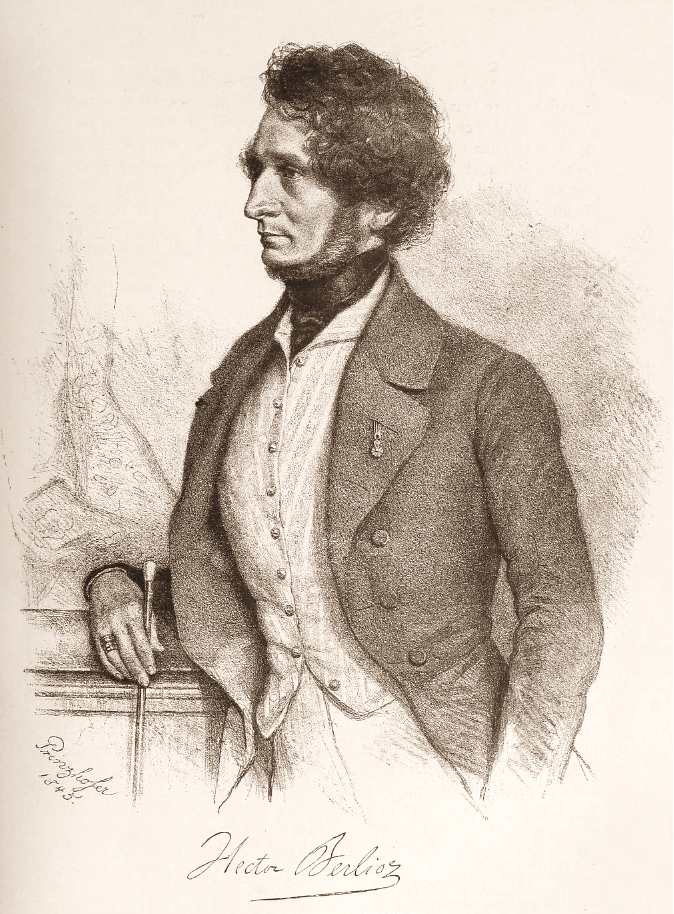
August Prinzhofer: Hector Berlioz, 1845
From this image, we can see so much about the man: his unruly head of hair, which so often figured in the caricatures of the time, his highly fashionable clothes, and the discrete medal worn on the lapel.
Berlioz was born in southwest France, in the département of Isère. His father was a doctor, and a medical career was planned for their sole surviving son. He was the eldest child and had two sisters, Nanci and Adèle, both of whom were close to their brother throughout their lives. He was educated at home by his father, and music had no important role but did have a place: he learned recorder (flageolet) and later took flute and guitar lessons. The major difference between Berlioz and his contemporaries is that he did not study keyboards and, later in life, he considered this to be one of his unique advantages, as he was not tied to ‘the tyranny of keyboard habits, so dangerous to thought, and from the lure of conventional harmonies.’
In 1821, Berlioz entered the School of Medicine at the University of Paris. His father gave him an ample allowance, and he used it to evade his hated anatomy lessons and attend the opera. Elements that would be important in his later career had the groundwork laid here: he admired Gluck’s use of the orchestra, he admired the staging and orchestral sound at the Paris Opèra, and so he set out to take formal music lessons. Accordingly, he became a private pupil of Jean-François Le Sueur, director of the Royal Chapel and professor at the Conservatoire.
In 1824, Berlioz graduated with his medical degree, which he promptly abandoned. His father suggested a law degree, which did not meet with his son’s favour. Father did not approve of a career in music and cut Hector’s allowance several times in an attempt to bend him to his will, but to no avail.
He started his composition career at the highest level with his first major composition, a Messe solennelle. This was followed by an opera, Les francs-juges. The mass was suppressed by Berlioz and only rediscovered in 1991. Les francs-juges was never performed and survives only in fragments, parts of it reused in other works.
In 1826, Berlioz was admitted to the Paris Conservatoire, studying composition under Le Sueur and counterpoint and fugue with Anton Reicha. He immediately tried to win the Prix de Rome, which granted three to five years of study in Italy, funded by the state. His first three attempts at the Prix failed, and it was with his 1830 cantata, La mort de Sardanapale, that he was victorious.
In the meantime, Berlioz had been attending the theatre, and, despite not knowing any English, fell in love with Shakespeare and Harriet Smithson, the leading lady of Charles Kemble’s touring company. He pursued her for several years while she, wise one, refused to meet him.
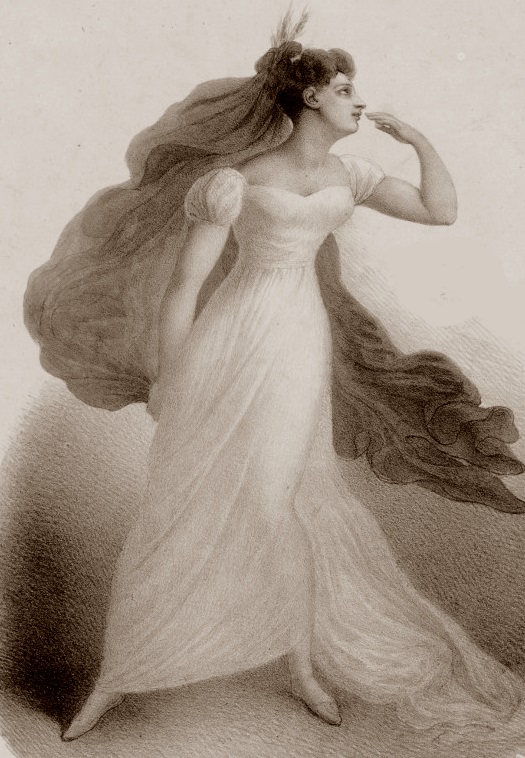
Martinet rue du Coq St Honoré: Harriet Smithson as Ophelia in Hamlet, 1827–1833
(Bibliothèque nationale de France, département Musique)
Turning aside from the unresponsive Smithson, Berlioz fell in love with a 19-year-old pianist, Marie Moke, known as Camille Moke, and they planned to wed.
In December 1830, was the premiere of the work for which he is best known today: Symphonie fantastique. This drug-dream of a work broke all of the traditional symphony rules and, in doing so, created a more dynamic symphonic world. Liszt was at the premiere and sought out this radical young composer. Their friendship would last for decades.
After settling in Italy with the Prix de Rome, Berlioz fled the city when he found out that Camille had broken off their engagement and was intending to marry a much better prospect than a music student. Her new intended was Camille Pleyel, the heir to the Pleyel piano manufacturing company. Berlioz rushed north, complete with plans to murder Marie and her mother, and collected poisons and a pistol (and a disguise) to accomplish this. After arriving in southern France, he reconsidered his plans and asked to return to Rome. This was granted, but while in Nice, he wrote his King Lear overture (more of the Shakespeare influence).
Berlioz arrived back in Paris in November 1832 and, in December 1832, presented a concert of his works, including the overture of Les francs-juges, a revision of the Symphonie fantastique, and Le Retour à la vie (a sequel to the Symphonie fantastique), in which Bocage, a popular actor, declaimed the monologues. The room was full of celebrities, including Franz Liszt, Frédéric Chopin and Niccolò Paganini on the music side, and Alexandre Dumas, Théophile Gautier, Heinrich Heine, Victor Hugo and George Sand on the writers’ side. Also in attendance was Harriet Smithson, and so she was able to finally meet her long-time fan.
They not only met, but, 10 months later, married, the ceremony taking place at the British Embassy in Paris on 3 October 1833. On 14 August 1834, their only son, Louis-Clément-Thomas Berlioz, was born. Harriet could not return to the stage in Paris, mostly because of her inability to speak French fluently.
Berlioz’s time in Italy was instantly reflected in his music with works such as Harold in Italy, Benvenuto Cellini, Roméo et Juliette, Les Troyens, and Béatrice et Bénédict, all containing some of the sunshine and scenery of his visit.
Berlioz was commissioned by Niccolò Paganini for a viola work, and he responded with Harold in Italy, which Paganini turned down as there wasn’t enough viola, i.e., not enough Paganini, for the virtuoso’s taste. Paganini later regretted turning down the work. In one account, after a performance in Paganini’s presence, the great violinist, speechless due to his tuberculosis of the larynx, ‘…is said to have made clear to Berlioz his admiration of the work, kneeling before him and kissing his hand, and following this, the next day, by a present of 20,000 francs, brought to Berlioz by Paganini’s young son, Achille’.
To make money, in addition to his music, he also took up music criticism. He hated the work but was very good at it. Although he complained that his time would be better spent on his own music and not that of others, he was able to express his hates and loves in the current music scene. These articles were collected from his books, such as Evenings with the Orchestra of 1854, and also formed the technical part of his Treatise on Ornamentation of 1844, still used today.
In the 1830s, Berlioz attempted to take on the Paris Opéra, as opera composers were much higher on the social scale than mere orchestral composers. Unfortunately, operas such as his Benvenuto Cellini (1838) were more difficult than current singers were willing to endure – a weak libretto and poor staging didn’t help.
This caricature gives some indication of how the work was regarded by critics for his attempt at ‘Grrrand Opéra’.
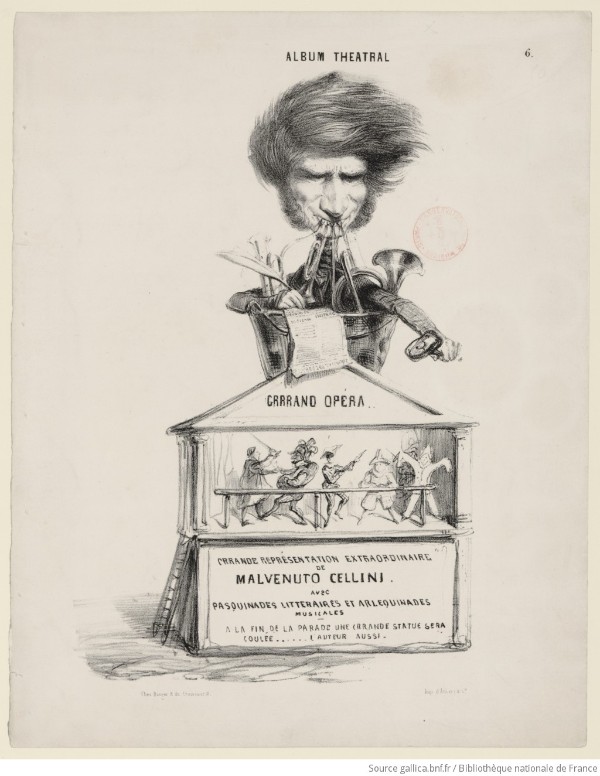
Banger: Hector Berlioz and Malvenuto Cellini, 1837 (Gallica, btv1b8415753f)
On the concert stage, however, his dramatic symphony Roméo et Juliette caught critics and composers’ ears alike. His huge instrumental and vocal forces impressed the young Richard Wagner, who used what he heard there to create his Tristan und Isolde.
This caricature, where we will note the multitude of brass instruments and a cannon to add to the general uproar, as well as the audience, some of whom are shuddering away from the orchestra and covering their ears and others who are lifted to exult at the sound.
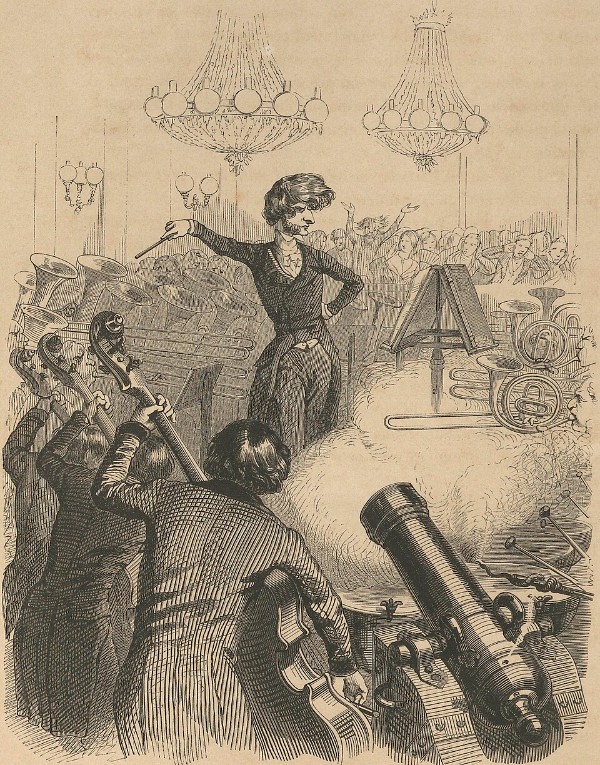
J.J. Grandville: Caricature of Berlioz from Louis Reybaud’s Jérôme Paturot à la recherche d’une position sociale, 1846 (National Library of Poland)
The 1840s saw some advancement in Berlioz’s career. The Paris Opéra hired him to update Weber’s Der Freischütz to a Paris standard; recitatives replaced the German dialogue, and the obligatory ballet was added, in this case, his orchestrations of Weber’s Introduction to the Dance. He wrote Les nuits d’été, based on the poetry of his friend Théophile Gautier. He started work on an opera to a libretto by Eugène Scribe, but never completed it. He published his influential Treatise on Instrumentation. He also discovered the joys of conducting his works on the international stage. The Germans were much more enthusiastic than his home audiences, and he could meet composers such as Mendelssohn and Schumann in Leipzig, Wagner in Dresden, and Meyerbeer in Berlin.
Unfortunately, his marriage with Harriet Smithson disintegrated due to both her jealousy over his success (and her sidelining) and her alcoholism, which became her comfort. He took a mistress, Marie Recio, and moved in with her in central Paris while Harriet kept their house in Montmartre.
His highly Romantic opera La Damnation de Faust hit the Paris stage in December 1846 but never brought full houses. Romantic operas were no longer the style of the day, and Berlioz hadn’t found the new key to the opera stage.
In mid-September 1848, Harriet suffered a series of strokes that paralysed her; Berlioz paid for the round-the-clock nursing and supported her until her death in 1854. That same year of 1854 saw his marriage to Maria Recio.
The summer of 1862, unfortunately, saw Marie Recio’s death. She was survived by her mother, who took care of the widower until his death.
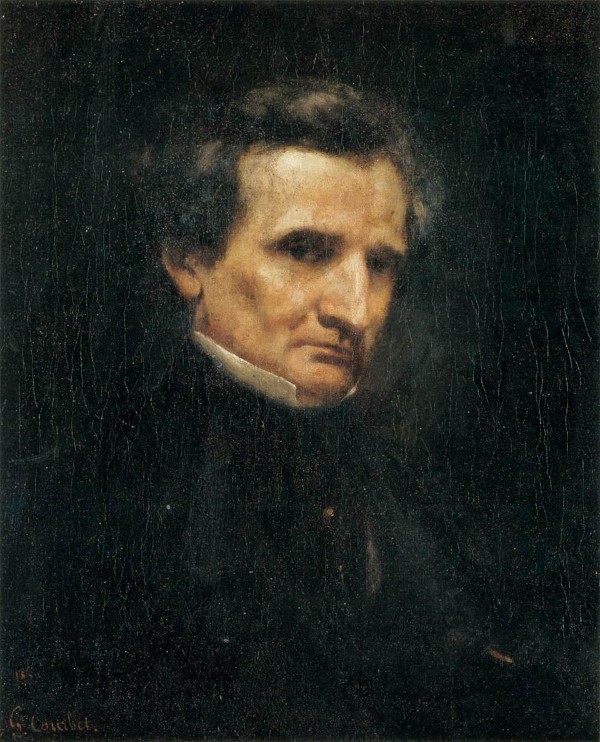
Gustave Courbet: Hector Berlioz, 1850 (Musée d’Orsay)
His last great opera came at the suggestion of Franz Liszt and Carolyne zu Sayn-Wittgenstein. They suggested he look to Homer’s Aeneid for inspiration. Thus was born the gigantic opera Les Troyens (The Trojans). Berlioz’s five-act, five-hour opera was too large for the Paris Opéra to consider, and he had to split the work over two nights: ‘The Fall of Troy’ and ‘The Trojans at Carthage’. The Trojans at Carthage received its premiere at the Théâtre‐Lyrique, Paris, in November 1863, but didn’t work. It had only 22 performances, and each night more and more was cut away. This so dispirited Berlioz that he wrote no more music after Les Troyens.
Berlioz continued his conducting career but wore himself out during a tour to Russia and returned to Paris, never again to have his health. He died at home on 8 March 1869, at the age of 65. He’s buried in Montmartre Cemetery with Harriet and Marie.
In his life, Berlioz constantly took up arms against the normal, the calm, and called for the Romantic life of the heart. Mad love affairs were his norm, and even the pursuit of his first wife was more the actions of a fan than a responsible person. He pushed French music out from the shadow of the German school and created a style that definitely wore its heart on its sleeve. Works such as his Symphonie fantastique have no precedent and show a wild originality that no other composer matched.
His late arrival as a musician and composer, without the solid background of the keyboard that every other composer took for granted, produced a composer who had a wonderful melodic sense, matched with a flexible approach to musical rhythm. Above all, he was a master of orchestration and continues to lead through his writings on the subject.
March 8 sees the 157th anniversary of Berlioz’s death, and we should reflect on all the ways that, even now, we cannot match this most Romantic of composers.


