Thomas Mann, Doctor Faustus
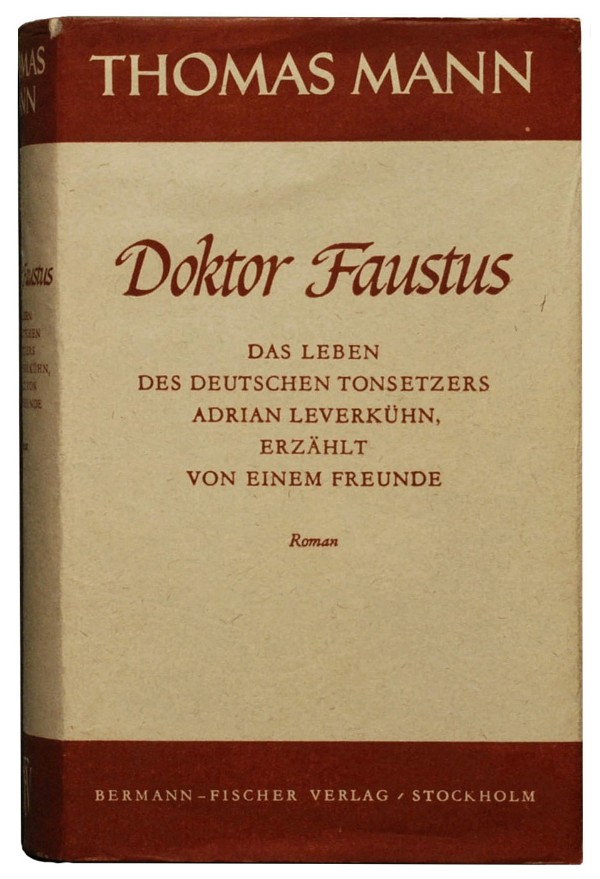
Doctor Faustus First edition cover in Europe © Wikipedia
This work of fiction is gargantuan not only in length but in its relation to aesthetics, the politics and history of Germany (both medieval and pre-WWII), and the intellectual life of many prominent German artists and theorists. As such, many of the complexities of this novel will go untouched in this article, but we will endeavour to look at some of the interesting ways in which the book relates to music.
Thomas Mann’s Doctor Faustus (1947) draws on the legend of Faust, a semi-historical medieval tale originating with Johann Georg Faust (c. 1480–1540), alchemist, astrologer, and magician. The story of Faust in early books soon grew into many retellings in the form of ballads, dramas, and puppet-plays; Christopher Marlowe wrote his play The Tragical History of Doctor Faustus in 1592, and Goethe also reworked the legend in the early nineteenth century. The story has enduring appeal, as it frames a central aesthetic and ethical conflict of human experience: at what cost should human excellence and knowledge be obtained? In the original Faust, the eponymous character meets the Devil at a crossroads, and, unsatisfied with his already successful and erudite life, sells his soul for infinite knowledge and experience. The adjective “Faustian” has come to mean any kind of sacrifice of spiritual goodness, wholesomeness, and health for power and greatness, often with the implication of self-defeat in the form of degradation, illness, or death. The “Faustian pact” varies in its details but is always made with Mephistopheles or a similar figure. The existence of such a corrupting influence implies, to varying degrees depending on the retelling, the presence and rejection of theological morality and God, though this was of greater focus in the medieval tales.
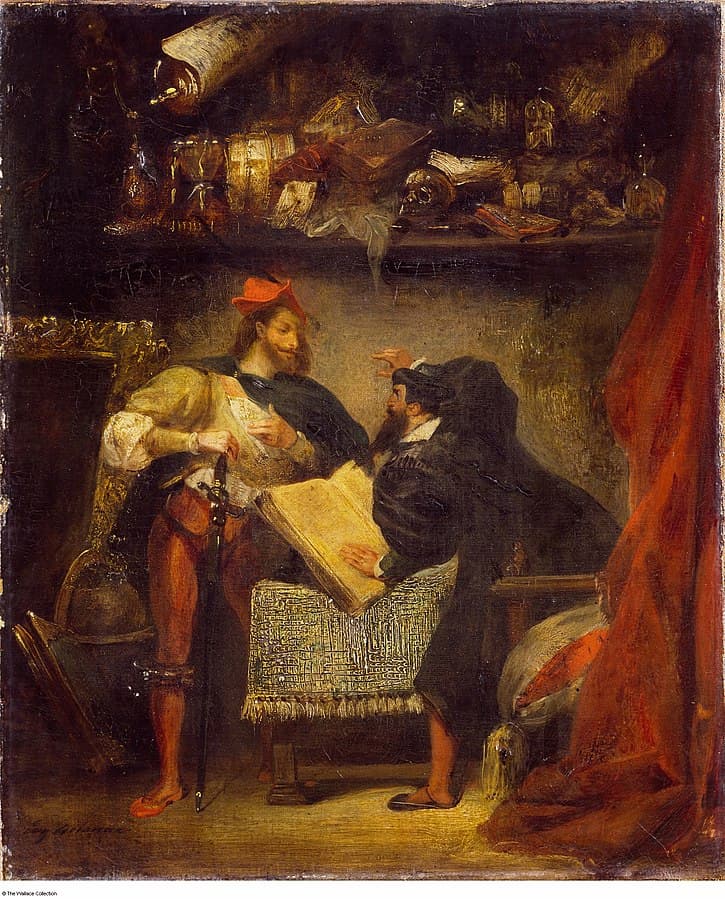
Delacroix: Faust and Mephistopheles, 1827 (The Wallace Collection)
In the novel by Thomas Mann, fictitious composer Adrian Leverkühn, of great genius and ambition, intentionally contracts syphilis so that the madness and hallucinations may deepen his artistic genius. He is visited by a Mephistophelean being, and renounces love for other human beings in exchange for twenty-four years of brilliance and creation. Leverkühn eventually looks upon his nephew, Echo, with love and fondness while working to finish his final masterpiece. When Echo dies, Leverkühn believes it to be caused by the pact and descends fully into madness and infirmity, unable to premiere his last work. The book situates this final downfall as happening at the same time as the full initiation of the Third Reich – the political allegory of Germany’s descent into sickness is clear.
The author’s son published an article on the musical symbolism of Doctor Faust. In it, Michael Mann quotes his father: “It is a grave error of the historical legend that it did not establish any connection between Faust and music.” Thomas Mann clearly saw something in the disposition of musicians, or composers, well-suited to corruption by temptation – or the Devil! His son notes that “critical thought and music – love of music and inner musicality of the word – are the very cornerstones of that work.” For Mann, music had a dual nature, “a Christian art with negative sign… [consisting of] both calculative order and chaos-breeding irrationality.” Arnold Schoenberg, then, was the perfect model for the character of Leverkühn, as the inheritor of the German Romantic musical lineage of Wagner and Mahler, and yet a famous inventor of the meticulous, mathematical twelve-tone system in response to the events of WWII. Schoenberg was displeased by Mann’s “homage” – in the book, the fictional Leverkühn is said to invent serialism – and Mann later added an addendum at Schoenberg’s request, in which the composer is credited for both serialism and the information Mann drew from studying Harmonielehre, Schoenberg’s treatise on harmony.
In Faustus, music becomes a kind of ethical, political, and aesthetic battleground – but Michael Mann notes that “the musical world of Adrian Leverkühn is not the musical world of Thomas Mann.” While Schoenberg’s theory ignited his literary excitement, his son notes that “his ears rejected Schoenberg’s music… his was the world of Richard Wagner…
Tchaikovsky, Saint-Saëns.” Even in the process of writing Faust he remarked: “If I were a composer, I should compose, perhaps, like Cesar Franck.” In his private life, Mann still sought the “beautiful illusion of art” that he “denounced in his workshop,” deeply rooted in the bürgerliche Kunst, bourgeois art, of the 19th century. In Mann’s Doctor Faustus, we find one of the most complex and paradoxical musico-literary relationships in history, as well as a harrowing and rich narrative for any lover of history or music.
The Pyramid, William Golding
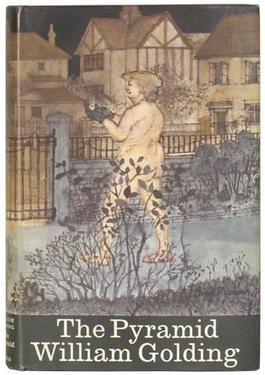
The Pyramid First edition cover © Wikipedia
Of all the works thus far, Golding’s The Pyramid (1967) displays what we might call the “lightest” treatment of music out of the novels surveyed. Instead of making music representative of weighty concepts like genius or freedom, or imbuing it with a powerful ethical valence, Golding’s book centres upon the protagonist Oliver’s upbringing in the fictional sleepy English village of Stilbourne, his transition to Oxford, and his mid-adulthood, in a gentle, reflective coming-of-age narrative. Oliver and his family are very musical, and as such, music features in a way that is faithful to the ways of life of the English countryside: Oliver plays violin and piano, takes lessons with the local organist, and takes part in local community productions with his mother. Music and its practical realities, familiar to any musician – struggling with a new piece, scales, having a melody stuck in your head, and the silly mundanities of lessons and rehearsals – are all woven into the daily fabric of Oliver’s life. Mundane realities of the music world are also shown to be entangled with questions of social status and class – Oliver is ashamed of his secret desire to be a professional pianist, and is told by his father to prioritise studies – and getting into Oxford – over his music lessons.
The poignancy and beauty of music are explored alongside Oliver’s life and experiences with no strong sense of separation – music is one of the languages he speaks on a daily basis, a model of a life lived with music as a companion rather than a master, idol, or unbridled temptation. As such, we end this two-part article on the least sensational, but perhaps most realistic and healthy, portrayal of music in literature – as a daily source of comfort and beauty to those who love it.