Today we’re looking at the history of classical music for trivia inspiration. Learn about everything from a composer who murdered his wife, to a Venetian orchestra of talented orphans, to forbidden love affairs, a deaf composer at the premiere of his groundbreaking symphony, and hypnotherapy that inspired a piano concerto.
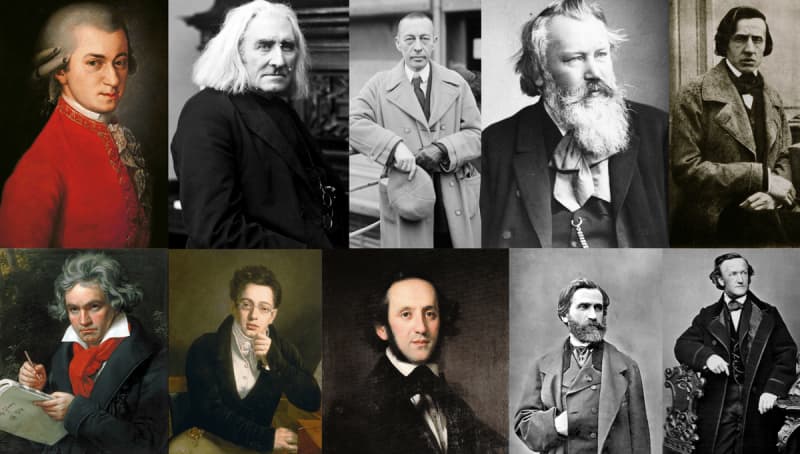
© classicalregister.com
Without further ado, here are our twenty trivia questions from classical music history:
Which composer from Bingen is also known as a saint?
Hildegard of Bingen!
Hildegard of Bingen was born around 1098 in present-day Germany. She started having visions at an early age and joined a Benedictine monastery as a child.
Around 1150 she composed a famous sacred music drama called Ordo Virtutum, or Order of the Virtues.
Hildegard of Bingen wasn’t just a composer. She also wrote theological works based on her visions, as well as scientific and medical texts.
Some modern popes have referred to her as a saint.
Which composer murdered his first wife and was never punished for it?
Carlo Gesualdo!
In 1586, when he was twenty, Gesualdo married his first cousin, Donna Maria d’Avalos. They had one son.
Four years later, Gesualdo came home and discovered his wife in bed with another man. Gesualdo killed both his wife and her lover with a gun and sword.
The authorities decided he had not committed a crime.
Which composer died after striking his foot with a staff he used while conducting?
Jean-Baptiste Lully!
Italian composer Jean-Baptiste Lully was both a dancer and musician.
He got a job in the court of Louis XIV. In 1687, to celebrate Louis’s recovery from surgery, he conducted a performance of his Te Deum.
He conducted by pounding a staff on the floor. In the process, he accidentally hit his foot. Gangrene developed and he refused to amputate because he still wanted to be able to dance.
Lully died on 22 March 1687 of his injuries.
Which composer had seven kids with his second cousin, and thirteen kids with his second wife?
Johann Sebastian Bach!
In 1707, Johann Sebastian Bach married his second cousin, Maria Barbara Bach.
She died tragically and unexpectedly in July 1720.
The following year, Bach married an accomplished young singer named Anna Magdalena. She was twenty and he was thirty-six.
They had thirteen children together. Their youngest child, a daughter named Regina Susanna, was only eight years old when he died.
Which composer wrote music for virtuoso orchestra of women who had been abandoned as babies?
Antonio Vivaldi!
He was a teacher at a facility known as the Ospedale della Pietà, which took care of orphaned or abandoned children.
As children, the most musically talented girls were chosen to perform in the figlie di coro, or daughters of the choir. They would both sing and play instruments.
Vivaldi wrote many of his works for them.
Which composer had a dream that the devil played violin for him – and then woke up and wrote it down?
Giuseppe Tartini!
Giuseppe Tartini wrote in Jérôme Lalande’s Voyage d’un François en Italie:
One night, in the year 1713 I dreamed I had made a pact with the devil for my soul. Everything went as I wished: my new servant anticipated my every desire. Among other things, I gave him my violin to see if he could play. How great was my astonishment on hearing a sonata so wonderful and so beautiful, played with such great art and intelligence, as I had never even conceived in my boldest flights of fantasy. I felt enraptured, transported, enchanted: my breath failed me, and I awoke. I immediately grasped my violin in order to retain, in part at least, the impression of my dream.
Even so, Tartini insisted that the work was not nearly as impressive as the one he’d dreamed.
Which composer was fired by an archbishop and kicked on the behind?
Wolfgang Amadeus Mozart!
In 1781, Mozart was aiming to ingratiate himself with Emperor Joseph II, while still remaining employed with Prince-Archbishop Hieronymus Colloredo in his hometown of Salzburg.
Unfortunately, Colloredo kept Mozart from making lucrative appearances, and acrimony grew between them.
Mozart tried to resign, but Colloredo refused to accept the resignation.
Meanwhile, Mozart’s father was horrified at his son’s behavior and was encouraging him to make nice with the archbishop.
The following month, Colloredo finally accepted the resignation…but not before having his steward kick Mozart on the behind.
Mozart decided to make a go at freelancing in Vienna. The decision would change his life and career and music forever.
Which composer was also one of the best swordsmen in Europe?
Joseph Bologne, Chevalier de Saint-Georges!
Bologne was the illegitimate son of a white planter named Georges and an enslaved Black woman named Nanon.
When he was seven, he was brought to France to be educated. At thirteen, he enrolled in a fencing academy. He soon proved to be a talented student.
A fencing master derided him by labeling him an “upstart mulatto.” Bologne beat that fencing master in a match, to the intense pride of his father.
Bologne also studied music as a teenager and became a great violinist and composer as an adult.
Which composer had his skull stolen out of his coffin?
Joseph Haydn!
Haydn died in 1809 in Vienna and was buried. Soon after, the gravedigger was bribed by two men named Joseph Carl Rosenbaum and Johann Nepomuk Peter.
They wanted to examine Haydn’s skull because they were interested in phrenology, the pseudo-science then in vogue of associating character traits or talents with physical features.
Haydn’s skull ended up in Rosenbaum’s possession, and a series of darkly zany misadventures occurred.
Haydn’s skull and body were only reunited in the twentieth century, when a descendent of Haydn’s employer built a tomb for him.
Which composer went deaf and had to be turned around to see the audience at the premiere of his ninth symphony?
Ludwig van Beethoven!
Beethoven was only in his mid-twenties in the 1790s when he first started noticing that his hearing was deteriorating.
By the time of the premiere of his ninth symphony in 1824, he had been completely deaf for a decade.
After the work’s first performance was over, he didn’t realize how the audience was applauding, and so singer Caroline Unger turned him around so he could see.
Which composer and pianist were kept from marrying by the pianist’s father?
Robert Schumann and Clara Wieck!
Clara Wieck was born in 1819 and her music teacher father was insistent on molding her into a great musician.
Between his strict teaching regimen, his daughter’s astonishing inborn talent, and a little luck, Clara became one of the greatest pianists in Europe.
Another older piano student named Robert Schumann was rooming with the Wiecks. To Wieck’s horror, Robert and Clara fell in love. Robert proposed when she was eighteen, and she accepted.
Robert and Clara actually went to court to bypass Wieck. The court battle was bruising, but they were married in September 1840, the day before Clara’s 21st birthday.
Their love affair has since become one of the best-known love stories in the history of classical music.
Which composer and violinist did people think had made a deal with the devil?
Niccolò Paganini!
The violin has always had a bit of a demonic connotation (see the Devil’s Trill sonata!). This may have started because portable violin-like instruments were popular in dances during the Renaissance and had connections with physical love.
Violinist Niccolò Paganini was born in Italy in 1782, and he was so good at playing the instrument that audiences struggled to believe his talent had a natural explanation.
His appearance contributed to the myth. He was pale and vampiric, and looked like a cadaver.
He was also said to be a dangerous womanizer, which didn’t help his reputation!
Which composer almost carried out a mass shooting – but didn’t because he was a composer?
Hector Berlioz!
Berlioz was a promising young composer when he became involved with pianist Marie Moke, sometimes known as Camille Moke. They became engaged when she was nineteen.
Berlioz traveled to Italy to compose. While there, he got news that she’d broken off the engagement and married an heir to a major piano making business by the name Camille Pleyel. (Yep: two Camilles in one marriage!)
Berlioz was so infuriated that he got on a carriage to go to Paris, carrying two pistols. He intended to shoot Moke, her mother, and then himself.
However, his rage eventually abated, and he decided not to go through with his violent plan, in part due to the music that the world would lose out on if he’d kill himself at the start of his career.
Beyond a doubt, it’s one of the most disturbing stories in classical music history.
Which composer fell in love with Clara Schumann…but never married her?
Johannes Brahms!
Brahms was only twenty years old when he came to visit Robert and Clara Schumann in the autumn of 1853.
Both Robert and Clara were hugely impressed by the young man and took him under their wings. Robert even wrote a famous article in which he hailed Brahms as the savior of music.
In February 1854, Robert’s mental health issues came to a head, and he went to an asylum for treatment, leaving behind a distraught pregnant Clara and seven other young children.
Brahms tried to help Clara how he could, and, awkwardly, fell in love with her.
For a variety of reasons, even after Robert’s death, they never married. But they continued to love each other deeply and inspire one another creatively until Clara died in 1896.
Which composer died after getting cholera from drinking unboiled water?
Pyotr Ilyich Tchaikovsky!
Tchaikovsky was feeling uncharacteristically optimistic after writing and premiering his famous sixth symphony – also known as the Pathetique – in October 1893.
However, his life was cut short just a few days later, when he went to a restaurant and drank a glass of unboiled water. There was a cholera outbreak in St. Petersburg at the time. Tchaikovsky came down with cholera and after an illness of just a few days’ duration, died.
Rumors have circulated that Tchaikovsky’s death was suicide or forced suicide. The New Grove Dictionary of Music reports, “We do not know how Tchaikovsky died. We may never find out.”
Which composer and pianist had to get hypnotherapy to cure his writer’s block?
Sergei Rachmaninoff!
In 1897 composer Sergei Rachmaninoff suffered a humiliating premiere of his first symphony. The conductor may have been drunk, and the critics panned the work.
For three years, he couldn’t compose a thing, and he sank into a deep depression. After months of this, his aunt suggested that he seek help from a mental health professional, which he did.
He began working with a doctor named Nikolai Dahl, seeing him daily for four months in early 1900. He was composing again by the summer.
His next big work is perhaps his most famous – his second piano concerto. He dedicated the work to Dahl in appreciation.
Which composer once claimed he only ate white food?
Erik Satie!
Satie wrote in his book, the amusingly titled Memoirs of an Amnesiac:
My only nourishment consists of food that is white: eggs, sugar, grated bones, the fat of dead animals, veal, salt, coconuts, chicken cooked in white water, fruit-mould, rice, turnips, camphorated sausages, pastry, cheese (white varieties), cotton salad, and certain kinds of fish (without their skin). I boil my wine and drink it cold mixed with the juice of the Fuchsia. I am a hearty eater, but never speak while eating, for fear of strangling.
This portion of the memoir is somewhat satirical, but it’s unclear exactly how much he was exaggerating.
Which composer left his first wife, who later shot herself?
Claude Debussy!
Debussy met and married his first wife, Lilly Texier, in 1899.
Within four years, Debussy had grown bored of her. She wasn’t a sparkling intellect, and he felt she was too dull. She also never gave birth to a child, which disappointed Debussy.
Debussy’s solution to his marital troubles was to have an affair with a glamorous married singer named Emma Bardac.
The day before their fifth wedding anniversary, Lilly shot herself at the Place de la Concorde. She didn’t die, but the dramatic gesture didn’t save their marriage.
Debussy would eventually divorce Lilly and marry Bardac .
Which composer never married and had a houseful of Siamese cats?
Maurice Ravel!
The perpetually single composer lived in a magical house called Belvedere outside Paris. Instead of a wife or lover or children, he filled Belvedere with various mechanical trinkets, Siamese cats, and music.
In his opera L’enfant et les sortilèges Ravel wrote an aria called Duo miaulé, or Meowed Duet. This work was clearly inspired by his cats.
Which American composer died of a brain tumor in his late thirties?
George Gershwin!
In the mid-1930s, at the height of his creative powers, Gershwin began complaining about headaches, stomach aches, and other symptoms.
In 1937, while soloing with the Los Angeles Philharmonic, he had a brief seizure, followed by an olfactory hallucination of burning rubber.
He began deteriorating mentally, rubbing chocolate on his body and trying to shove a man out of a car. Doctors labeled him a hysteric.
However, when he went to the hospital for the last time, it was clear to doctors something was physically wrong. Gershwin was diagnosed with a brain tumor and died on the operating table .
Conclusion
Classical music trivia is full of facts about generations of musicians and performers. We hope you enjoyed these twenty, and that they’re a good jumping off point to learn more!