Showing posts with label Alexander Scriabin. Show all posts

Saturday, May 2, 2026

Facing Alexander Scriabin (Died on April 27, 1915)

 by Hermione Lai  April 27th, 2026


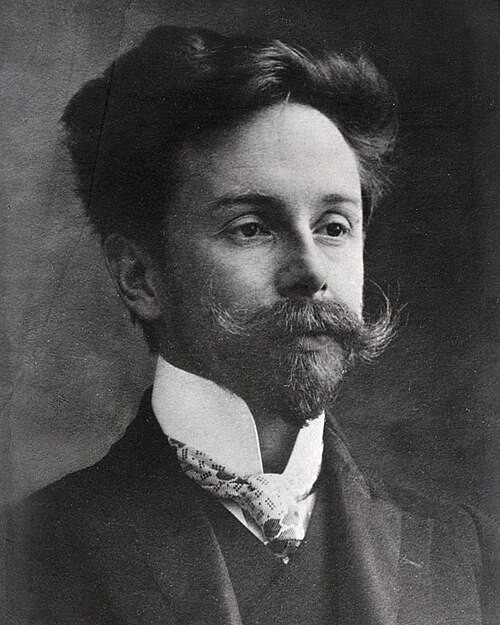
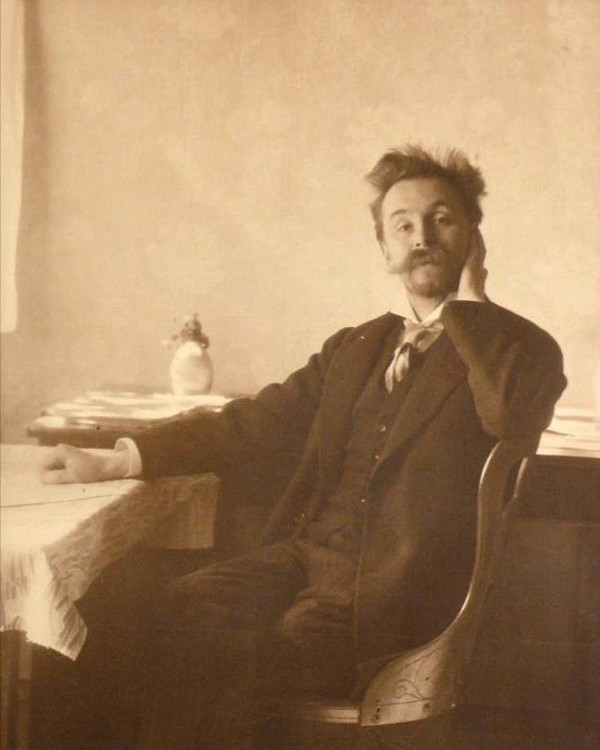
Alexander Scriabin

Alexander Scriabin

Chords become alien, textures are all over the place, and the music doesn’t breathe in regular phrases. It’s almost like getting seriously lost. How can you communicate something that can’t be grasped?

No Place to Hide

The harmonic language expresses colours and metaphysical visions, not really something you can handle in the practice room. And I can’t even imagine having to memorise the music. I’ve heard it said that pianists need a kind of vulnerability to perform his music, as it is impossible to hide behind structure or tradition.

I think it’s time I confront my demon. So, to commemorate Scriabin’s death on 27 April 1915, let’s have a quick guide to his 10 piano sonatas. Mind you, I’ll try to stay away from too many technical descriptions, and I am immensely grateful to Simon Nicholls for his 1996 notes accompanying Marc-André Hamelin’s interpretations.  

Between Prayer and Despair

Scriabin’s first attempt at a piano sonata was written at the age of fourteen, while he was at the Cadet Corps in Moscow. This turned out to be his Sonata-Fantasy in G-sharp minor of 1886, a work that was never published. So let’s forget about this work and move straight to his Sonata No. 1 in F minor, Op. 6, published seven years later in 1893.

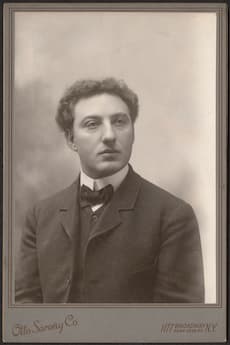
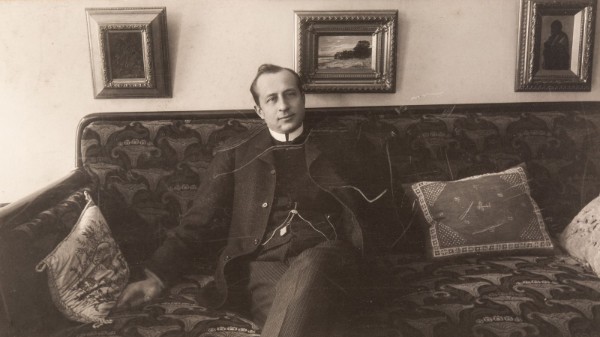
Josef Lhevinne

Josef Lhevinne

Scriabin had been trying to compete with the unbelievable virtuosity of his classmate Josef Lhevinne, and he injured his right arm and hand. Doctors told him that he would never recover. Thus, this first sonata, as Scriabin calls it, was a cry against fate and against God.

That cry is heard in the opening measures of the movement, which at times almost sounds like Brahms. Doubts and prayers appear in the second movement in a musical language influenced by César Franck.

The Rondo movement sounds like the finale, but that place is taken by a seriously gloomy Funeral March. It all sounds like Scriabin is trying to find his bearings in a late-Romantic language, throwing in snippets of Chopin, Schumann, and Modest Mussorgsky.   

Nature Transformed

Alexander Scriabin

Alexander Scriabin

It took Scriabin the better part of five years to write and publish his Sonata No. 2, Op. 19. The piece unfolds in two movements, and the composer told us what to expect in a short programme note.

“The first part evokes the calm of the night by the seashore in the South; in the development we hear the sombre agitation of the depths. The section in E Major represents the tender moonlight which comes after the first dark of night. The second movement, presto, shows the stormy agitation of the vast expanse of ocean.”

This sonata is one of Scriabin’s most famous works, and it is technically approachable. It certainly helps that in the opening movement, the exposition, development, and recapitulation all start with the same music.

Scriabin’s style has changed in comparison to his first sonata, as the piano writing is much more delicate, almost in the style of Chopin. There are plenty of polyrhythms in the opening movement, while the finale features endless streams of triplets against a marching rhythm.   

A Soul’s Journey

Scriabin’s Sonata No. 3 was composed between 1897 and 1898, around the time he married the young pianist Vera Ivanovna Isaakovich. Initially, he is said to have called the finished work “Gothic,” like the impression of a ruined castle.

Several years later, he or his second wife, Tatyana Schloezer, came up with a different description and nickname, namely “States of Being.” And in this description, all four movements represent a story of a soul’s strife, from being free and untamed to reaching the abyss of nothingness.

A clever person once said that composers who issue programmes for their music often live to regret it, and that seems pretty apt in this case. The music, however, has once again advanced in style. All movements are closely linked to each other in a cyclic treatment reminiscent of Liszt.

Hints of Wagner’s Tristan float through parts of the closing movement, which really does not have a happy ending. There is plenty of counterpoint and a seemingly symphonic conception underneath it all.  

From Desire to Radiance

As Scriabin went through a turbulent personal period, his musical language was transforming as well. His Sonata No. 4, issued as Op. 30 in 1903, is headed by a poem describing a flight to a distant star.

Thinly veiled in transparent cloud
A star shines softly, far and lonely.
How beautiful! The azure secret
Of its radiance beckons, lulls me…
Vehement desire, sensual, insane, sweet…
Now! Joyfully I fly upward toward you,
Freely I take wing.
Mad dance, godlike play…
I draw near in my longing…
Drink you in, sea of light, you light of my own self…

In this shortest of his sonatas, Scriabin uses cyclic themes throughout the 2-movement work. We find unusual harmonies and plenty of “Tristan” references in the opening introduction.

The second movement, which follows without a break, features plenty of new sounds. The first-movement theme returns in a jubilant manner and in an explosion of overwhelming joy. Compared to the sombre finales of the first three sonatas, this one is full of light and ecstasy.   

Ecstasy Unleashed

Scriabin’s Sonata No. 5 was written shortly after his orchestral “Poem of Ecstasy” in 1907. Apparently, he wrote this sonata in only a couple of days as his musical style had evolved once more.

The “Poem of Ecstasy” features a lengthy poetic introduction, describing in rather sexual terms the release from the unconscious mind.

I call you to life, mysterious forces!
Drowned in the obscure depths
of the creative spirit, timid
Embryos of life, to you I bring audacity!

I am not sure we could call it a transitional work, but the music relates directly and clearly to the tonal system, yet many features already point to his late style. We are certainly treated to a contrast between ecstatic fast themes and languid slow ones.

We find cyclic links between sections, and this sonata might be the most difficult among this group. Some parts are downright unpianistic, but we do find some of Scriabin’s most creative harmonic writing, nevertheless.   Play

Fear and Shadows

After Scriabin completed “Prometheus,” he set to work on his Sonata No. 6, Op. 62.

There is no programme, and Scriabin never played it in public. He considered it frightening, dark, mysterious, and dangerous.

The music is disturbing, switching between playful and fleeting, and within this concentrated mysteriousness, tonality has almost disappeared. One might practically call this sonata atonal.

In addition, a transformation of the piano sound had taken place. We find monolithic chords, fluttering airborne impulses, and what has been called an arching theme of boundless sensuality.

There is plenty of febrile hyperactivity that exceeds the range of the keyboard, and it gives the impression of a dream. This sonata remains obscure, and you won’t see it much on concert programmes.   

White Mass

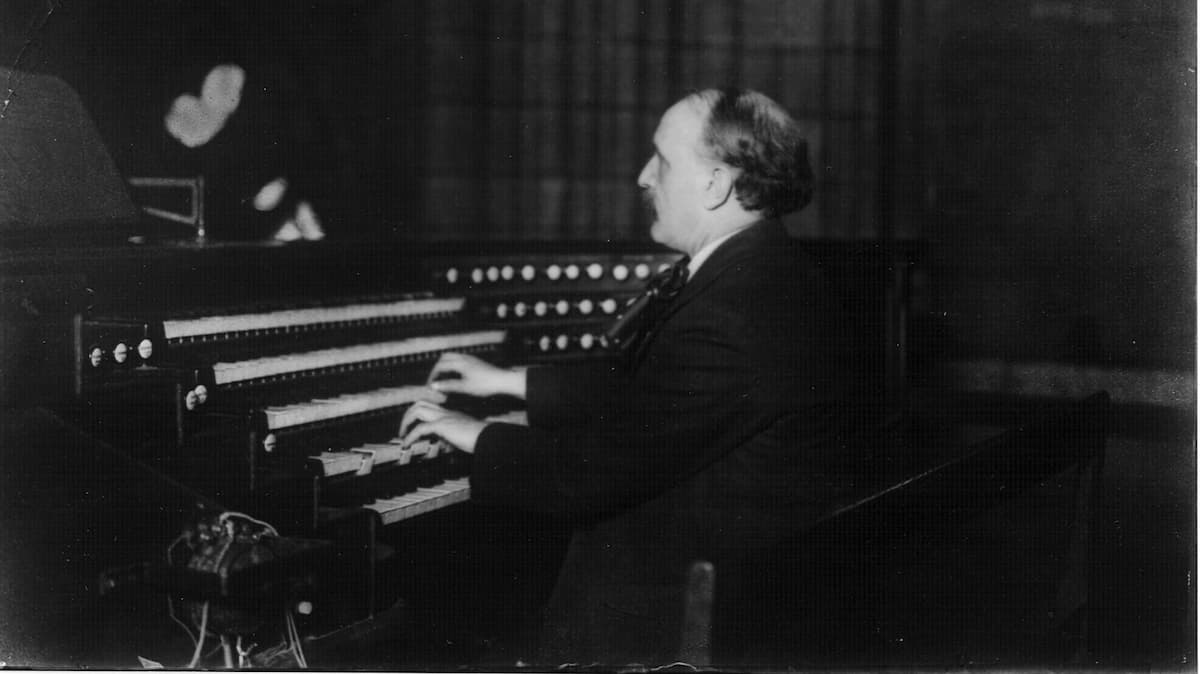
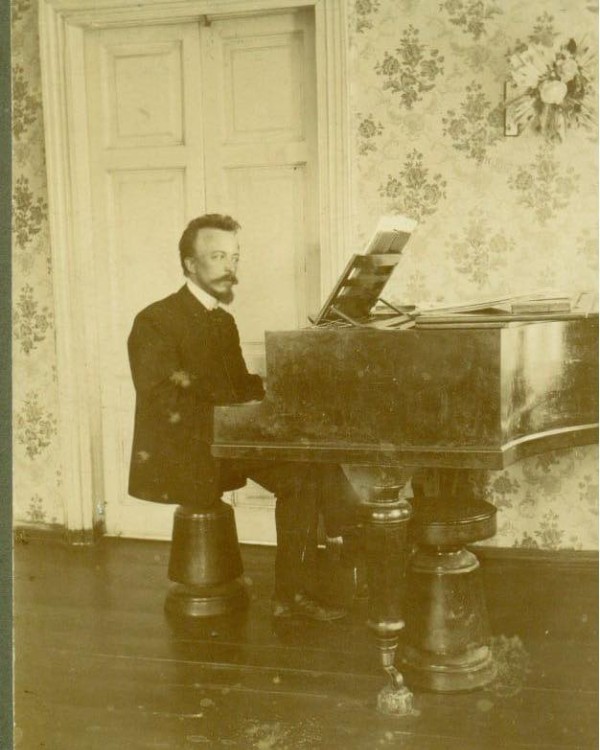
Scriabin at the piano

Scriabin at the piano

With the 7th Sonata of 1911, actually finished before the No. 6, we are squarely in the grasp of the composer’s Messianic pretensions. Subtitled “White Mass,” it features wondrous sonorities, extreme dissonances, and a number of themes related to heavenly exorcism.

Scriabin set out to create a prophetic atmosphere; just listen to the opening fanfares and the lightning flickering across the score. Chiming bells present a motif of invocation, and arpeggios drift like clouds of incense.

It all, predictably, ends in a mighty climax, a light flutter of trills and a polyrhythmic ascension after a chord that spans 5 octaves. Many consider this sonata Scriabin’s crowning achievement.

Scriabin loved to play this sonata in public, but the reactions were rather cold. There are just too many technical difficulties, and the harmonic structure and rhythm tend to be a great challenge to pianists.   

Quietest Storm

The Sonata No. 8 turns out to be the quietest of the set. Actually, it was the last sonata to be finished in 1913, and Scriabin spoke enthusiastically of it. But it is the longest and most complex of all Scriabin’s works.

Apparently, Scriabin thought of its form as a quasi-geometrical organisation that bridges the visible natural world with the invisible artistic realm. He also thought himself superior to Bach in terms of contrapuntal writing.

We do find plenty of counterpoint and less dissonance as the entire sonata exudes a static mood. This is possibly what Scriabin had in mind when he called parts “at perfect peace.”

Horribly difficult to perform, on par with the 5th and 7th Sonatas, but it has a much more mature personality. The material for this sonata is summed up in a final dance, and then everything just dissolves.   

Black Mass

In terms of popularity, the Sonata No. 9, subtitled “Black Mass”, is by far the most frequently performed of the set. That subtitle actually comes from an admirer, who described the atmosphere as Satanic.

The work dates from 1912, and it is one of the more approachable sonatas, both in terms of technical demand and in understanding the composer’s mystic ideals. Opening dissonances and repeated notes reach a nightmarish first climax.

The lyrical second subject appears in various seductive guises and turns into a grotesque march. The music becomes more intoxicating by the minute, and the coda evokes the cackle of the devil. Yet, it all ends in subdued quietness, or as A.E. Hull calls it “molecular vertigo.”

Into the Light

In his final sonata, Scriabin returns to the harmony of nature. Sonata No. 10 is bright and sunny, and much less dissonant. It was written on his country estate. The serene opening finishes with luminous trills in a blazing vision of light.

There are plenty of fluttering chords and joyous screams, and Scriabin thought he was on the brink of great new developments. Surprisingly, this sonata is more tonal and features more exposed tonal chords.

Scriabin died in 1915, but he was convinced that “the masses need to be shaken up, in order to purify the human organisation.” I wonder what he might have thought of World War I and the Russian Revolution.

After looking at and listening to the 10 sonatas by Scriabin, my fear of his music will probably never completely go away. It’s like stepping into quicksand, with no anchors for fingers or the mind. And maybe that’s the point; you’ll just have to let go and lunge into the music headfirst.

Friday, March 27, 2026

10 of the Saddest Piano Pieces in Classical Music History

 by Emily E. Hogstad,  March 23rd, 2026


In addition to the inherent sadness of the music itself, we’re also going to look at what was happening in the lives of the composers around the time they wrote each of these pieces.

As you’ll see, many of the saddest piano pieces in classical music history were shaped by grief, upheaval, illness, exile, or personal crisis.

From Bach’s years in mourning, to Mozart’s frightening leap into independence, to Chopin’s terminal illness, to Brahms’s late-in-life loneliness, and to Rachmaninoff’s experience of the Russian Revolution, every piece on this list – whether deliberately or not – captures a composer’s reaction to a time when life got overwhelming.

J.S. Bach – Prelude in B-minor, arranged by Alexander Siloti (1722)   This piece has a unique background.

Nineteenth-century Russian pianist Alexander Siloti took Bach’s Prelude and Fugue in E-minor from the Well-Tempered Clavier and rearranged it in B-minor: a darker and more mysterious key.

Alexander Siloti

Alexander Siloti

Bach wrote the Well-Tempered Clavier in 1722, a pivotal year in his life.

It’s hard to say exactly what he was feeling emotionally at this time, because none of his personal letters or diaries has survived.

But his wife Maria Barbara had died shortly before, in the summer of 1720. She was only 35 years old and had given birth to seven of his children.

Maybe he drew on his grief when writing this particular movement. We’ll never know. But it’s certainly one of the most melancholy piano pieces ever written.

Mozart – Fantasy in D-minor, K. 397 (1782)   

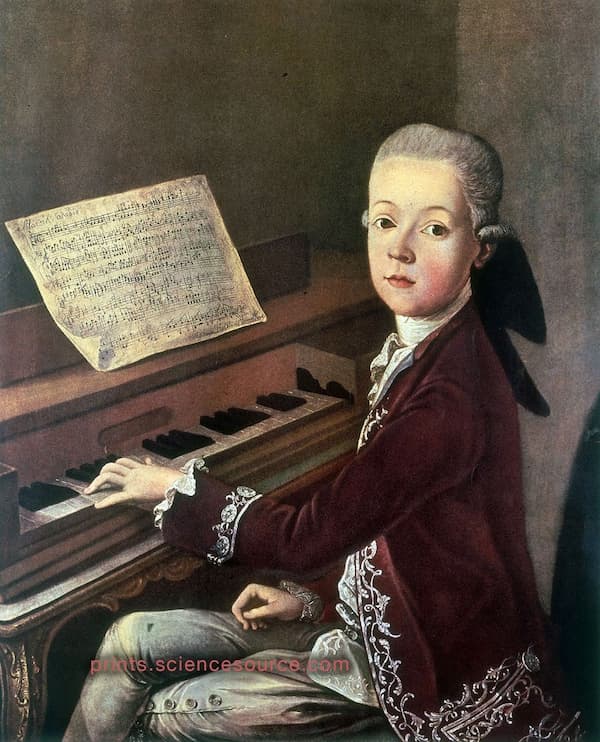
This unfinished fantasy comes from 1782, the year after Mozart disobeyed his loving but controlling father’s wishes and relocated to Vienna to start a hugely risky freelance career.

To help support himself, he taught aristocratic patrons and wrote works to play in glittering salons to entertain them. There was no guarantee his plan was going to work.

The D-minor Fantasy captures emotions one might feel in a moment of transition: worry, restlessness, and a willingness to improvise.

If it seems unfinished, that’s because it is. We don’t know why, but Mozart abandoned the piece before completing it.

Another composer tacked on ten measures after Mozart’s death, making the work playable in concert and bringing the work to a close – albeit an abrupt one.

The fragmentary quality that results mirrors the unsettled, transitional quality of Mozart’s life in 1782…and the unsettled quality of any listener going through a similar life change.

C.P.E. Bach – Fantasia in F-sharp-minor (c. 1787)   

The melancholic, virtuosic Fantasia in F-sharp-minor was written near the end of C.P.E. Bach’s career, while he was serving at the court of Frederick the Great.

By the mid-1780s, C.P.E. Bach had spent his entire career in the shadow of his father J.S. Bach, the greatest giant of the Baroque Era. (His mother, by the way, was the wife that Bach had lost in 1720.)

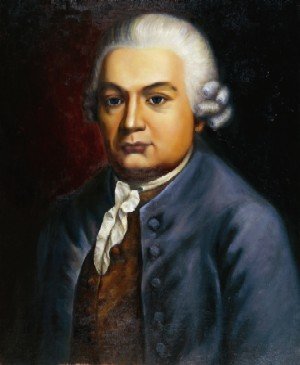
C.P.E. Bach

Carl Philipp Emanuel Bach

Meanwhile, his students would become well-known composers during the Classical Era.

He was one of the composers who had built a bridge between the two generations.

It’s very possible that he was reflecting on his life and legacy around the time he wrote this confessional fantasia, with its unpredictable surging sighs that ultimately all collapse into melancholy meanders.

Chopin – Nocturne No. 13 in C-minor, Op. 48, No. 1 (1841)  

In 1841, Chopin was at the height of his artistic maturity, but facing increasing physical frailty, thanks to his tuberculosis diagnosis.

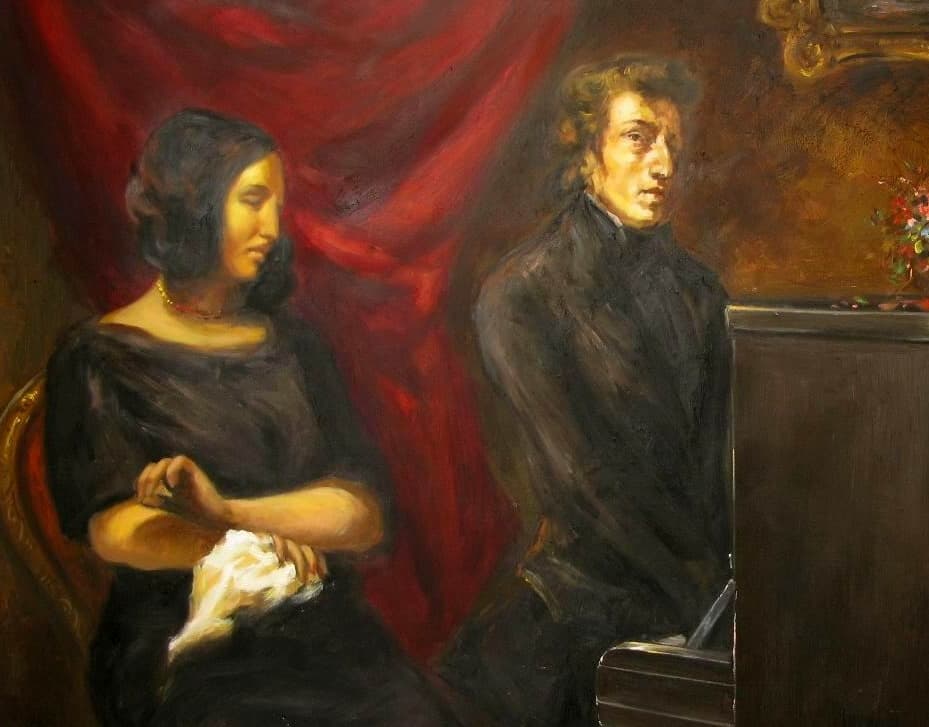
He and his lover, authoress George Sand, had settled into a domestic rhythm in Paris and at her family home in rural France.

Portrait of Frédéric Chopin and George Sand by Eugène Delacroix

Portrait of Frédéric Chopin and George Sand by Eugène Delacroix

But their relationship, and the relationship between Sand and her two teenage children, were all starting to show cracks.

Chopin was also deeply homesick for his Polish homeland, continually distressed by Polish politics and his status as a permanent exile.

The C-minor Nocturne is one of his darker pieces for solo piano: elegant and melancholy, but bitterly so.

Its quiet, contrasting middle section is a cry from the heart of a man who was feeling increasingly sick, isolated, and vulnerable.

Grieg – Lyric Pieces, Book I, Op. 12, No. 1, “Arietta” (c. 1866)  

Over the course of his career, between 1867 and 1901, Edvard Grieg published 66 “Lyric Pieces” for solo piano.

This brief “Arietta” was the very first one, written around the time of his marriage to his wife, soprano Nina Hagerup.

In 1901, a few years before his death, he reused the theme in his very last Lyric Piece, “Efterklang” (“Remembrances”).

Edvard Grieg | “Remembrances” Op. 71 No. 7 from “Lyric pieces” (by Vadim Chaimovich)   

Was he remembering a sad thing in particular? It’s possible: in 1868, the year after the lullaby-like Arietta was written, he and his wife had their only surviving baby, Alexandra.

Alexandra died of meningitis when she was still an infant, and the couple never had any more children.

That was just one of the many struggles that he and Nina survived as a married couple.

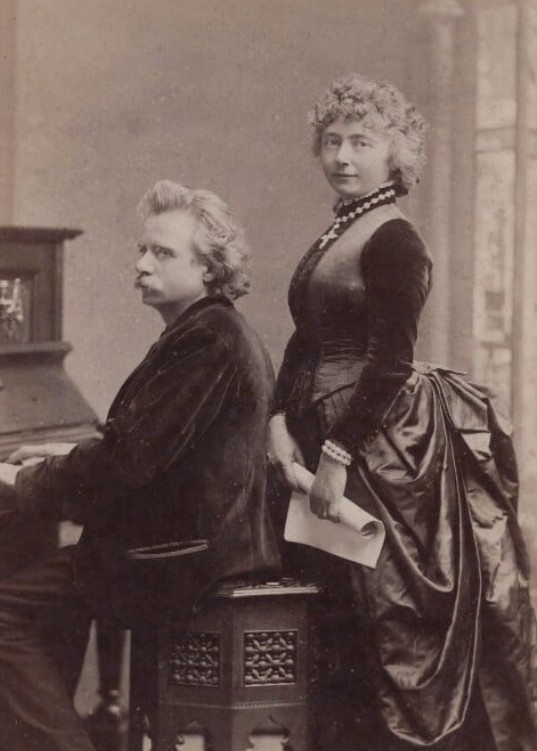
Edvard Grieg and Nina Hagerup Grieg

Edvard Grieg and Nina Hagerup Grieg

Although their relationship was occasionally rocky, they were married until he died.

Maybe turning a 35-year-old theme into a quiet waltz was his way of communicating that he – and they – had made it through decades of marriage, despite the troubles and tragedies they’d endured to get there.

Scriabin – Prelude in E minor, Op. 11, No. 4 (1888)   

Alexander Scriabin was born into a noble Russian family in 1871. His mother was a concert pianist but, tragically, died when he was just a year old.

After he was widowed, Scriabin’s father decided to follow his own family’s tradition of joining the military, leaving his baby son with his grandmother, great-aunt, and aunt.

His aunt played piano, which little Alexander loved. As a child, he begged to be played with. He grew up to play the piano himself, studying under Rachmaninoff’s infamously strict teacher Nikolai Zverev.

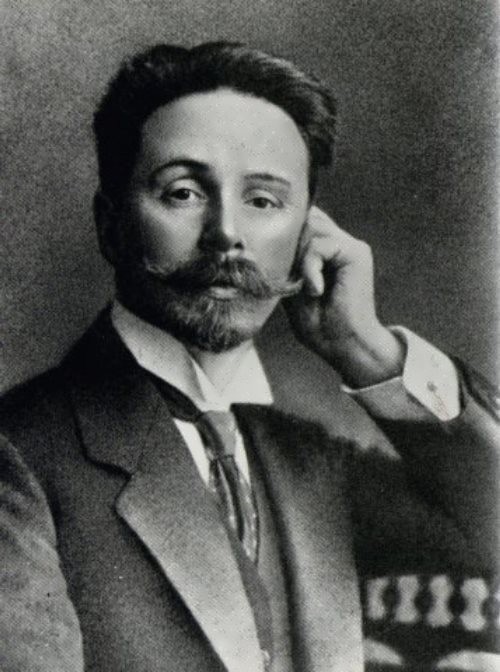
Alexander Scriabin

Alexander Scriabin

At one point, Alexander tried to assemble an orchestra of local children to try his hand at conducting, but the venture ultimately failed, leaving him in tears.

In short, he was a wounded loner during his childhood, and you can perhaps hear some of that in this early Chopin-inspired prelude, written in 1888, the year he turned seventeen.

Rarely has teen angst been so elegantly channeled.

Brahms – Intermezzo in E-flat-minor, Op. 118, No. 6 (1893)   

The Op. 118 set of piano pieces is a product of Brahms’s final years: a period in which he was preoccupied with nostalgia and mortality. By 1893, Brahms was nearing sixty and contemplating retirement.

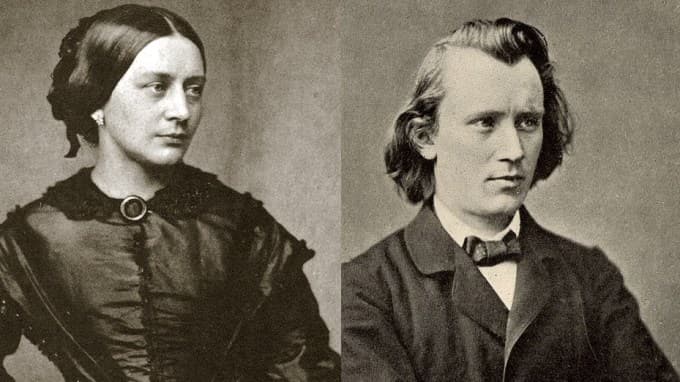
To make matters worse, pianist Clara Schumann, his musical soulmate who was thirteen years his senior, was in failing health. And they’d found themselves in a quarrel.

Black and white collage of composer Johannes Brahms and Clara Schumann

Clara Schumann and Johannes Brahms

Brahms wrote his Op. 118 and 119, in part, as a gruff but meaningful olive branch to her.

The E-flat-minor Intermezzo is one of his most despairing creations for solo piano. Many of Brahms’s works can feel emotionally subdued compared to more demonstrative contemporaries like Tchaikovsky or Dvořák, but this one is unusually frank about expressing sadness.

Happily, after receiving the scores for his Ops. 118 and 119, Clara Schumann wrote back to him, and they resolved their differences before their deaths, which would occur in 1896 and 1897, respectively.

Janáček – In the Mists: I. Andante (1912)   

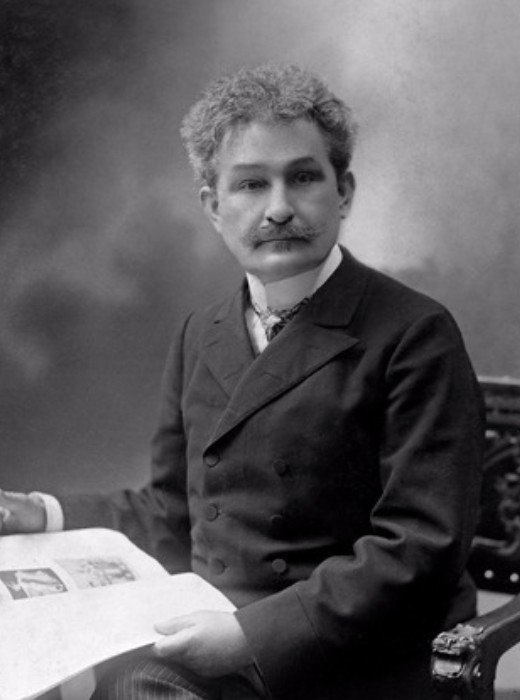
Janáček composed In the Mists during an agonising period of professional stagnation.

He was 58 and felt deeply alone. His beloved daughter Olga had died in 1903, and his marriage had been deeply strained ever since.

He was also having trouble getting his work performed. He feared that his composing career was coming to a close and that he hadn’t fulfilled his potential.

Leoš Janáček

Leoš Janáček

The first movement of In the Mists drifts through blurry, seemingly improvisatory harmonies.

It captures the emotions of a man facing professional disappointment and wandering through obscurity.

Rachmaninoff – Étude-tableau in E-minor, Op. 39, No. 5 (c. 1917)   

Rachmaninoff wrote his Op. 39 between 1916 and 1917, right as the world seemed to be collapsing around him.

World War I was ongoing, and revolution was coming. By 1917, it became clear to Rachmaninoff that the genteel aristocratic world he’d been born into was doomed – and never returning.

While writing this piece, he was struggling with fears about the safety of his family and friends, the necessity of exile and the loss of property and possessions, the end of his Russian career, and the fear of starting over in another country while in his mid-forties.

When he fled Russia later that year, he took these etudes with him. They are some of the last works he ever wrote on Russian soil, and they sound like an unhappy, unwilling goodbye.

Glass – Etudes: No. 5 (1994)   

Philip Glass’s official description of his first ten etudes is very matter-of-fact:

Book 1 (Etudes Nos. 1 through 10) had a twin objective – to explore a variety of tempi, textures, and piano techniques. At the same time, it was meant to serve as a pedagogical tool by which I would improve my piano playing. In these two ways, Book 1 succeeded very well. I learned a great deal about the piano, and in the course of learning the music, I became a better player.

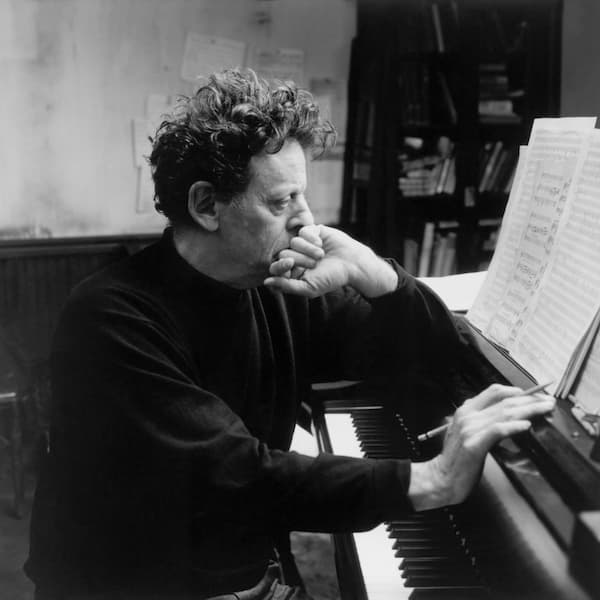
Philip Glass

Philip Glass

The first six etudes – including the fifth – were commissioned by conductor and pianist Dennis Russell Davies for his fiftieth birthday.

This piece was written during a difficult period in Glass’s life. His wife, artist Candy Jernigan, died of liver cancer in 1991, just weeks after being diagnosed. She was only 39.

“She was going to live forever, as far as I was concerned. It was a big shock for everybody, particularly the kids,” he told The Guardian in 2001.

It’s unclear whether Glass deliberately meant to portray this feeling in his fifth etude, but he captures the quiet repetitive numbness that a person can feel after the sudden death of a loved one.

Conclusion

Whether you’re searching for heartbreaking piano music, reflective pieces for difficult days, or just music to set a melancholy mood, these ten pieces stand apart. They are some of the saddest in the entire piano repertoire.

They all remind us of the humanity we share with the great composers, and testify to how music will always be one of the most powerful ways a person can process change, loss, disappointment, and grief.

Featured Post

Yuja Wang wore a heart rate monitor in Rachmaninov marathon, with astonishing results

4 April 2024, 17:03 | Updated: 5 April 2024, 15:58 Yuja Wang’s heart rate results revealed, after marathon Rachmaninov performance.  Picture...