By

Khatia Buniatishvili © Gavin Evans
She has been called a “social-media pianist,” accused of cultivating an image at the expense of musical depth. These opposing narratives often clash more loudly than the music itself, revealing as much about our cultural anxieties as about Buniatishvili’s artistry.
Yet somewhere between the extremes lies a far more interesting story. How does a singular performer navigate the fault line between genuine expression and hyper-visibility of the modern classical world?
Self-Made Spotlight
What often gets lost in these polarised assessments is just how shrewd Buniatishvili has been in shaping her career. Long before the magazine covers and viral clips, she had already proven her musical calibre, placing respectably in major piano competitions and earning the approval of figures who cared little for glamour.
Yet she also understood, perhaps earlier than many of her peers, that she wasn’t playing in the same league as Yuja Wang, Daniil Trifonov, or Grigory Sokolov. The era in which runner-up prizes alone could propel a pianist to international prominence was clearly fading.
Rather than waiting for gatekeepers to grant her visibility, Buniatishvili seized the tools of modern media and made herself visible on her own terms, not as a shortcut around musicianship, but as a parallel pathway to an audience that the old model no longer reliably delivered.
Crafting a Persona
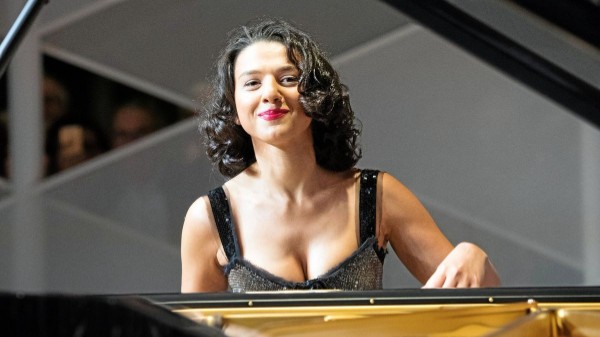
Khatia Buniatishvili
Central to this recalibrated path was her self-fashioned image, an image she cultivated with unmistakable intentionality, and something she calls “authentic vulnerability.” Buniatishvili understood that in an age saturated with content, visibility alone was meaningless unless it carried emotional charge.
So she leaned into what audiences already sensed, particularly her intensity at the keyboard, her kinetic presence, the way she seemed to play through emotion rather than merely shaping it. The visual language she adopted, including touches of cinematic glamour, was simply a way of amplifying the magnetism that was already there.
It made her instantly recognisable, fiercely memorable, and yes, sometimes controversial. But it also signalled an artist unafraid to fuse musical vulnerability with a boldly curated aesthetic that challenged long-standing expectations about virtuosity.
Digital Glamour
All of this, however, circles back to an essential point. Buniatishvili can play; everybody can these days. And she often plays with a fluency and fire that justify her broad popularity. Her sound is unmistakable, her instincts bold, and when she connects with a work, the result can be genuinely thrilling.
But the amplification provided by social media does not, in itself, confer artistic genius. Visibility is not vision. Followers are not proof of interpretative depth. The danger lies in confusing the mechanisms that propel a career with the qualities that define a great musician.
Buniatishvili’s online presence may magnify her allure, but it cannot substitute for the hard currency of musical insight. This distinction is increasingly difficult to ascertain, yet vital to maintain in the digital age.
Dual Virtuosity
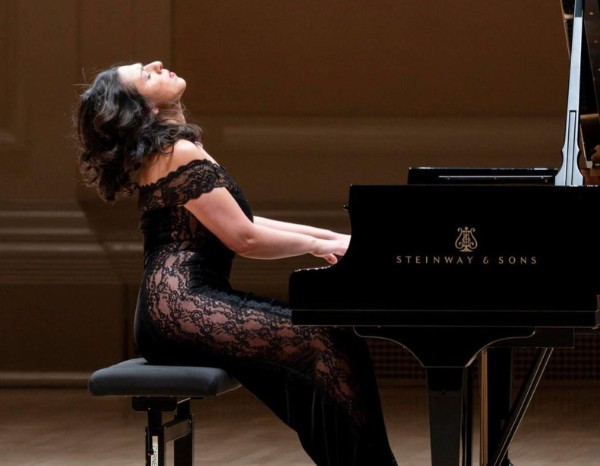
Khatia Buniatishvili
In the end, Khatia Buniatishvili occupies a curious and unmistakably modern position in the classical music landscape. She is, by any reasonable measure, an able and often compelling pianist. She is certainly capable of moments of real eloquence, technical ease, and emotional charge.
But her true virtuosity may lie not only in her playing but in her ability to navigate and manipulate the currents of contemporary visibility. In a field still negotiating its relationship with image, immediacy, and digital spectacle, she has turned self-promotion into an art form of its own.
Khatia Buniatishvili has shaped her persona just as meticulously as any performance. Whether one admires or resents this dual mastery, Buniatishvili stands as a reminder that in the twenty-first century, artistry and self-fashioning travel side by side. Does hype outstrip substance? Time will tell; the debate continues.


