Carl Ruggles (1876–1971) was a musician from a young age, first playing his homemade violin (with a cigar box for the body) and then a quarter-sized violin from a local friend. His mother loved singing, and Ruggles learned his music by ear, being famed locally for the jigs and hornpipes he played on his little violin. Summer visitors to his hometown of Marion, Massachusetts, were entertained, including President Grover Cleveland in 1885. The child musician went on to play violin duets with the First Lady, Rose Cleveland.
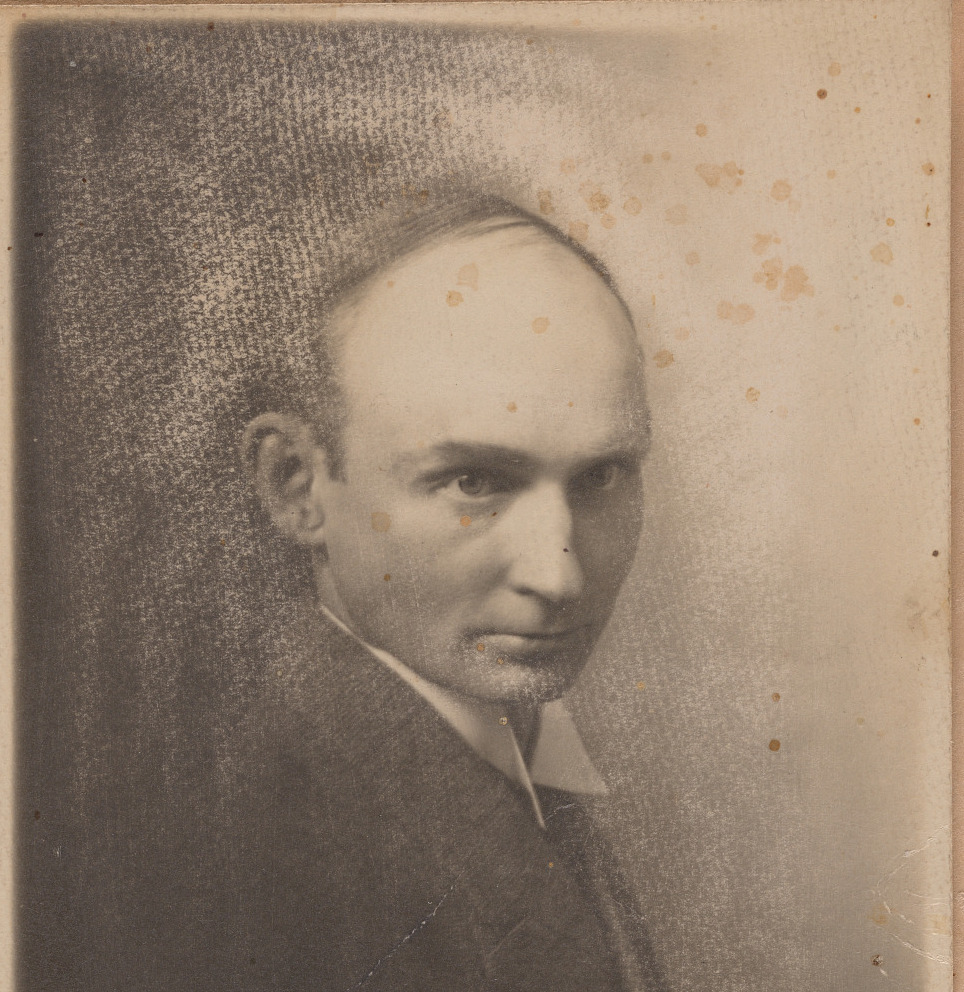
Carl Ruggles, 1911
The death of Ruggles’ mother when he was 14 signaled a significant change in his life. Responsibility for him was split between his father and his grandmother, and his father’s alcoholism and gambling lost the family their money.
Carl’s first professional appointment occurred in 1892, at age 16, when he was appointed director of the YMCA orchestra in Lexington, Massachusetts.
His first compositions were songs that were published in 1899. As his family’s financial situation worsened, he took on more jobs in music, teaching violin and music theory.
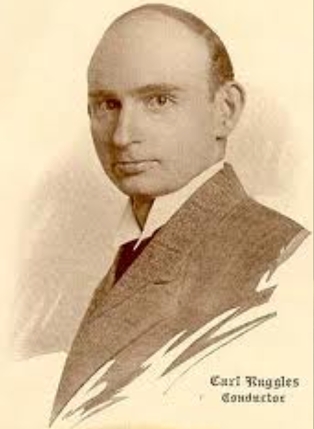
The young Carl Ruggles
Around the turn of the century, living near Boston, he took advantage of the music that he could access: he studied violin with Felix Winternitz and composition with Josef Claus and John Knowles Paine. He audited English courses at Harvard, engraved music and title pages for the Stanhope Press, and had a short-lived, and highly contentious, career as a music critic.
In 1906, he married the contralto Charlotte Snell and sought a more stable position at the Mar D’Mar School of Music in Winona, Minnesota, as a violin teacher. He also took a more prominent role as a violin soloist, appearing with the Winona Symphony Orchestra before becoming their director. After the music school and the orchestra closed in 1912, the Ruggles moved to New York City. He started to write an opera, but its German theme did not go well in the anti-German feelings in the US during WWI. He submitted a version of his opera, based on The Sunken Bell by Gerhart Hauptmann, to the Metropolitan Opera, but destroyed his scores when he decided that opera was not his future. He’d been working on the score as late as 1923, but in 1960, the clear copy was destroyed, still unfinished.
His song, Toys, was written in 1919 for his 4-year-old son Micah’s birthday. The dissonance may surprise you, in a work referencing ‘choo-choo cars’ and a balloon, but that is the secret of Ruggles: uncompromising and cutting edge.
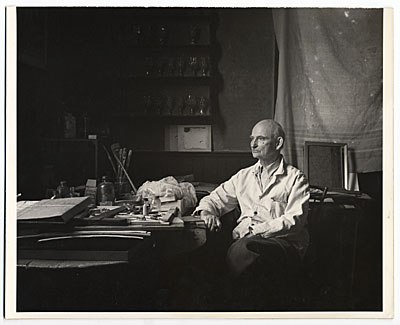
Carl Ruggles at his work table
Ruggles is paired most with his contemporary, Charles Ives (1874–1954), two years younger. Both sought their own sound worlds, and often it took decades for their listeners to catch up to them.
One of his early works is Angels, a hymn for six trumpets. Written in 1921 for six trumpets, it was rewritten in 1940 for trumpets and trombones and again in 1946 for piano.
His first significant work is Vox clamans in deserto of 1923. Written for soprano and chamber orchestra, it uses poems by three very different poets: Robert Browning’s Parting at Morning, Charles Henry Meltzer’s Son of Mine, and Walt Whitman’s A Clear Midnight. Each poet has his own characteristics; Browning’s sudden horizons, Meltzer’s pained longing, and Whitman’s “fully forth emerging” soul are delivered by Ruggles with soaring melodies and dissonances.
This was the last work he wrote with words. Henceforth, he would write music for music’s sake.
His great work is Sun-Treader, and it builds off earlier works. Men and Angels, an orchestral work written in 1921, became Men and Mountains in 1924, and finally morphed into Sun-Treader in 1926. The score was completed in 1931.
Sun-Treader uses what Ruggles called ‘dissonant melody’. Unlike the Viennese 12-tone school, Ruggles used free melodies, not rows. He spoke about his compositional process through a set of questions:
What makes you take the high note? the low note? the middle note? There’s a million things…there’s a whole generation back of that. It’s not environment, it’s not heritage—environment of course prepares things…certain factors come in there. That’s what I believe in…what makes you do that? the feeling that makes you take the right note.
Ruggles’ dissonances create a style where a held note can change definition, can change style, and can change from a melodic note to a member of a chord. The music moves in huge arcs, always releasing at the end by relaxing the pitch or the volume. Arc might be separated by echoes of what happened. One writer sees the piece as having a melody that is so free and matched with a dissonance that is so burning that we seem to be part of the sun itself, in a world of flames. 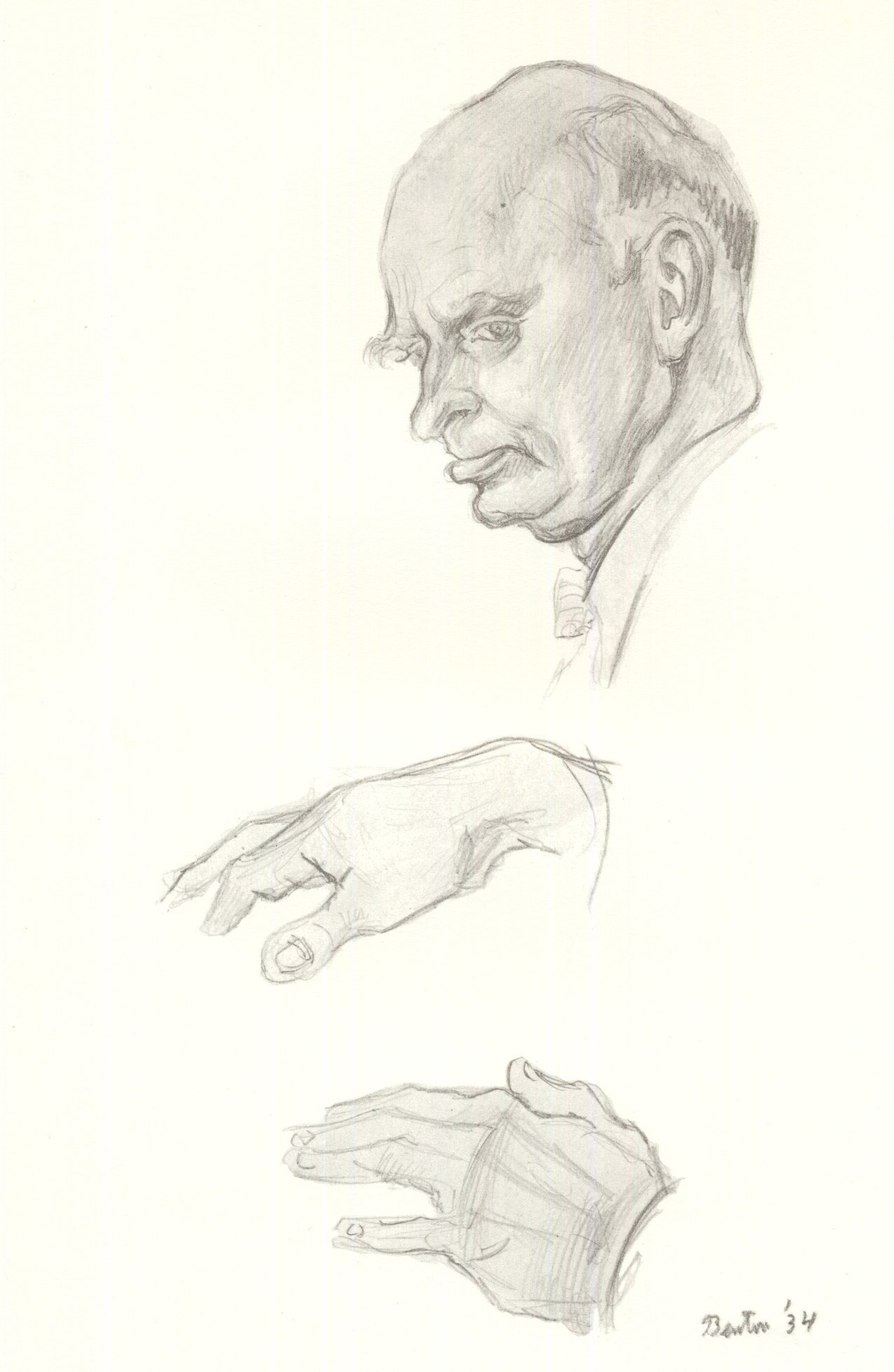
Thomas Hart Benton: Carl Ruggles, 1934 (Benton Testamentary Trust/UMB Bank)
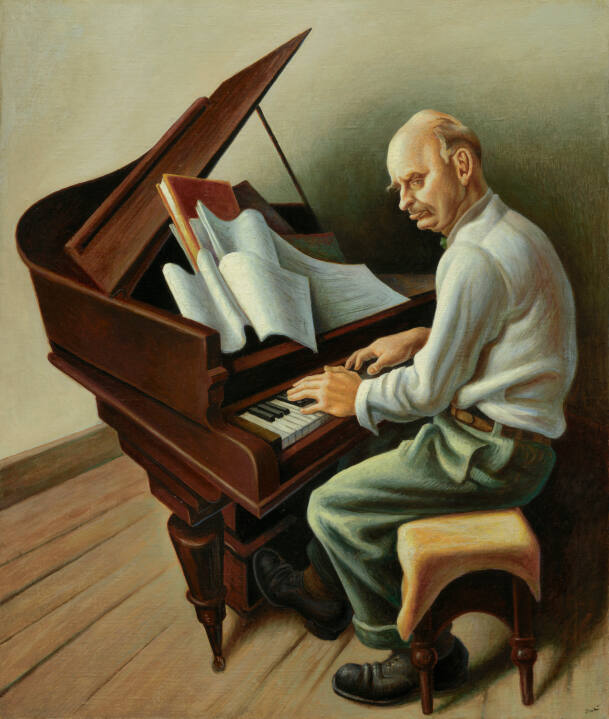
Thomas Hart Benton: The Sun Treader (Portrait of Carl Ruggles), ca. 1934. (Kansas City, MO: The Nelson-Atkins Museum of Art)
In 1929, Ruggles met Charles Ives, who did what he could to help him. One thing was to have his best copyist make a score of Sun-Treader, but it was quickly covered in revisions. The score was finally published in 1934, after its premiere in Paris and Berlin, conducted by Nicholas Slonimsky.
Around 1929, Ruggles took up painting, and his growing abilities had a relaxing effect on his music. His first exhibition was in April 1935, and he continued to have summer shows at the Southern Vermont Art Center for years. He also exhibited at the Chicago Arts Club (1937) and the Detroit Institute of Arts (1941). His paintings were in a modernist style and often more implied than defined their images.
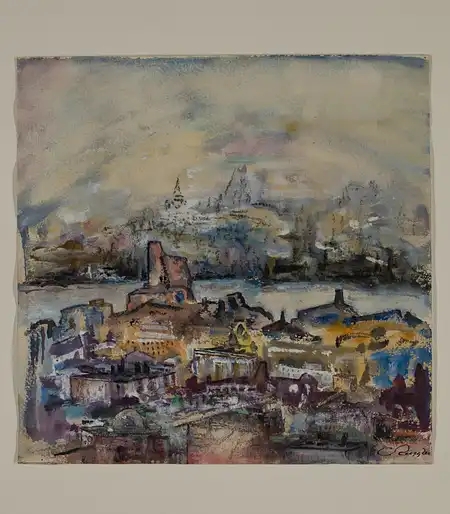
Ruggles: From No. 1, Christopher Street, no date (Detroit Institute of Arts)
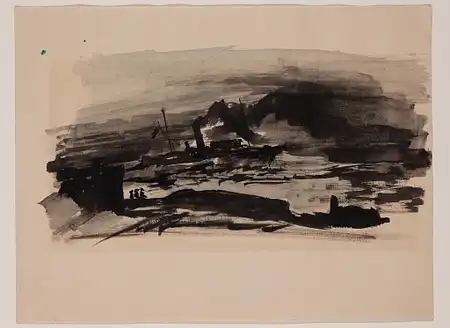
Ruggles: Sea Impression, no date (Detroit Institute of Arts)
His last musical works were a series of Evocations, written first for piano and then orchestrated. His same method of holding melody notes to create a dissonant melody was used, and, in its orchestral version, Evocations is a powerful work.
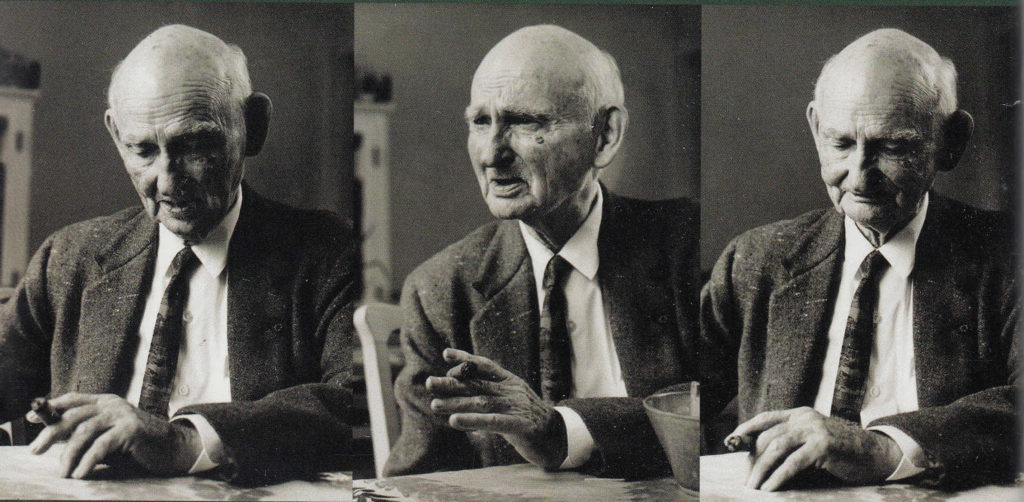
Carl Ruggles in his 90s
Each movement was written for a different subject, the first in 1937, then one in 1940 dedicated to Charles Ives, one in 1941 for pianist John Kirkpatrick, and the last in 1943 for his wife Charlotte. The general order of play is 1937–1941–1973–1940, with the Charles Ives movement last.
We’ll close this life of Carl Ruggles with a work he wrote at the request of his wife. She always wanted a hymn, and so he wrote Evocation. In keeping with his lifelong vow of no more poets, it’s a hymn without words (Although Watts’s “O God, our help in ages past” will fit).
And so, with his last song, we return to the songwriting of his youth. Ruggles wasn’t a popular composer and didn’t have an extensive output. In many ways, he matches the outliers in other artistic fields, such as Georgia O’Keeffe, Rockwell Kent, and Charles Ives. As a composer, he challenges his listeners; as a painter, he challenges his viewers. As a uniquely American artist, however, he’s unrivaled.


