by Emily E. Hogstad January 26th, 2026
For over a hundred years, skaters have skated to music, oftentimes classical music.
Although the International Skating Union began allowing the use of songs with lyrics in 2014, leading to a rise in skating programs performed to other musical genres, many skaters still use classical music today.
Here are twelve of the most famous routines performed to the most famous classical music.
Jayne Torvill and Christopher Dean, 1984
Boléro by Maurice Ravel
Torvill & Dean Bolero – 1984 Olympic Winning Routine
In 1984, skating to Ravel’s hypnotic orchestral showpiece Boléro, British skaters Jayne Torvill and Christopher Dean became the first non-Russian ice dancers to ever win gold at the Olympics.
They scored a perfect set of 6.0s for artistic impression. This was the first (and last) time that feat was ever achieved in Olympic skating.
Their choreography included a sultry eighteen-second opening during which their skates didn’t touch the ice.
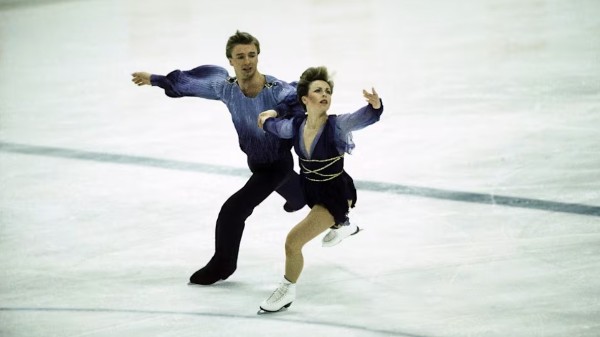
Jayne Torvill and Christopher Dean
That opening is a result of two specific circumstances: the Olympic rulebook stating that no skating program could last longer than 4’10”, and their desire to use a particular 4’28” cut of Boléro.
As long as their skates didn’t touch the ice for those opening eighteen seconds, they were allowed to skate to the 4’28” cut.
Katarina Witt, 1988
Carmen by Georges Bizet
Katarina Witt (GDR) – 1988 Calgary, Figure Skating, Ladies’ Long Program (US ABC)
Katarina Witt’s fiery interpretation of Bizet’s operatic heroine Carmen is delightful.
The middle portion of her long program doesn’t even have much skating in it at all. Rather, Witt used a combination of dazzling footwork and her acting ability to embody Carmen.
Her charismatic flair and technical aptitude in this program resulted in her second Olympic gold medal. She is the only modern women’s singles skater to ever win gold twice.
Michelle Kwan, 1998
Lyra Angelica by William Alwyn
Michelle Kwan Figure Skating to “Lyra Angelica” at Nagano 1998 | Music Monday
In 1998, Michelle Kwan skated to a little-known harp concerto by British composer William Alwyn.
The result was an ethereal program that showcased the 17-year-old skater’s grace and maturity.
Though newcomer Tara Lipinski won the gold that year, this program was one of the many high points of Kwan’s long and starry career.
Sarah Hughes, 2002
Daphnis et Chloe by Maurice Ravel and Rhapsody on a Theme by Paganini by Sergei Rachmaninoff
Sarah Hughes (USA) – 2002 Salt Lake City, Figure Skating, Ladies’ Free Skate
Sarah Hughes came into Salt Lake City as an underdog; Michelle Kwan was favoured to win gold that year.
But in her free skate, Hughes threw down the gauntlet with her Ravel program, full of triple jumps, balletic grace, and irrepressible joy. Her scream of excitement at 4:50 at having nailed her jumping pass is especially adorable!
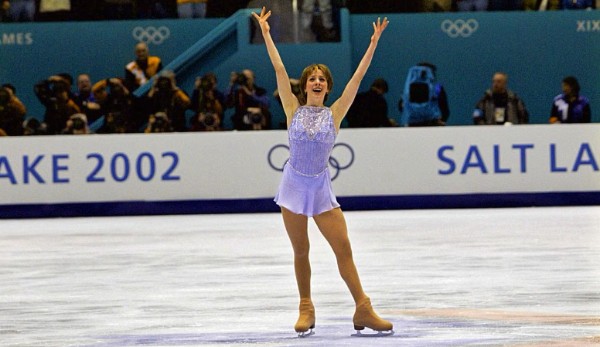
Sarah Hughes
This performance, as well as missteps by her competitors, resulted in her winning the gold medal.
Yuna Kim, 2010
Piano Concerto by George Gershwin
Yuna Kim – Free Skate – Ladies’ Figure Skating | Vancouver 2010
Inspired by Michelle Kwan, Korean skater Yuna Kim, born in 1990, became one of the great skaters of her generation.
At the Vancouver Olympics in 2010, she skated her free program to Gershwin’s jazzy piano concerto in F-major. She gave a masterclass in technique, landing jump after jump with a sleek and sassy panache.
She shattered the world record and brought South Korea its first Olympic figure skating gold. Gershwin’s music was a perfect accompaniment to her triumph.
Evan Lysacek, 2010
Scheherezade by Nikolai Rimsky-Korsakov
Evan Lysacek 2010 Vancouver free skate | Rimsky-Korsakov’s Scheherazade
American skater Evan Lysacek’s 2010 Olympic free skate was to Rimsky-Korsakov’s gloriously dramatic orchestral suite Scheherezade.
At the time, Lysacek was plagued by injury and forced to rely on less valuable triple jumps instead of quadruple jumps. He needed to nail all of his jumps just to have a chance at the gold.
Even with his reduced technical content, he ended up winning gold: a testament to how artistry and a skater’s connection to the music can help secure a medal.
Tessa Virtue and Scott Moir, 2010
Symphony No. 5 by Gustav Mahler
Tessa Virtue & Scott Moir FD 2010 Vancouver Olympics (Symphony No.5 by Gustav Mahler)
At their 2010 Olympic debut in Vancouver, Canadian ice dancers Tessa Virtue and Scott Moir chose to skate to the bittersweet Adagietto from Mahler’s Fifth Symphony.
Their free dance, with its soft and seamless quality of movement, radiated romantic intensity.
Their home crowd received them rapturously, and so did the judges. They became the first North American couple to ever win Olympic gold in ice dance.
They would go on to win gold again in 2018, as well as silver at the 2014 Sochi Olympics.
Yulia Lipnitskaya, 2014
Schindler’s List soundtrack by John Williams
Yulia Lipnitskaya’s Phenomenal Free Program – Team Figure Skating | Sochi 2014 Winter Olympics
At just fifteen years of age, Yulia Lipnitskaya shot to international stardom while skating to John Williams’ haunting score to Schindler’s List.
Her performance in her trademark red dress (a callback to the film) became the emotional centerpiece of Russia’s team gold medal.
Even today, this program remains one of the most memorable of the Sochi Games.
Tragically, Lipnitskaya’s career was brief, in no small part to her abusive coach Eteri Tutberidze (who, eight years later, would become internationally infamous for her treatment of Kamila Valieva, another fifteen-year-old wunderkind who tested positive for doping).
Mao Asada, 2014
Piano Concerto No. 2 by Sergei Rachmaninoff
Mao Asada skates to Sergei Rachmaninoff in Sochi 2014 | Music Monday
After a disastrous short program that saw her place a devastating sixteenth, Japanese skater Mao Asada returned with a free skate for the ages at the 2014 Sochi Olympics.
Landing an astonishing eight triple jumps (including two triple axels, the most difficult jump regularly performed at that time), she demonstrated her raw athleticism and fierce grace to excerpts from Rachmaninoff’s second piano concerto.
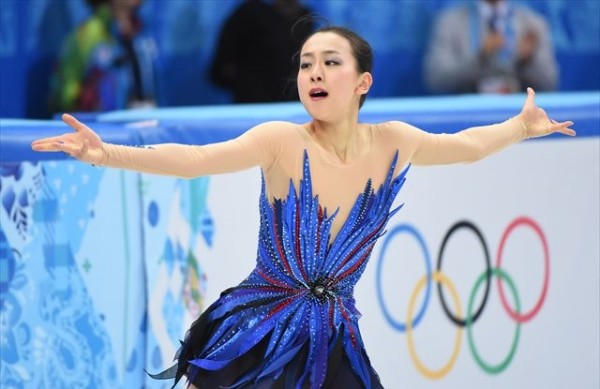
Mao Asada
Although she missed the Olympic podium because of her short program, her free skate is remembered today as a triumph of resilience and artistry.
Alina Zagitova, 2018
Don Quixote by Leon Minkus
Alina Zagitova (OAR) – Gold Medal | Women’s Free Skating | PyeongChang 2018
At just fifteen, Russian skater Alina Zagitova (coached by Eteri Tutberidze) unveiled a clever program strategy: saving her jumps for the second half to maximise bonus points.
This made her program feel like a ballet showpiece, and she used classical music to match: the work of nineteenth-century Austrian ballet composer Leon Minkus.
At the Olympics, her performance ended up securing Russia another gold medal in women’s singles skating.
After this music and choreography, the International Skating Union instituted what became known as the Zagitova Rule: i.e., skaters can no longer backload all of their jumps to the end of a program to get bonus points.
Yuzuru Hanyu, 2018
Ballade No. 1 by Frederic Chopin
Yuzuru Hanyu performs to Chopin’s Ballade No 1 at PyeongChang 2018 | Music Monday
Yuzuru Hanyu is widely considered to be the most artistic men’s singles skater of the modern era.
Already a legend after winning the gold medal in Sochi in 2014, Hanyu defended his Olympic title in 2018 with this masterful short program.
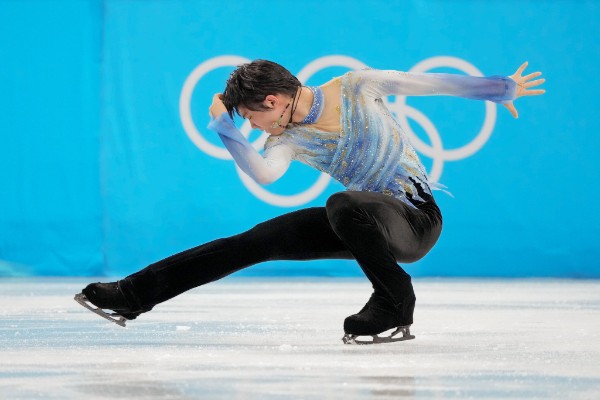
Yuzuru Hanyu
Every jump and spin seems to emerge from Chopin’s score organically. It’s a perfect marriage of movement and music.
This program helped make Hanyu the first man in decades to win back-to-back Olympic gold medals.
Isabeau Levito, 2022
The Swan by Camille Saint-Saëns
Isabeau Levito performs “The Swan” by Joshua Bell
We’re cheating a bit with this one because it’s a skate from the National Championship in 2022 rather than the Olympics, but it’s a preview of a skater we can expect to see at the 2026 Olympics.
A rising star of U.S. skating in 2022, Isabeau Levito enchanted audiences with Saint-Saëns’ lyrical Swan from the Carnival of the Animals.
Just fourteen years old, she skated with a fluid grace beyond her years, with commentators comparing her to a ballerina.
The program marked her as one to watch on the world stage.
This season, she’s one of the three American women skaters most likely to represent America at the 2026 Olympic Games in Milan. However, as the saying goes, ice is slippery… You’ll have to tune in to see if she ended up making the team!
Conclusion
For generations now, classical music has been an indispensable part of the sport of figure skating.
Each of these programs showcases the magic that can happen when an athlete and the music are truly in sync.
As you watch the 2026 Olympic Games (6-19 February), keep an eye and an ear out for familiar classical music. What you hear might surprise you!


