Most famous for his iconic – and polarising – composition 4’33”, John Cage was a composer, artist, and thinker whose explorations and experiments changed the course of classical composition. His compendium of lectures and writings, Silence, will be of interest to anyone who likes to think about musical organisation and value at a meta level, and those who are fascinated by people who live and think eccentrically, which is, I suspect, most of us with any investment or interest in the arts.
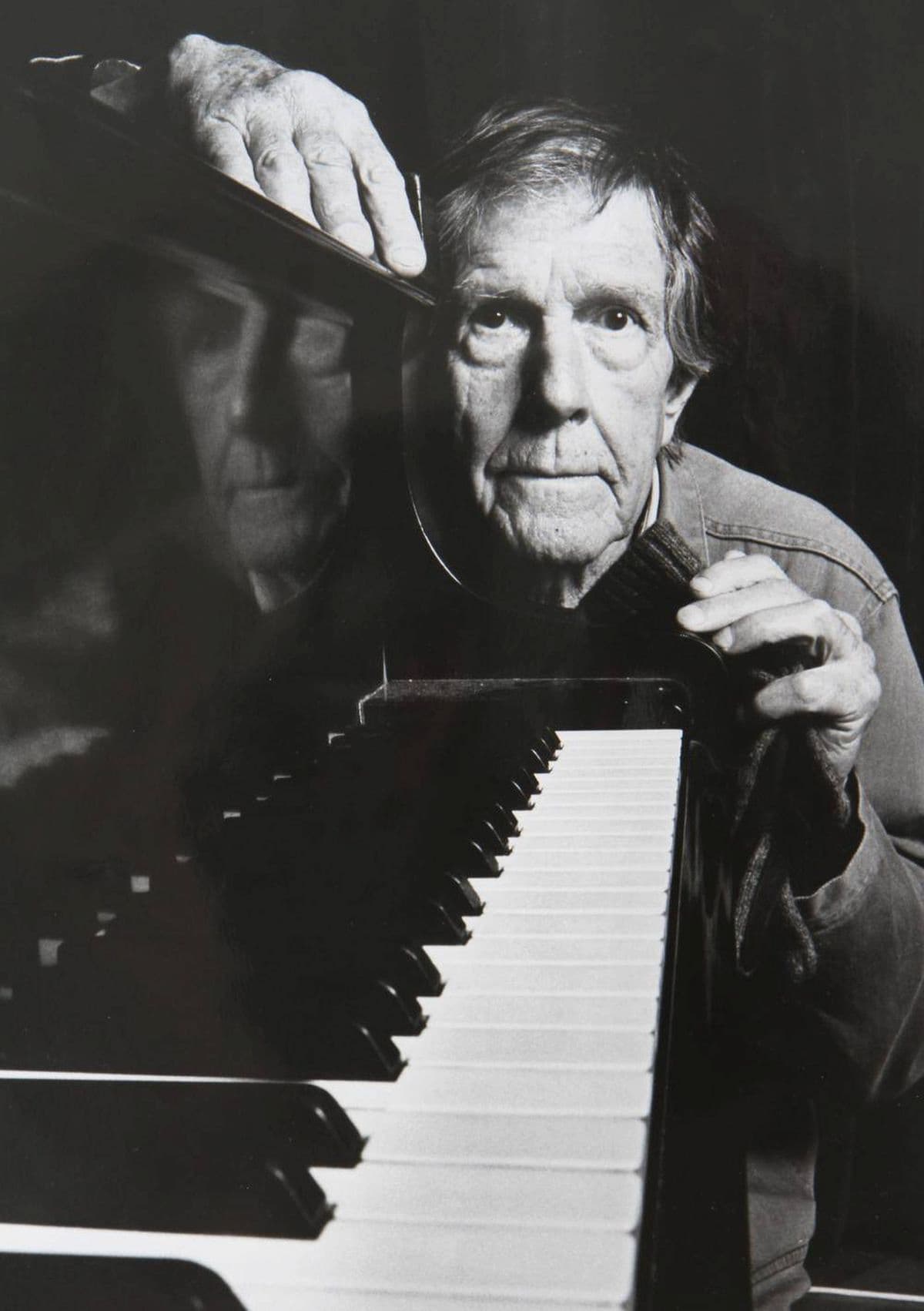
John Cage
From the onset, this compendium paints a picture of a man who liked ambiguity, the frustration of expectations, and absurdity – a kind of contrariness of spirit reminiscent of Erik Satie. In the foreword he recounts an incident during his Lecture on Nothing delivered at the Artists’ Club on Eighth Street in New York, which involved the giving of the same six, randomly-selected, pre-prepared answers in response to whatever question was asked, where good friend and attendee Jeanne Reynal stood up and screamed, “John, I dearly love you, but I can’t bear another minute,” and promptly left. The anecdote is recounted not as a triumph at having irritated and frustrated another human being, but as a kind of soft acknowledgement that his way of thinking and making, his explanations of his own artistry, his music – all contain a challenging preoccupation with form, repetition, and meaning that are, in a myriad of ways, crazy-making. Later in the foreword, he acknowledges the influence that both Zen and Dadaism have had on his thinking, while also stating that he does not wish Zen to be “blamed” for his work, and that he wanted “to free Zen of any responsibility for [his] actions.” Instead of aligning himself fully with either school of thought, he gives two explicitly stated reasons or justifications for all of these lectures and writings. The first is that he sought above all else “poetry,” which he defines as “the allowing musical elements (time, sound) to be introduced into the world of words.” The other stated aim was to collapse content and message into form by communicating ideas via their embodiment rather than by abstract description or definition, such as delivering a lecture on repetition by the actual use of extensive repetition. By virtue of this latter aim, Cage’s Silence is a mixture of spatialised poetry, instructions for performance art, text scores, transcribed or written lectures, and everything evading definition in between – making for a varied and amusingly bumpy read.
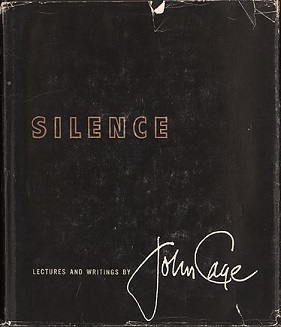
First edition of John Cage’s Silence: Lectures and Writings
Of real interest from the 21st-century perspective are Cage’s predictions about the future and purpose of composition. In his lecture ‘Future of Music: Credo’ given in 1958, Cage correctly forecasted the extent to which technology, electronic instruments, and recorded sound would come to dominate music-making, and the ways in which this would blur the lines between music and the “noise” that constantly surrounds us. Some of the conclusions he reaches from the new technologies being discovered in his lifetime – high fidelity recording, and the ability to manipulate those recordings along a continuous spectra like amplitude or overtone structure – are quite extreme. He makes the analogy that writing music with simple rhythms and twelve tones alone is discrete and traditional, like walking, whereas utilising technology to make music of infinite rhythmic and pitch complexity is like flying. The other compositional alternative he seems to endorse is to turn to the sounds of nature, “to give up the desire to control sound, clear [the] mind of music, and set about discovering means to let sounds be themselves rather than vehicles for man-made theories or expressions of human sentiments.” Having presented these two options – making complex noise-music using the outermost limits of technology, or creating sound-art out of randomness and the natural world – Cage then somewhat paradoxically says that nothing need change in music-making at all, that “the more things there are, the merrier.” He goes so far as to say we should embrace a dominant seventh chord every now and then. While none of this hangs together as the most coherent or well-defended musical philosophy, it’s certainly food for thought for anyone interested in the history of modern composition.
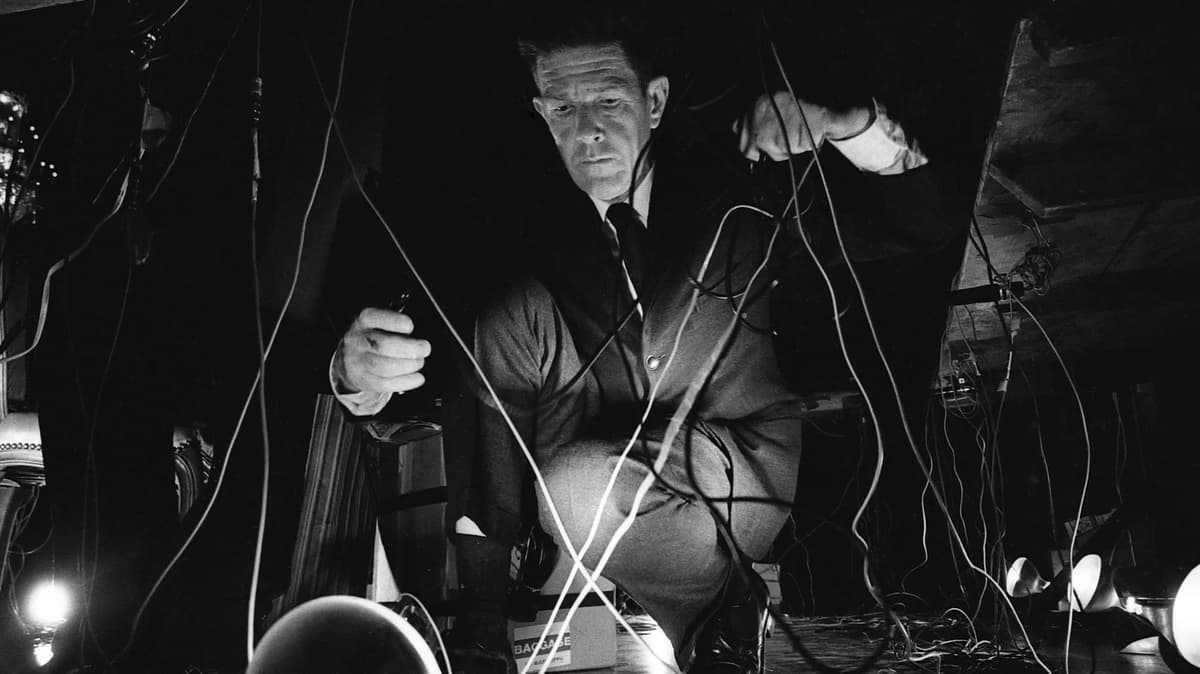
John Cage during his 1966 concert at the opening of the National Arts Foundation in Washington, D.C. © Rowland Scherman/Getty Images
Scattered throughout the book are strange anecdotes from Cage’s life and those of mentors and artist friends. In small italics, these surreal stories of submarines, travel, and mushroom-picking punctuate the ongoing conceptual wrestling, the never-ending tensions between noise and music, sound and silence, choice and non-choice. These serve as nice moments of levity from the dense, sometimes technical, and experimentally formatted meditations on process and musical form. On the whole, the earnestness of Cage’s desire to understand things deeply and well is always tempered with humour and a surrealist, interdisciplinary spirit. The spatialised poetry calls to mind André Breton, and Cage is as versed in theatre, philosophy, and the visual arts – with many mentions of Max Ernst and Gertrude Stein – as he is in music, perhaps more so.
Frustrating, enlightening, thought-provoking, and clever in equal measure, this is the kind of book anyone interested in music would do well to own and return to throughout their lifetime.


No comments:
Post a Comment