by Georg Predota July 26th, 2026
Field’s nocturnes are a window into the salons of 19th-century Europe, but to celebrate his birthday on 26 July, let us highlight the more public side of his artistic persona by featuring his seven piano concertos. In fact, like any good Netflix series, let’s binge-listen to all of them.
A Pianist for a New Age
In short, John Field was born in Dublin and moved to London to study with Muzio Clementi. The 12-year-old boy was an instant sensation, and Clementi took him on extended tours of the continent. After performing in Paris and Vienna, teacher and student went on an excursion to Russia.
In time, he became the biggest name on the salon circuit, mesmerising audiences with performances of his music. He also set up a highly successful private piano studio, giving lessons to affluent and well-educated members of society.
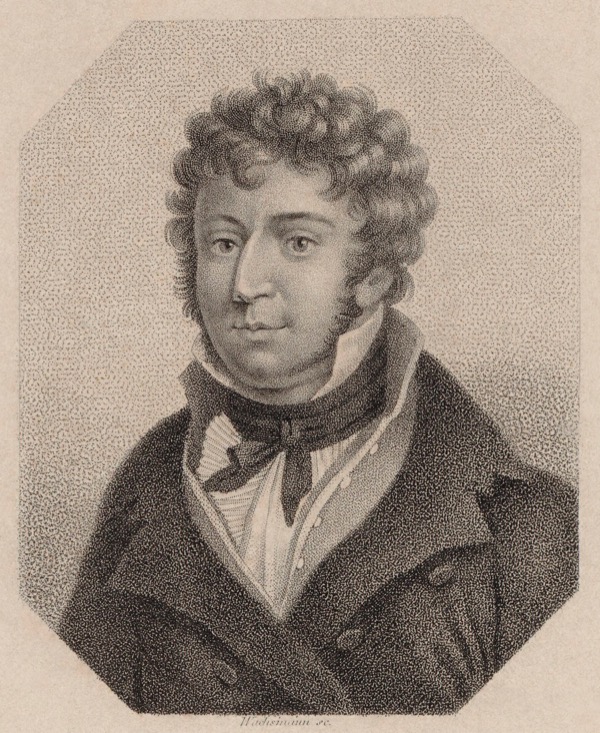
John Field
John Field was a special virtuoso, with contemporaries telling of his delicacy of touch and the refinement of his sonority. Powerful chords and blazing velocity were simply not part of his style. Instead, particularly in his character pieces, he focused entirely on tone, colour and shading.
In his short twilight meditations, the nocturnes, words faded away in favour of pure emotion. Field made great use of the technical improvements of the instrument, using a more sustained legato, a greater variety of touch, a subtler range of dynamics, and a more efficient use of the sustaining pedal.
Pointers Towards Maturity
John Field performed his first piano concerto on 7 February 1799 at the King’s Theatre in London. However, it was first published only in 1814 in St Petersburg after having undergone substantial revisions. And we do know that Field himself sometimes played this concerto without an orchestra, omitting orchestral passages and making adjustments as necessary.
The work opens almost in a Mozartian style, but we soon hear the widely-spaced accompaniment with ornamented flourishes in the piano. A dramatic development switches to the minor key, and the thematic material sounds like modulating progressions later much used by Chopin.
The slow movement consists of two variations on James Hook’s song “Within a mile of Edinburgh Town,” introducing some fashionable exoticism. The Scottish air is simply stated and features the characteristic rhythmic snap. Short cadenzas lead to subsequent variations on the tune.
The concluding “Rondo” opens with an imitation of bagpipe drones, followed by a “cuckoo” motif in the piano. Plenty of Mozartian touches appear in the tutti passages, while the episodes offer some pianistic bravura.
As Philip Buttall writes, “Although this concerto does not show the composer as fully-developed, it does, nevertheless, exhibit one or two pointers towards his later style…There is a lot of passage-work not only to be seen again in Field’s works, but also to be developed in the works of Chopin. (Buttall, Field Concertos, 2005)
A Blueprint for Chopin
Composed after settling in Russia, Field’s piano concerto No. 2 in A-flat major was a highly influential blueprint for Chopin’s own piano concertos. This once-celebrated concerto was admired and taught by Chopin, and Robert Schumann called it “divine.”
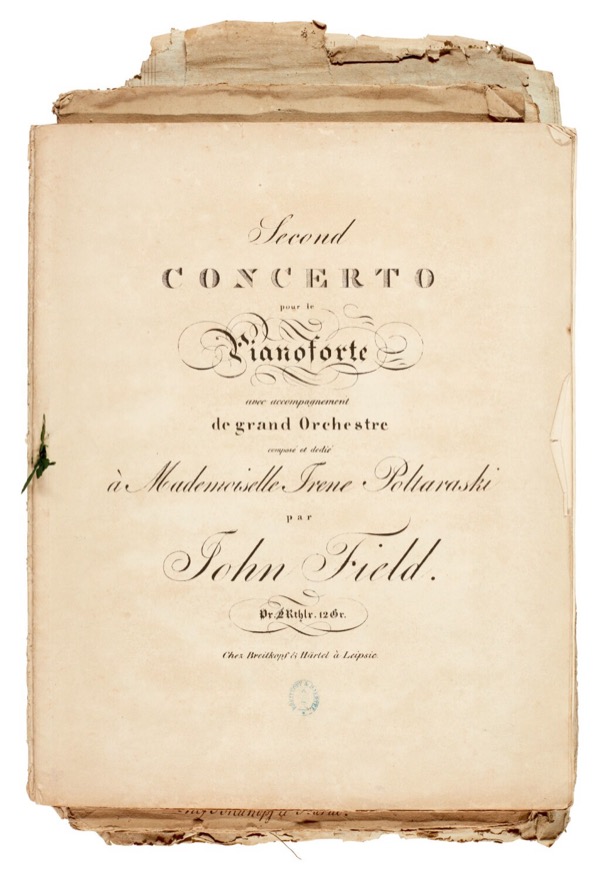
Title page: John Field’s Piano Concerto No. 2
Its origins probably date to around 1811, but it was first published in Leipzig in 1816. The first subject is given by the strings alone, and subsequently joined by clarinets and a lengthy tutti section.
However, it is with the piano’s first entry that Field established a new era, laying down the foundation on which the generation of Romantic composers would build. Here, the soloist enters with his own treatment of the principal theme, elegantly developed, before the music moves to the secondary contrast.
We might also mention that “Field’s accompanying use of the orchestra is considerably fuller and more imaginative than Chopin’s.” (Buttall, Field Concertos, 2005) The “Poco Adagio” is as much a Nocturne as any of his pieces in that genre, and it was published separately as a romance and a serenade.
The concluding “Rondo” is based on a bouncy melody that returns to frame various episodes, but the primary purpose of pianistic display is never really forgotten. This concerto was played throughout the 19th century, as the appealing thematic material and its most effective piano-writing easily account for its former popularity.
A Tribute to Clementi
Field dedicated his Third Concerto to Muzio Clementi, and it seems to have been written before his second concerto. Stylistically it is closer to the Concerto No. 1, scored for similar orchestral forces and in the same key.
Unusually, the Third Concerto only features two long and brilliant outer movements, and in later years, Field often wedged one of his Nocturnes between these movements. In the featured Chandos recording, Field’s orchestral arrangement of the Nocturne in B-flat Major was used.
The opening “Allegro” movement opens with a beautiful orchestral theme that spins its way to a second group of lyrical contrasts. Once again, the piano makes a declamatory entrance and wanders expressively through a wide range of major and minor keys.
The finale is marked “Tempo di polacca” and unfolds in the manner of a polonaise used in Russia at balls and courtly occasions. It features a good-humoured theme followed by playful passage work. A central episode apparently made listeners weep, and it all ends in a jovial tutti.
The Lyrical Romantic
Field’s fourth concerto in E-flat major probably dates from around 1814, and it has been described as one of the most beautiful of all Romantic concertos. Eve Bersham writes, “Field was at the height of his powers, as yet in good health and flourishing financially, his fame having by now spread far beyond St Petersburg. Soon the work was in print both in Russia and in Germany, and Field eventually made an arrangement of it for piano solo.” (Bersham, Field Piano Concertos)
Scored for a slightly smaller orchestra, the first subject is quietly announced by the strings alone, followed by a military-sounding transition that leads into the elegant second subject. The soloist’s first statement features lyrical embellishments before a tender Romantic theme is introduced.
The orchestral passages are primarily accompanimental, but they nevertheless provide some colourful passages. However, the stirring martial rhythms overrule all gentleness. The slow movement is titled “Siciliano,” and it might take its inspiration from a slow movement of a Mozart Piano concerto with hints of Mendelssohn sprinkled over the music.
The concluding “Allegretto” sounds like a nursery tune, with witty harmonic digressions and plenty of pianistic challenges. Alongside lively orchestration and brilliant piano writing, Field also reveals humour as an important facet of his musical personality.
The Blazing Storm
Field’s 5th Piano Concerto was once among his most popular and colourful pieces. Inscribed “The Blazing Storm,” it originates from the rivalry between Field and Daniel Steibelt, who in 1815 also lived and worked in St Petersburg.
Steibelt had composed a concerto subtitled “The Storm,” and Field’s “Blazing Storm” was certainly calculated to outdo the programmatic effects of the earlier work. From the very beginning, Field is not simply suggesting a storm, but some kind of catastrophe resulting from it.
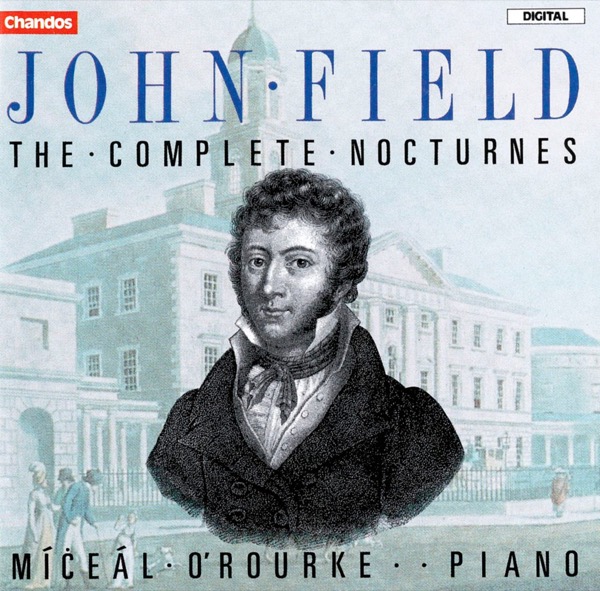
John Field: Nocturnes
The opening “Allegro” starts gently and lyrically, with no hint of the drama to come. However, regarding the development section, we understand the addition of a bass trombone and additional percussion. Now turning to C minor, with the wind increasing, there are rumbles of thunder in the distance.
We can hear some lighting, gusts of wind, and a downpour, when an unexpected harmonic digression leads to an enormous crash on the tam-tam. Once the storm subsides, we are still treated to a devilishly difficult cadenza.
The “Adagio” is mainly taken by the orchestra, with the piano entering in quick flurries between phrases. The orchestra continues serenely, and we enter the “Allegro” rondo without pause. Another light-hearted theme is decorated and embellished, offering plenty of charm and entertainment for an adventurous soloist.
The Russian March
The Piano Concerto No. 6, again scored in C Major, was first heard in St Petersburg in 1819. Like all Field concertos, it was thoroughly revised before publication. The work opens with a grandiose military march that turns more lyrical. It is then decorated by the piano and spun into what could possibly pass as a Russian folksong.
The “Larghetto” turns out to be an arrangement of Field’s 6th nocturne, and the concluding “Moderato” might have been composed in some haste. It is, by comparison, probably the slightest and lightest in all of Field’s concertos.
It does include many florid and attractive passages, but there are no real contrasting episodes of any melodic distinction. As such, Field probably decided to conclude this work in an overly cheerful manner.
Seeds of Chopin
Field’s only concerto in the minor key had a lengthy gestation period. The first movement of Field’s Seventh Concerto was performed by the composer in Moscow in 1822. The completed work, with a dedication to Mademoiselle d’Albini, was first performed in 1832 in Paris and published two years later.
At the first complete performance in Paris, both Liszt and Chopin were in the audience, and Schumann later suggested that it may have influenced his own concerto. Field’s last concerto is scored for the full resources of the orchestra, including timpani and bass trombone.
The timpani open the first movement, followed by a subject played by the clarinet and bassoon. The piano then remains the centre of attention, including a slow section modelled after Nocturne No. 12. The second of the two movements is again a rondo, with the principal theme evoking Russian ballrooms.
The celebrated critic, François-Joseph Fétis, wrote in the Revue Musicale that the Seventh Concerto was “diffuse, but full of happy ideas.” For the Parisian public, however, it was an immediate success.
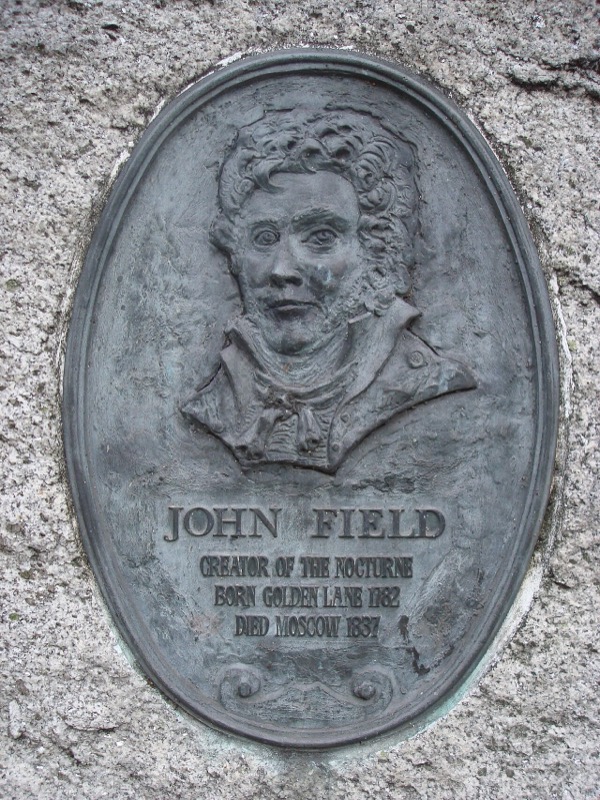
John Field’s Memorial plaque, Golden Lane
Philip Buttall writes, “John Field not only invented the nocturne, but also brought into being a whole new range of pianistic expressiveness and feeling, from the cantilena melodies, with their opera-like embellishments in the Nocturnes and the Concertos, to the bravura technical passages and devices in the latter, and in other works.” (Buttall, Field Concertos, 2005)
Having listened to all seven of Field’s concertos, I have been struck by how much of Field’s influence seems to be present in Chopin’s two concertos. The singing melodic lines, ornamental filigree, and nocturne-like lyricism abound, as does the tendency to treat the orchestra as an elegant frame for the piano’s poetic utterances. It seems that the seeds of Chopin’s concerto style had been planted several decades earlier.