Showing posts with label by Maureen Buja. Show all posts

Friday, October 16, 2026

Vienna Soundscapes: The Quatuor Hermès

 by Maureen Buja  October 12th, 2026


In choosing their works for this album, the Quartet looked at both Beethoven and Haydn before settling on Mozart. As the starting cornerstone, Mozart’s 1783 quartet (Quartet No. 15 in D minor) opens the discussion. The Quartet sees Webern and Korngold as further embodiments of the Viennese soul.

The invisible body in the middle of these works is Romanticism, and by jumping from Mozart’s Classical quartet, which they view as ‘pre-Romantic’, to Webern’s and Korngold’s definitive post-Romantic works, we’re asked to imagine what lies between them. Mozart’s dramatic quartet and its use of D minor as its key only emphasises the work’s ‘post-Classical’ position in this context.

Webern’s Langsamer Satz, written in 1905, transcends Romanticism on the edge of atonality. Webern sets a love story in a man’s walk with his beloved, but at the same time finds traditional atonality unable to fully convey the emotions he wants to express. In the same idea of intimacy and anxiety that can be found in Mozart’s Quartet No. 15, said to have been written while he awaited the birth of his first child, Webern carries us with a sense of emotional restraint.

The album ends with Erich Korngold’s String Quartet No. 2. The precocious Korngold was often compared to the equally precocious Mozart, and one of the strengths of his music from the beginning was its ability to conjure up stories and images. The Quartet first met Korngold through his Piano Quintet, and they found the same sense of farewell in this String Quartet. They are protagonists in an epic tale, and the music seems to have cinematic qualities, as will so much of his future Hollywood material.

The recording is an imaginative and creative look at the string quartet as it moves from tradition to the future. Emotions give way to emotional stories that lead to cinematic ones.
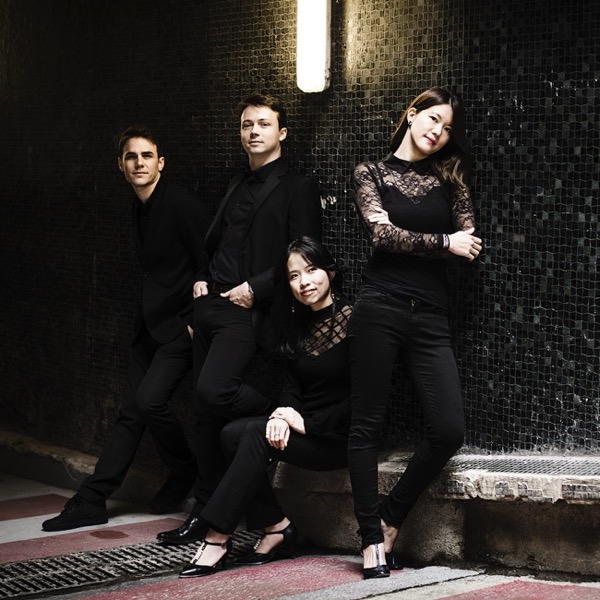
Quatuor Hermès (photo by Lyodoh Kaneko)

Quatuor Hermès (photo by Lyodoh Kaneko)

They play with skill and authority, and their extensive work with late Romantic and Early Modern quartets and quintets gives them a unique modern viewpoint. They note that this recording is their first to include Mozart.

This album joins an extensive list on La Dolce Volta by the Quartet, including Schumann’s Three Quartets, Op. 41 (LDV 17), String quartets by Ravel, Dutilleux, and Debussy (LDV 33), Brahms’ Piano Quintet in F minor, Op. 34, with Geoffroy Couteau (LDV 61), and his Piano Quartets nos. 1–3 (LDV 62.3), and Schubert’s Rosamunde and Der Tod und das Mädchen (LDV 85).
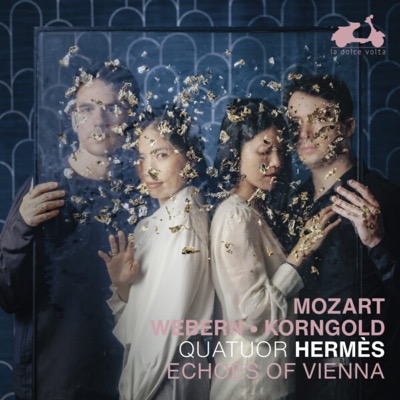
LDV134 Quatuor Hermes album cover

Echoes of Vienna: Mozart, Webern, Korngold

Quatuor Hermès
La Dolce Volta LDV 134

Official Website

For more of the best in classical music, sign up for our E-Newsletter

Wednesday, September 16, 2026

Artists at the Opera & Ballet: Pablo Picasso

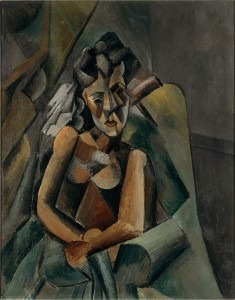
1909, Femme assise (Sitzende Frau) (Staatliche Museen, Neue Nationalgalerie, Berlin)

1909, Femme assise (Sitzende Frau) (Staatliche Museen, Neue Nationalgalerie, Berlin)

When you look at everything that the Spanish artist Pablo Picasso (1881-1973) was involved with, you have to cover most of the fine arts and then add a good slog of literature. He was a painter, sculptor, printmaker, ceramicist, and a poet and a playwright, as well as being a stage designer.

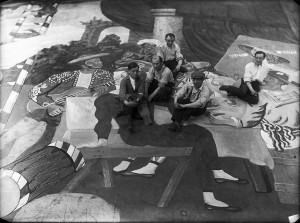
Pablo Picasso and scene painters sitting on the front cloth for Léonide Massine's ballet Parade, staged by Sergei Diaghilev's Ballets Russes at the Théâtre du Châtelet, Paris, 1917

Pablo Picasso and scene painters sitting on the front cloth for Léonide Massine’s ballet Parade, staged by Sergei Diaghilev’s Ballets Russes at the Théâtre du Châtelet, Paris, 1917

Picasso’s move into cubist with fellow artist Georges Braque beginning in 1909 was a fundamental influence on his stage designs. Cubism on the canvas moves the viewer into a strange multi-dimensional world, where foreground and background seem to move and the subject is viewed from different juxtaposed angles concurrently.

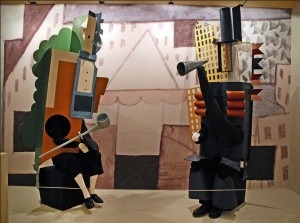
Picasso: Costumes for the roles of the Manager américain and the Manager français from the Exposition Ballets russes held at the Bibliothèque-musée de l'Opéra de Paris, 2009

Picasso: Costumes for the roles of the Manager américain and the Manager français from the Exposition Ballets russes held at the Bibliothèque-musée de l’Opéra de Paris, 2009

In 1917, Satie’s work Parade was put on by Russian impresario Sergei Diaghilev. The ballet combined the talents of Paris’ top artists: Satie as composer, Jean Cocteau wrote the scenario, and Picasso did the costumes and stage design. The ballet was choreographed by the great Léonide Massine, who also danced. Although cubism may not be well-illustrated in the following pictures of Picasso and staff, you can certainly see cubism in the costume design:

Some of the costumes haven’t survived, such as the costume for the Female Acrobat. The character was added at the last minute by Massine and her costume of a spiral running up her legs was painted directly onto her body by Picasso.

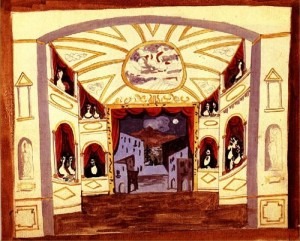
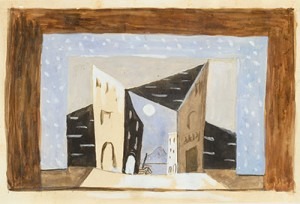
Scene design from Pulcinella (note Mount Vesuvius looming in the background)

Scene design from Pulcinella (note Mount Vesuvius looming in the background)

Picasso designed another work for Diaghilev: the curtain for Le Train Bleu (1924) with costumes by Coco Chanel and music by Darius Milhaud.

Stage design for Pulcinella in blue

Stage design for Pulcinella in blue

Picasso worked on another ballet project for Diaghilev, but this time with Igor Stravinsky as his collaborator. Diaghilev had brought Stravinsky some scores that he’d found in Naples, attributed (at the time) to Pergolesi. The music, now thought to be by composers including Domenico Gallo, van Wassenaer, Carlo Monza, and others, would have been sold under Pergolesi’s name because of his then-current fame. Stravinsky took the music and made it his own, and the resultant style-change became known as Stravinsky’s ‘neo-classical’ style.

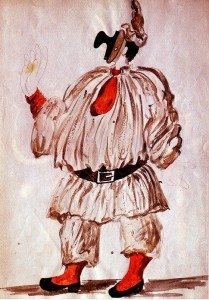
Costume design for Pulcinella, danced by Massine

Costume design for Pulcinella, danced by Massine

In the two scene designs, we can still see Picasso’s cubism come to the fore. At the same time, the use of panels also suggests the portable scenery used by the travelling commedia dell’arte companies. The dancers wore costumes in an 18th century style while Pulcinella, who was danced by the choreographer Massine himself, also wore the traditional mask.

In these days new to design teams, each with a different responsibility for all the elements of a staging, it’s refreshing to see Picasso’s unified designs. It’s also very interesting to see Picasso’s cubism step off the wall and become a three-dimensional world.