How physical and psychological adversity shaped some of classical music’s most radical voices
There is a persistent myth in the telling of great artistic lives: that genius triumphs despite its hardships. The more honest — and more interesting — story is often that genius triumphs through them. Across the history of classical music, some of the most radical and enduring works were not produced in comfortable studios by comfortable people. They were wrested from silence, from pain, from confinement, from a single remaining hand.
What follows is not a catalogue of suffering. It is something closer to the opposite: a record of transformation.
The Composer Who Could No Longer Hear the World
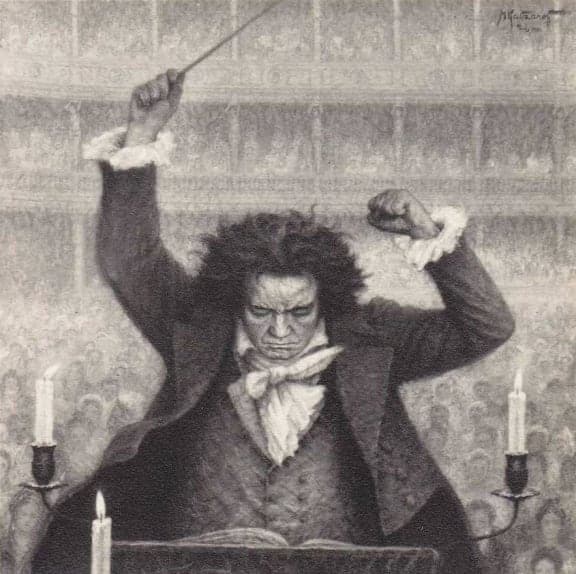
Beethoven conducting
The story of Beethoven‘s deafness has been told so many times that it risks becoming a kind of motivational poster — something to be invoked and moved past. But its implications for music history deserve more careful attention.
Beethoven began losing his hearing in his late twenties. By the final decade of his life, the silence was almost complete. He reportedly pressed a wooden stick against the piano and held it between his teeth, feeling the vibrations through bone rather than air. He could no longer perform publicly as a pianist.
What deafness took from him — the ambient noise of fashionable Viennese musical life, the pressure of trends, the approval or disapproval of audiences — it replaced with something more demanding and more free: total inwardness. The late string quartets and the Ninth Symphony were not composed for listeners he could hear react. They were composed for a musical logic that existed entirely within him. The result was music so strange, so structurally bold, that his contemporaries were baffled. We now call it the birth of musical Romanticism.
The Eyes That Heard Everything
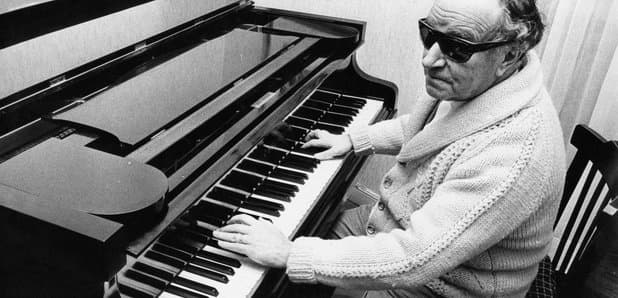
Joaquín Rodrigo
Joaquín Rodrigo lost his sight to diphtheria at the age of three. He would go on to write one of the most performed guitar concertos in history — despite never having mastered the guitar.
He composed in Braille, working through scores with his fingers before they reached any instrument. His wife, the pianist Victoria Kamhi, transcribed his work. The Concierto de Aranjuez — its famous Adagio in particular — conjures light, shadow, memory, and imagined landscape with a vividness that seems almost paradoxical from a composer who had lost his sight in earliest childhood.
Perhaps that is precisely the point. Rodrigo had little visual memory to constrain him. He had sound, and what he had made sound mean. His relationship to the guitar was analytic and exterior rather than habitual and physical — and it produced something that every guitarist since has had to reckon with.
The Mind That Played Differently
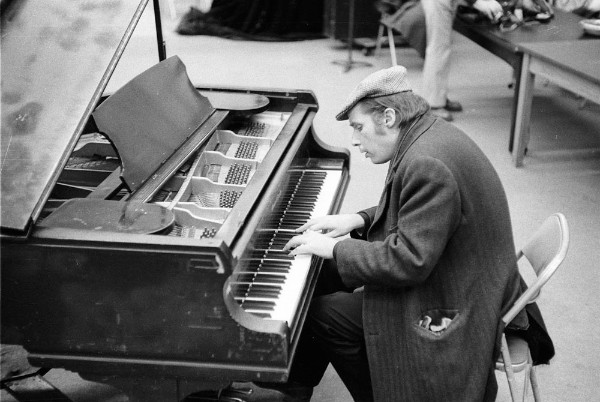
Glenn Gould at the piano
Glenn Gould has often been discussed in relation to the autistic spectrum, although no formal diagnosis was made during his lifetime. His hypochondria was legendary; his posture at the piano — hunched over a specially built low chair constructed by his father — was singular; his habit of humming audibly throughout his performances drove recording engineers to distraction and has haunted every recording he ever made.
Whatever the source of his unusual cognitive style, it gave him something that conventional pianists rarely possess: the ability to hold multiple contrapuntal voices in simultaneous, independent focus. He did not experience polyphony as a blur to be navigated but as a kind of architecture to be inhabited room by room. His 1955 recording of Bach‘s Goldberg Variations remains, for many, the most radical and clarifying interpretation the piano has ever produced.
Gould withdrew from the concert stage entirely in 1964, at thirty-one. He found live performance anxious, wasteful, and socially exhausting. He spent the remaining eighteen years of his life in recording studios, treating microphone placement and tape editing as compositional tools in their own right — becoming one of the first pianists to treat the studio not as a documentary space, but as an instrument.
The Composer Who Could No Longer Play
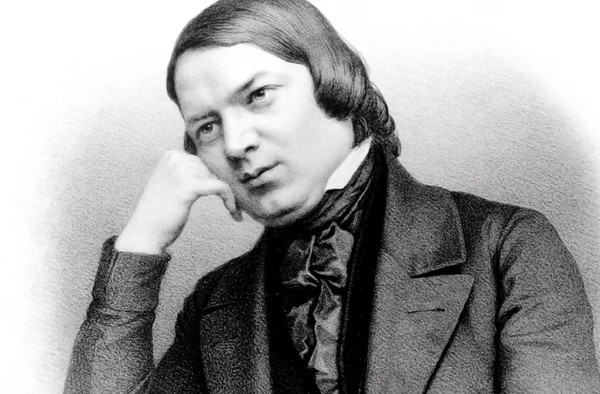
Robert Schumann
According to a long-repeated account, Robert Schumann damaged his right hand while using a mechanical device intended to strengthen his fingers — a story that remains debated, but has become inseparable from the mythology of his abandoned career as a virtuoso pianist.
What followed was a compositional life of extraordinary psychological richness. Schumann invented two alter egos — the impetuous, extroverted Florestan and the introspective, melancholy Eusebius — as vessels for emotional extremes that many modern scholars have associated with bipolar disorder. These were not merely literary conceits. They structured his music, giving it a dialectical tension, an inner argument, that animates the piano works and the symphonies alike. His injury did not make him a composer; but it removed the alternative, and in doing so, gave music a voice it would not otherwise have had.
One Hand, a New Literature
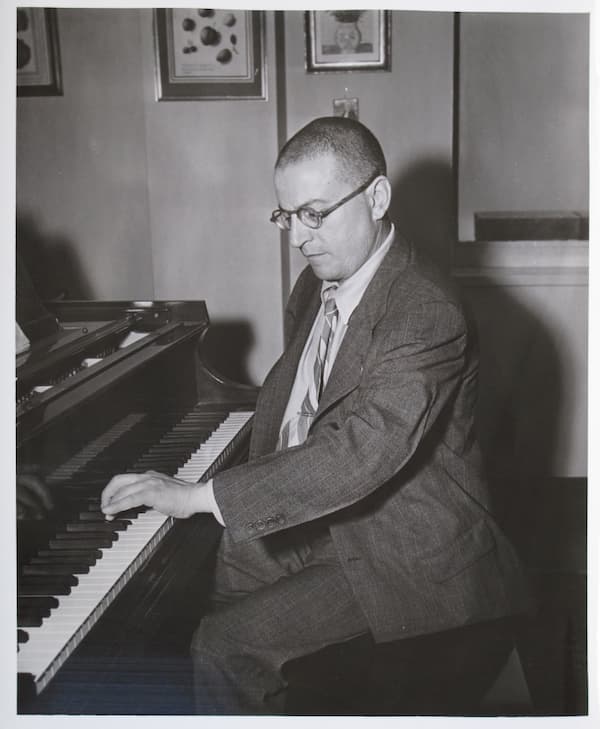
Paul Wittgenstein
And then there is the case that is perhaps the most extraordinary of all — not because it involved a single person overcoming a limitation, but because one person’s refusal to accept that limitation changed what classical music itself contained.
Paul Wittgenstein — brother of the philosopher Ludwig — was a promising pianist when he was called up in the First World War. On the Russian front, he was shot in the right arm. The arm was amputated. He was taken prisoner, and when he returned to Vienna, he returned without the limb that his entire musical life had depended upon.
He did not stop playing. He rebuilt his technique from the ground up, developing a left-hand method that used pedal, arpeggio, and register-leaping to create the illusion of two-handed texture. Listeners heard what sounded like a full piano; they were hearing one hand, moving with extraordinary speed and deliberate intelligence across the keyboard.
But Wittgenstein’s most lasting contribution was not technical — it was his role as a commissioner. He used his family’s considerable wealth to approach the greatest composers of the age and ask them, explicitly, to write for him: for one left hand, against orchestra.
The result was a body of work that might not exist otherwise. Ravel’s Piano Concerto for the Left Hand — premiered in 1932 — is now considered one of the masterworks of the concerto form, its single-line piano part emerging from the orchestral mass with a dramatic concentration that two hands might have diffused. Prokofiev wrote his Fourth Piano Concerto for Wittgenstein. So did Richard Strauss, Benjamin Britten, and Paul Hindemith.
Wittgenstein did not always perform these works as written — he was reportedly not above altering passages he found unidiomatic, to the fury of composers — but his existence as a patron and performer forced some of the most brilliant musical minds of the century to ask what they had previously never needed to ask: what can one hand do that two cannot?
The answer, it turned out, was to make the listener lean in. To make absence audible. To discover that constraint, properly inhabited, is not the opposite of expression — but one of its most demanding forms.
What these musicians share is not the triumphalist arc of the inspirational story — adversity overcome, normal life resumed. Their limitations did not disappear. They became, instead, the very condition of their originality: the pressure under which something new was forced into being.
Tunacan Tuna is a cultural journalist and researcher based in Istanbul, writing on music, heritage, and cultural memory across Europe and the Mediterranean.