Showing posts with label and More. Show all posts

Friday, October 23, 2026

The Best Friends of the Great Composers: Brahms, Shostakovich, and More

From Johannes Brahms and violinist Joseph Joachim to Leonard Bernstein and Aaron Copland, these relationships offered the great composers companionship, encouragement, and profound musical inspiration.

Here are some of the most remarkable composer friendships in classical music history – along with the music they helped bring into the world.

Johannes Brahms and Joseph Joachim
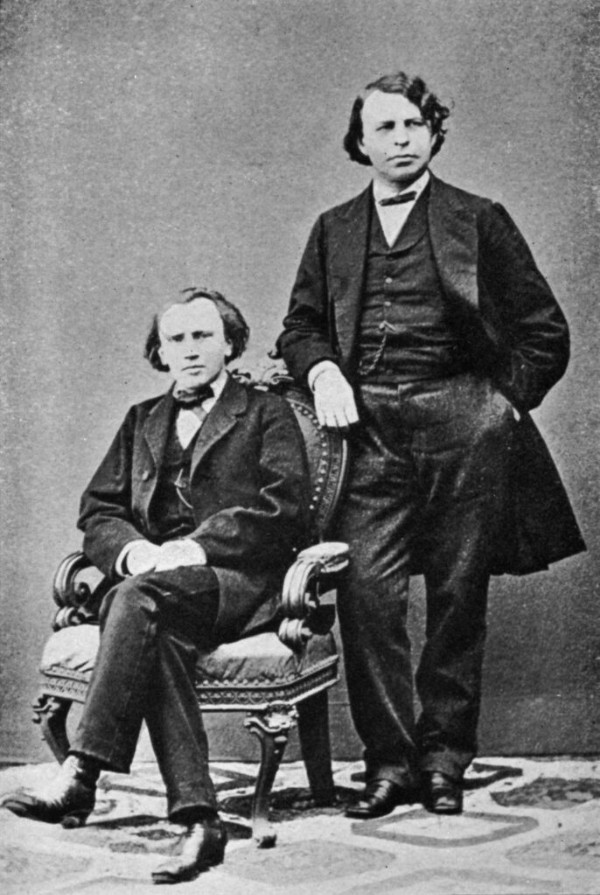
Johannes Brahms and Joseph Joachim

Brahms and Joachim

Composer Johannes Brahms and violinist Joseph Joachim met in 1853, when Brahms, an unknown musician who’d grown up in the commercial harbour city of Hamburg, arrived in Hannover with a letter of introduction to the already-famous Joachim.

Joachim was floored both by Brahms’s piano playing and his compositions, so he began spreading the word about his new friend, even writing a letter of introduction for Brahms to Robert and Clara Schumann. These relationships put Brahms on the musical map.

Over the years, Joachim and Brahms became close musical collaborators and friends. The friendship’s high water mark was arguably the creation of Brahms’s 1878 violin concerto, written specifically for Joachim’s strengths and tastes. Joachim even composed the cadenza.

Brahms: Violin Concerto   

In the early 1880s, they had an intense falling-out. It began after Joachim accused his wife Amalie of infidelity and began divorce proceedings. Brahms thought those suspicions were overblown and wrote her as much in a letter – and it was later used in court, much to Joachim’s anger.

In 1887, Brahms was the first to extend an olive branch, composing his Double Concerto for violin and cello, and requesting Joachim’s feedback.

In the end, Joachim premiered it, and the two were reconciled. Although they were never as close as they’d been as young men, the friendship endured until Brahms died in 1897.

We wrote about the divorce and how it impacted their friendship here: https://interlude.hk/did-brahms-break-up-the-marriage-of-the-joachims/.

Edward Elgar and August Jaeger
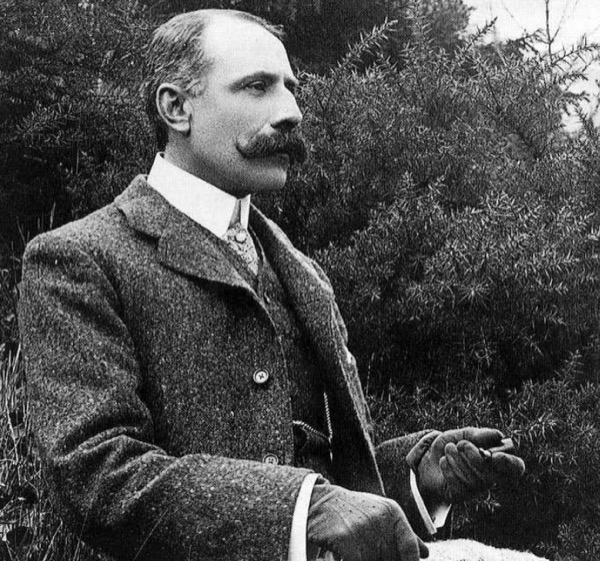
Edward Elgar

Edward Elgar

Edward Elgar first began corresponding with August Jaeger, the German-born music publisher at the London-based publishing firm Novello, in 1897.

At the time, Elgar was a composer and music teacher who had never made his longed-for breakthrough – and who, at the age of 40, seemed unlikely to.

The two men became fast friends, and Jaeger’s belief in Elgar’s talent helped to pull him back from the brink of quitting composing.
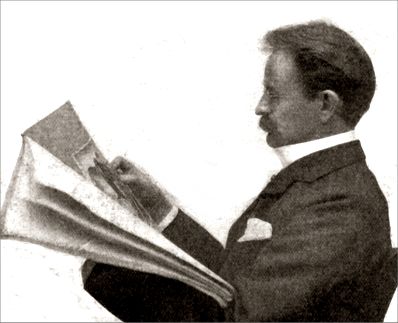
August Jaeger in later years

August Jaeger

In 1898, Elgar was improvising at the piano when he hit upon a theme he liked. That theme evolved into the Enigma Variations, an orchestral work with fourteen variations on the theme, each portraying a different person in his life. It became Elgar’s first large-scale hit.

Edward Elgar – Enigma Variations, Op.36: IX. (Nimrod)  

The emotional heart of the work, a variation titled “Nimrod”, became a tribute to his publisher: Jäger is German for hunter, and the Biblical figure Nimrod is described in the book of Genesis as a “mighty hunter.”

Jaeger provided feedback to Elgar’s works that the composer valued deeply, including for his 1900 oratorio The Dream of Gerontius and even the Enigma Variations themselves.

In 1905, Jaeger became ill with tuberculosis and was forced to relocate to Switzerland to attempt a rest cure. The cure failed to arrest the infection, and Jaeger died of tuberculosis in 1909 at the age of 49.

That same year, the Worshipful Company of Musicians commissioned Elgar to compose a musical tribute to the late Reverend Robert Hadden. The resulting work was his Elegy, Op. 58. Given that it was written within a month of Jaeger’s death, some listeners have connected it to Jaeger’s death.

We wrote about the Enigma Variations’ origin story here: https://interlude.hk/on-this-day-19-june-elgar-enigma-variations-was-premiered/.

Jean Sibelius and Ferruccio Busoni
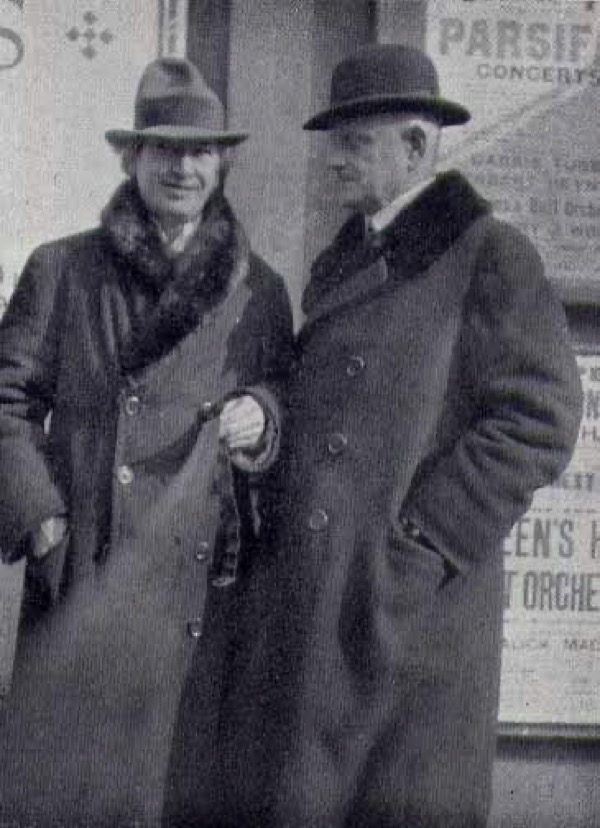
Ferruccio Busoni and Jean Sibelius

Busoni and Sibelius

Jean Sibelius and Ferruccio Busoni met in Helsinki in 1888, when Busoni accepted a position as a piano instructor at the Helsinki Music Institute, where Sibelius was studying. Both men were in their early twenties.

They were an odd couple. Busoni had been a piano prodigy who toured so much he once said, “I never had a childhood.” At the same time, Sibelius was a modestly talented violinist dreaming of becoming a travelling virtuoso.

But the two got along anyway, and even jokingly dubbed themselves “Leskovites” after the name of the restaurant where they and their friends gathered (and drank heavily).

Two years after they met, Busoni was offered a prestigious position at the Moscow Conservatory, which he accepted. Busoni and Sibelius never lived in the same city again, but they kept in touch via letter-writing.

By then, Busoni was a prominent figure in Berlin’s new-music scene and occasionally conducted Sibelius’s works, advocating for his music before it had cemented its place in the repertoire.

Gustav Holst and Ralph Vaughan Williams
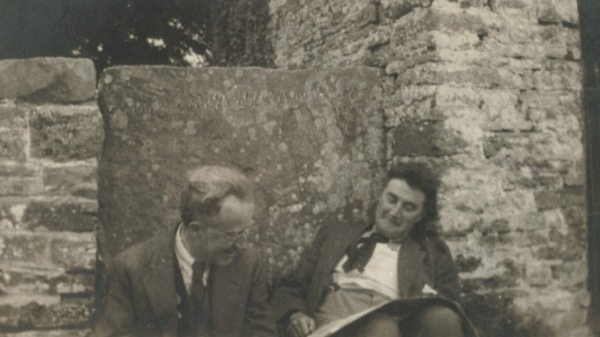
Gustav Holst and Ralph Vaughan Williams

Holst and Vaughan Williams

Gustav Holst and Ralph Vaughan Williams met in 1895 while studying at the Royal College of Music in London.

There they began a ritual they dubbed “field days” – regular meetings where they’d play each other’s works-in-progress and give feedback on them. Both men found these discussions formative.

They also shared a passion for British folk music. Vaughan Williams went on multiple long excursions to gather folksong, and Holst drew on his friend’s work in his own writing.   

The music of both composers became known for its uniquely English identity. That identity was especially meaningful given the rise of musical nationalism and the dominance of German and French music.

When Holst died in 1934, Vaughan Williams was devastated. He spent years afterwards helping to preserve and champion his friend’s works, including editing and promoting his manuscripts.


Dmitri Shostakovich and Ivan Sollertinsky
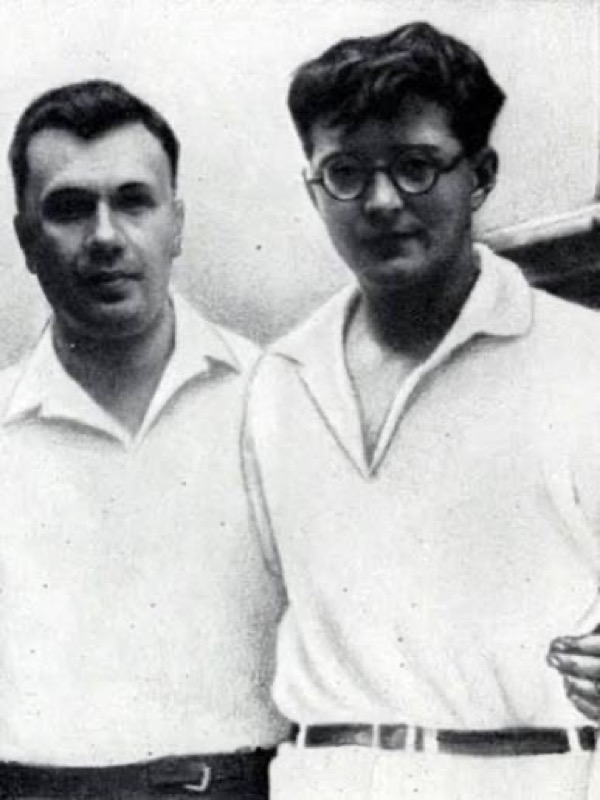
Dmitri Shostakovich and Ivan Sollertinsky

Shostakovich and Sollertinsky

Sollertinsky, then in his mid-twenties, was already an unnervingly brilliant musicologist, celebrated for his encyclopedic knowledge of literature, philosophy, and languages (according to legend, he could speak around thirty).

Shostakovich’s talents weren’t quite so showy, but he was clearly one of the most promising up-and-coming young Soviet composers, and thanks to their shared interests, he and Sollertinsky became friends.

Sollertinsky even began influencing Shostakovich’s music by introducing him to Gustav Mahler’s output, which gave him a model for what an ambitious large-scale symphonist could achieve.

Sollertinsky enthusiastically praised Shostakovich’s opera Lady Macbeth of the Mtsensk District – praise that came under fire after the opera was denounced in an unsigned Pravda editorial widely believed to reflect Stalin’s own views.

Even after it became clear that supporting Shostakovich was dangerous, Sollertinsky refused to retract that praise until Shostakovich, terrified for his friend’s safety, finally convinced him to.

After years of poor health, impacted by the privations of World War II, Sollertinsky died of heart issues in February 1944.

Shostakovich was devastated, writing that he had lost his “closest and dearest friend.”

He had already begun a new piano trio that December; after Sollertinsky’s death, the work became a tribute to his friend and was completed that August.

Leonard Bernstein and Aaron Copland
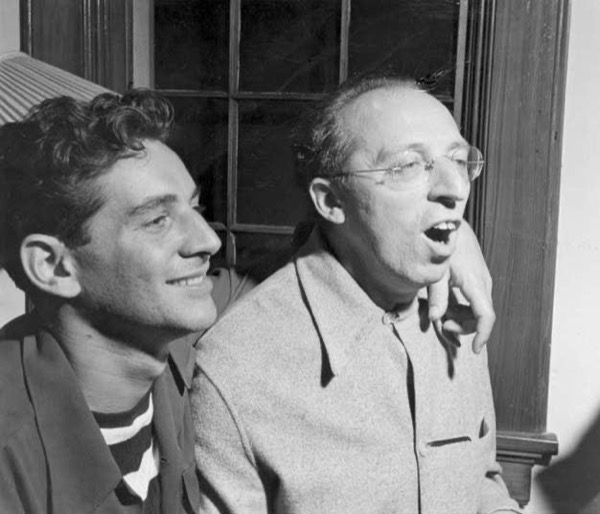
Aaron Copland and Leonard Bernstein

Copland and Bernstein           

They remained close friends for decades. They ended up dying just seven weeks apart – Bernstein in October 1990 and Copland in December 1990.

Conclusion

Each one of these friendships left fingerprints on the music itself: Joachim’s cadenza is still played in performances of Brahms’s concerto, Jaeger inspired the nickname of the famous “Nimrod” variation, and Sollertinsky’s loss runs through the piano trio Shostakovich wrote in his honour.

Knowing these stories helps us understand not only the composers better, but also the music they wrote.

Friday, December 19, 2025

The Most Memorable Composer Christmases: Mahler, Rachmaninoff, and More

by Emily E. Hogsta

The great composers also experienced a wide variety of Christmas celebrations. Today, we’re looking at five memorable Christmases from the lives of five great composers. (Read Part 1 here: The Most Memorable Composer Christmases: Chopin, Schumann, and More)

Mahler’s Devastating Breakup – 1884

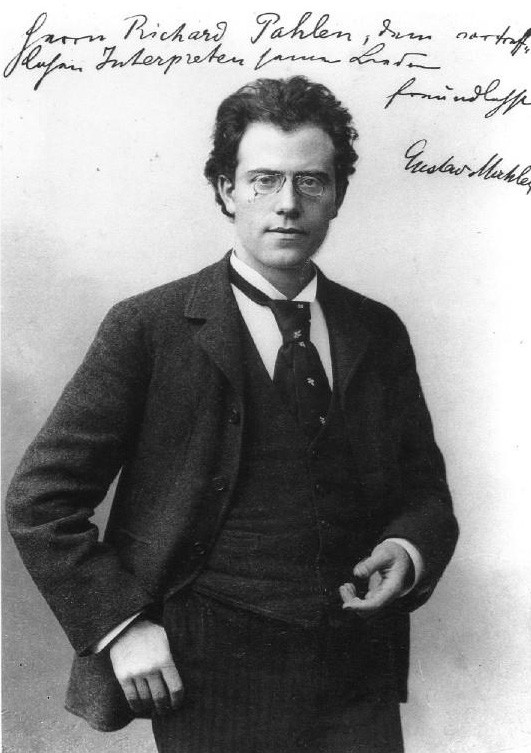
Gustav Mahler

Gustav Mahler

In mid-1883, 23-year-old Gustav Mahler took a job conducting opera at the Königliches Theater in Kassel, Germany.

While there, he began working with 25-year-old coloratura soprano Johanna Richter and fell in love with her. It was his first intense love affair.

We are not sure if Richter reciprocated Mahler’s feelings quite as intensely; only one letter from her survives.

In 1884, he began composing for her, writing lyrics based on folksongs and setting them to music. He called the resulting song cycle Lieder eines fahrenden Gesellen, or Songs of a Wayfarer. His December 1884 was absorbed by the project.   

Despite his passion for Richter, the couple was ultimately doomed.

He spent New Year’s Eve of 1884 with her and wrote to a friend about the experience:

I spent yesterday evening alone with her, both of us silently awaiting the arrival of the new year.

Her thoughts did not linger over the present, and when the clock struck midnight, and tears gushed from her eyes, I felt terrible that I, I was not allowed to dry them.

She went into the adjacent room and stood for a moment in silence at the window, and when she returned, silently weeping, a sense of inexpressible anguish had arisen between us like an everlasting partition wall, and there was nothing I could do but press her hand and leave.

As I came outside, the bells were ringing, and the solemn chorale could be heard from the tower.

Although the relationship didn’t work out, Mahler did reuse ideas from Songs of a Wayfarer in his first symphony, which he composed between 1887 and 1888. He wasn’t about to let his holiday heartbreak go to waste!

Fanny Mendelssohn Hensel Is Disappointed by the Christmas Singing of Papal Singers – 1839

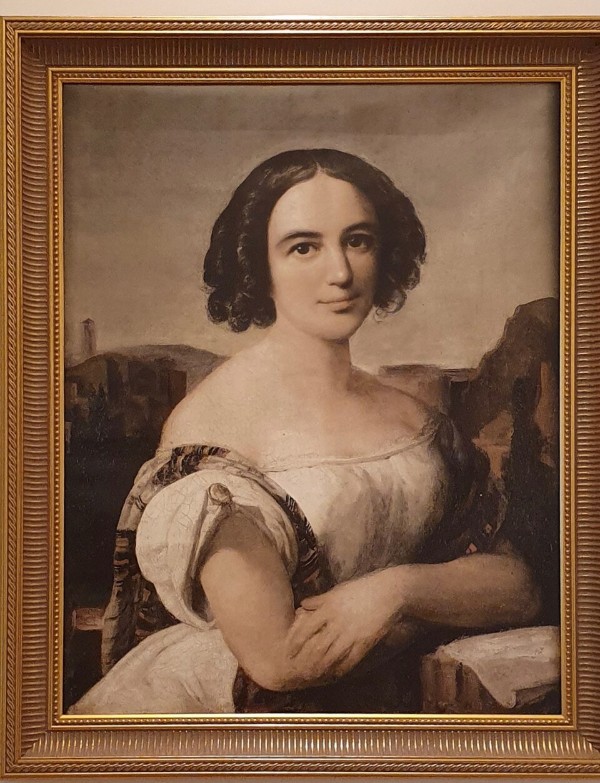
Fanny Mendelssohn-Hensel

Fanny Mendelssohn-Hensel

Felix Mendelssohn and his sister Fanny Mendelssohn were two of the most talented child prodigies in the history of music. They remained close for their entire lives.

Felix, however, was encouraged to pursue a musical career, while Fanny’s musical accomplishments were viewed as mere feminine adornments. (Luckily, her husband understood her talent and encouraged her music-making.)

Long story short, Felix got support that she never did, and in 1830, when Fanny was 24, and Felix was 21, the family sent him on a ten-month trip to Italy…without Fanny. The trip was formative, and Fanny was fascinated by the stories of his travels.   

Happily, Fanny got to go eventually. Between 1839 and 1840, Fanny, her husband, and her baby son Sebastian took their own trip to Italy, following in Felix’s footsteps.

On 1 January 1840, she wrote to her brother, sharing some observations about musical life in Rome:

We’re enjoying a pleasant life here. We have a comfortable, sunny apartment and thus far have enjoyed the nicest weather almost continuously. And since we’re in no particular hurry, we’ve been viewing the attractions of Rome at our leisure, little by little.

It’s only in the realm of music, however, that I haven’t experienced anything edifying since I’ve been in Italy.

I heard the Papal singers 3 times – once in the Sistine Chapel on the first Sunday in Advent, once in the same place on Christmas Eve, and once in St. Peter’s basilica on Christmas day – and have to report that I was astounded that the performances were far from perfect.

Right now, they seem to lack good voices and sing completely out of tune…

One can’t part with one’s trained conceptions so easily.

Church music in Germany, performed with a chorus consisting of a few hundred singers and a suitably large orchestra, assaults both the ear and the memory in such a way that, in comparison, the pair of singers here seemed quite thin in the wide expanses of St. Peter’s.

With respect to the music, a few passages stood out as particularly beautiful. On Christmas Eve, for instance, after the parts had dragged on separately for a long time, there was a lively, 4-part fugal passage in A-minor that was very nice.

I later discovered that it began precisely at the moment when the Pope entered the chapel, and I didn’t know it at the time because women, unfortunately, are placed in a section behind a grille from which they cannot see anything.

This section is far away, and in addition, the air is darkened by the smoke from candles and incense.

On the other hand, I could at least occasionally see the officials on Christmas day in St. Peter’s very well, and found them quite splendid and amusing.

We naturally had a Christmas tree, because of Sebastian, and constructed it out of cypress, myrtle, and orange branches. The branches were very lovely, but it wasn’t the best-looking tree, and Sebastian and I attempted to outdo each other the entire day in feeling homesick.

Johannes Brahms Surprises Clara Schumann – 1865

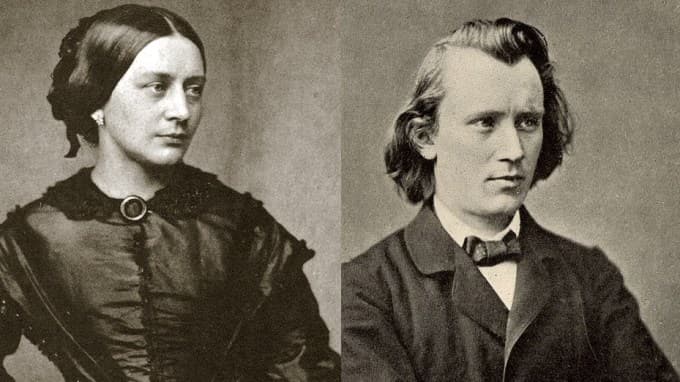
Black and white collage of composer Johannes Brahms and Clara Schumann

Clara Schumann and Johannes Brahms

Johannes Brahms and Robert Schumann’s wife, virtuoso pianist Clara Schumann, stayed close friends until the end of their lives.

They never had a traditional romance, but they loved each other deeply, and over their decades-long relationship, Brahms spent many holidays with Clara and her children.

At Christmas 1865, Johannes was 32, and Clara was 46. Both had busy performing careers that necessitated frequent travel, and Clara assumed that she wouldn’t be seeing Johannes for the holidays.   

She sent him a traveling bag as a Christmas gift. With the gift, she included a letter talking about her daughter Julie, who had recently been ill.

She wrote, “Thank heaven we have fairly good news of Julie. She has got over the danger of typhoid, but it will be a long time before she has completely recovered.”

The family was worried about Julie’s health, and they didn’t even bother lighting candles on the tree that year.

But then the door opened – and Brahms appeared! He had made a seven-hour journey to Düsseldorf to surprise the family and check in on Julie himself.

Clara wrote in her diary that she was “very pleased and excited.”

Read our article about Christmas with Brahms.

Rachmaninoff Flees Russia – 1917

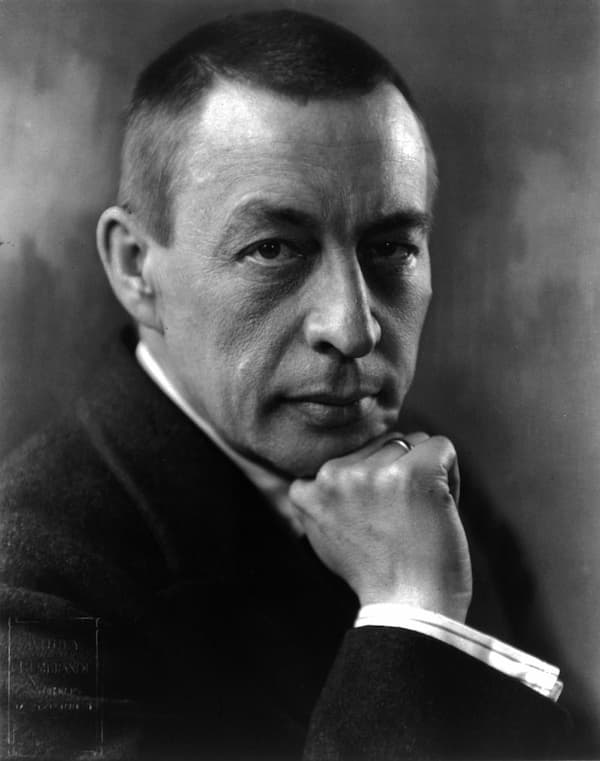
Kubey-Rembrandt Studios: Sergei Rachmaninoff, 1921

Kubey-Rembrandt Studios: Sergei Rachmaninoff, 1921

The Russian Revolution began in February 1917, leading to Tsar Nicholas II’s abdication in March and a provisional government taking power.

During that year’s October Revolution, a Bolshevik insurrection overthrew the provisional government. Once the Bolsheviks took power, a broader civil war broke out.

The conflict impacted Rachmaninoff’s life deeply. In the spring of 1917, he returned from touring to find that his estate had been seized by the Social Revolutionary Party. He departed, disgusted, and vowed never to return.

He and his family moved to Moscow. As tensions rose throughout the fall, he made edits to his first piano concerto with the sound of bullets flying in the background.   

During this tense time, he received an invitation to give a series of recitals in Scandinavia. He accepted because it would give him and his family an excuse to flee the country.

On 22 December 1917, the Rachmaninoffs got on a train in St. Petersburg, crowded with terrified passengers who feared arrest. Fortunately, the officials who met them were kind.

The following day, they arrived at the Finnish border. To get across it, Rachmaninoff, his wife, and two daughters had to travel in an open peasant sleigh during a blizzard.

They arrived in Stockholm on Christmas Eve. Exhausted, the family stayed in their hotel.

After escaping Russia, Rachmaninoff would go on to a celebrated performing career, but he would compose less and less. Later in his life, he would remark, “I left behind my desire to compose: losing my country, I lost myself also.”

Leonard Bernstein Conducts the Historic Berlin Wall Concert – 1989

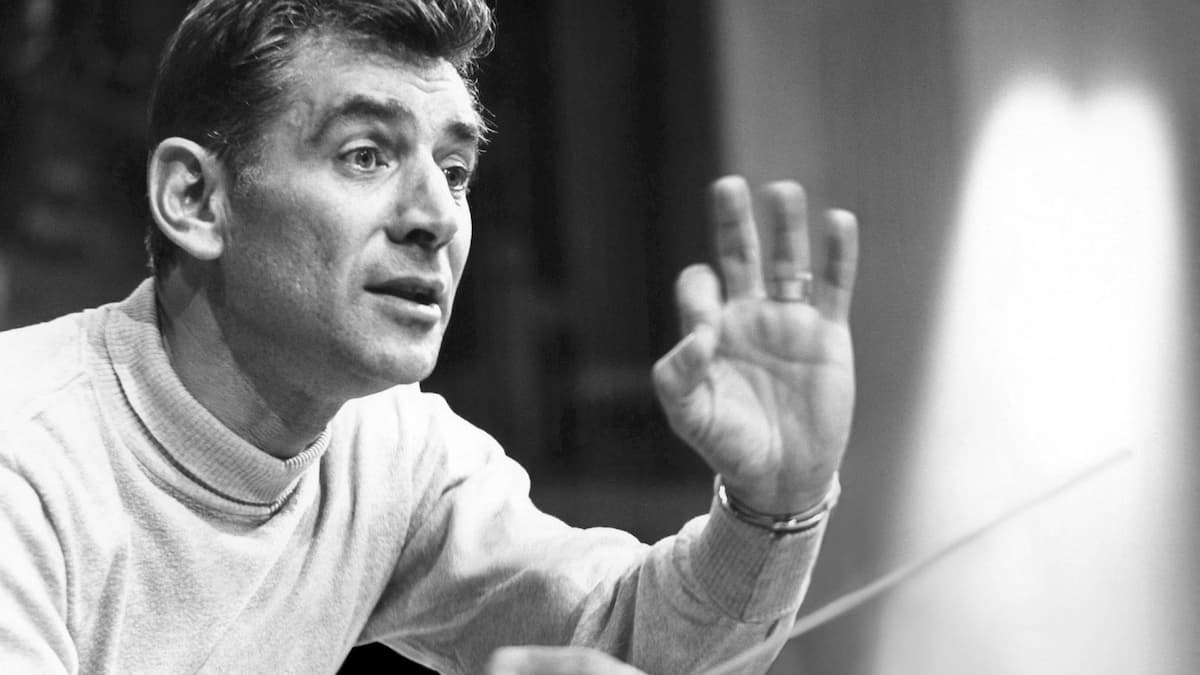
Leonard Bernstein

Leonard Bernstein

In November 1989, the Berlin Wall was taken down, signaling the demise of the so-called Iron Curtain that had hung across Europe for a generation.

Conductor and composer Leonard Bernstein helped to organise a performance at the present-day Konzerthaus Berlin. This venue had been burned out during World War II but was reconstructed in the late 1970s and early 1980s, opening just a few years before this concert.

Musicians from all around the world participated, including men and women from Leningrad, Dresden, New York, London, and Paris.

Together on Christmas Day 1989, they performed a concert celebrating the fall of the Berlin Wall.

Bernstein programmed Beethoven’s Ninth Symphony and changed the Ode to Joy to the Ode to Freedom.

It was broadcast all over the world and became one of the most famous orchestral performances of the twentieth century, seen live by around 100 million viewers. How’s that for a memorable Christmas?