Many composers have turned to music when emotions were too intense for letters or speech to express.
In fact, some of the most iconic pieces in the repertoire began as deeply personal love letters, whether hopeful, obsessive, nostalgic, or even forbidden.
Today we’re looking at seven unforgettable works of classical music that were written as love letters, ranging from Berlioz’s feverish Symphonie fantastique to Janáček’s volatile Intimate Letters.
Together, they reveal how love and romantic obsession have shaped classical music. In 1827, Berlioz became infatuated with Irish actress Harriet Smithson after seeing her perform the role of Ophelia in Hamlet.
She didn’t speak French, and he didn’t speak English, and she – understandably – ignored his repeated requests to meet.
Consequently, the lovelorn Berlioz channeled his unrequited passion into his Symphonie fantastique.
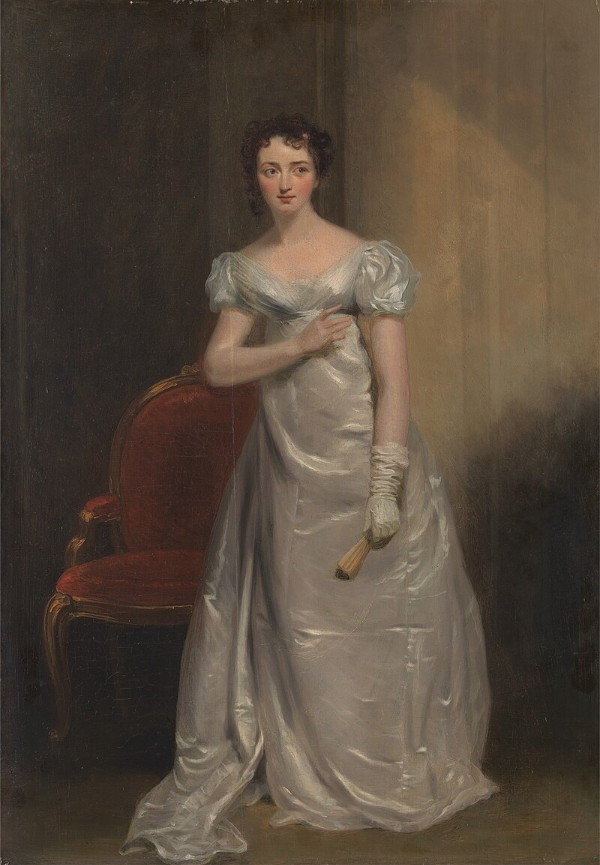
Harriet Smithson
Over the course of five imaginative movements, the symphony’s autobiographical hero experiences a variety of love-induced (and drug-induced) visions.
The dreamy “idée fixe” melody in the opening movement represents the beloved.
In the second movement, that theme is transformed into a waltz at a ball, where she appears, then vanishes.
Next, a peaceful rural scene is disturbed by his doubt about her love.
Opium-fueled nightmares of murdering his beloved and being executed follow, culminating in a macabre “Witches’ Sabbath” where the beloved’s theme returns in a grotesque manner.
This emotionally charged fantasy was Berlioz’s way of immortalising his love and despair.
Six years later, in October 1833, Hector Berlioz ended up marrying Harriet Smithson. The marriage was a nightmare, but that’s a story for another day.
In the late 1830s, composer Robert Schumann was in love with virtuoso pianist Clara Wieck.
Separated by Clara’s disapproving father, Robert poured his emotions into a piano piece called Ruines in early 1836.
Later he added two movements to the piece, creating a new work to help fundraise for a Beethoven monument in Bonn, Germany. It became known as the Fantasie.
But although the outside world might have seen it as a work written to pay tribute to Beethoven, it was still meant to be a love letter. In a March 1838 letter to Clara, Schumann confessed that the Fantasie contained “perhaps the most impassioned music I have ever written.”
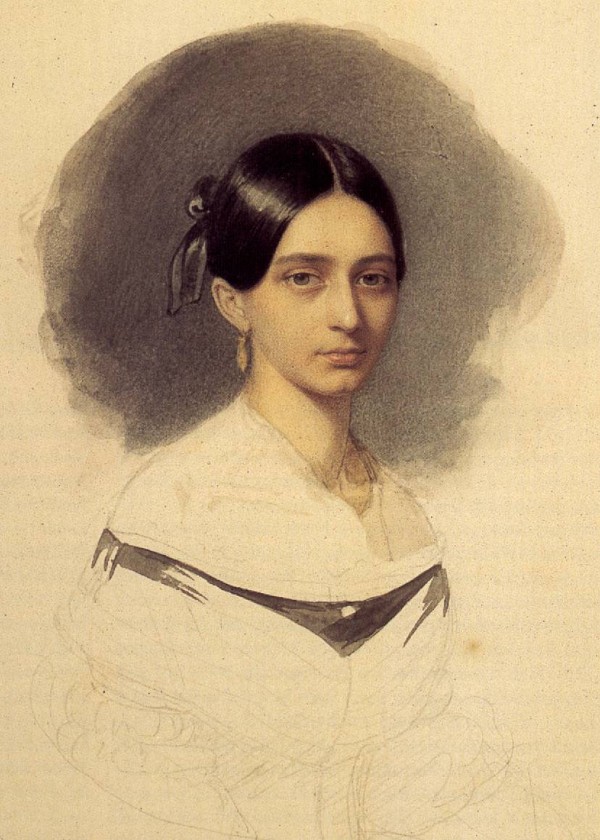
Clara Wieck Schumann
Schumann even embedded a secret message in the music. In the quiet coda of the first movement, he quotes a phrase from Beethoven’s “An die ferne Geliebte” (“To the Distant Beloved”) – “Nimm sie hin denn, diese Lieder” (“Take then these songs, beloved”).
We went into detail about how Robert Schumann’s Fantasie is a love letter to Clara .
The Siegfried Idyll was composed as an intimate musical love letter to Richard Wagner’s second wife, Cosima.
On Christmas morning, 1870, the day after her 33rd birthday, Cosima awoke in their villa to the sound of music rising up the stairs.
Wagner had assembled a 13-player ensemble on the staircase to surprise her with this sweet and tender piece.
The Siegfried Idyll incorporates themes from Wagner’s opera Siegfried (the year before, they had named their infant son Siegfried) and a German lullaby that was meaningful to their family.
Cosima recounted waking to “such music!… Richard came into my room with the children and offered me the score of the symphonic birthday poem. I was in tears.”
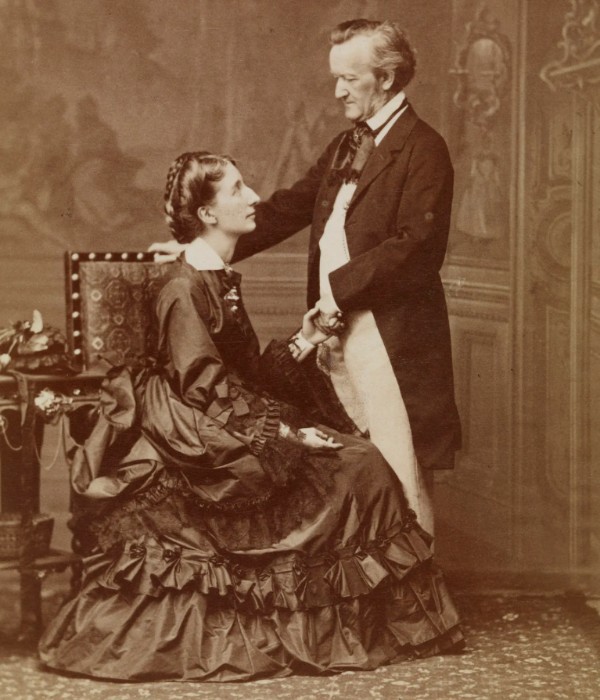
Cosima and Richard Wagner
This piece was initially meant to be a private message of love. Only later did financial need cause Wagner to publish it, in 1878.
Even today, the Siegfried Idyll remains a touching musical portrait of marital love and domestic bliss.
Edward Elgar – Salut d’Amour (“Liebesgruß”), Op. 12 (1888)
Elgar wrote this piece as an engagement present to his fiancée, Caroline Alice Roberts, in the summer of 1888.
Alice was a poet and had given Elgar a poem she wrote (“The Wind at Dawn”) as a token of love. Elgar responded in kind with this musical greeting of love.
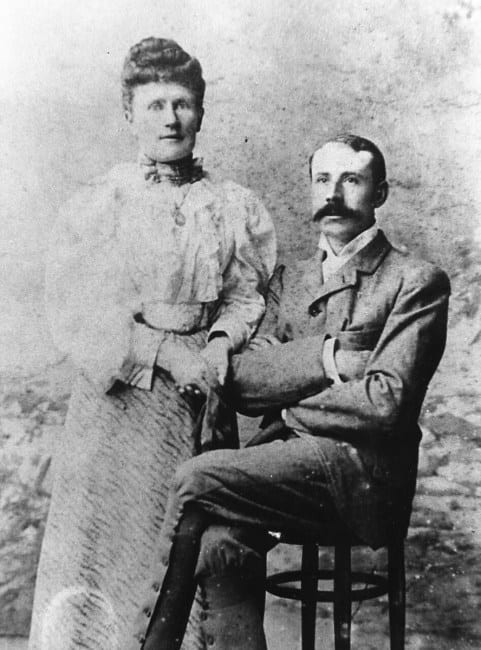
Alice Roberts and Edward Elgar
He originally titled it “Liebesgruß” (“Love’s Greeting”) and dedicated it “à Carice” – a contraction of Caroline Alice.
They would later name their daughter “Carice.”
“Salut d’Amour” is imbued with the gentle charm of a love letter, featuring a singing melody, warm harmonies, and a sweet violin line.
Elgar’s publisher later used the French title Salut d’Amour to appeal to the commercial market, but its true origin remains that private exchange between two lovers.
Johannes Brahms – Intermezzo in A-major, Op. 118, No. 2 (1893)
By 1893, Brahms was in his sixties, and his musical soulmate Clara Schumann had been a widow for nearly four decades.
Both were feeling their age, especially Clara, who was thirteen years his senior.
Brahms’s set of Six Pieces for Piano, Op.118 was published with a dedication to Clara.
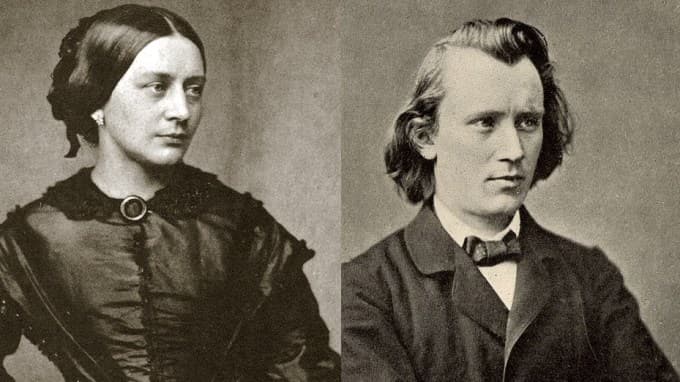
Clara Schumann and Johannes Brahms
The A-major Intermezzo (marked Andante teneramente, or “tenderly”) is often seen as Brahms’s musical love note to her…and maybe a kind of thank-you note, as well as a goodbye.
Its gently arching melody and warm harmonies exude a truly pungent, poignant mix of love and nostalgia.
Alban Berg – Lyric Suite (1926)
For decades, the Lyric Suite was admired as an abstract, modernist masterpiece.
Only in the 1970s did musicologists discover that Berg had actually woven a hidden romantic narrative into the work.
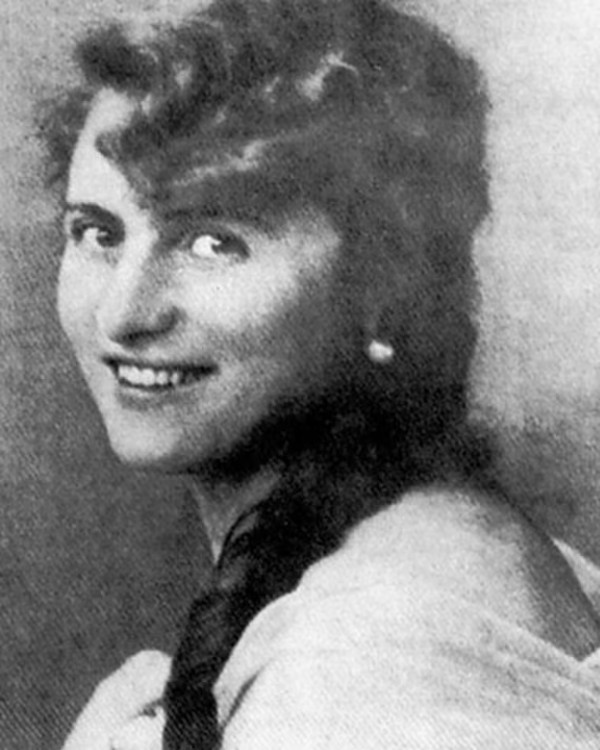
Hanna Fuchs-Robettin © The Guardian
Through the use of cyphers and musical quotes, the Lyric Suite became Berg’s private love letter to his married lover, Hanna Fuchs-Robettin.
He subtitled several movements with suggestive indications: “amoroso” (lovingly), “appassionato” (passionately), “estatico” (ecstatically), and “delirando” (deliriously).
He also embedded both his and Hanna’s initials as musical notes (A–B-flat for “Alban Berg” and B-natural–F for “Hanna Fuchs”) throughout the score.
He even slipped in the famous “Tristan chord” from Wagner’s opera Tristan und Isolde (the quintessential musical symbol of adulterous love) as a reference to their circumstances.
In the final movement, marked Adagio appassionato, Berg quoted a clandestine message: a melody from Zemlinsky’s Lyric Symphony that set the words “Du bist mein eigen” (“You are my own”) – explicitly tying the music to the idea of the lovers’ union.
In short, this is among the most carefully crafted works in the history of classical music, taking on two seemingly opposed identities simultaneously: an expressive atonal string quartet and a secret love letter.
Leoš Janáček – String Quartet No. 2 “Intimate Letters” (1928)
In his sixties, composer Leoš Janáček fell in love with Kamila Stösslová, a married mother who was nearly forty years his junior. Over the last decade of his life, he sent her over seven hundred letters.
This quartet, which Janáček nicknamed “Intimate Letters”, was inspired by his love for her: a love that is, from a modern perspective, deeply uncomfortable to ponder.
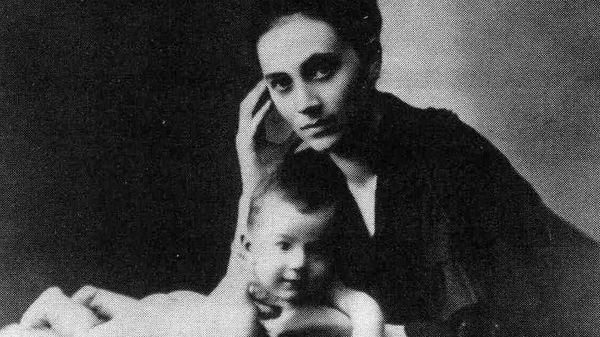
Kamila Stösslová in 1917
Among the unsettling words he wrote to her: “Our life is going to be in this piece… I composed the first movement as my impression when I saw you for the first time… It will be beautiful, strange, unrestrained, inspired… this piece was written in fire.”
The first movement’s surging motif depicts his first glimpse of Kamila (“the chilling mystery of an encounter”), while later movements reference a tender shared moment. Janáček even imagines having a love child with her.
The third movement he called one of the “Love Letters”, and the finale ends in “great longing and fulfilment.”
As disturbing as its backstory may be when seen through a modern lens, Janáček’s “Intimate Letters” quartet is still remarkable for its emotional expressivity and autobiographical inspiration.
Conclusion
From Berlioz’s hallucinatory visions to Janáček’s fevered late-in-life obsession, these love letters in music reveal just how vulnerable composers can be when writing under the influence of romantic and erotic obsession.
Each work distills a private emotion into something listeners can still feel generations later, whether it’s Schumann’s yearning, Wagner’s domestic warmth, or Berg’s encoded passion.
If you want to understand the emotions behind some of classical music’s most famous works, these seven musical love letters are a great place to start!


