Friday, October 30, 2026

TIFFANY is coming to Davao on February 12, 2027

We heard you DAVAO. TIFFANY is coming to Davao on February 12, 2027 8pm at University of Southeastern Philippines(USEP) DAVAO City.😍
A Pre-Valentine Concert for Dabawenyo! ❤️
😘 Don’t miss this chance to see her in person and watch her sing Live of her iconic hits like “All this Time” “If Love is Blind” “I Think We’re Alone Now," and many more . IT'S A DATE DAVAO!!!! SEE U SOON☺️
⏰ Buy Your Tickets Here!👇
Please Call 09163711936 for Tickets & Inquiries and Sponsorships.🙂
Produced by MusicMaster Production
Organized by LR Production & Events
Tiffany Concert Live in DAVAO!❤️
MESSENGER
Tiffany Concert Live in DAVAO!❤️
Send message

If You Love the “Great” Composers, You’ll Love These Women Composers Too

 by Emily E. Hogstad  October 25th, 2026


But women composers were also composing at the same time. They were writing symphonies, tone poems, concertos, operas, and overtures in the same styles, often studying with the same teachers. And yet their work didn’t enter the repertoire in the same way, despite its obvious quality.

Here are seven connections between the orchestral works of great men composers and great women composers.

Louise Farrenc’s Symphony No. 3 (1847)   

Louise Farrenc was born in Paris in 1804.

One of her teachers was pianist Ignaz Moscheles, who taught Felix Mendelssohn and his sister Fanny.

Farrenc also studied with Anton Reicha, Hector Berlioz’s composition teacher – giving her an impressive resume all around.

Louise Farrenc

Louise Farrenc

French composers of Farrenc’s generation were encouraged to focus their highest ambitions on writing theatre music and opera, not symphonies. Even Berlioz, arguably the greatest French composer of his generation, wrote only four, none of them a conventional symphony.

Farrenc wrote three. Her elegant third symphony is perhaps her best, with its dramatic G-minor opening movement and fairy-like scherzo, reminiscent of the writing in Mendelssohn’s overture to A Midsummer Night’s Dream (at 25:15 in the video above).   

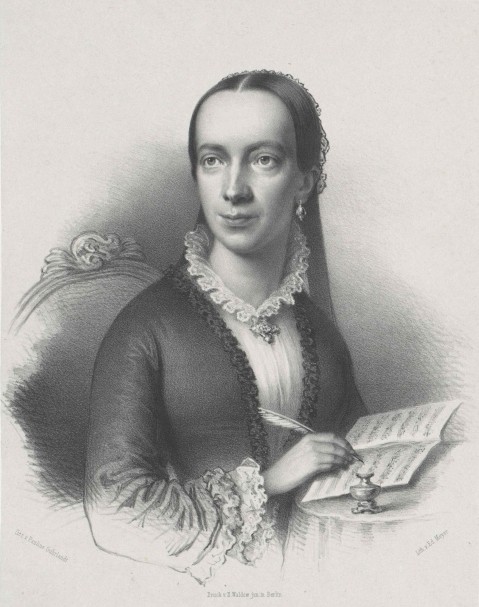
Emilie Mayer was born in 1812 in Germany. A couple of years later, her mother died. Then, in 1840, her father died by suicide on the anniversary of her mother’s burial. He left Emilie enough money to live on, enabling her to do what she wanted with her life.

She had studied music as a young person and pursued it as a devoted amateur throughout her early adulthood. But after her father’s death, she chose to make a new start, throwing herself into studying music at a professional level.

Emilie Mayer

Emilie Mayer

During this time, she studied with music theorist Adolph Bernhard Marx, who was close to the Mendelssohn family and a music critic and colleague of Robert Schumann’s.

Like many Germans of her generation, she was deeply inspired by drama and literature. She later wrote an overture to Faust in 1880, echoing Robert Schumann’s fascination with the great writer and his oratorio-like work Scenes from Goethe’s Faust.

Mayer’s fourth symphony embodies this appreciation for drama and psychological complexity; it’s especially noticeable in the first movement, with its growling trills and timpani rolls.

Augusta Holmès was born in 1847 in Paris to Irish parents. She was a musical child, but her gender kept her from enrolling at the Paris Conservatoire.

She became a fan of Liszt in 1861, when she was just thirteen. At 21, she travelled to Munich to see the premiere of Wagner’s Das Rheingold. While there, she met and befriended Franz Liszt, who was impressed by her work, and they began corresponding by letter.

Like Liszt, she gravitated toward big, bold tone poems over symphonies. Her symphonic poem Andromède follows the story of Andromeda, daughter of a king who is chained to a rock and sacrificed to the sea in the hope that the sea monster Cetus will stop ravaging the coastline. Holmès evokes the wind and waves in her tone poem, as well as the thrill of her eventual rescue.

She also wrote symphonic poems on nationalist themes, such as Irlande (Ireland) and Pologne (Poland), calling to mind Liszt’s Hungarian Rhapsodies.   

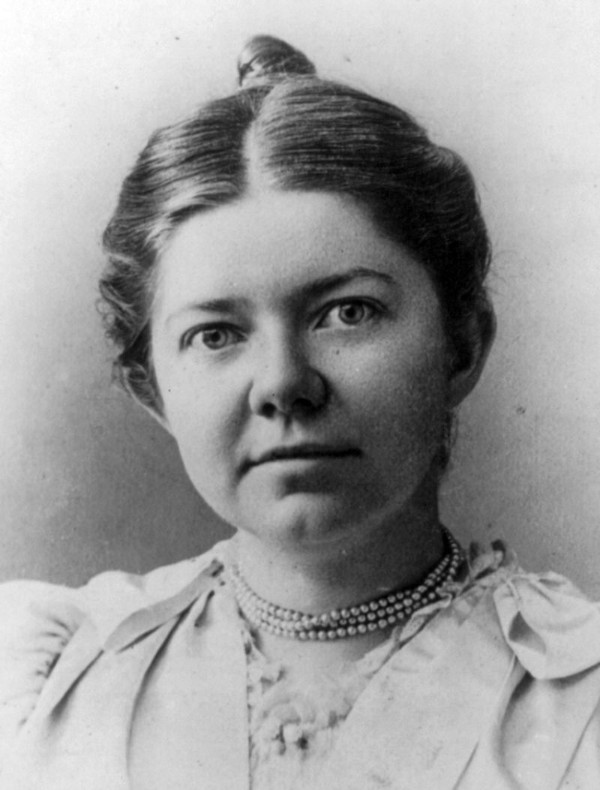
Amy Beach was born in 1867 in New Hampshire. She was an impressive child prodigy, starting to compose at the age of four. She became a piano virtuoso as a teenager and was encouraged to study in Europe to take her career to the next level, but she opted to stay in America.

At 18, she married a wealthy Boston doctor. It would have been insulting to him to make money as a performer while married, so she limited her performances to charity performances and began focusing on composing instead.

Amy Beach

Amy Beach

In November 1892, two months after arriving in America to lead the National Conservatory of Music, composer Antonín Dvořák gave a controversial interview published in the Boston Post, claiming that women could be fine interpreters but not great creators. In December, Amy Beach wrote a rebuttal, citing dozens of great works written by women.

Shortly after this exchange, both composers soon embarked on the defining symphony of their careers.

In January 1893, Dvořák began writing his ninth symphony, later known as the New World; Beach attended the Boston premiere. She heard that Dvořák was clearly inspired by Black folk music and noted it, but, given her ancestry, she felt more drawn to use Gaelic folk music.

Within the year, she began writing her own folk-inspired symphony, which came to be known as the Gaelic Symphony. It demonstrated – pointedly – that Dvořák’s ideas about women’s inability to write music were wrong.   

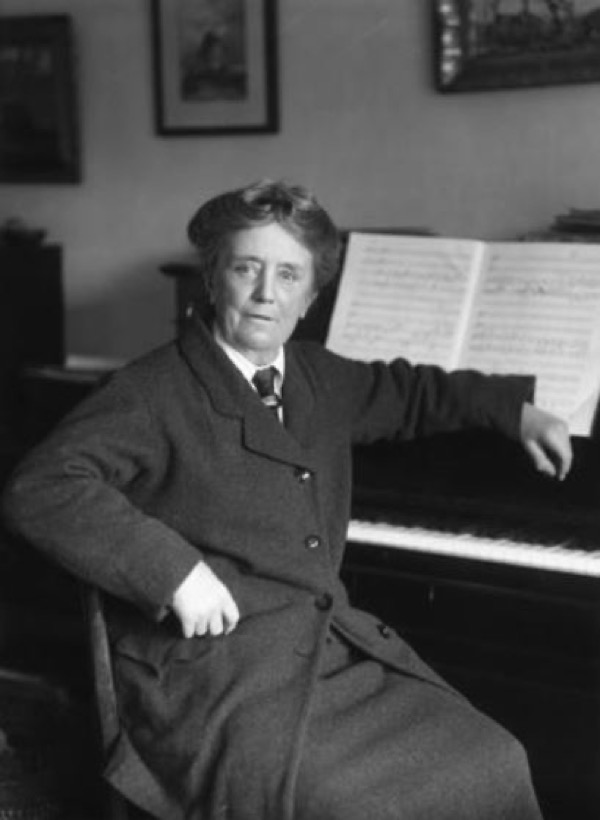
Ethel Smyth was born in London in 1858 and became famous for being a musician and a suffragette. Against her family’s wishes, she left England to study music in Germany as a young woman and eventually became a professional composer.

In 1877, she went to see Wagner conduct, later describing him as “an undersized man with a huge head, apparently in a towering rage from start to finish of the concert.”

Ethel Smyth

Ethel Smyth

Despite that wry description, she took inspiration from Wagner while writing opera. In her creative life, she veered away from stereotypically feminine qualities and toward stereotypically masculine ones, specialising in big, bold writing for brass sections and large, loud orchestral writing.

This emotionally expressive, Wagnerian style was on full display in her 1906 opera The Wreckers.

Ina Boyle was born in Ireland in 1889. She began studying music at home with her governess, then took composition lessons in Dublin.

In 1923, she began studying with British composer Ralph Vaughan Williams. She took sea voyages to see him and also took lessons by correspondence. She kept those letters in a folder labelled “Letters from my beloved teacher, Dr Ralph Vaughan Williams O.M., from 1923 to 1938.”

Ina Boyle

Ina Boyle

She wrote her violin concerto between 1932 and 1933. Its soaring, yearning string lines call to mind her teacher’s celebrated 1910 work for string orchestra, Fantasia on a Theme by Thomas Tallis.

Boyle’s lessons with Vaughan Williams ended when World War II began. She remained in Ireland, isolated from peers, but continued composing daily: a purity of intention and love for the art that few other composers, “great” or not, can match.  Grażyna Bacewicz was born in 1909 in Łódź, Poland, into a musical family. She learned to play piano and violin, and at thirteen, she began composing.

She became known for her violin playing and was named concertmaster of the Polish National Radio Symphony Orchestra in the 1930s.

She also kept composing, experimenting with the neoclassical style then in vogue. In 1932, she took composition lessons with Nadia Boulanger, the same teacher who had taught Igor Stravinsky, then famous for his own neoclassical works.

Grażyna Bacewicz

Grażyna Bacewicz

During World War II, she moved to Warsaw and performed in underground concerts there. In 1944, during the Warsaw Uprising, she fled to Lublin.

The politically restrictive environment in Poland in the mid-1940s was not conducive to aesthetic experimentation, and Bacewicz stuck close to the neoclassical style she’d first embraced in the 1930s.

Her 1948 Concerto for String Orchestra is fiercely confident, driven by propulsive rhythms that recall Stravinsky’s own carefully structured neoclassical works.

However, while Stravinsky’s neoclassicism can sometimes feel detached or ironic, Bacewicz’s approach ultimately comes across as more rooted and emotionally expressive.

Conclusion

All seven of these women created extraordinary work that should never have been dismissed or forgotten.

All of their achievements are remarkable. Farrenc wrote three symphonies in a genre the French establishment tended to dismiss, despite the symphony’s importance to music history generally. Beach not only publicly advocated for women composers but demonstrated their talent in her work. Boyle kept writing music after she was cut off from her teacher and everyone outside of Ireland.

Each of them took the same forms, the same influences, and the same historical moment, and blended those ingredients to make something distinct enough that their works still sound like their own. Listeners deserve to hear everything they did, regardless of whether historians, critics, and gatekeepers label them “great” or not.

Art is a matter of evolution, not revolution


65-26070 years ago, the world completely ignored the passing of one of the most creative and influential composers of the 20th century. Béla Bartók (1881–1945) originally hailed from the Hungarian town of Nagyszentmiklós, now Sînnicolau Mare in Romania, had died in a West Side Hospital in New York City. Throughout his life he was struggling with poor health and constant financial difficulties. His works were almost exclusively neglected—particularly so in his own country—and he was mercilessly ridiculed by the press. Bartók was exceedingly slight in stature, never weighing more than 116 pounds, and sometimes as little as 87. Journalists joked “he looked like a botany professor from a girls college.” Despite his small and fragile body, Bartók was endowed with an iron and uncompromising character. Mild-mannered, he had a keen and penetrating intellect that was interested in everything; science, foreign countries, unusual foods, literature, languages, and especially philology. He lived a simple and modest life, yet refused to ask for favors or engage in shameless self-promotion. The pride and integrity of his personality, however, is ever-present in his music. His personal friend, the pianist, teacher and composer Erno Balogh wrote, “It was part of the Bartók tragedy that not until immediately after his death did his popularity spread to every part of the world.”

Bartók received his initial musical instruction from his mother, with the family moving to Pressburg—currently Bratislava in Slovakia—to further the musical education of the highly talented son. Eventually, Bartók became a student at the Royal Academy of Music in Budapest, graduating in 1903. In collaboration with Zoltán Kodály, Bartók began collecting Hungarian folk music soon after leaving the academy. The joint publication, Hungarian Folk Songs for Voice and Piano appeared in print in 1906, and spawned extended musical and scientific research in the native musical expression of Slovakian, Rumanian and Turkish language groups. In all, Bartók published roughly 6000 folk songs in carefully annotated musical and scholarly editions. Most significantly, however, his study of folk music decidedly influenced his compositional style. By 1908, he had developed a personal style that merged folk influences and turn-of-the century art music styles. Using the piano as a percussion instrument, Bartók pushed the limits of dissonance and tonal ambiguity and infused them with irregular and sweeping natural rhythms.


Always interested in education, Bartók extensively discussed how peasant music can become an integral part of modern music. “We may,” Bartók writes, “take over a peasant melody unchanged or only slightly varied, write an accompaniment to it and possibly some opening and concluding phrases. Another method involves the composer not using a real peasant melody but inventing his own imitation. There is no true difference between this method and the one described above. Yet, there is a third way, when neither peasant melodies nor imitations of peasant melodies are used, but when the music is pervaded by the atmosphere of peasant music. In this case we may say he has completely absorbed the idiom of peasant music, which has become his musical mother tongue.” Bartók took his explanations to heart and produced works with pounding motoric rhythms that nevertheless breath the spirit of peasant culture. This compositional intensity and angularity of musical expression is maintained in the brutal pantomime The Miraculous Mandarin of 1919, and the two Violin Sonatas of 1921 and 1922, respectively, in which Bartók’s music approaches the peak of its chromatic intensity.

With war looming on the European Continent, Bartók and his wife Ditta reluctantly immigrated to the United States in 1940. They settled in New York City but found life rather difficult. Bartók’s mature musical language, which integrated folk idioms within strict contrapuntal forms, simply did not resonate with the American public. Since there was little interest in his music, the couple lived on money received from a meager research fellowship from Columbia University, and from charitable handouts from his friends and supporters. Concordantly, Bartók’s health gradually started to fail. For years he battled bouts of fever and exhaustion, but doctors were unable to diagnose the underlying medical condition. By the time he was diagnosed with leukemia in April 1944 it was too late for treatment. Bartók had stopped composing altogether when he received a commission from Serge Koussevitzky. The Concerto for Orchestra was premièred by the Boston Symphony Orchestra in December 1944, and quickly became Bartók’s most popular work. Subsequently, Yehudi Menuhin commissioned a Sonata for Solo Violin, and Bartók started work on his Piano Concerto No. 3 and his Viola Concerto. On 26 September 1945 he succumbed to leukemia, and only ten people attended the funeral. In the 1980’s, at the request of the Hungarian government and his surviving family, Bartók‘s remains were exhumed and transferred back to Budapest for burial.

Monday, October 26, 2026

The Passionate Stories of Composers Starstruck By Their Wives

 by 

A performance, a chance meeting, a dinner party, or even a single conversation could leave these men completely captivated – and sometimes they moved fast between fascination, courtship, and marriage.

What makes these stories especially fascinating is how often the women who captured their attention were great artists themselves. Actresses, singers, pianists, sculptors, and composers became not only their wives but also creative collaborators, muses, interpreters, and sometimes accomplished artists in their own right.

Here are some remarkable composer marriages that feature especially starstruck husbands.

Composers Who Married Women They Fell In Love With at First Sight

Hector Berlioz and Harriet Smithson, 1833

Berlioz’s Symphonie fantastique, 1830  

The most famous example of a composer falling in love at first sight is surely French composer Hector Berlioz.

In 1827, the 23-year-old composer watched Irish actress Harriet Smithson play Ophelia with an English-language touring theatre troupe. Her craft magnetised him – along with the rest of Paris.
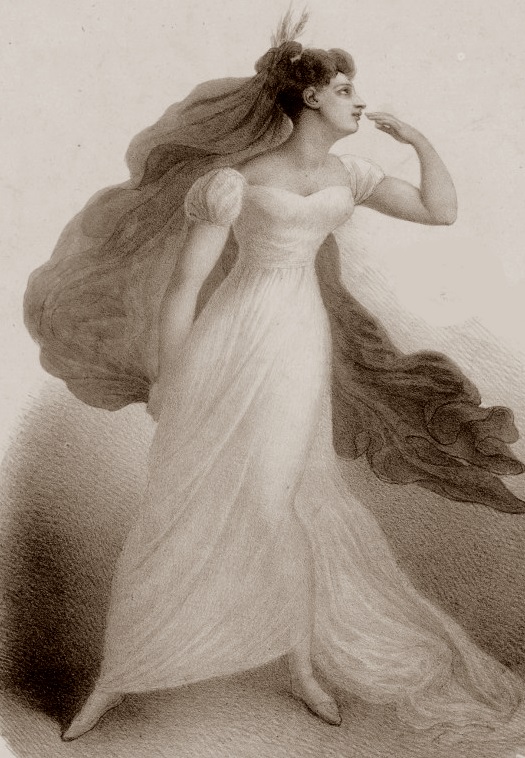
Martinet rue du Coq St Honoré: Harriet Smithson as Ophelia in Hamlet, 1827–1833 (Bibliothèque nationale de France, département Musique)

Martinet rue du Coq St Honoré: Harriet Smithson as Ophelia in Hamlet, 1827–1833 (Bibliothèque nationale de France, département Musique)

He began sending her love letters in French (she didn’t – and couldn’t – answer), and even moved in across the street from her lodgings to monitor her comings and goings.

That spirit of unrequited obsession found its way into his 1830 Symphonie Fantastique, a programmatic symphony about a lovesick artist who descends into a drug-fueled reverie.
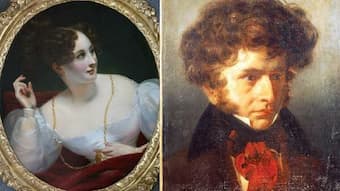
Hector Berlioz and Harriet Smithson

Hector Berlioz and Harriet Smithson

His obsession with Smithson inspired the use of a technique known as the idée fixe – a theme heard in various guises throughout the work, standing in for the idea of the beloved.

Understandably, Smithson initially stayed away from Berlioz for quite a while. But after some time had passed, and she attended a performance of the symphony, she became intrigued by the composer who had written such bold music about her. They began dating and eventually married in 1833.


Gustav Mahler and Alma Schindler, 1902

Mahler’s Adagietto from Symphony No. 5, 1901–1902   

Gustav Mahler had a similar epiphany in early November 1901 upon meeting Alma Schindler, a 22-year-old aspiring composer at a Viennese dinner party. They got into a quick-witted sparring match about music and beauty.

Although he was nearly twice her age, his physical attraction to her was overwhelming. At this time, Mahler was arguably the most famous musician in Vienna, serving as the music director at the court opera, and he invited Alma and her family to visit him there the following day.
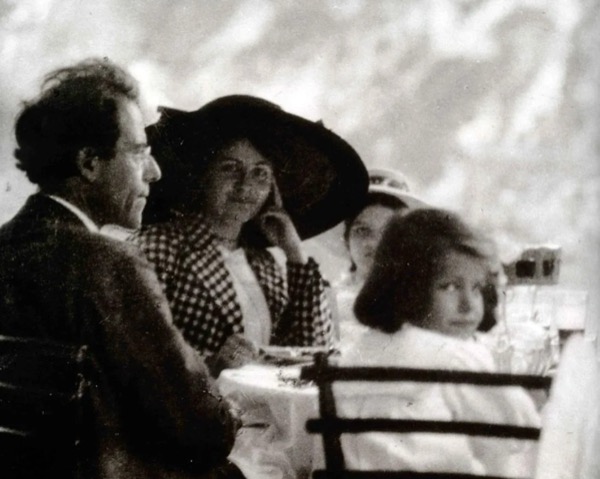
Alma and Gustav Mahler with their children

Alma and Gustav Mahler with their children

They’d met on 7 November 1901. Less than three weeks later, he was talking to her as if the question of their getting married was already settled.

They announced their engagement on 27 December and began sleeping together shortly afterwards. She became pregnant quickly, and they married on 9 March 1902.


Felix Mendelssohn and Cécile Jeanrenaud, 1837

Mendelssohn’s Paulus, 1836     

Felix Mendelssohn’s love thunderbolt was less scandalous than Berlioz and Mahler’s – but no less impactful.

On 4 May 1836, while visiting Frankfurt, he stepped in to conduct a choir for a friend who had fallen ill. There he was introduced to soprano Cécile Jeanrenaud, the young unmarried daughter of a pastor.
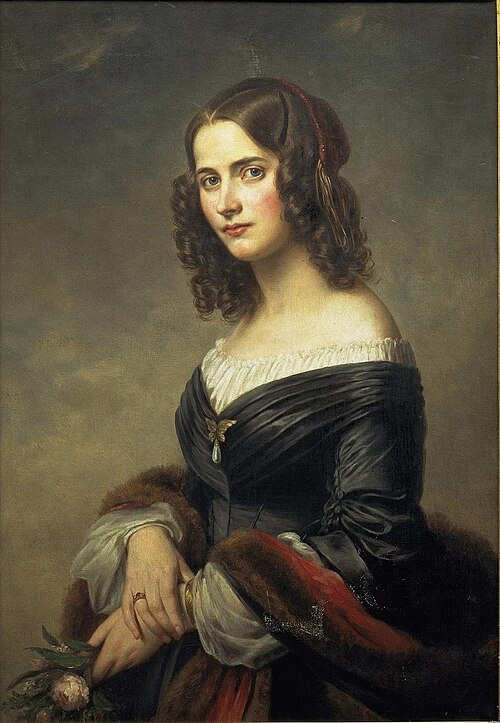
Cécile Charlotte Sophie Mendelssohn Bartholdy (née Jeanrenaud, 1817–1853)

Cécile Charlotte Sophie Mendelssohn Bartholdy (née Jeanrenaud, 1817–1853)

He was deeply taken with her and could not get her out of his mind. A couple of days later, he left Frankfurt for Düsseldorf to oversee the premiere of his oratorio Paulus. After that, he travelled to the Dutch seaside town of Scheveningen, preoccupied by thoughts of Cécile and weighing whether to return to Frankfurt.

On 7 June 1836, he did. Three months later, he proposed to her while on a picnic. She said yes, and they were married in March of 1837.


Composers Who Married a Prominent Artist

Robert Schumann and Clara Wieck, 1840

Robert Schumann’s Widmung, 1840  

In 1828, 17-year-old Robert Schumann, newly arrived in Leipzig to study law, saw 8-year-old piano prodigy Clara Wieck perform at a house concert.

He was deeply impressed by what he saw – so much so that he ultimately gave up studying law and moved in with Clara’s father, Friedrich, to study piano with him.

He and Clara became friends in between her international tours, as he found his voice as a musician and ultimately composer. Eventually, they fell in love.
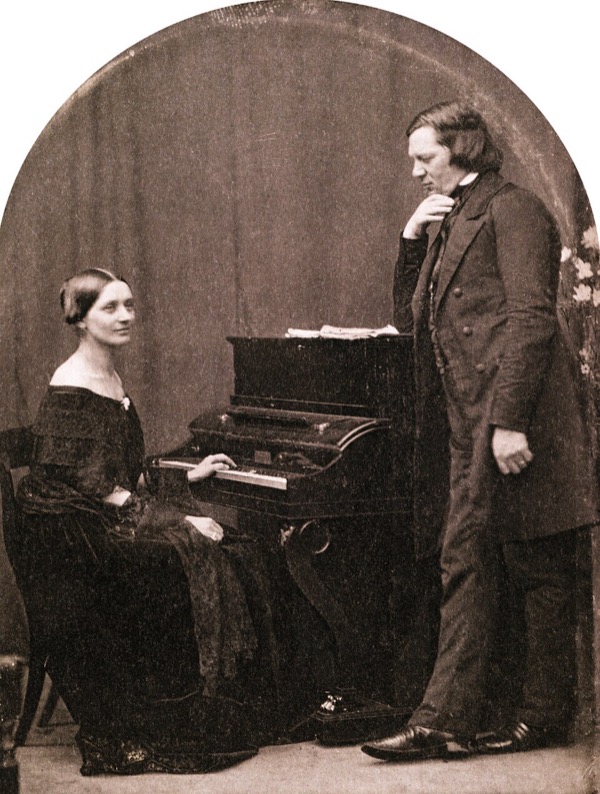
Robert and Clara Schumann, daguerreotype

Robert and Clara Schumann, daguerreotype

Friedrich, however, fought against the match – ferociously. The family ended up in court. They finally achieved legal permission to wed, and on 12 September 1840, the day before her 21st birthday, they were married.

Clara went on to become one of the great pianists of the 19th century, integral to both Schumann’s creativity and the promotion of his work after he died in 1856.


Carl Nielsen and Anne Marie Brodersen, 1891

Nielsen’s Symphony No. 1, 1891–1892  

On 2 March 1891, while Danish composer Carl Nielsen was studying in Paris, he met a sculptor and fellow Dane named Anne Marie Brodersen. He was intrigued by her from the start, writing in his diary that she was “really quite pretty.” They went out to the Moulin Rouge, where they danced together past two in the morning.
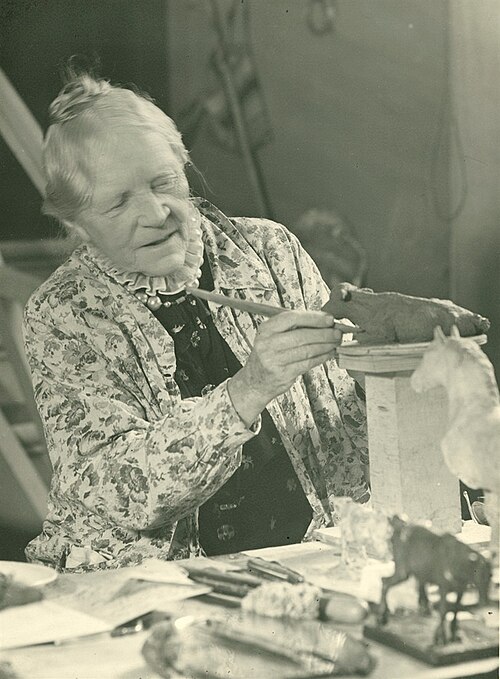
Anne Marie Carl-Nielsen working on a sculpture

Anne Marie Carl-Nielsen working on a sculpture

Eighteen days later, they “considered themselves married.” They had a party celebrating their union on 10 April and made it legal on 10 May in Florence during a whirlwind Italian honeymoon.

Unlike many women artists of her generation, she continued working even after her marriage. She became one of the most prominent Danish sculptors of the early 20th century.

That career strained their relationship, and they endured several periods of separation. (Nielsen even had a child out of wedlock with another woman that she never found out about.) They ultimately reconciled…even if they never rediscovered the emotional intimacy they’d once enjoyed.

Richard Strauss and Pauline de Ahna, 1894

Strauss’s “Morgen”, 1894      

Richard Strauss met soprano Pauline de Ahna in Munich in 1887. He was 23 – just over a year older than her – but despite his youth, he’d already won a position as music director of the Bavarian State Opera, and he began giving her vocal lessons.

They worked together professionally for years. In 1894, she was cast in the premiere of Strauss’s first opera, Guntram.
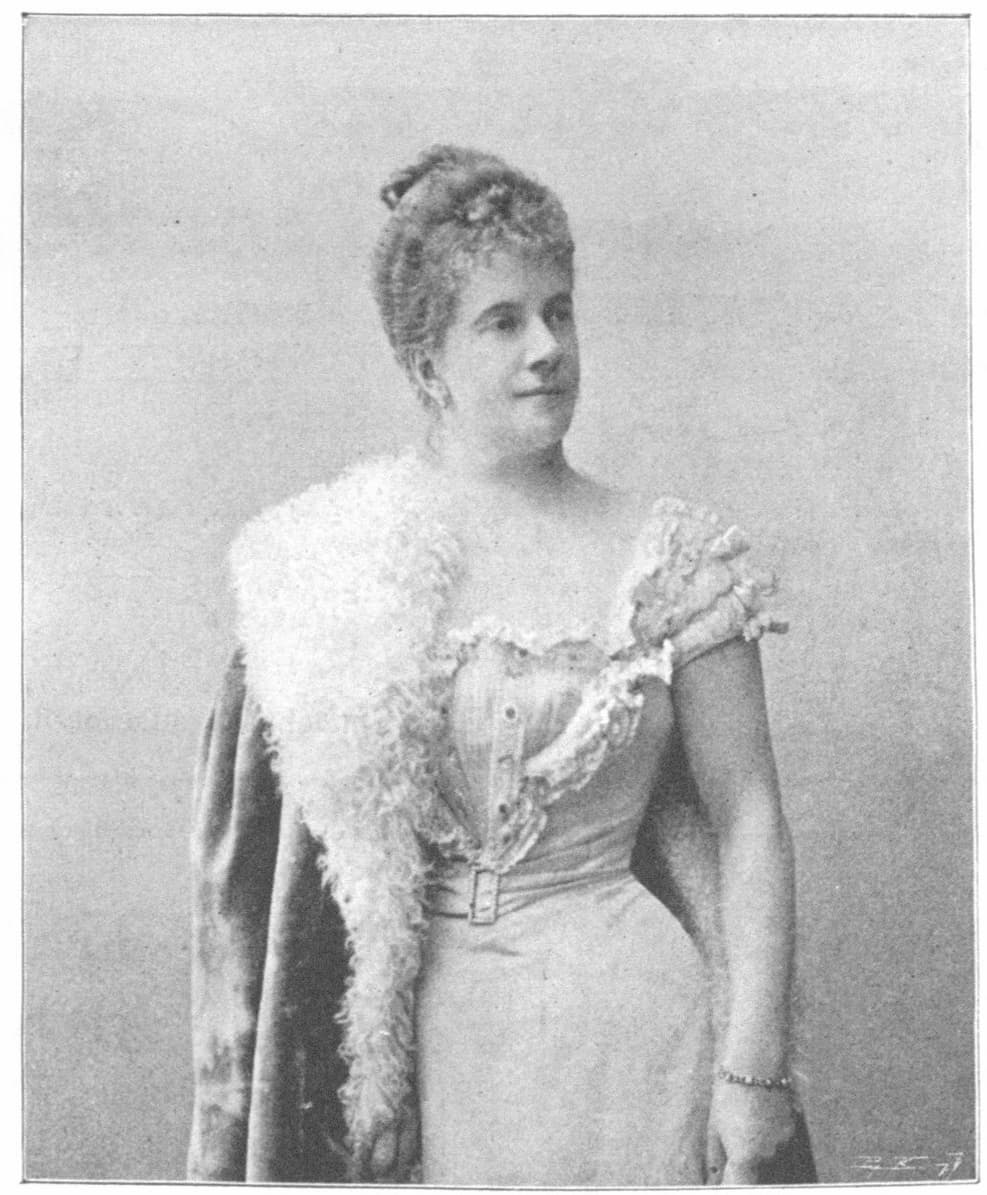
Pauline de Ahna

Pauline de Ahna

During one rehearsal that May, he corrected the tenor multiple times, as de Ahna grew increasingly irritated. Eventually she started screaming at Strauss that she wanted to be interrupted, too – and threw her vocal score at him before storming offstage. He excused himself to confer with her, then returned to the podium to announce that they were engaged.

Their marriage was long and happy. Although she retired from the operatic stage in 1897 after the birth of their only son, she continued performing his works, inspiring many of them, until 1948’s Four Last Songs.


Olivier Messiaen and Claire Delbos, 1932, and Yvonne Loriod, 1961

Messiaen’s Thème et variations, 1932   

Over the course of his life, composer Olivier Messiaen married two great artists.

He met his first wife, violinist and composer Claire Delbos, in the 1920s while studying at the Paris Conservatoire. They became recital partners, fell in love, and married in 1932.

Her reproductive health suffered during the marriage, and she had a series of miscarriages; only their son Pascal, born in 1937, survived.
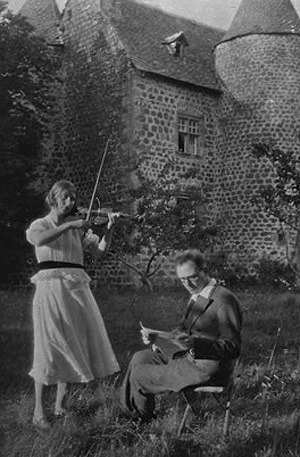
Claire Delbos and Olivier Messiaen in Neussargues-Moissac

Claire Delbos and Olivier Messiaen in Neussargues-Moissac

In 1949, when she was 43, her recovery from a hysterectomy went wrong, resulting in a cerebral infection that in turn caused severe brain damage and amnesia. She lived the final ten years of her life in an institution.

In the early 1940s, Messiaen taught a talented pianist named Yvonne Loriod and even wrote works for her to play. Their intense creative relationship raised eyebrows and eventually evolved into something romantic – but, being devout Catholics, they remained celibate, even after Delbos’s institutionalisation. They only married in 1961, two years after Delbos’s death.
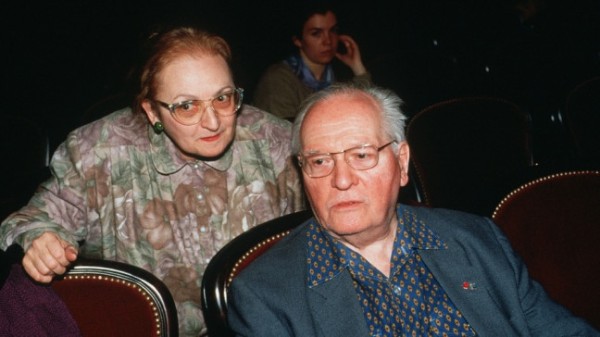
Yvonne Loriod and Olivier Messiaen

Yvonne Loriod and Olivier Messiaen

Loriod remained Messiaen’s primary inspiration and greatest interpreter until he died.


Conclusion

Regardless of what ultimately happened in their relationships, all these composers had early encounters with their wives that proved to be more than a fleeting attraction.

In many cases, the woman who initially captivated them became deeply intertwined with their creative lives. Harriet Smithson inspired one of the most famous musical portraits of romantic obsession; Clara Wieck became an essential interpreter of Robert Schumann’s music; Pauline de Ahna championed Richard Strauss’s works for decades; and Yvonne Loriod ultimately became Olivier Messiaen’s greatest interpreter.

Of course, love at first sight did not guarantee an uncomplicated marriage. Some of these relationships endured happily for decades, while others were marked by separation, infidelity, illness, or profound personal hardship.

But they all began with the same extraordinary initial experience: a composer encountering a talented woman who was impossible to forget.

For more of the best in classical music, sign up for our E-Newsletter