Thursday, July 21, 2022

Dolphins behave better after listening to Bach and Beethoven, study finds

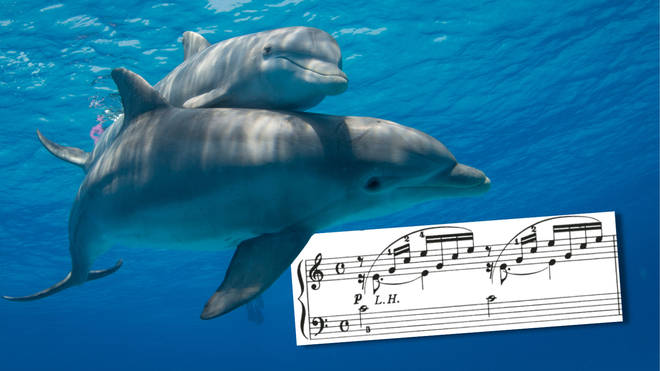
Bottlenose dolphins enjoyed listening to Bach as part of the study

Bottlenose dolphins enjoyed listening to Bach as part of the study. Picture: Getty

By Sophia Alexandra Hall, ClassicFM

Beethoven’s ‘Almost a Fantasy’ and ‘The Swan’ by Saint-Saëns are just some of the pieces of classical music enjoyed by Italian dolphins involved in this latest scientific study. 

Most scientists agree that dolphins are very intelligent creatures. The species have demonstrated in multiple studies that they are quick learners, empathetic, self-aware, and great at problem solving.

But a recent study published in the journal Applied Animal Behaviour Science has now proved that dolphins are also music lovers, and that classical music specifically could improve social behaviours of the aquatic animals.

Researchers at the University of Padua in Italy found that playing classical music resulted in the dolphins showing more interest in each other, giving more gentle touches and swimming in synchrony for longer.

Eight dolphins in the eastern beach-front city of Riccione, Italy, were played 20 minutes of classical music a day via an underwater speaker for seven sessions. The aquatic mammals heard a number of pieces of classical music including Bach’s Prelude BWV 846, Grieg’s ‘Morning Mood’ from Peer Gynt, Debussy’s Reflets dans l’eau, Beethoven’s Almost a Fantasy, and ‘The Swan’ from The Carnival of the Animals by Saint-Saëns.


Bottlenose Dolphins (Tursiops truncatus) in the Caribbean Sea
Bottlenose Dolphins (Tursiops truncatus) in the Caribbean Sea. Picture: Getty

On other days, the dolphins were played the sound of rainfall for 20 minutes (auditory stimulus), given floating toys to play with for 20 minutes (an already known form of enrichment for the animals), or shown natural environments on television screens for 20 minutes (visual stimulus).

The group of dolphins was made up of five female and three male dolphins between the ages of five and 49 years old. Three of these dolphins, which are housed at a dolphinarium in Riccione, were born in the wild.

The researchers found that only the music had a long-lasting positive effect on the dolphins’ behaviour. As only classical music was used, the researchers admitted the results may not be specific to just the classical genre, but that classical music could be particularly useful when improving social behaviours in dolphins.

The use of music was also a particularly useful tool for when the animals were under stress or in situations that could lead to increased conflicts.

 Lead researcher Dr Cécile Guérineau said the way the dolphins acted, suggested they were showing happiness.

“This system is linked to reward, social motivation, pleasure and pain perception,” explained Dr Guérineau. “Activation of opioids receptors is correlated with a feeling of euphoria. [And] we know that in a wide range of animals – from mammals, monkeys, dogs, rats etc, to non-mammals, birds – endorphins, i.e. one type of endogenous opioids, are related to social bonding.

“Dolphins may also be able to perceive rhythm because they are a vocal-learning species. It may be that, similar to how dancing at a party makes us feel good and helps people to bond, when dolphins synchronize to a beat, they also feel good and connect with their fellow swimmers.”


GIRL FROM IPANEMA


The Girl From Ipanema
Antônio Carlos Jobim, Stan Getz, ...
Olha que coisa mais linda
Mais cheia de graça
É ela menina
Que vem e que passa
Num doce balanço, a caminho do mar
Moça do corpo dourado
Do sol de Ipanema
O seu balançado é mais que um poema
É a coisa mais linda que eu já vi passar
Ah, porque estou tão sozinho
Ah, porque tudo é tão triste
Ah, a beleza que existe
A beleza que não é só minha
Que também passa sozinha
Ah se ela soubesse
Que quando ela passa
O mundo sorrindo
Se enche de graça
E fica mais lindo
Por causa de amor
Tall and tan and young and lovely
The girl from Ipanema goes walking
And when she passes
Each one she passes goes, "Ah"
When she walks, she's like a samba
That swings so cool and sways so gently
That when she passes
Each one she passes goes, "Ah"
Oh, but he watches her so sadly
How can he tell her he loves her?
Yes, he would give his heart gladly
But each day, when she walks to the sea
She looks straight ahead, not at he
Tall, and tan, and young, and lovely
The girl from Ipanema goes walking
And when she passes, he smiles
But she doesn't see
Oh, but he sees her so sadly
How can he tell her he loves her?
Yes, he would give his heart gladly
But each day, when she walks to the sea
She looks straight ahead, not at him
Tall, and tan, and young, and lovely
The girl from Ipanema goes walking
And when she passes, he smiles
But she doesn't see
She just doesn't see
No, she doesn't see
But she doesn't see
She doesn't see
No, she doesn't see
Quelle: Musixmatch


Cole Porter song EVERYTIME WE SAY GOODBYE and his life and music


Cole Albert Porter (June 9, 1891 – October 15, 1964) was an American composer and songwriter. Many of his songs became standards noted for their witty, urbane lyrics, and many of his scores found success on Broadway and in film.

Born to a wealthy family in Indiana, Porter defied his grandfather's wishes and took up music as a profession. Classically trained, he was drawn to musical theatre. After a slow start, he began to achieve success in the 1920s, and by the 1930s he was one of the major songwriters for the Broadway musical stage. Unlike many successful Broadway composers, Porter wrote the lyrics as well as the music for his songs. After a serious horseback riding accident in 1937, Porter was left disabled and in constant pain, but he continued to work. His shows of the early 1940s did not contain the lasting hits of his best work of the 1920s and 1930s, but in 1948 he made a triumphant comeback with his most successful musical, Kiss Me, Kate. It won the first Tony Award for Best Musical.

Porter's other musicals include Fifty Million Frenchmen, DuBarry Was a Lady, Anything Goes, Can-Can and Silk Stockings. His numerous hit songs include "Night and Day", "Begin the Beguine", "I Get a Kick Out of You", "Well, Did You Evah!", "I've Got You Under My Skin", "My Heart Belongs to Daddy" and "You're the Top". He also composed scores for films from the 1930s to the 1950s, including Born to Dance (1936), which featured the song "You'd Be So Easy to Love"; Rosalie (1937), which featured "In the Still of the Night"; High Society (1956), which included "True Love"; and Les Girls (1957).


Wednesday, July 20, 2022

"Somewhere In Time" - Complete Soundtrack


Track List:
00:01 Somewhere In Time 
03:03 Old Woman  
05:55 Journey Back In Time 
10:25 Day Together 
16:32 Rhapsody/Paganini 
19:24 Is He The One 
20:15 Man Of My Dreams 
24:21 Return To Present 
28:33 Theme (Roger Williams)


John Dunbar Theme - Dances with Wolves


0:02 / 4:07


John Dunbar Theme - Dances with Wolves
5,455,107 views  Jun 26, 2011  John Barry composed many pieces and this is one of his most beautiful.  Sweeping and magnificent to match the cinematography.  This is my favourite version of the piece  performed by the band of  Royal Scots Dragoon Guards.

Out Of Africa | Soundtrack Suite (John Barry)


Out Of Africa | Soundtrack Suite (John Barry)
10,227,972 views  Mar 12, 2012  Original Motion Picture Soundtrack (1985). Composed and Conducted by John Barry.

Please note that the rights belong to the owner. Support the publishers, if possible, to get the full listening experience.

Get the Soundtrack:
Get the Movie:

Music Awards:
- Academy Award - Best Original Score

Playlist:
-00:00 = "Main Title (I Had A Farm In Africa)"
-02:53 = "Safari"
-04:36 = "Karen's Journey / Siyawe" (Siyawe: Trad. African Song)
-08:16 = "Flying Over Africa"
-09:52 = "If I Know A Song Of Africa (Karen's Theme III)
-11:36 = "End Title (You Are Karen)"

Music Source:
MCA Records MCD 03310/DMCF 3310


Monday, July 18, 2022

Make Friends With the Music

by 

© Jordan Mixson on Unsplash

Too often it seems that we view learning, studying, practising and performing music as a kind of fight. People talk about “doing battle with Beethoven” or “fighting the fear” (of performing) as if one must take up arms against unseen, powerful forces.

Beethoven: Violin Concerto in D Major, Op. 61 – III. Rondo: Allegro

It’s true that learning new repertoire can be a Herculean task, and practising can feel like a form of captivity, the same page of music confronting one day after day, coupled with the sense that one has hardly moved forward from the previous day’s practising. It is also true that in order to learn any repertoire properly, and deeply, we must spend inordinate amounts of time sweating the small stuff – all the details in the score, the directions and signposts the composer gives us to navigate the keyboard and produce a coherent path of sound to take the listener on a unique journey into the composer’s own inner landscape, while also to enabling us to make our own interpretative choices about how we will perform the music.

There is no alternative to the hard graft of learning new work in depth: working, with pencil and score, cutting through the music to the heart of what it is about. Living with the piece to find out what makes it special, studying style, the contextual background which provides invaluable insights into the way it should be interpreted and performed. The endless striving to find the emotional or spiritual meaning of a work, its subtleties and balance of structure, and how to communicate all of this to an audience as if telling the story for the very first time.

Studying, practising performing and ultimately sharing music, the musician’s “work”, should not feel like a battle or a mountain summit that must be conquered. I know many musicians, professional and amateur, who have personal strategies to prevent this sense of struggle. Spending time with the score away from the instrument can be particularly helpful, familiarising the shape and architecture of the music on the page, and imagining the sound in one’s head, without the added distraction of the geography of the piano keyboard, for example. For very complex music, I like to leave the score, or copies of the score, around the house – on the dining table, by my bedside, so that I see the score regularly, often many times during the day. When I come to place it on the music desk, it already feels comfortable, even if I have yet to touch the piano’s keys.

Practising is an act of doing, creating, living with the music. It defines who we are as musicians and gives us a reason for being. A positive, open minded approach to practising can remove the feelings of toil and travail. Making friends with the music brings joy, pleasure and excitement to practising. We should live and breathe our work, beginning every practise session with the question “What can I do that’s different today?”.

This excitement and affection for our music is very palpable when we perform – audiences sense and appreciate it – and it brings the notes to life with vivid colour and imagination.