Friday, September 11, 2026

6 Violin-Like Instruments From Around the World

The violin is one of the most recognisable instruments in the world – but it is far from the only instrument of its kind.

Across cultures and centuries, musicians have developed bowed string instruments that share the violin’s basic logic: strings, a resonating body, and a bow.

Some of these instruments predate the violin; others were built to solve problems the violin couldn’t. All of them are worth knowing.

Here are six violin-like instruments from around the world.

Stroh Violin  

The Stroh violin was invented by electrical engineer Johannes Matthias Augustus Stroh in 1899.

Unlike a traditional violin, it replaces the wooden body with a metal diaphragm and attached horn, which amplify the sound and project it outward.
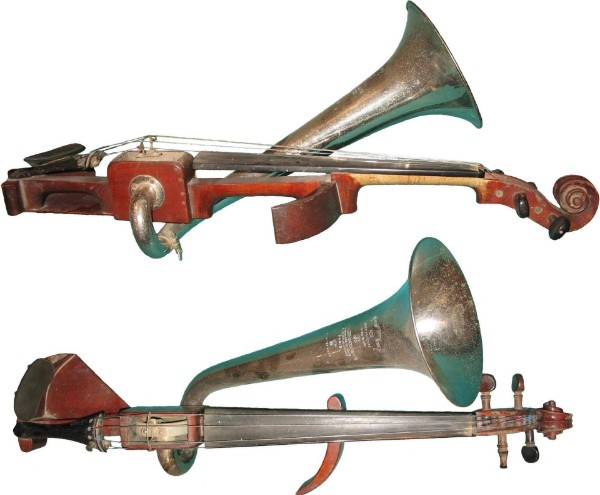
Stroh violin or Horn-violin

Stroh violin or Horn-violin

This made it perfect for the early recording era, when it was difficult for recording equipment to capture the sound of acoustic string instruments.

However, it was more expensive to manufacture than a traditional violin, and once recording technology advanced, the instrument became obsolete.

The Stroh violin is largely forgotten today, but is still admired as a historical curiosity.

Electric Violin   

Electric violins are violins equipped with an electronic pickup that transmits sound to an amplifier.

The pickup is attached to the bridge, body, or fingerboard.

Electric violins don’t need to hew to traditional designs, and many don’t. It’s common to see instruments with five or more strings, frets, or carbon fibre bodies – enough differences to differentiate the electric violin as a separate instrument from its acoustic counterpart.
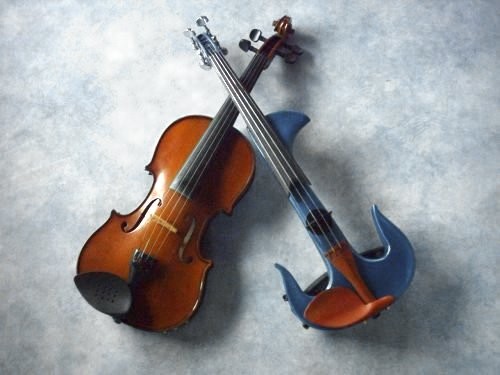
A traditional acoustic violin and a modern electronic violin from Marc Capuano

A traditional acoustic violin and a modern electronic violin from Marc Capuano

The electric violin’s roots stretch back to the 1920s. Jazz violinist Stuff Smith (1909-1967) was among the first to bring the electric violin to prominence. By the 1930s, they were being sold commercially.

Apache Fiddle  

The Apache are indigenous people native to the southwestern United States.

One of their musical instruments is called the “tsii’ edo’a’tl”, which, translated literally, means “wood that sings.” However, it is better known in English as the Apache fiddle.
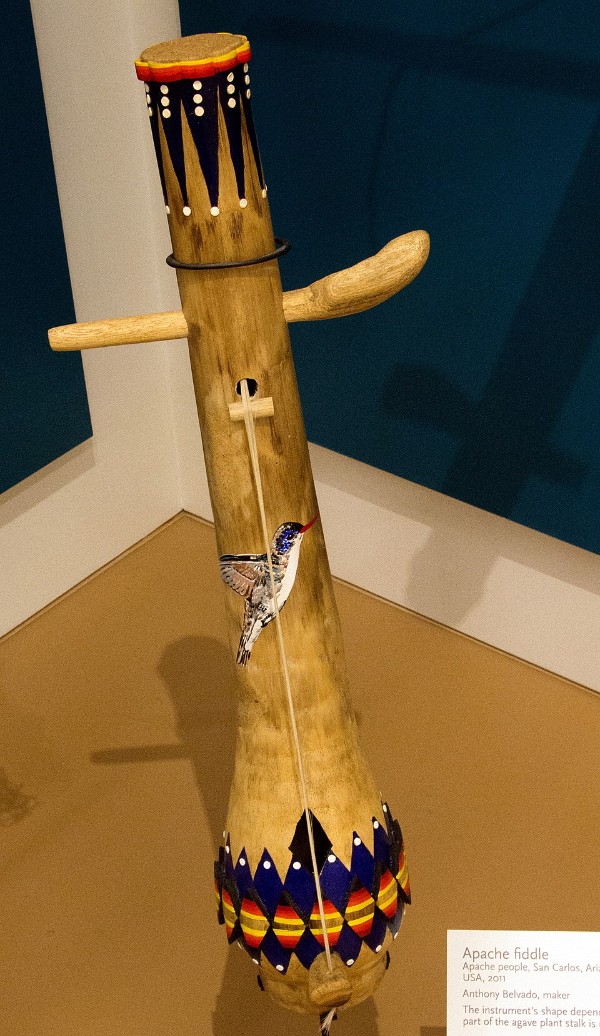
Arizona Apache fiddle, from the Musical Instrument Museum - Phoenix, Arizona

Arizona Apache fiddle, from the Musical Instrument Museum – Phoenix, Arizona

The Apache fiddle is made from the stem of a thick-stalked plant, such as agave.

One or two strands of natural material – such as horsehair – serve as strings. The player stops the strings with their fingers and draws a bow across them.

To create more friction between the string and the bow, the player might apply sticky pine pitch onto the bow – similar to how rosin is used for violin bows.

Historically, the instrument is known for its role in Apache courtship rituals.

Pochette   

We wrote a whole article on the pochette here: https://interlude.hk/the-violin-in-your-pocket/

Pochettes (French for “pockets”) were miniature violin-like instruments that first appeared in the 1400s. They were favoured by dancing masters due to their portability.
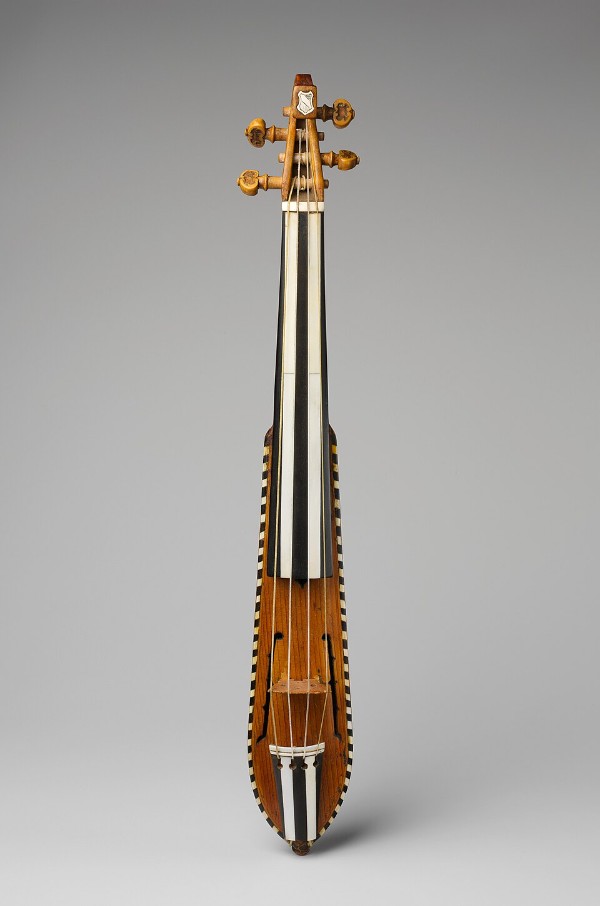
Decorated pochette

Decorated pochette

The instrument is played tucked onto the player’s chest.

The pochette is usually tuned one octave above a violin’s range, and its sound is shriller. Its range is also notably smaller; in fact, a player can’t shift above third or fifth position without running out of string to stop.

Erhu   

An erhu is an ancient two-stringed Chinese instrument. Its predecessor instruments first appeared during the Tang Dynasty (600–900 CE).
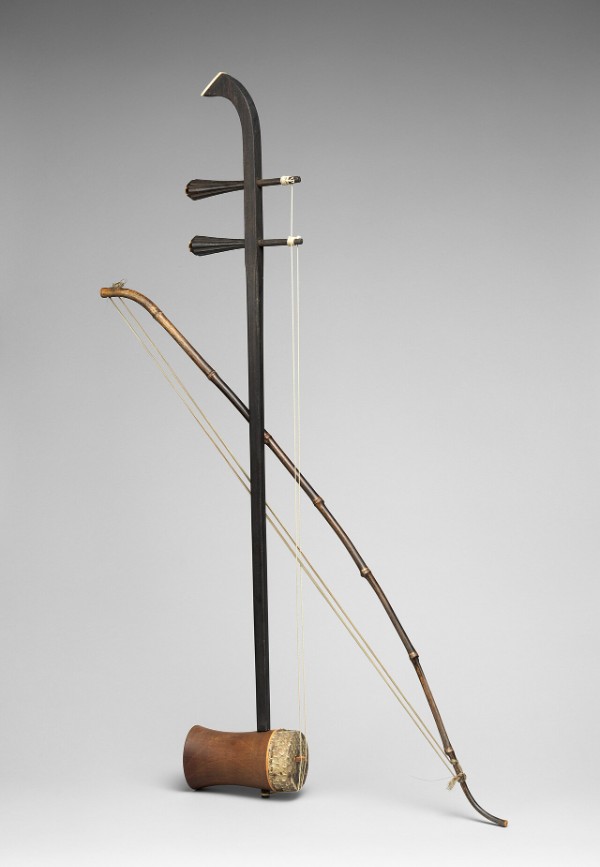
Erhu in the Mets

Erhu in the Mets

Over the following centuries, the erhu evolved into a folk instrument most often seen in southern China.

An accomplished erhu player, Liu Tianhua, introduced the erhu to Beijing in the 1920s, updating the instrument and composing new music for it.

The bodies of many erhus are covered with python skin. In 2005, new regulations were put in place in China requiring documentation of the origins of the skin; today, erhu python skins must come from farm-raised pythons rather than endangered wild specimens.

The player vibrates the skin by bowing the two strings. The two strings are tuned to A and D – interestingly, the same pitches as the middle two strings of a violin.

Hardanger fiddle   

The national instrument of Norway, the Hardanger fiddle has inspired generations of composers, from Edvard Grieg to film composer Howard Shore.

The earliest surviving Hardanger fiddle was built in 1651 by maker Ole Jonsen Jaastad, who lived in the town of Hardanger, Norway.
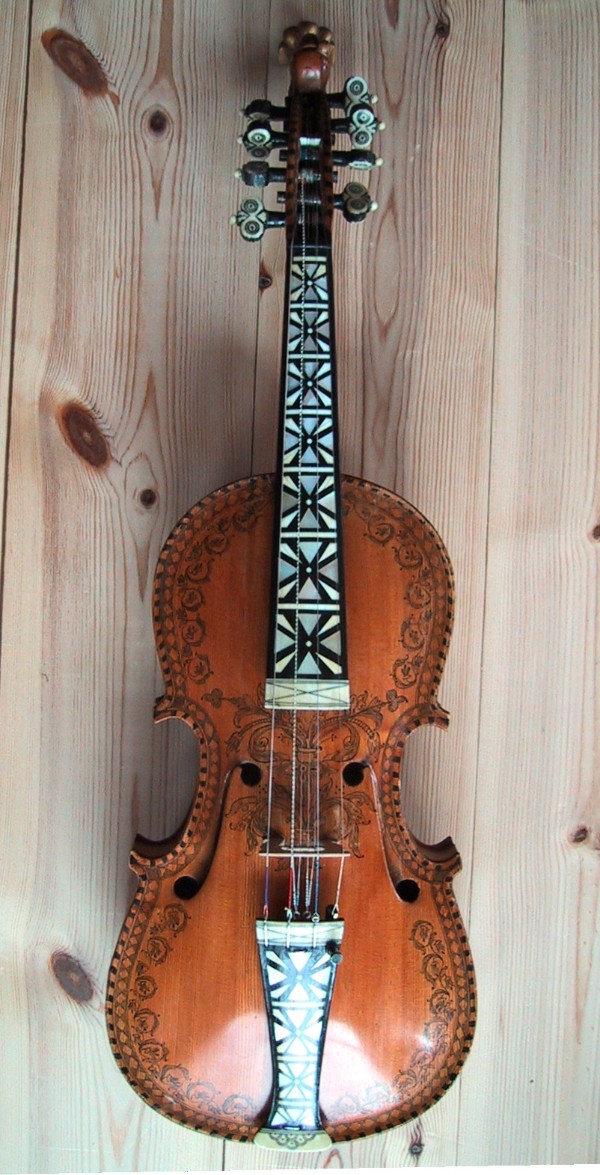
A Hardanger fiddle made by Knut Gunnarsson Helland. Owned by Monica Skaro, who inherited it from her grandfather Knut Skaro from Geilo, Norway.

A Hardanger fiddle made by Knut Gunnarsson Helland. Owned by Monica Skaro, who inherited it from her grandfather Knut Skaro from Geilo, Norway

Although at first glance a Hardanger fiddle looks similar to a modern violin, there are some noteworthy differences.

The fiddle has four main strings like a violin, as well as secondary strings that vibrate sympathetically when particular pitches are played.

A Hardanger fiddle also has a longer scroll and more tuning pegs (to account for the extra strings), a larger bridge designed to facilitate playing on two strings at once, and folk-inspired decorations.

The Hardanger fiddle, like many European folk instruments, has long been associated with the devil. In fact, during religious revivals of the 1800s, many Hardanger fiddles were destroyed.

In 2023, we wrote about the history of the Hardanger fiddle and how Grieg was inspired by it: https://interlude.hk/finding-home-griegs-violin-sonata-no-1/

Conclusion

From the Apache fiddle’s agave stem to the Hardanger fiddle’s sympathetic strings, these six instruments represent just a fraction of the world’s bowed string traditions.

The violin may be the version most familiar to Western ears – but as these instruments attest, the instinct to draw a bow across a string to make it sing is very nearly universal.

The Best Pianist of Each Decade of the 1800s

 by Emily E. Hogstad  September 7th, 2026


This list isn’t about who wrote the greatest music for the instrument. (If it were, Chopin would be on the list, despite the fact he rarely performed in public.) Instead, it’s about who took the concert stage by storm, and how each of the era’s touring virtuosos built on each other’s work to redefine what the piano could do.

Taken together, the names below trace something more than individual careers: they create an unbroken chain of teachers, students, rivals, and mentors that runs from Beethoven to the dawn of the 20th century.

1800s: Ludwig van Beethoven   

When Ludwig van Beethoven first arrived in Vienna in 1792, he worked more as a pianist than a composer. Over the following years, he gained a reputation as a fierce performer in Viennese salons. Aristocrats found his improvisations shocking – and irresistible.

Around the turn of the century, his deteriorating hearing became increasingly noticeable. He performed less and less, turning his focus to composition instead.

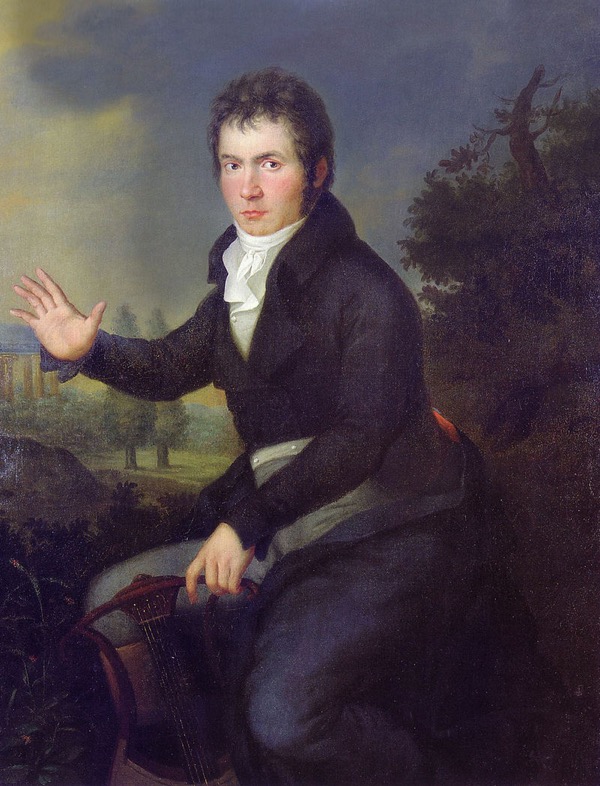
Joseph Willibrord Mähler: Beethoven, 1804 (Vienna Museum)

Joseph Willibrord Mähler: Beethoven, 1804 (Vienna Museum)

Between 1800 and 1810, Beethoven wrote 14 of his 32 piano sonatas, as well as his three final piano concertos. He infused them all with his revolutionary spirit – and they pushed the instrument’s technical and expressive limits further than any composer before him.

The next generation of pianists, from Hummel to Liszt, would spend the rest of the century reacting to how Beethoven had changed pianism.

1810s: Johann Nepomuk Hummel  

Johann Nepomuk Hummel was born in present-day Bratislava, Slovakia, in 1778, seven years after Beethoven.

He was a child prodigy who began studying with Mozart when he was eight. (He even lived in the Mozart household for a while.)

He later studied with Beethoven’s teacher Joseph Haydn, and even succeeded Haydn as Kapellmeister at the Esterházy court.

Hummel pushed back (politely) against Beethoven’s theatrical style, prioritising clarity, precision, and refinement. That contrast made him attractive to the more conservative listeners in Vienna.

After Beethoven withdrew from the stage in 1815 due to his worsening deafness, Hummel graciously stepped into the spotlight.

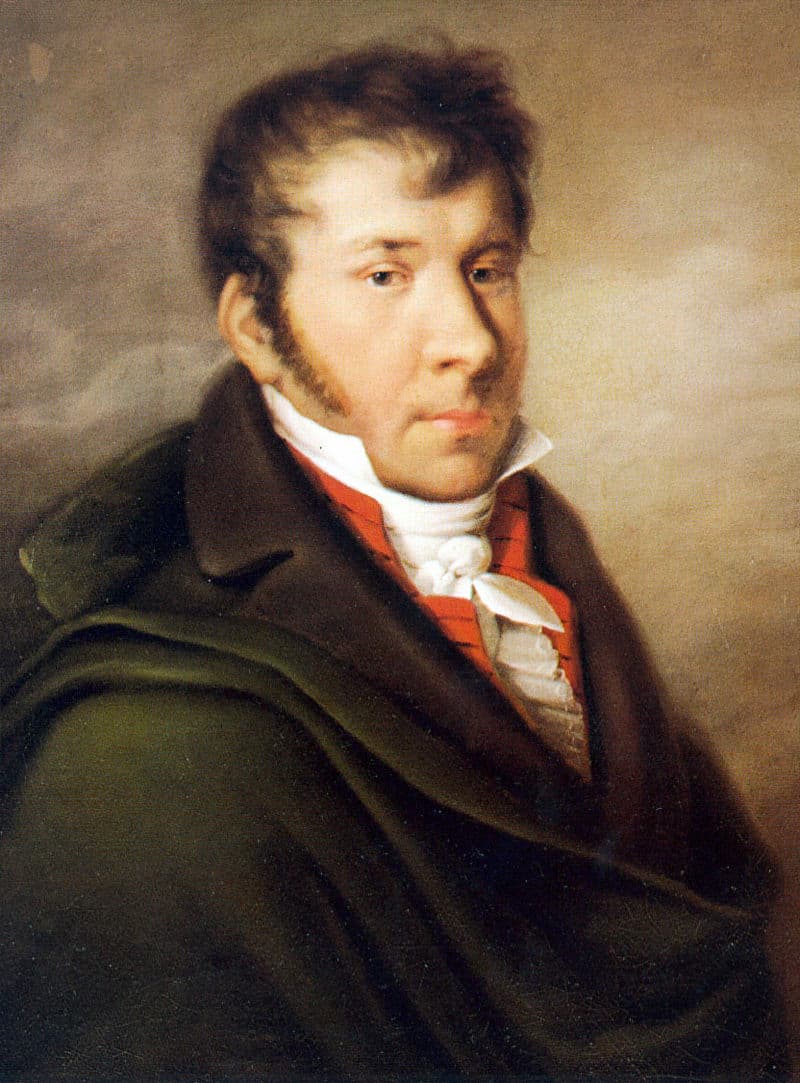
Johann Nepomuk Hummel, 1814

Johann Nepomuk Hummel, 1814

Hummel’s music has fallen out of the modern canon, likely because it was old-fashioned even in his own lifetime. But his Fantasy was a major inspiration to Franz Schubert, and his Piano Sonata in F-sharp minor was admired by Robert Schumann.

1820s: Ignaz Moscheles

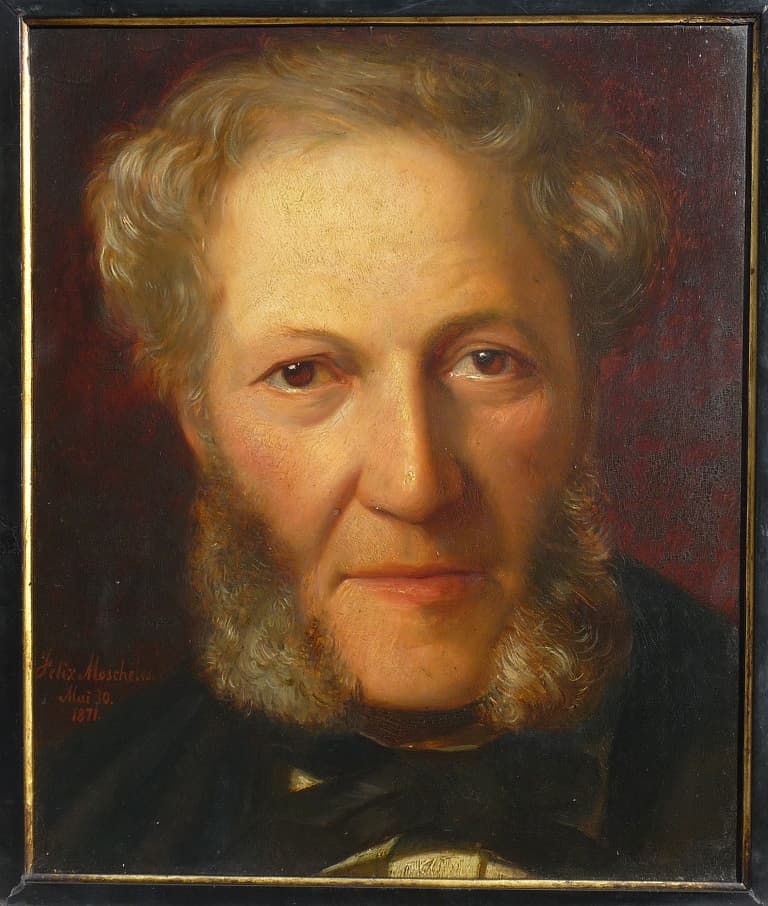
Ignaz Moscheles

Ignaz Moscheles

IIgnaz Moscheles was born to a wealthy family in Prague in 1794. From an early age, he loved Beethoven’s piano music. His teacher tried to restrict him to the Classical repertoire by composers such as Mozart and Clementi – in vain. As an adult, he would be one of the primary advocates for Beethoven in Britain.

After becoming a fully fledged virtuoso in Vienna, he moved to London in 1825 and became that city’s leading pianist.

Over the course of his career, and especially during the 1820s, he had a profound impact on Romantic giants. He mentored Felix Mendelssohn and his sister Fanny; his playing also inspired Robert Schumann to pursue a career as a piano virtuoso.

Historians disagree whether Moscheles or Franz Liszt was the first man to invent the concept of a solo recital. But regardless of who was first, Moscheles helped to define and refine the idea, changing piano performance forever.

1830s: Friedrich Kalkbrenner

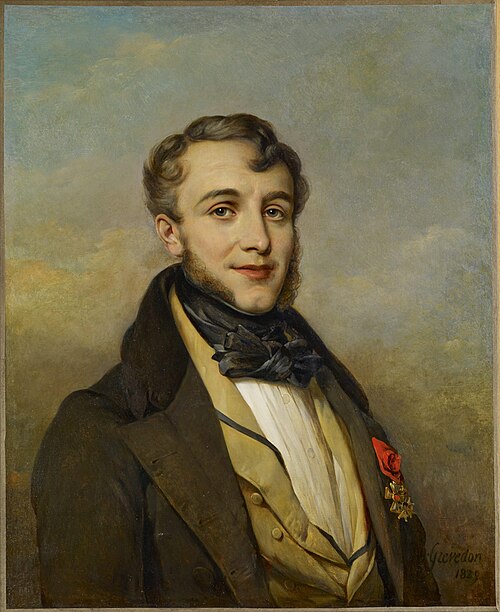
Friedrich Kalkbrenner

Friedrich Kalkbrenner

Friedrich Kalkbrenner built on Moscheles’s successes, helping to create the Romantic-era archetype of the celebrity pianist.

He was born in 1785 in a carriage somewhere between Kassel and Berlin. A child prodigy, he lived in Vienna in his late teens, meeting both Haydn and Beethoven. He also played duets with Hummel and became a friendly rival of his younger contemporary, Ignaz Moscheles.

Between 1814 and 1823, Kalkbrenner came to prominence as a performer, composer, and teacher. He hit peak popularity in the 1830s, spurred by his travels around Europe.

In his teaching, he popularised a device known as the chiroplast, which set pianists’ arms and fingers in a particular position. He even opened an academy with the device’s inventor in 1817, and also wrote a method book to propagate his pedagogical ideas. A few years later, in 1824, he joined the Pleyel and Co. piano-making company. These activities outside of performing made him a fortune.

By the end of the decade, he’d laid the groundwork for a new kind of musician: the celebrity pianist.

1840s: Franz Liszt

The career of Franz Liszt, born in 1811, was a culmination of influences from all the pianists on this list so far.

Through his teacher, Carl Czerny (a former Beethoven student), Liszt met and played for Beethoven as a child.

Czerny had himself studied with Hummel. In fact, Liszt’s father originally wanted Hummel to teach his son, but Hummel’s fees were too high – so Liszt ended up with Czerny instead.

Meanwhile, Moscheles was a Liszt fan and even bailed him out in 1841 after a disastrous British tour, and Kalkbrenner often appeared on programs with him in Paris.

After absorbing all of these influences (and countless others), Liszt went on the road, conquering Europe over an eight-year period that lasted for much of the decade.

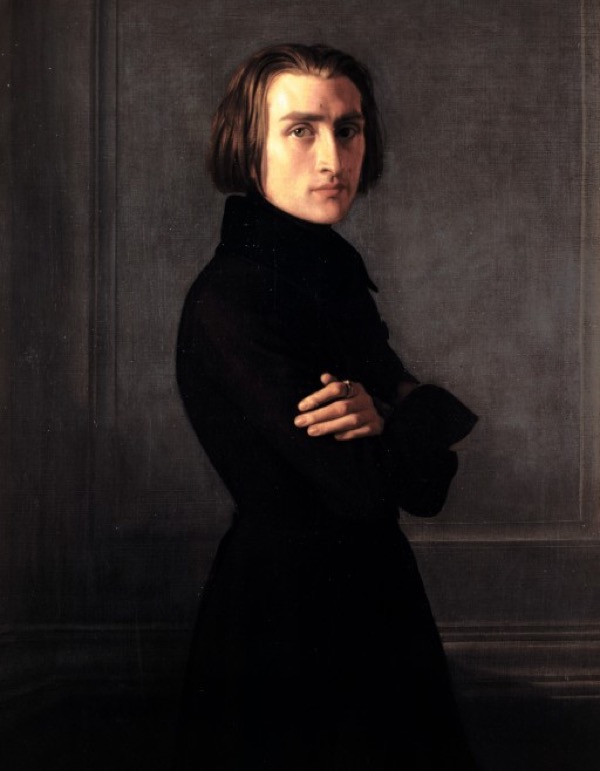
Franz Liszt

Franz Liszt

In doing so, he popularised the idea of the solo recital, as well as playing by memory – and even orienting the piano perpendicular to the audience, so they could see his dramatic side profile. He also had the greatest technique of any pianist of the century, as evidenced by his piano music.

In 1847, at the height of his fame, he retired from public performance to settle in Weimar. There he focused on composition, conducting, teaching, and supporting the musicians who would shape the second half of the century. But the impact of his 1840s tours has reverberated to the present day.

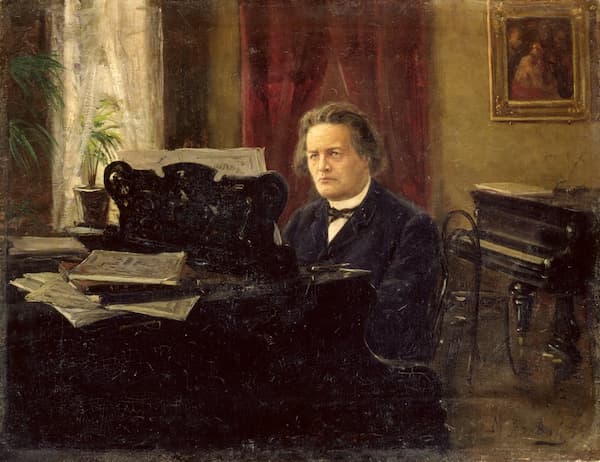
1850s: Anton Rubinstein   

Anton Rubinstein was born in present-day Moldova in 1829. Since the Russian Empire of the time lacked infrastructure for music education, he trained and toured in Berlin and Paris as a child, meeting Chopin, Liszt, and Mendelssohn.

Portrait of Composer Anton Rubinstein by Michail Michailovich Yarowoy

Portrait of Composer Anton Rubinstein by Michail Michailovich Yarowoy

During the first half of the 1850s, after escaping the revolutions of 1848, he became a fixture in the Imperial court in Russia. In the second half of the decade, he spent touring Europe to acclaim. His predecessor Moscheles paid credit to him in 1855, writing, “In power and execution he is inferior to no one.”

However, arguably the most important contribution that Rubinstein made to the piano happened offstage in 1862, when he founded the St. Petersburg Conservatory. It would soon become one of the most prestigious institutions in the world, training dozens of the greatest pianists who ever lived.

1860s: Clara Schumann  

Clara Wieck Schumann was born in 1819 in Leipzig. She was one of the most celebrated child prodigies of the 1820s and 1830s, and was a major inspiration to her husband, Robert Schumann.

After he died in 1856, driven by both grief and the need for money to support her children, Clara ramped up her touring schedule, resulting in a career she famously treated with the seriousness of a priestess.

During the 1860s and 1870s, she championed her husband’s works and inspired new ones by Brahms. She also drew audiences away from flashy but empty virtuoso pieces toward more challenging repertoire by Bach, Beethoven, and Schubert, helping solidify what we think of today as the canon. At every concert, she prioritised fidelity to the score over her own whims. It was a departure from the showmanship of Liszt – and her immense influence meant that her male colleagues took notice.

She was also among the first pianists to play from memory.

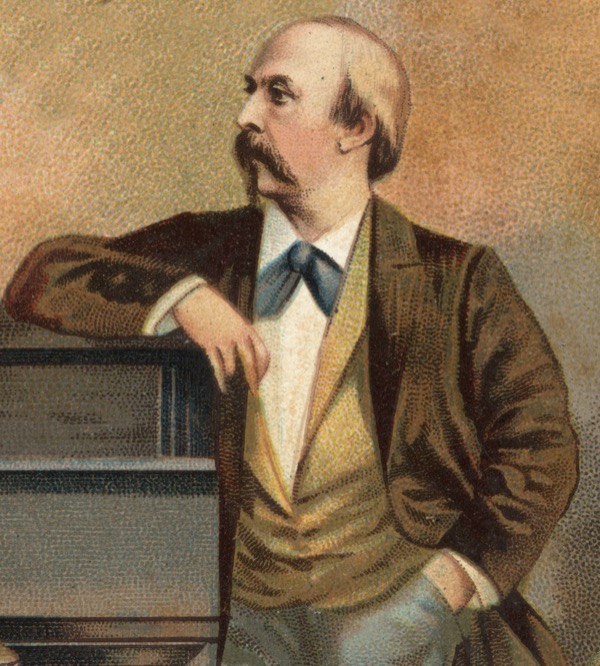
1870s: Hans von Bülow

Hans von Bülow

Hans von Bülow

Hans von Bülow was born in Dresden in 1830. Early on, he studied with Clara Schumann’s father. After a stint studying law, he was drawn back into the musical world by Wagner‘s work. In 1851, he began studying piano with Liszt and even married Liszt’s daughter, Cosima, in 1857 – the same year he premiered Liszt’s B-minor piano sonata in Berlin.

In the early 1860s, Cosima fell in love with von Bülow’s idol Wagner. He resisted granting her a divorce for a few years, but after she had three children with Wagner, he finally agreed to one.

He was best known as a conductor, but also made major contributions to 19th-century pianism. In 1875, he premiered Tchaikovsky’s first piano concerto, among the most famous in the repertoire. He also made an important edition of Beethoven’s complete piano sonatas, and became the first pianist to perform all 32 sonatas.

Hans von Bülow’s piano career offered an intriguing new career model for up-and-coming pianists: a holistic one that mixed conducting, composing, editing, and interpreting others’ music – one that some modern touring pianists embrace today.

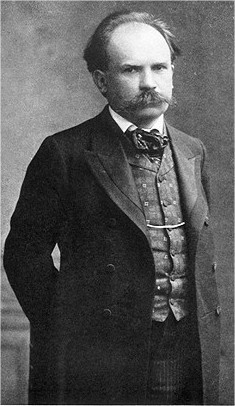
1880s: Eugen d’Albert

Eugen d'Albert in 1904

Eugen d’Albert in 1904

Eugen d’Albert was born in Glasgow in 1864 to an English mother and a French-Italian father from Germany.

As a young man, d’Albert emigrated to his father’s homeland and began taking lessons from the elderly Liszt in Weimar. This made him one of the youngest links between Liszt, his teacher Czerny, and Czerny’s teacher Beethoven. Not surprisingly, Beethoven became a d’Albert speciality.

In 1882, at the age of seventeen, he became the youngest pianist (up to that point) to perform a solo with the Vienna Philharmonic. He also published his first piano sonata and first piano concerto in 1883 and 1884, respectively, kicking off a long composing career that ran in tandem with his performing career.

Excerpts of his 1930 performance of Beethoven’s Emperor Concerto are among the earliest broadcast recordings we have of a classical pianist.

He was also famous for his love life: he married six wives and divorced five – including our pick for the greatest pianist of the 1890s, Teresa Carreño.

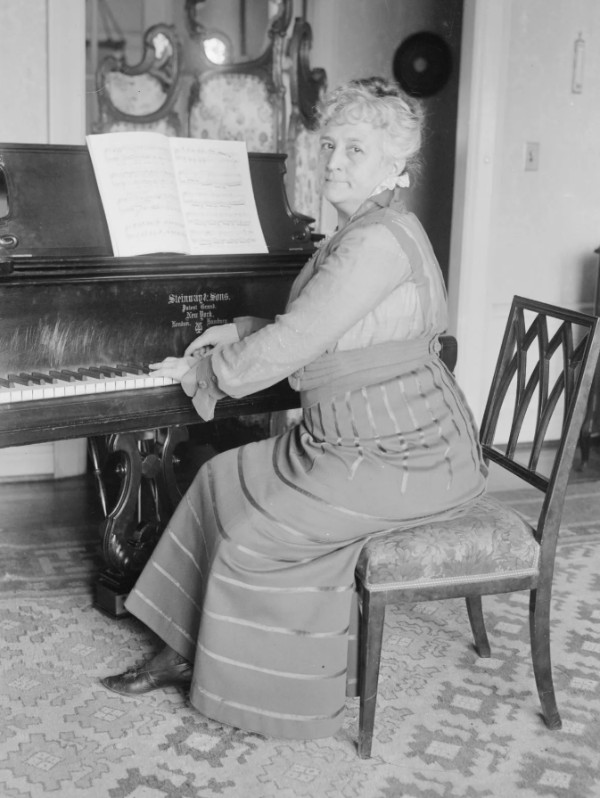
1890s: Teresa Carreño 

Teresa Carreño was born in Venezuela in 1853.

Her career – begun when she was a young girl – intersects with nearly every name on this list.

Beethoven was a vital part of her repertoire. She played Hummel at her debut concert at the age of eight. Her teacher Georges Mathias had studied composition with Kalkbrenner. She performed for Liszt in the 1860s and then declined to take lessons from him – but did study with Anton Rubinstein. Clara Schumann had proved that a woman could have a long-lasting career as a solo pianist. She played under von Bülow, who called her “the most interesting pianist of the present age.” And of course, she married Eugen d’Albert (then, a few years later, divorced him).

Teresa Carreño

Teresa Carreño

Her connections to these men didn’t define her career. But their presence in her biography does serve to illustrate how she became the culmination of an entire century’s worth of pianistic inspirations and trends.

At the end of the 19th century, she pointed toward the next hundred years and beyond, proving that women and non-European pianists could become global superstars, too.

Thursday, September 10, 2026

Facing the Music: Who are we when we cannot practise our art?


For many artists, being an artist is not merely a profession. It is an essential part of their identity. A musician does not necessarily stop thinking of themselves as a musician when they leave the concert platform; a painter remains a painter even away from the studio; a writer may continue to inhabit an imaginative world even when not actively writing. Artistic identity can become so deeply embedded in our sense of self that it is difficult to separate what we do from who we are.

But what happens when circumstances prevent us from doing it? What does it mean to be an artist when the circumstances that allow us to practise and share our art are suddenly taken away?

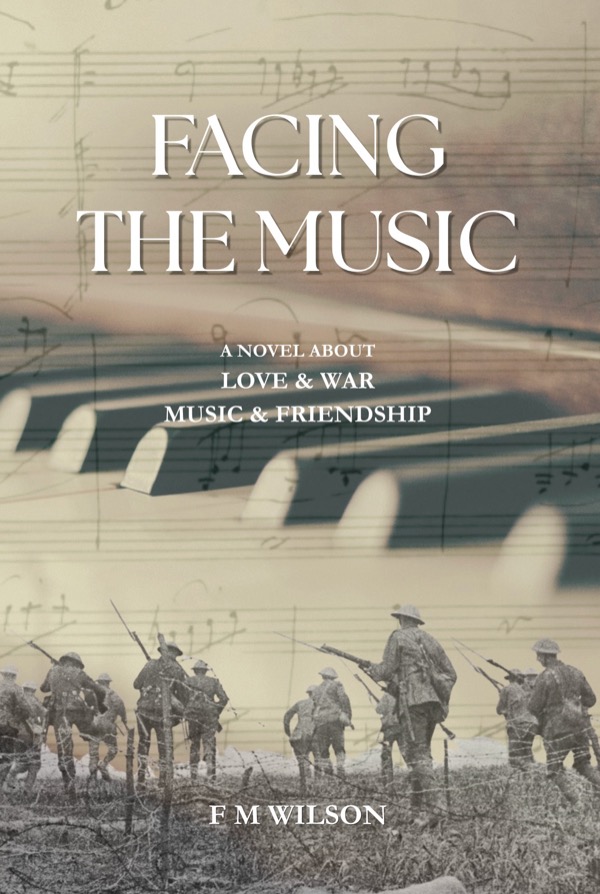
This question lies at the heart of my debut novel, Facing the Music, which follows two ambitious, gifted young musicians – pianist Theo Browne and violinist Jonathan Lane-Fox – poised on the cusp of professional success in the summer of 1914.

Facing the Music — cover

Facing the Music by F M Wilson

At the beginning of the novel, Theo’s sense of identity is absolute: he is a pianist. Years of study with his beloved teacher, Mr Hines, hours of disciplined practice, and his musical partnership with Jonathan have all been directed towards a professional career. Following a triumphant London debut in August 1914, that future appears assured.   


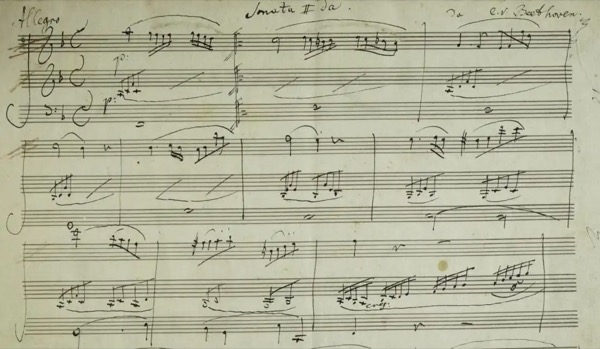
Autograph of the "Spring" Sonata

Autograph of the “Spring” Sonata

The First World War abruptly removes Theo and Jonathan from the world in which their artistic identities have been formed. Concert halls, rehearsals and lessons give way to military service and the brutal reality of the Western Front. Yet they do not cease to be musicians simply because they are no longer performing. Music persists through memory: in remembered works, in habits of discipline and listening acquired over years of study, and in the words of teachers whose influence has become part of their inner lives.

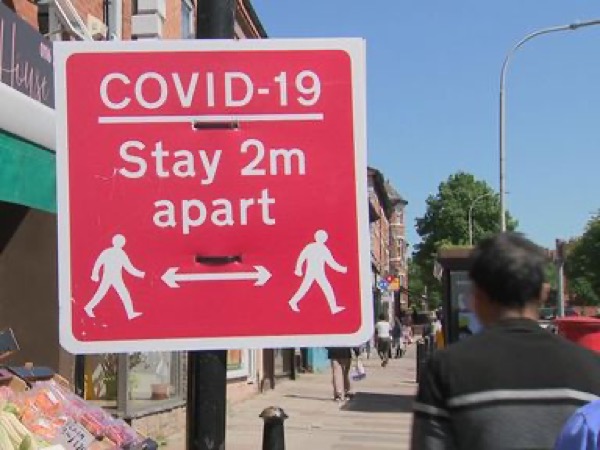
Although Facing the Music is set more than a century ago, my exploration of these ideas was influenced by a much more recent interruption to artistic life: the COVID-19 pandemic.

Covid sign

Covid sign

During the UK lockdowns, I spoke to several professional musicians about their experiences. Initially, some welcomed an unexpected break from performing and travelling, seeing it as an opportunity to practise, explore new repertoire, rest and reset. But as the months passed, the absence of concerts and live audiences became increasingly difficult to bear: spare time became an affliction rather than a source of gratification. Musicians spoke of feeling bereft and dislocated, and some began to wonder whether they would be able – or even want – to return to concert-giving when restrictions were finally lifted.  

Concerts had disappeared, venues were closed, and collaborative music-making in its familiar form had become impossible. For people whose lives are so closely bound up with their art, this was far more than the loss of work. It raised questions about identity and purpose.

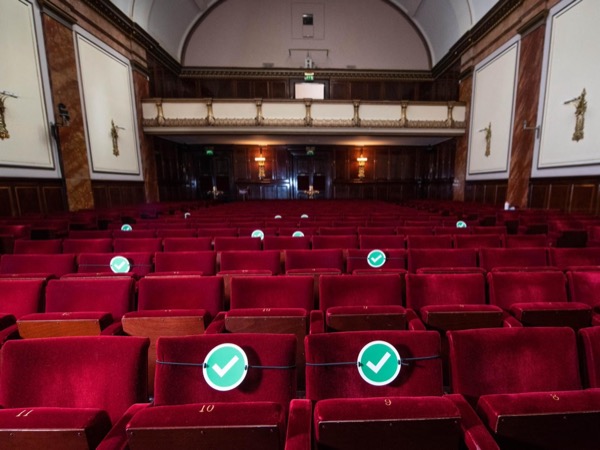
Wigmore Hall in preparation for re-opening on 1 August (Photo by Matt Crossick/PA Wire)

Wigmore Hall in preparation for re-opening on 1 August (Photo by Matt Crossick/PA Wire)

Those conversations made me reflect on the distinction between being a musician and working as one. If there is no audience, no concert and no engagement in the diary, are you still a performer? If circumstances prevent you from pursuing the career you had imagined, does that diminish your identity as an artist?

These questions found their way indirectly into Facing the Music, particularly into Theo’s story. The First World War and Covid are, of course, profoundly different historical experiences, and the novel does not seek to draw an equivalence between them. What interested me was something more universal: the experience of sudden interruption, the disappearance of familiar routines and expectations, and the necessity of adapting when circumstances beyond one’s control make the expected future impossible.

For Theo, and to a lesser extent for Jonathan, music endures through memory, friendship, teaching, thought and, eventually, performance. But Theo’s understanding of what it means to be a musician changes. Artistic identity can no longer be measured simply by prestigious engagements, public performance or professional success.  

The question facing him is no longer, “Can I still play?” It has become something more fundamental: “What does being a musician mean to me now?”

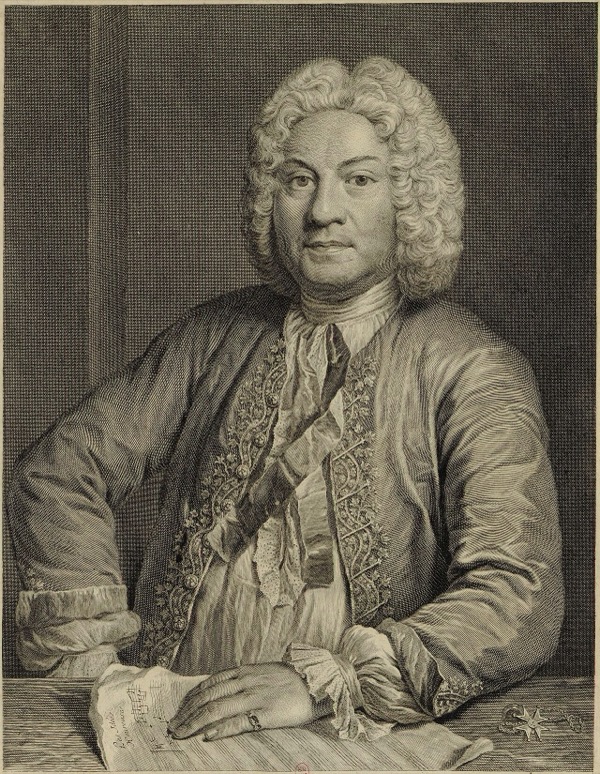
François Couperin (Died on September 11, 1733) The Art of Touch


François Couperin

François Couperin

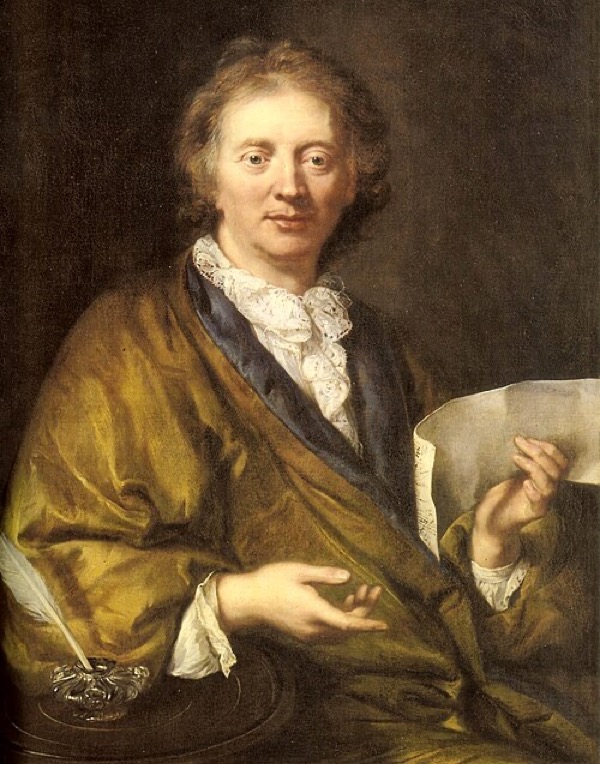
Couperin died on 11 September 1733 at the age of sixty-four, and the early music expert Jordi Savall suggests that Couperin was the “poet musician par excellence” who believed in “the ability of Music to express itself in prose and poetry.”

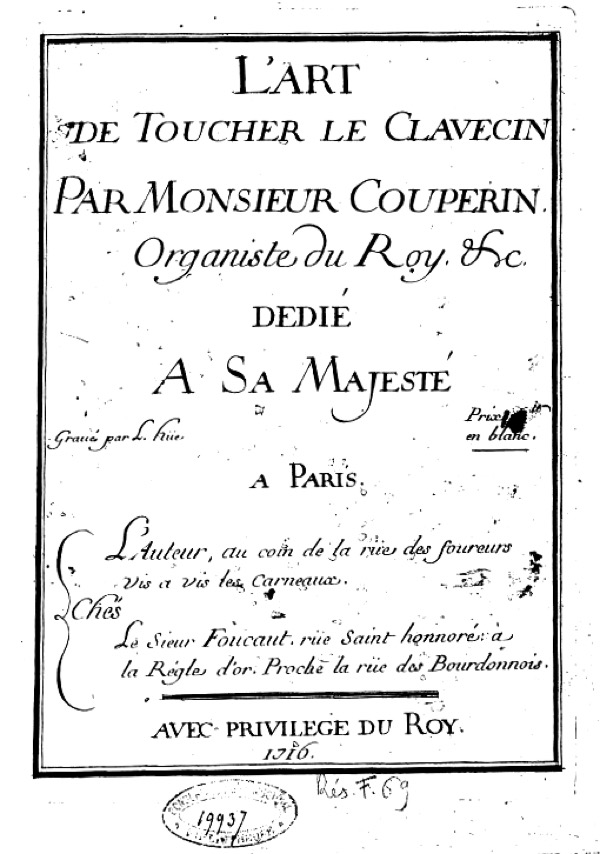
To commemorate his passing, let’s have a look at his most famous book, which contains suggestions for fingering, touch, ornamentation, and various features of keyboard technique. It also contains eight preludes and an Allemande that demonstrate his ideas about keyboard playing. 

Teaching Good Taste

L'art de toucher le clavecin

L’art de toucher le clavecin

Couperin’s reasons for writing his L’Art de toucher le Clavecin are detailed in the preface. “This instrument,” he writes, “has its own peculiarities, just as the violin has its own. If the harpsichord cannot swell its notes, if the rapid repetition of the same note does not particularly suit it, then it has other advantages: accuracy, clarity, brilliance, and its greater range.”

“Above all, one must develop a sensitive touch for the keys and always have a well-feathered instrument. However, I understand that there are people for whom this may be irrelevant, because they play equally badly on any instrument.”

Although Couperin presents his treatise as something new and unique, it belongs to a growing tradition of instrumental methods. As amateur music-making became an important part of fashionable French society, learning an instrument was considered essential to education and good taste.   

When Music Learns to Speak

As Couperin suggests in his preface, the most important aesthetic idea is the comparison between musical performance and rhetoric. Reading musical notation is not the same as performing music, as it does not tell us how the music should speak. As such, the author spends much time on phrasing, punctuation, articulation, and expression.

Couperin begins with the player’s physical position and hand position. He soon turns to matters of touch, stressing “la belle souplesse” (suppleness) and the soft, flexible hands required for harpsichord playing. The search for the most perfect touch was the holy grail of harpsichordists of his time.

Feathery touch aside, Couperin demonstrates how expressive possibilities can be created through means other than simple dynamic pressure. Essentially, the performer shapes music through a subtle hierarchy of gestures and the character of individual phrases.   

Grammar of Ornament

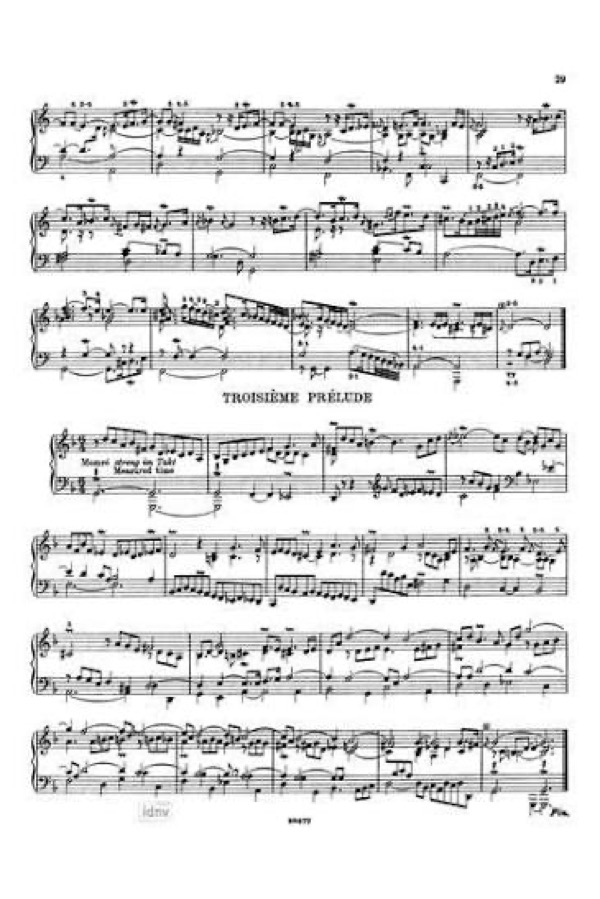
Couperin: The Art of Playing the Harpsichord

Couperin: The Art of Playing the Harpsichord

Couperin devotes considerable space to ornaments as part of the musical language. This includes the manner of fingering and execution, and his explanations demonstrate the close relationship between fingering and musical expression. The elegance of performance is inseparable from expression.

To demonstrate his didactic and theoretical ideas, Couperin included eight preludes and one Allemande. In his 1717 revision, Couperin explains why he composed the eight preludes himself. “I must not forget to explain, before finishing this little discourse, that the method entitled L’Art de toucher le clavecin, which I have just mentioned, contains, among other things, eight preludes suitable for all ages and for all kinds of hands.”

“The fingers with which they are to be played are marked there by numbers, and I have even composed these preludes expressly in all the keys of my pieces, both those of my first book and those with which this second is filled.”  

Beyond the Bar Line

François Couperin

François Couperin

The first prelude in C Major serves as an instruction, while No. 2 is particularly rich in ornamentation and expressive inflexion. No. 3 in G minor is darker and rhetorically charged, with No. 4 in F Major presenting a flowing and lyrical discourse. No. 5 in A Major is bright and expansive, while No. 8 becomes more concentrated.

These preludes belong to a tradition in which the music is written without conventional bar lines. As such, they accord the performer considerable freedom in determining the rhythmic flow. They are not to be taken as improvisations, but as music that is fundamentally free in form.

The inclusion of the Allemande allows Couperin to demonstrate how technique becomes musical expression. Every individual section of the treatise is now combined in a fundamental dance of the French keyboard suite. It contains everything Couperin has been discussing, and it also serves as a demonstration of the differences between French and Italian styles.

L’Art de Toucher is the most important Baroque text on playing the harpsichord, and Carl Philipp Emanuel Bach still acknowledged it in his treatise of 1753. At that time, 37 years had elapsed, and the musical world had undergone a radical change of taste and style.

Monday, September 7, 2026

Star Wars Rocks My World


🎼 Legendary composer John Williams made a surprise appearance at a Hollywood Bowl tribute show in his honor. Reports confirm the 94 year old maestro took the stage to conduct a single encore piece, taking the podium for "The Imperial March". It was a massive moment for Star Wars fans in attendance who got to see the master in action.

(Source: Hollywood Bowl)