Friday, September 4, 2026

The Enduring Magic of the Harp Top 10 Harp Favourites


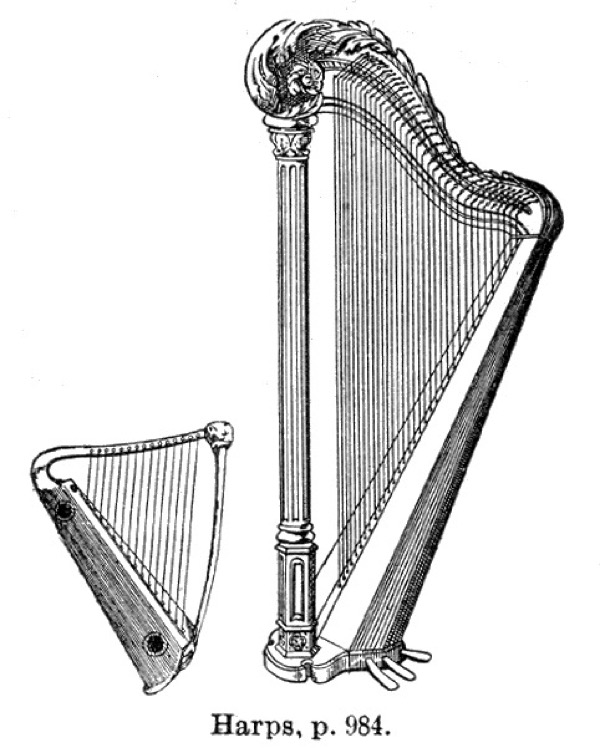
The harp is one of the oldest known string instruments, dating back to ancient Egypt and Mesopotamia. Although we find many different types and models, the basic shape features a triangular frame with strings running between the neck and the soundboard.

The standard orchestral harp features 47 strings, and it uses seven pedals at the base to alter string pitches and change keys. The instrument is played by plucking the strings with the fingers, usually while seated.

The harp has strong political and symbolic value, especially in Ireland, where it has long served as a national emblem. In Christian tradition, heaven is depicted as populated by angels playing harps. As its corporate logo, the Irish brewer Guinness has used the harp since 1759.

Harps can produce a broad range of intoxicating sounds, from warm plucked notes to shimmering glissandos and arpeggios. The repertoire for the harp is vast, and here is a top 10 list of some of the most beautiful harp music ever written.
Harp

Harp

Félix Godefroid

Félix Godefroid (1818-1897) might not be a household name, but several generations of players and listeners have enjoyed his harp compositions and didactic works. In fact, when he made his debut in Paris in 1847, he was quickly dubbed the “Paganini of the harp.”
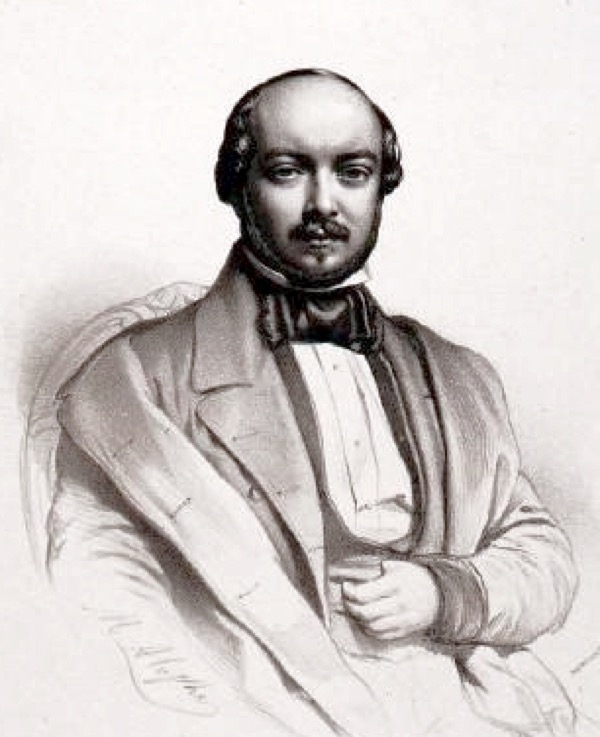
Félix Godefroid, by Marie-Alexandre Alophe

Félix Godefroid, by Marie-Alexandre Alophe

Godefroid hailed from Namur in Belgium and studied at the Paris Conservatoire and later with Elias Parish-Alvars. He was a travelling harp virtuoso, visiting the Middle East, Spain, England, and Holland. He even wrote an opera titled La harpe d’or, which included a harp fantasy that he himself played from the wings.

His studies for the harp focus on left-hand technique, and many of his 300 pieces have maintained a firm place in 19th-century harp literature.  

The Parisian instrument makers Pleyel and Érard were bitter rivals, and they continually modified and improved their harps’ designs. To showcase their respective technical and musical innovations, both companies commissioned the leading French composers to write music for their new and improved instruments.
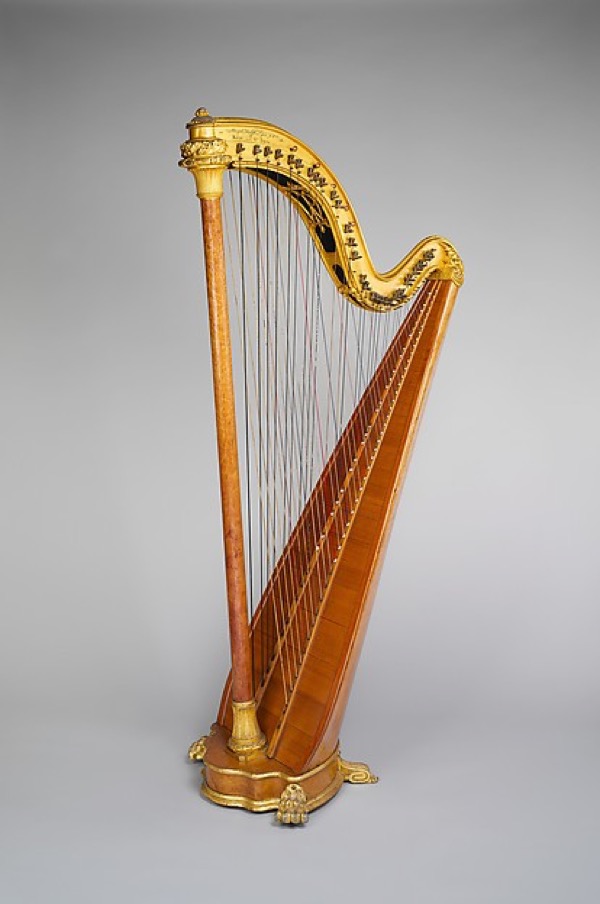
Chromatic harp

Chromatic harp

In 1904, Pleyel asked Claude Debussy to write his Danse sacrée et danse profane (Sacred and profane dances) for harp and orchestra. In turn, Érard commissioned Maurice Ravel (1875-1937) to compose a piece that would showcase the expressive range of the new double-action pedal harp.

Ravel responded with his Introduction and Allegro for harp, flute, clarinet and string quartet. This unique composition contrasts the smooth sound of the woodwinds, the percussive sound of the harp, and the warmth of the strings. The work is often described as a miniature harp concerto, with the instrument introducing important themes, providing shimmering accompaniments, and playing a major solo cadenza.

Claude Debussy: Danse sacrée et danse profane  

Debussy’s Danse sacrée et danse profane was commissioned by the firm of Pleyel in 1904. The instrument maker wanted it for use in competitions associated with a newly inaugurated class in the chromatic harp at the Brussels Conservatory.
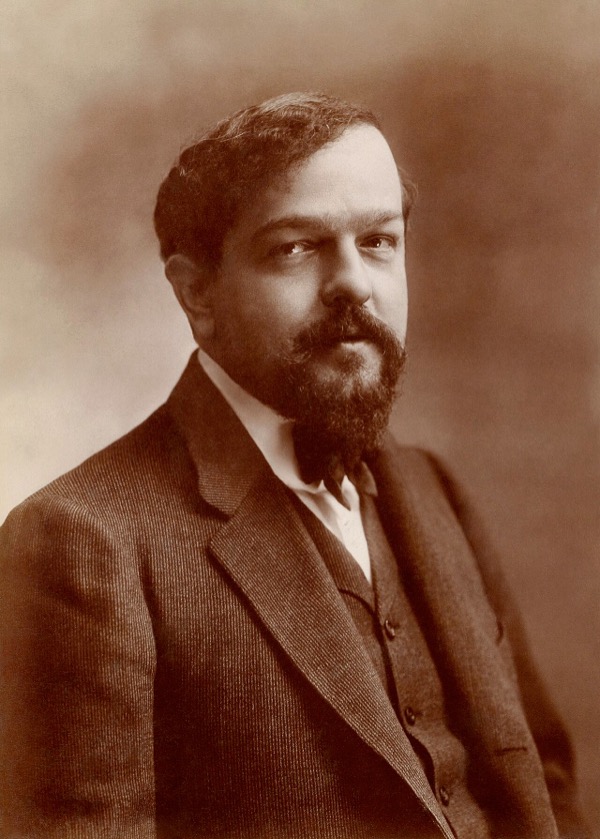
Claude Debussy, by Atelier Nadar

Claude Debussy, by Atelier Nadar

Pleyel’s chromatic harp featured two rows of strings that cross each other without touching. One side has 7 strings per octave, while the other has 5. Think of it in terms of the piano, with 7 white and 5 black keys per octave.

This particular harp was designed to eliminate the need for pedals by providing 78 separate strings for every note on the chromatic scale. Debussy’s composition contains two movements: a slower sacred dance with slow-moving modal sonorities, contrasted with a lilting waltz.   

Wolfgang Amadeus Mozart: Concerto for Flute and Harp, KV 299  

The harp was Marie Antoinette’s favourite instrument, and it was also the most popular instrument of the day. As such, the harp had started to replace the harpsichord in the salons of the upper bourgeoisie. It was the instrument of fashion.

Marie Antoinette played the harp every day, and she had several beautifully decorated instruments at her disposal. She composed her own tunes and melodies and encouraged composers to write music for it.
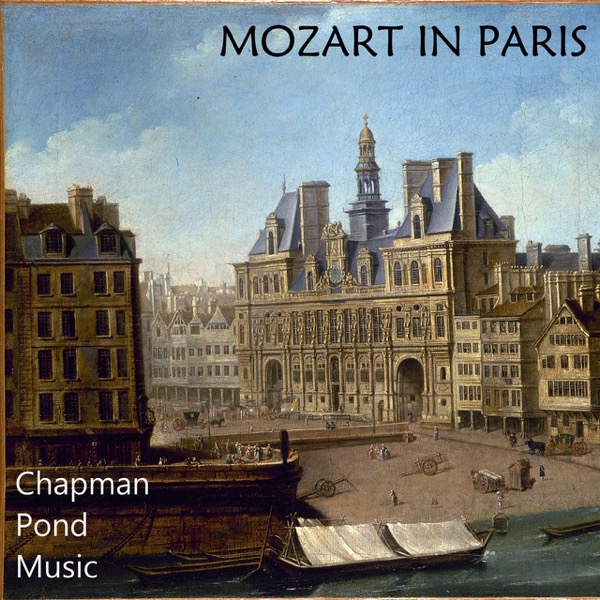
Mozart in Paris

Mozart in Paris

Wolfgang Amadeus Mozart arrived in Paris in 1778, and since Marie Antoinette was indisposed, he took on several private students. In April 1778, he was engaged to give composition lessons to Marie-Louise-Philippine Bonnières, the youngest daughter of the Duke of Guînes. His young charge was a capable harpist, and the duke an excellent flautist. As such, the duke commissioned Mozart to compose a concerto for him to perform with his daughter.  

Although Camille Saint-Saëns (1835-1921) never held a teaching position at the Paris Conservatoire, he served on various juries and selection committees. He made sure that his student Gabriel Fauré was appointed director, and that Alphonse Hasselmans was appointed professor of harp in 1884.
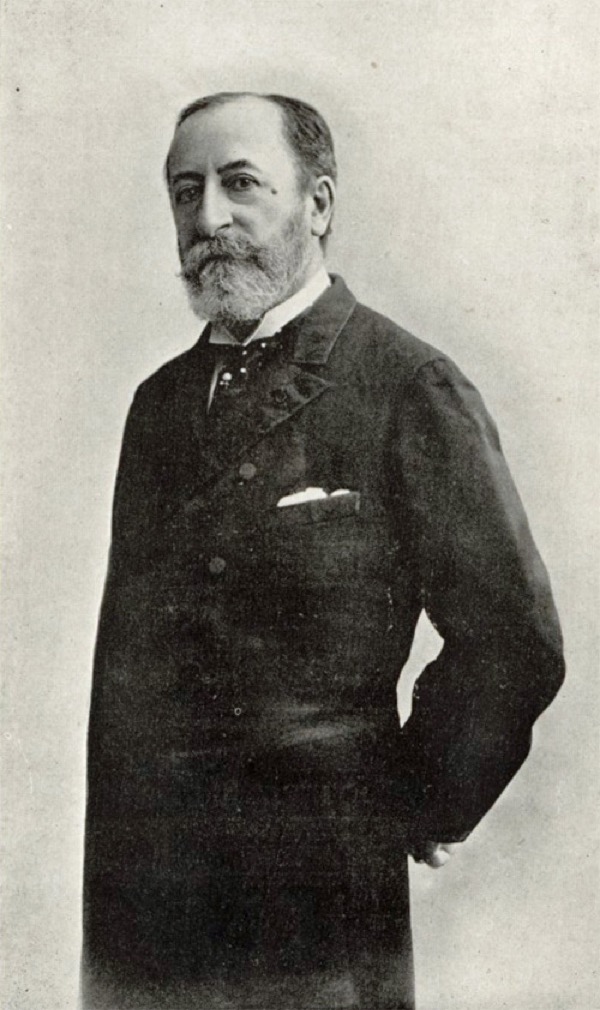
Saint-Saëns, circa 1880

Saint-Saëns, circa 1880

In all, Saint-Saëns composed three works for the harp, with the Fantaisie for Solo Harp, Op. 95, dating from 1893. It is one of the best-known pieces for the instrument, and its two movements are still used as a Paris Conservatoire examination piece.

The Fantaisie explores the whole potential of the harp in terms of expression and colour. Because it combined lyrical writing and technical brilliance, it has remained a cornerstone of the repertoire.   

Josef Hasselmans became the first director of the Strasbourg Conservatoire in 1854, and Richard Wagner called him a “very good-natured, amiable fellow.” He is also remembered for two major schools of double-action harp playing.

His son Alphonse Hasselmans (1845-1912) first studied with his father in Strasbourg, and eight successful solo concerts in Paris in 1877 brought him appointments as solo harpist with the Paris orchestras of the Conservatoire, Opéra, and Opéra-Comique.
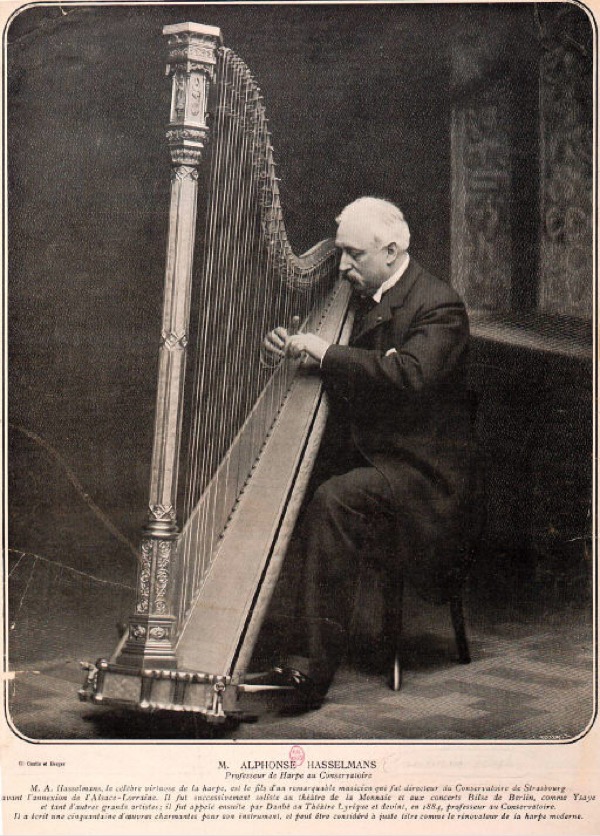
Alphonse Hasselmans

Alphonse Hasselmans

Hasselmans wrote 54 pieces for the harp, and many of his compositions were inspired by his performance and dedicated to him. His solo harp etude La Source dates from 1898 and is dedicated to his student Hélène Gayat. Often nicknamed “The Brook,” the rippling textures and cantabile line make it one of the most beloved works in the harp repertoire.  

Paul Hindemith (1895–1963) was one of the most versatile musicians of his time, and he could play all instruments of the orchestra, except for the harp. However, his Sonata for Harp is a pioneering example of contemporary harp music.

It is part of a series of 26 sonatas for various wind and string instruments, as well as for piano and organ. Hindemith finished this work in 1939, just weeks after the outbreak of World War II, and just before he departed for the United States.
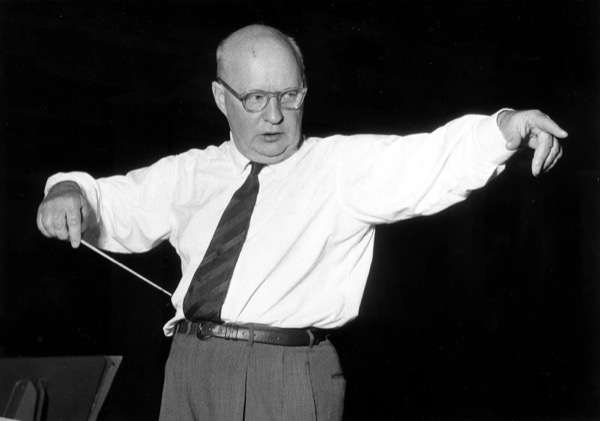
Paul Hindemith

Paul Hindemith

It is a three-movement work, and the final movement in a slow tempo is inscribed with an ode of mourning by Ludwig Christoph Heinrich Hölty. The poem relates a dying harpist’s last wish that, after his death, the harp be placed behind the church altar as a memorial, to sound of its own accord much like the Aeolian harps of antiquity.    

Eli Parish (1808-1849) hailed from a small port in Devonshire, yet he became one of the most illustrious musical figures of the 19th century. Franz Liszt excitedly wrote, “From beneath his forehead speak his dreamy eyes, expressive of the glowing imagination which lives in his composition.”
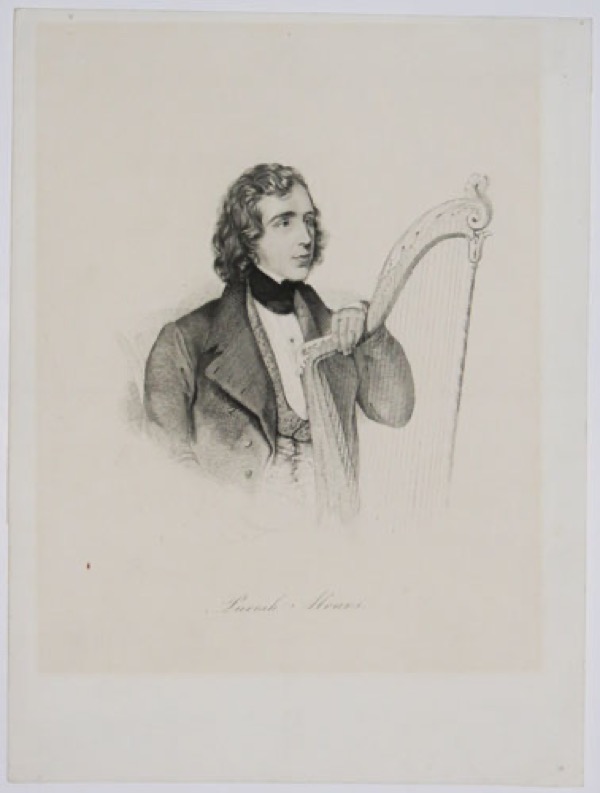
Parish Alvars

Parish Alvars

Not to be outdone, Berlioz stated, “This man is a magician. In his hands the harp becomes a siren, with lovely neck inclined and wild hair flowing, stirred by his passionate embrace to utter the music of another world.”

Elias Parish-Alvars, a name he freely invented, bought his first double-action harp from Pierre Erard in May 1842, and this more robustly constructed and mechanically superior instrument opened up new musical horizons. He developed innovative techniques integrating pedal and manual skills in unprecedented ways. After all, two harps are always better than one.  

Marcel Tournier (1879-1951) was a student of Alphonse Hasselmans at the Paris Conservatory. He would eventually succeed his teacher as professor of harp in 1912, holding that position until 1948.

Tournier composed several solos for harp, and several chamber works that feature the harp prominently. His solo harp suite Images No. 4 is known for its pictorial character, featuring movements with evocative titles such as “La volière magique,” “Cloches sous la neige,” and “La danse du moujik.”
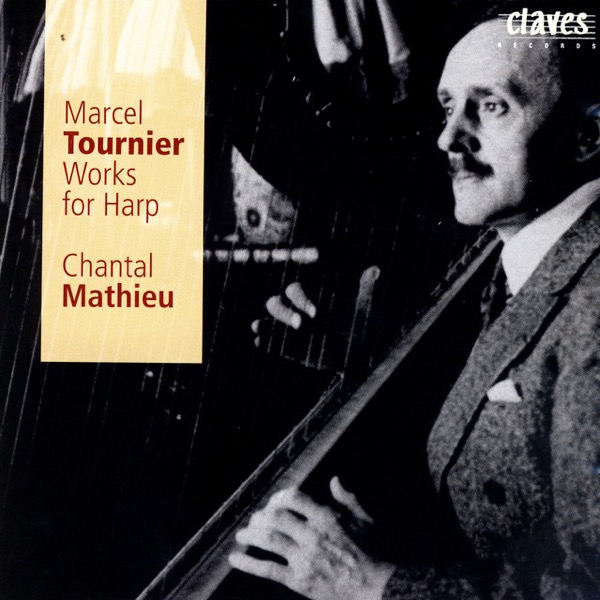
Marcel Tournier

Marcel Tournier

This work is one of his best-known contributions, as it paints contrasting musical scenes with a blend of virtuosity and colour.

Nicolas-Charles Bochsa: Six Preludes
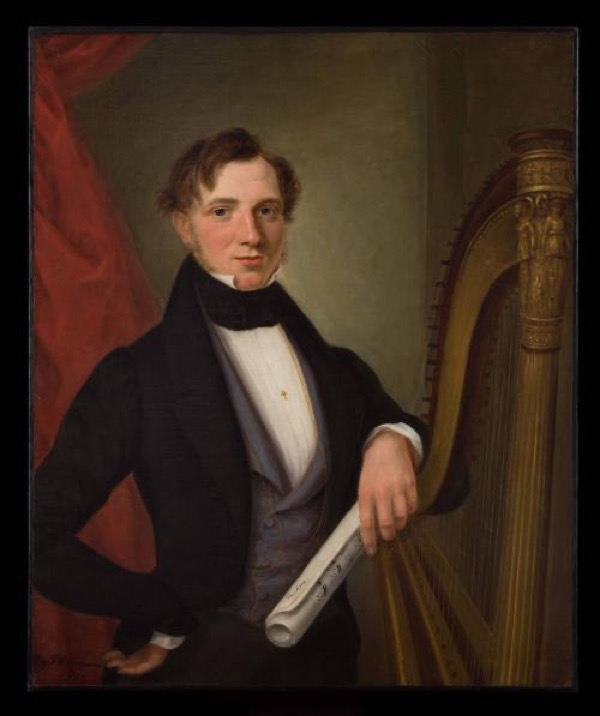
Robert Nicolas-Charles Bochsa, the harpist

Robert Nicolas-Charles Bochsa, the harpist

Nicolas-Charles Bochsa (1789-1856) was one of the most prolific composers for the harp.

His reputation as a harpist rested on his compositions for this instrument, as he expanded its technical and expressive range.

Bochsa was appointed harpist to the emperor in 1813, and he was even commissioned to compose a requiem for Louis XVI. He was a busy and shifty man who was appointed professor of harp and general secretary of the RAM in London.

He left behind plenty of bankruptcies and broken hearts in his wake and eventually died in Sydney, Australia, in 1856. And while his compositions for harp are not profound, he constantly discovered new effects and exploited the full possibilities of Erard’s new double-action harp. He also wrote a harp method that was long regarded as a classic.

The harp repertoire is truly vast, and it certainly deserves more attention. Would you please let me know what other works deserve to be featured?

Sunday, August 30, 2026

BodyMinded Thinking in the Performance of Music

 by Greg Holdaway  April 28th, 2021


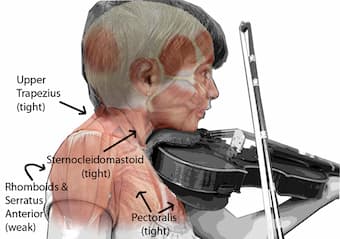
violin anatomy

© The Vital Gaitway, Center for Body Education

Musicians contribute so much to the personal and cultural well-being of the community and play music because they love it. Given that, it is a shame that for some, a career and/or long-term love of playing is associated with levels of stress and discomfort – sometimes a great deal of stress and discomfort. There are musicians who have become so injured as a consequence of their playing that they have been unable to continue with their beloved music making. Thankfully that is not everyone, but in the ranks of committed musicians, struggling with well-being while performing at their best is more common than you might realise.

That statement is supported by research into musicians’ wellbeing that is growing year by year1. As a result, physical and psychological struggles with playing, particularly high intensity playing, is being increasingly recognised as a professional problem that needs to be addressed.

This series of articles from BodyMinded in Australia aims to provide a practical guide to preventing and addressing playing related injury and stress, and in the process support development of musical potential at all levels of achievement.

If your focus is on performance, rather than dealing with injury, these articles will also provide support. Musicians move in order to make music, and as an embodied sense of how to cooperate with your own structure and your instrument takes hold, you will find your instrument becoming an integrated extension of the sense of yourself and the music will flow increasingly with ease, power and facility2.

And finally, after years of providing professional development training for music teachers, I’m aware of how deeply teachers take their responsibility for the well-being of their students. Creatively teaching safe body-use as a part of music lessons will help to prevent the kinds of difficulties that often arise when a musician becomes more serious and begins spending many more hours playing.

Treating the instrument as an extension of the self is common amongst long-term instrumentalists. I had a student in a workshop one day who, when I said “hello”, leant sideways to reply to me. Curious about that, I moved to the other side of the person and asked another question. Sure enough, he leant to the other side in order to answer! The next day he came to a musician’s class, with his instrument. A large tuba, which he sat with on his lap…

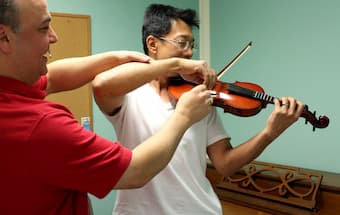
Addressing back pain for violinist

© K.C. Strings Violin Shop

Let’s get started with a practical illustration. Many instrumentalists experience shoulder and neck stiffness or discomfort, or experience heaviness in the arms after playing for a while. Here is a simple question: where do your arms attach to your body? Take a moment to point or touch that part of your body. Did you point to the outside of your shoulders? This is most usual representation.

Now feel your collarbones, at the top front of your chest. Feel along towards the centre until you find the bump where the collarbone attaches to the breastbone. This is the only bony joint where the arm bones attach to the rest of the skeleton. You can feel this by using one hand to feel how your collarbone moves as you lift the other arm. Can you feel it? When your arm moves the whole shoulder girdle (collarbone and shoulder blade) are involved. The arms are suspended from the spine, via those shoulder and neck muscles that are sometimes so uncomfortable. The shoulder blades are embedded in muscles that mean they can move a whole lot; up, down, forward, back, always in support of and following the movements of the arm.

This means that when you raise or use your arms for any purpose, your shoulder girdle is involved. The collarbones and shoulder blades are arm bones! See what happens if you try to keep your shoulder girdle held still or back while moving your arms, and then compare that to letting the shoulders move with and in response to movements of your arms. Can you feel the difference?  

Thinking about this a pianist comes to mind who complained of long-standing shoulder and arm discomfort while playing. Nothing had made a difference, and she had lived with that for a long time. After exploring how much her shoulder girdle can move the instruction became: “let your shoulders move when you bring your hands to the keyboard”. The result, so much relief she burst into tears.

This story illustrates how discomfort may be a consequence of simple misunderstanding about how things work. The BodyMinded process is to practise conscious cooperation with the way things work. This is sometimes stated as: Let everything move that needs to move in service of your activity.

Each article in this series will cover a specific example of BodyMinded thinking in practise, concluding with a general principle that applies to achieving and teaching good coordination as a musician. In this way I hope to assist you with your enjoyment and wellbeing in playing, and support those who are teaching others.

1 For example, of respondents to an extensive survey of Australia’s 8 full-time orchestras “84% had experienced pain or injuries that had interfered either with playing their instrument or participating in normal orchestral rehearsals and performances” Musculoskeletal Pain and Injury in Professional Orchestral Musicians in Australia B. Ackermann, T. Driscoll, D.T. Kenny https://doi.org/10.21091/mppa.2012.4034

2 There is neurological research which suggests that the brain grows the neurological ‘map’ of the self to include the instrument, in that sense the instrument does actually become an ‘extension of the self’. Coding of modified body schema during tool use by macaque postcentral neurones A. Iriki, M. Tanaka, Y. Iwamura https://doi.org/10.1097/00001756-199610020-00010

“Every great inspiration is but an experiment.”


“Every great inspiration is but an experiment.”

Charles Ives

Unconscious bursts of creativity that engender significant artistic endeavors are not necessarily inspired by passionate romantic love alone. Greek mythology believed that this kind of stimulus came from nine muses, the inspirational goddesses of literature, science, and the arts. Muses were long considered the source of knowledge embodied in poetry, lyric songs and ancient myths. Throughout the history of Western art, artists, writers and musicians have prayed to the muses, or alternately, drawn inspiration from personified muses that conceptually reside beyond the borders of earthly love. True to life, however, composer inspiration has emerged from the entire spectrums of existence and being. Nature has always played a decidedly important role in the inspiration of various classical composers, as did exotic cities, landscapes or rituals. Composer inspiration is also found in poetry, the visual arts, and mythological stories and tales. Artistic, historical or cultural expressions of the past are just as inspirational as is the everyday: the third Punic War or the contrapuntal mastery of Bach is inspirationally just as relevant as are the virulent bat and camel. Composer inspiration is delightfully drawn from heroes and villains, scientific advances, a pet, or something as mundane as a hangover. Discover what fires the imagination of people who never stop asking questions.

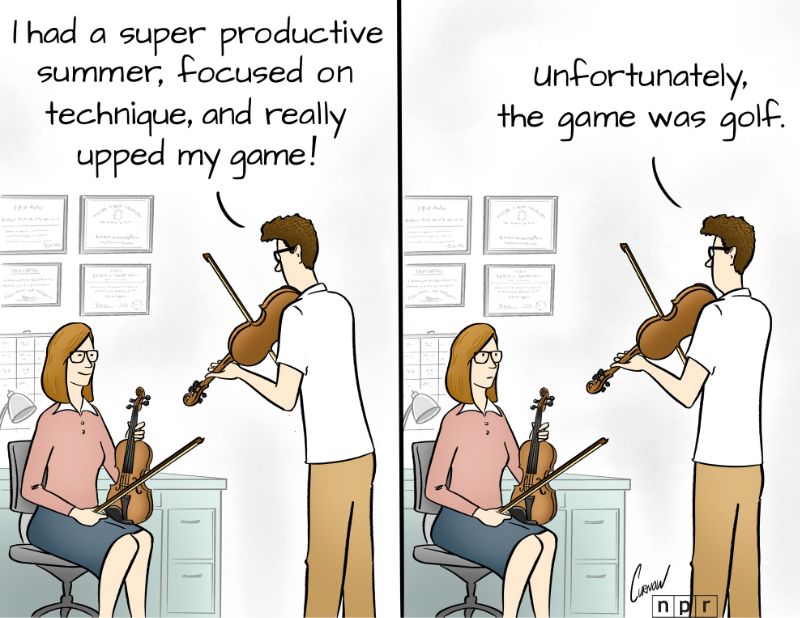
A Super Productive Summer!

 August 31st, 2026


Credit: NPR Classical on Facebook

Friday, August 28, 2026

If Beethoven was German, then why did he have the Dutch "van" Beethoven instead of the German "von" Beethoven?


“Beethoven” itself is not German either.

‘Beet‘ is Flemish and means “turnip.” And ‘hoven’ means “field.” So Beethoven should actually be called “Rübenacker” in high german.

Beethoven's family comes from Mechelen in Flanders. So the whole name is Flemish.

If you dig a little deeper, you'll find that the Beethovens themselves probably came from “Bettincourt,” which is the French name for a beet field or turnip field. “van Beethoven” thus means just “from Bettincourt”.
Beethoven's ancestors translated their name from French into Flemish, but then kept it when they moved to Germany.

And to be honest, I'm grateful for that, because “von Beethoven” sounds much better than “vom Rübenacker”.

Returning to the studio


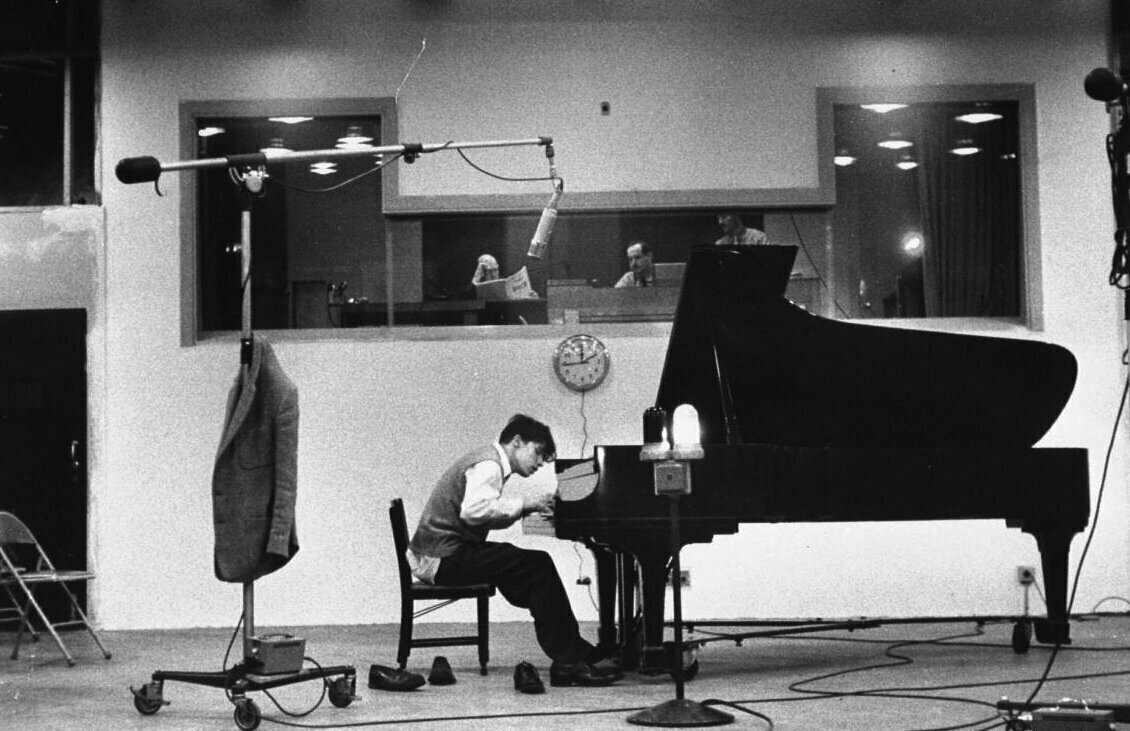
Glenn Gould recording at the studio


When Gould re-recorded the Goldbergs in 1981, recording technology had advanced considerably (stereo and Dolby surround sound had been invented and digital recording/editing could be used for mainstream recordings). This gave the artist greater flexibility, with the possibility of multiple takes to create a recording with which he was entirely satisfied. Gould had been unhappy with the tempi in the first recording and felt there was no sense of cohesion or narrative flow between the individual variations. The 1981 recording is undoubtedly that of a mature artist: the tempi are thoughtful, almost autumnal, and there is much greater expression throughout the variations. There are elegance and nobility rather than swooning, nervous energy.  

Gould’s two recordings of the Goldberg Variations demonstrate something profound – that two different approaches to the same notes say a great deal about how one ages and how tastes change over time.

The weather changes. The admirable impetuousness of youth usually yields to a more considered view
– John Humphreys, concert pianist

A recording is a snapshot in time, yet preserved forever, unlike a live performance which is a one-off, never to be repeated. Many artists are dissatisfied with their recordings because they know that they never play the same thing in exactly the same way and no sooner has a recording come out, than they wish they had done things differently. As amply demonstrated by Gould’s Goldbergs, the passage of time allows one to reflect on one’s repertoire and how one plays it. One’s perception of the music changes with time and so it makes perfect sense to re-record from a different, more mature perspective.

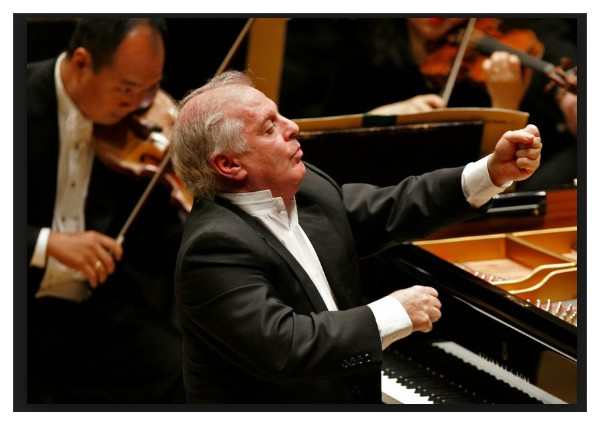
Daniel Barenboim

Daniel Barenboim


Other notable “repeat” recordings include Daniel Barenboim’s Beethoven Piano Sonatas. Barenboim was a young man when he recorded his first cycle (between 1966 and 1969), and like Gould’s 1955 Goldbergs, there’s an excitement and spontaneity in these readings. He re-recorded the sonatas for Deustche Grammophon in 1981-84 and two decades later Decca released the audio soundtracks of DB’s live performances of the sonatas (performed and filmed in Berlin’s Staatsoper unter den Linden and issued by EMI on DVD). Like Gould’s Goldbergs, these make for fascinating listening, offering one the opportunity to chart the performer’s artistic and interpretative development and maturity, resulting in new or renewed approaches to the music.


That artists choose to re-record works is a mark of how one develops as an artist: one does not and should not stand still artistically. Our responses to our music change with time, experience, growing maturity, and when we return to music we should always find something new within it. For some musicians, capturing the artistic changes that happen across their careers is an important goal and re-recording certain works is a way of marking these changes. In other instances, musicians respond to pressures from a record label: when an artist moves to a new label, they may be encouraged to re-record works to match the success of a previous label.

The best re-recordings don’t recreate, they reinvent. And while listening to them, we try to discover what motivations and inspirations stand behind them.

Making Fun of the Master Richard Wagner in Caricature

 by Maureen Buja  June 24th, 2023


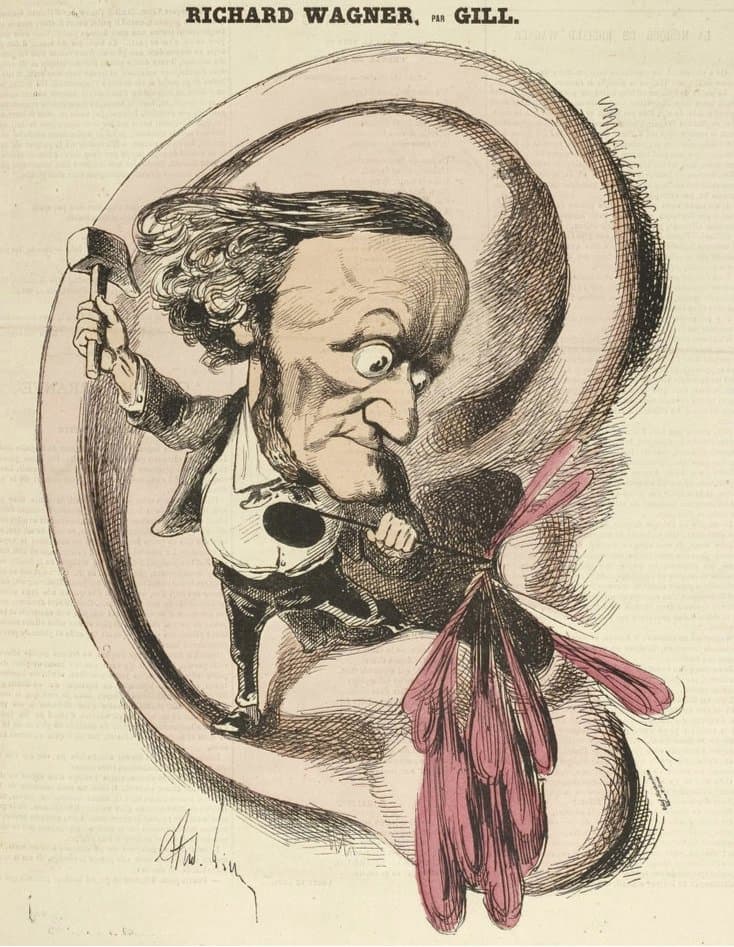
The French caricaturist André Gill (1840–1865) had a style that depicted enlarged heads on tiny bodies. He drew Wagner determinedly breaking a listener’s ear by hammering a note into place.

Gill: Wagner, 1868

Gill: Wagner, 1868

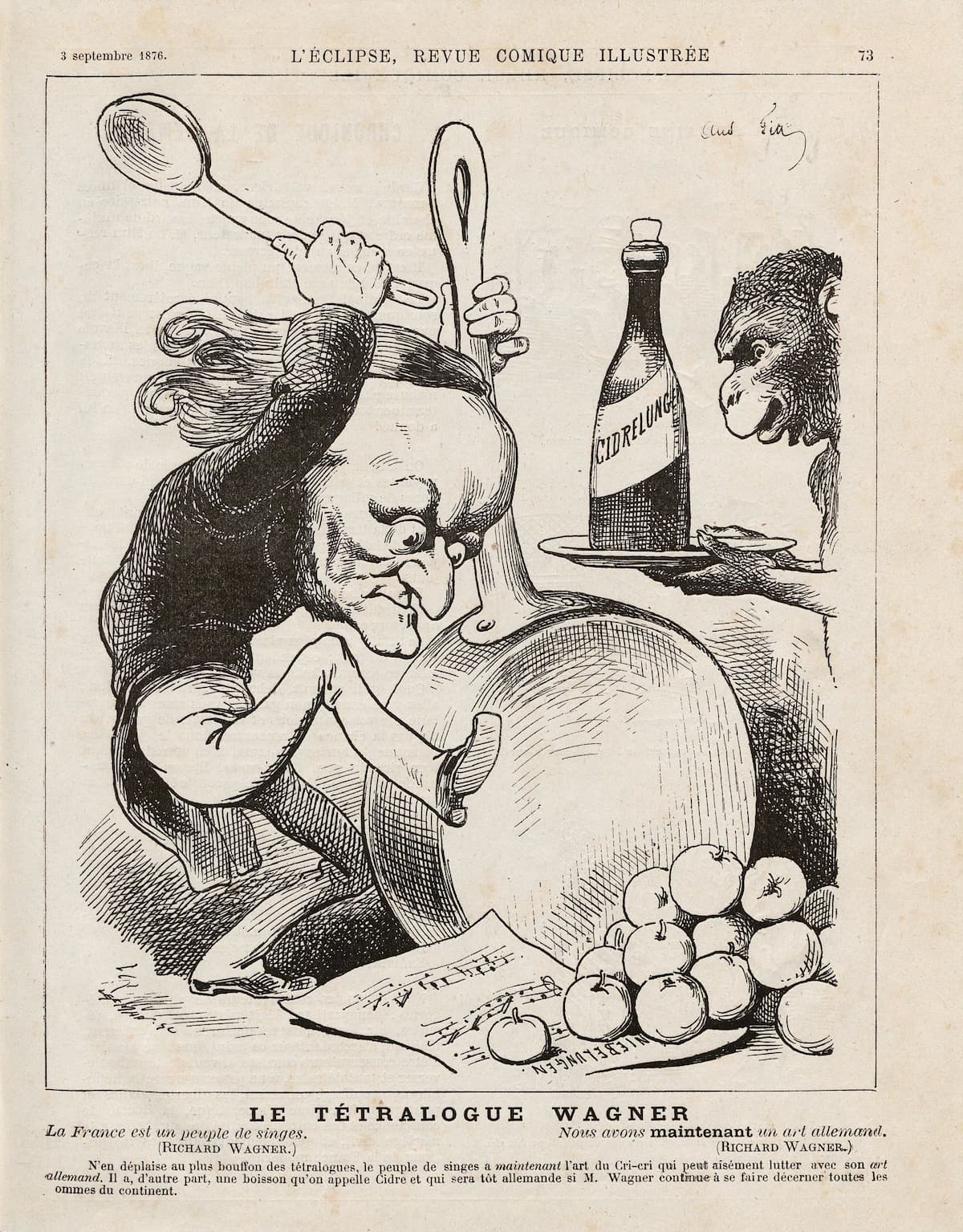
8 years later, Gill took on “The tetralogist” Wagner by showing him relentlessly banging a pot and being served apple cider by a monkey. Wagner, in the caption, dismisses the French “The French are a people of monkeys” and the cartoonist saying that the ape people now have the art of the scream, which will easily compete with Wagner. Wagner was quoting Voltaire, who called the French a mix of monkeys and tigers (Wagner: Art and Politics, 1868), but the French quickly took the quote out of context.

Gill: Le Tétralogue Wagner, 1876 (L’Eclipse, September)

Gill: Le Tétralogue Wagner, 1876 (L’Eclipse, September)

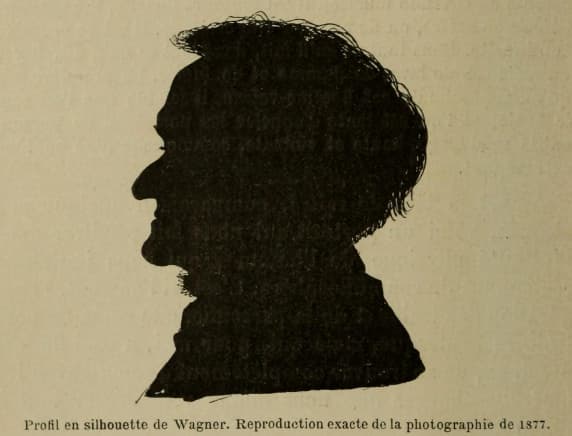
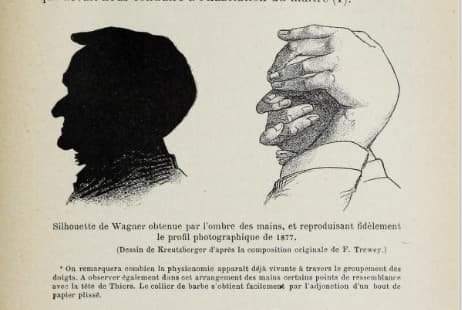
Another caricature helpfully shows how to create a shadow image of Wagner, although it does require holding your hands in seemingly impossible positions (and the note that the beard should be made with a piece of folded paper).

Trewey: Silhouette of Wagner, 1877

Trewey: Silhouette of Wagner, 1877


Kreutzburger: Silhouette de Wagner (after Trewey), ca. 1877

Kreutzburger: Silhouette de Wagner (after Trewey), ca. 1877

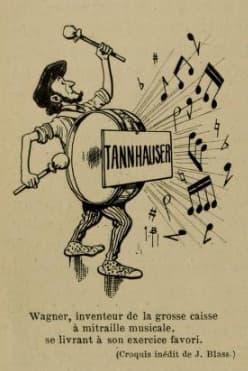
The overwhelming use of brass and percussion in Wagner’s scores led to several caricatures including this one showing Wagner beating his own drum for Tannhäuser.

Blass: Wagner, inventor of the bass drum with musical grapeshot, indulging in his favorite exercise

Blass: Wagner, inventor of the bass drum with musical grapeshot, indulging in his favorite exercise

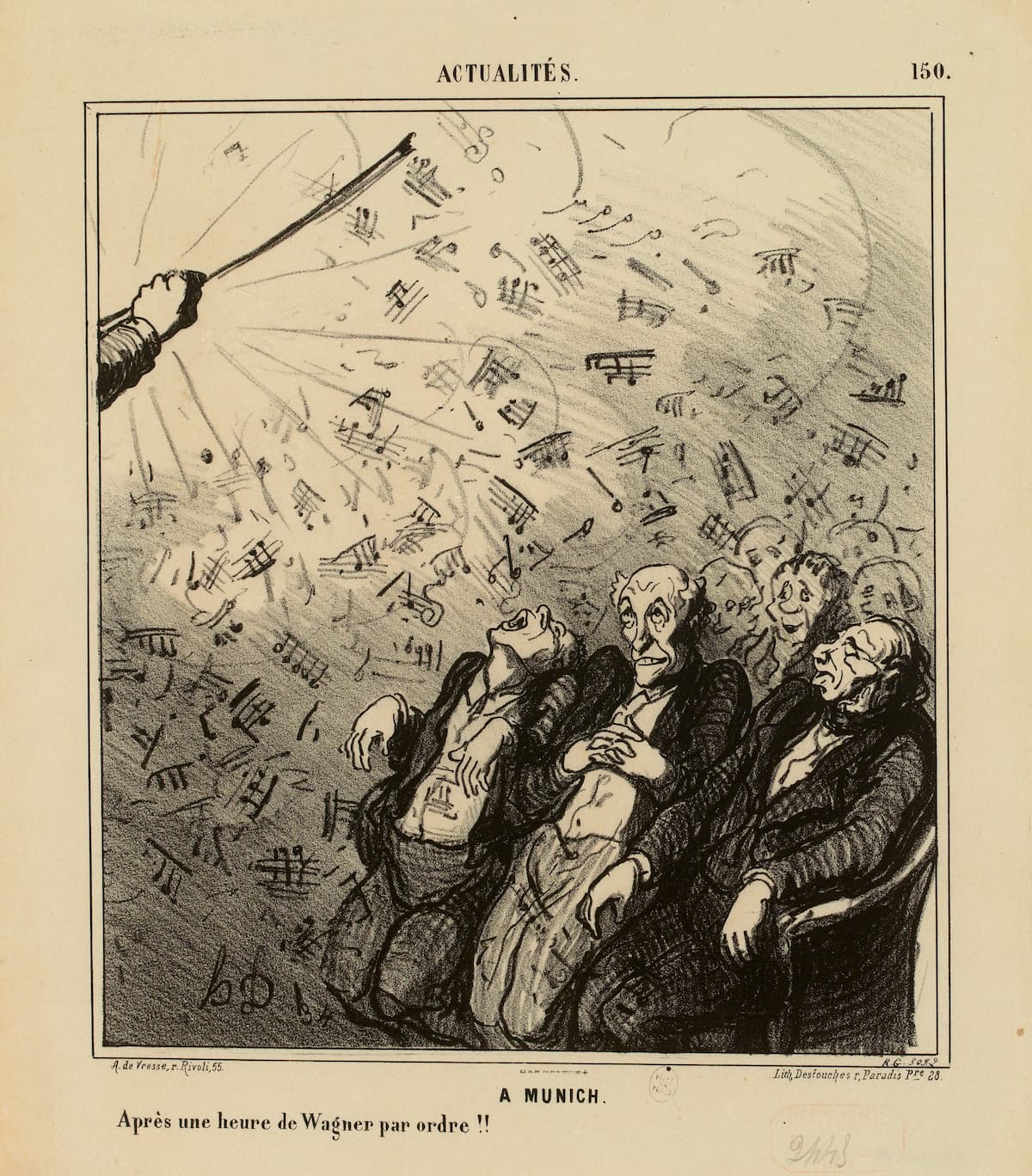
Honoré Daumier (1808–1879) depicts an audience that has been forced ‘par ordre’ to listen to an hour of Wagner. They slouch, they fall asleep, they endure, battered by a hail of notes, wielded by an authoritative hand.

Daumier: A Munich. Après une heure de Wagner par ordre!!, 1868 (Le Charivari, July 8, 1868)

Daumier: A Munich. Après une heure de Wagner par ordre!!, 1868 (Le Charivari, July 8, 1868)

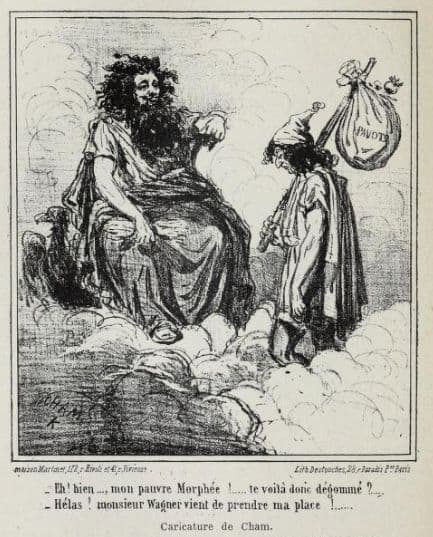
The downside of this is a complaint that Sleep (Morpheus) brings to Zeus – carrying his sack of poppies on his back, he’s out of job, replaced by Wagner.

Cham: Morpheus is out of a job, 1861

Cham: Morpheus is out of a job, 1861

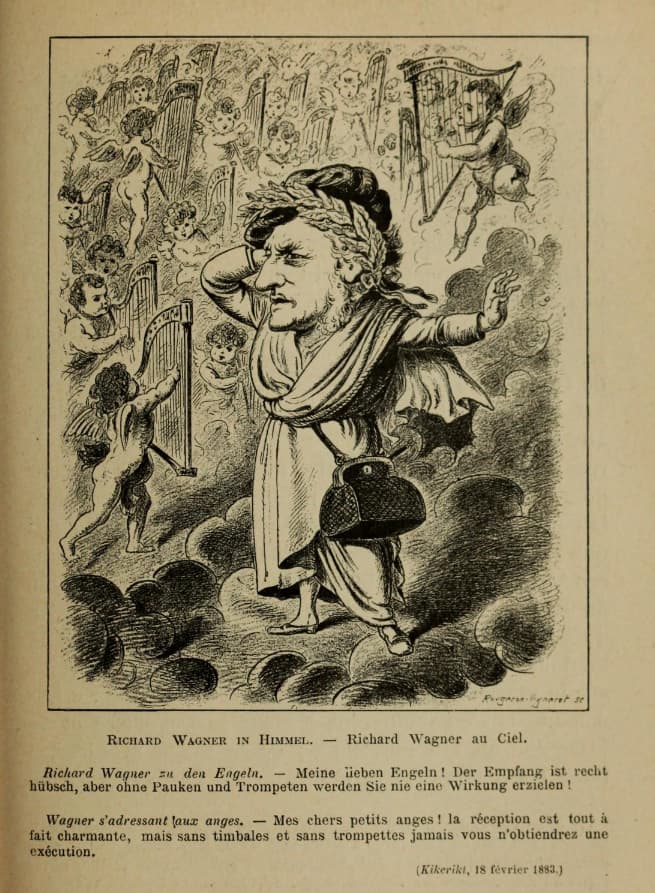
Another caricature, after the death of Wagner, shows him arriving in heaven and thanking the angels for the receptions but complaining that there aren’t enough trumpets and drums – you’ll never get a production without them!

Wagner in Heaven, 1883

Wagner in Heaven, 1883

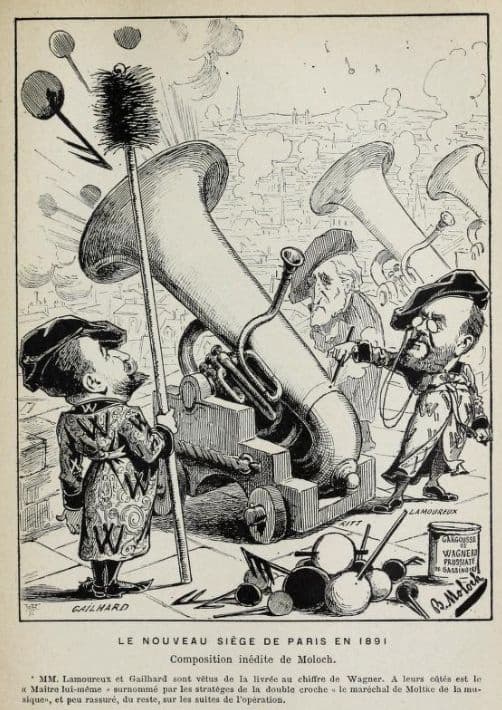
In a caricature after the death of Wagner, the theatre director Pierre Gailhard (1848–1918), director of the Paris Opera, and the French conductor Charles Lamoureux (1834–1899) bombarded Paris in 1891 with Wagner. They are dressed in ‘the livery of Wagner’, with ‘W’ embroidered everywhere. Wagner is depicted between the two mighty horns as a ghostly shadow. Written under the cannon is ‘Ritt’, director of the Paris Opera, for whom Gailhard worked.

B. Moloch: The New Siege of Paris in 1891.

B. Moloch: The New Siege of Paris in 1891

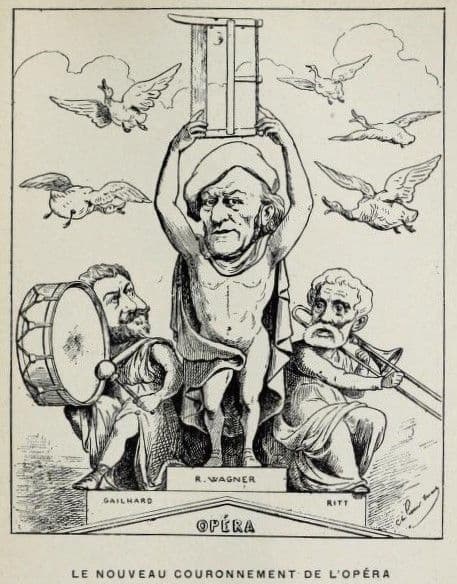
In another depiction of the Opera, Pierre Gailhard and Eugène Ritt (1817–1898) are shown on the peak of the Paris Opera holding a drum and a trombone (more brass and percussion!). Between them, holding a two-handed saw is Wagner. This caricature followed the premiere of Lohengrin at the Opèra.

Gilbert-Martin: Le Nouveau Couronnment de l’Opéra, 1891 (Le Don Quichotte, vol. 18, no. 399)

Gilbert-Martin: Le Nouveau Couronnment de l’Opéra, 1891 (Le Don Quichotte, vol. 18, no. 399)

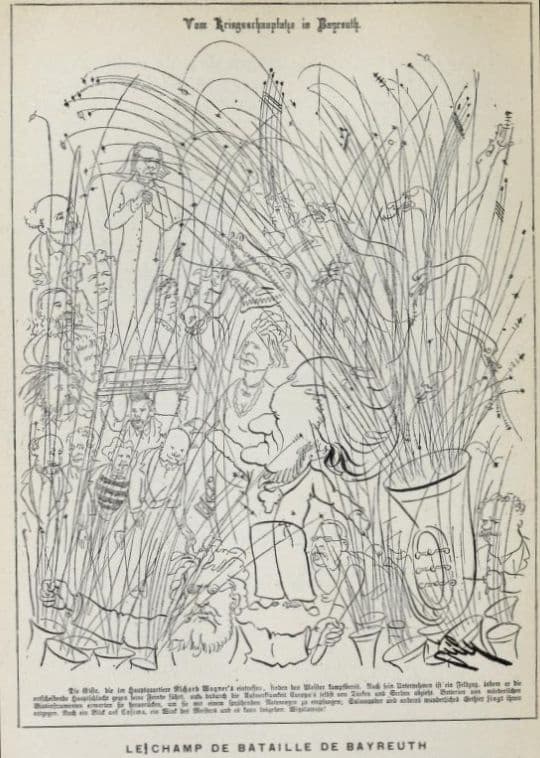
Another assault with brass, but this time depicting the field of battle as Bayreuth. Wagner is shown with the support of Hans Richter, in the foreground, the conductor at Bayreuth. Between Wagner and Liszt on the top left is Cosima Wagner. Below Wagner is Wilhelm Jahn, director of the Vienna State Opera, and the bass-baritone Emil Scaria, who sang in the premiere of Parsifal. We also have the dragon from Siegfried and Brunnhilde’s horse Grane just above Cosima. Other personalities down the left side include the German Emperor Louis II, the composer Johann von Herbeck, the Rhinemaiden Lili Lehman, actor Josef Lewinsky, and pianist Anton Rubinstein.

Klie: The Battle of Bayreuth, 1876

Klie: The Battle of Bayreuth, 1876

We’ll close with some of the greatest entry music of all time.