Friday, February 14, 2025
Morissette - LOVE THE PHILIPPINES (Official Music Video)

Widowhood and a Murder: Dvořák’s Holoubek
by Maureen Buja, Interlude
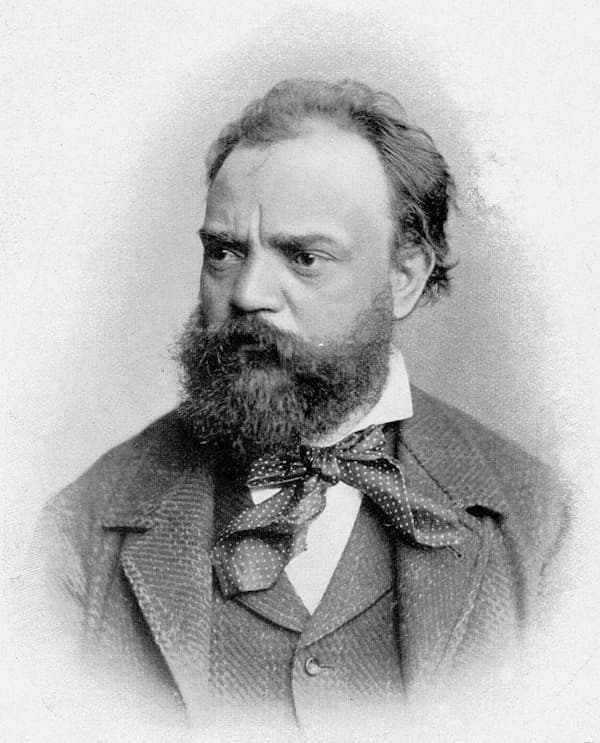
Antonín Dvořák, 1882
This development of the symphonic poem, all based on one literary source, was not unprecedented for Dvořák. Earlier works had literary elements, the most familiar perhaps being in his works written in America (the New World Symphony and the American Quartet).
The Garland, or, to give it its full name, The Garland of National Legends, was a cycle of 13 ballads. Holoubek, or The Dove (The Wood Dove, the Wood Pigeon) story starts in a graveyard. A widow mourns her recently departed husband and is seen by a passing youth (handsome, of course). After three days of resistance, she accedes to his demands and in a month they are married. The story then turns – she’s a widow because she gave her first husband a deadly potion so she could marry the handsome youth, and then at the end of the poem, after 3 years with her new husband, the sound of the dove, cooing in the oak tree over her first husband’s grave, drives her to suicide.
The tone poem opens with a funeral march, with a recurring march-beat of the funeral procession under the melodies. The flutes and violins bring in the young widow, but the following subject, on oboe and trumpets, belies the presented innocence. The widow’s tears, sarcastically presented in the flutes and violins, are another indication of her false heart. The handsome young man is signalled by a distant trumpet. The funeral march continues, but in a more spritely manner – perhaps the inconsolable widow is approachable after all!
The central section is the wedding of the widow and her new husband.
In the final section we return to the graveyard and the mournful call of the dove in the oak tree above the husband’s grave. Dvořák gives this an eery setting with harp and strings, wailing flutes, and a crying oboe. The widow / bride is driven to remorse and drowns herself, and the funeral march returns at the end. Although Erben’s poem ends with a pitiless description of her grave – no tombstone and her head laid only on a rock, buried in the middle of a field – Dvořák gives us an optimistic ending with a return of the dove’s song and the minor key turned to major one.
Antonín Dvořák: Holoubek, Op. 110, B. 198
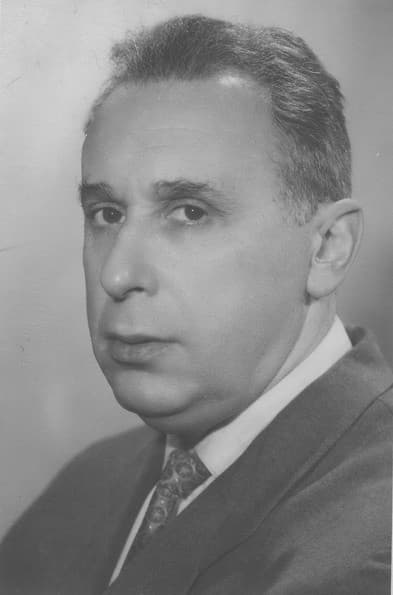
Nikolai Ravinovich
This recording was made in 1954 with Nikolai Rabinovich conducting the Leningrad Philharmonic Orchestra.
Nikolai Rabinovich (1908–1972) graduated from the Leningrad Conservatory in 1931 and was appointed professor of conducting there in 1968. His students included Yuri Simonov, Neeme Järvi, Vladislav Chachin, Vitaliy Kutsenko, and Victor Yampolsky, all of whom had exemplary conducting careers.
The Leningrad Philharmonic Orchestra, now the Saint Petersburg Philharmonic, was founded in 1802 and started as the orchestra for the Court of Alexander III of Russia. Its period of greatest achievement occurred under the leadership of Yevgeny Mravinsky, who led it for 50 years (1938–1988). This saw its first tours to the west and the start of their studio recordings. Under Mravinsky, the orchestra recorded seven of Shostakovich’s symphonies.
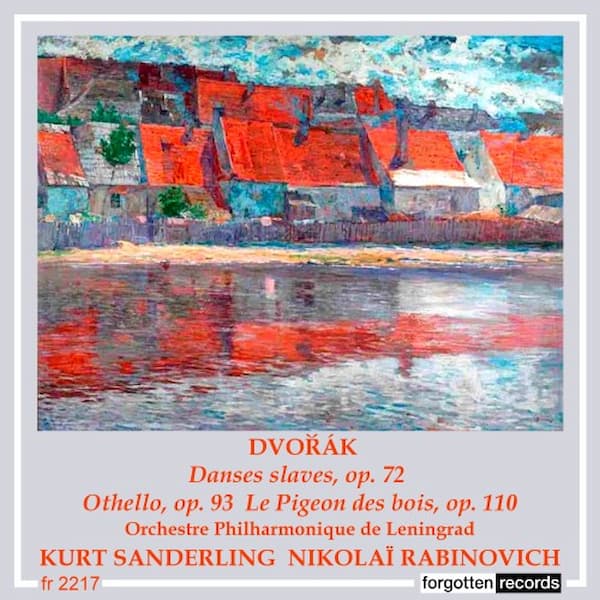
Performed by
Nikolai Rabinovich
The Leningrad Philharmonic Orchestra
Recorded in 1954
Official Website
For more of the best in classical music, sign up for our E-Newsletter

Buried Treasures: Felix Mendelssohn: Concerto for Piano, Violin and Strings in D Minor (1822)
by Georg Predota, Interlude
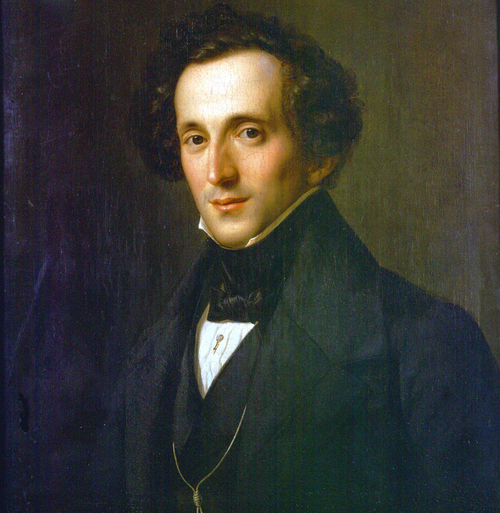
Felix Mendelssohn
When Felix Mendelssohn (1809-1847) died at the incredibly young age of thirty-eight, he simply had not yet made arrangements for literally hundreds of unpublished musical manuscripts and artworks, alongside thousands of personal letters to and from the composer. During his lifetime, and for a short period thereafter — with a large number of music published during a period of two years following his death — Mendelssohn was almost universally lauded musical genius. What is more, Mendelssohn was also the artistic director and chief conductor of The Gewandhaus (Garment House) in Leipzig, a venue that has long been recognized as one of the most important performing centers in Europe. Under his tutelage and leadership, the Gewandhaus Orchestra became a cultural institution. Mendelssohn not only initiated the revival of music by Bach, Handel, Haydn and Mozart, he also assured that his brand of musical historicism was disseminated throughout Europe and beyond. With the help of Richard Wagner who declared “Judaism the evil conscience of our modern civilization” in his 1850 treatise Judaism in Music, Mendelssohn and his music were quickly subjected to deliberate and systematic forms of historical revisions. And when Wagner declared Mendelssohn’s music “an icon of degenerate decadence,” publishers far and wide declined to make his manuscripts and letters public.
Of course, Wagner was not able to completely erase or dismiss Mendelssohn’s influence on Germanic arts, nor was he able to excise him from music-historical memory. This, of course, led to serious irritation within the propaganda machinery of Nazi Germany, and his name was promptly added to various lists of forbidden artists. At that time, according to Stephen Somary, founder and artistic director of the Mendelssohn Project, “a majority of Mendelssohn manuscripts — both published and unpublished — were housed in the basement of the Berlin State Library. They were smuggled to Warsaw and Krakow during the winter of 1936/37, and when the city fell under Nazi control in 1939, they were hurriedly smuggled out again and disbursed to locations wide and far between.” Following WWII, the majority of manuscripts remained buried behind the Iron Curtain. Haltingly, various unknown versions and unknown compositions were discovered and made available in one form or another.
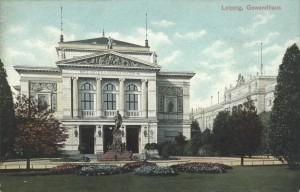
The Gewandhaus
Initially, these efforts focused on works Mendelssohn composed before his 14th birthday, pieces that had originally been presented at private concerts at the Mendelssohn home. Among them various sonatas for viola and for violin, religious choral music, numerous piano compositions and even a fourth opera. But it also included a succession of concertos, among them a concerto for piano and string orchestra in A minor (1822) and two concertos for two pianos and full orchestra in E and A-flat, originating from 1823 and 1824, respectively.
The concerto for violin, piano and string orchestra in D minor was composed for an initial private performance with his best friend and violin teacher Eduard Rietz. On 3 July 1822, Mendelssohn revised the scoring, adding timpani and winds and the premiere of this version was apparently performed on the same day. For reasons detailed above, it remained unpublished until 1960, when the Astoria Verlag in Berlin issued a miniature score, edited and arranged by Clemens Schmalstich. In 1966, Theodora Schuster-Lott and Frieder Zschoch prepared a scholarly edition for the Deutsche Verlag für Music as part of the new Mendelssohn complete edition, “which was engraved, but never published except in a reduction by Walter-Heinz Bernstein for violin and two pianos.” Finally, in 1999 the 1960 miniature score was reissued in a scholarly edition with the wind and timpani parts added. And just in case you are wondering, the A-minor Piano Concerto of 1822 had until recently been unavailable in any edition, and the Concerto for two pianos and orchestra in E major, composed as a birthday gift for his sister Fanny, had to wait until 2003 before audiences could get a listen to the original version.
And just in case you are interested in all the works and versions by Felix Mendelssohn, they are now available to the general public and performing artists, have a quick look at this link!
Tuesday, February 11, 2025
Beethoven - Symphony No. 7 (Proms 2012)
Prom 13: Beethoven Cycle -- Symphonies Nos. 7 & 8
Beethoven - Symphony No. 7 in A major, Op. 92
1 - Poco sostenuto -- Vivace
2 - Allegretto
3 - Presto -- Assai meno presto (trio)
4 - Allegro con brio
West-Eastern Divan Orchestra
Daniel Barenboim, conductor
Royal Albert Hall, 24 July 2012
Reminisce and cherish those memories of love
Reminisce and cherish those memories of love through the songs of your life this Valentine's Day.

Friday, February 7, 2025

Subscribe to:
Posts (Atom)
-
The BoholTimes MUSIC can raise someone’s mood, get them excited, or make them calm and relaxed. Music also – and this is important – allow...
-
2,261,443 views May 15, 2019 SUNTORY HALL Munich Philharmonic conducted by Valery Gergiev, Tokyo Suntory Hall Dec 1, 2018 00:05 - 15:5...
-
Yes, this first piano concerto by Tschaikowsky still brings tears into my eyes. Tchaikovsky (or Tschaikowsky) was the second of six survi...


