5,754,858 views • Mar 1, 2012
Sunday, September 29, 2024
David Foster - Earth,Wind&Fire "September" and "After The Love Has Gone"

The Manhattan Transfer - Chanson D'Amour (Live, 1978)
578,058 views • Nov 3, 2022
Luciano Pavarotti. 1987. Nessun dorma. Madison Square Garden. New York
Friday, September 27, 2024
Learn EVERY Chord and Chord Symbol - The 7 Systems
Heinrich von Herzogenberg - his music and his life
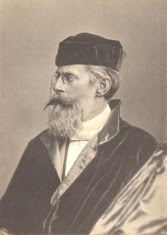
Born: June 10, 1843 - Graz, Austria
Died: October 9, 1900 - Wiesbaden
The Austrian composer, Heinrich von Herzogenberg, was the son of an Austrian Court official. He received his early education in the humanities at the Gymnasien in Feldkirch (Vorarlberg), Munich, Dresden, and Graz. In 1861, he enrolled at the University of Vienna and began a course of study in law and philosophy. This, however, was short-lived, as in 1862 he left the university to become a composition student of Felix Otto Dessoff, a professor at the Vienna Conservatory. Herzogenberg was to study with Dessoff for the next two years. It was at Dessoff's house that Heinrich first encountered Johannes Brahms. The two soon formed a lifelong friendship, with Herzogenberg devoting himself to the promotion of Brahms' music. Although he seems to have valued Herzogenberg's criticism of his own work, Brahms appears to have never found it in himself to take Herzogenberg seriously as a composer. In 1868, Herzogenberg married Elisabeth von Stockhausen (1847-1892), the daughter of a Hanoverian Court diplomat, and a pianist and composer in her own right. Von Stockhausen too shared a close friendship with Brahms, who seems to have valued von Stockhausen 's insights even more than those of Heinrich. It was through the family's interactions with Brahms that the Herzogenbergs came into contact with some of the most notable figures in German music at that time, including Robert and Clara Schumann.
For a period of four years, the Herzogenbergs lived in Graz, where Heinrich worked as a freelance composer. Then, in 1874, they moved to Leipzig where, with Philipp Spitta and several others, Heinrich was to found the Leipzig Bach-Verein (Bach Society). He became the director of the group in 1875, a position he held for the next ten years. In 1885, Herzogenberg was appointed professor of composition at the Berlin Hochschule für Musik, succeeding Friedrich Kiel. From 1889, in addition to his other teaching duties, he also conducted a master class in composition at the Hochschule. It was also in 1889 that Herzogenberg was elected a member of the Akademie and when he began his tenure as director of the Meisterschule für Komposition in Berlin, a position he was to hold from 1889 to 1892 and again from 1897 to 1900. Elisabeth's death, in 1892, seems to have been a heavy blow to Heinrich, who subsequently buried himself in his work. Later that year, he returned to his position at the Hochschule after an absence due to ill heath, no doubt compounded by his grief over the death of his wife. Herzogenberg continued teaching until 1900 when further ill health forced him to retire; he died shortly afterwards.
As a contemporary of Johannes Brahms, Heinrich von Herzogenberg spent most of his compositional life living in the shadow of Brahms' gigantic stature. Herzogenberg's works represent a great divergence in styles and influences. His output is vast and takes the form of every musical genre with the exception of opera. He wrote many concert works with sacred texts, three oratorios; several choral orchestral works, including two psalms, a mass, a requiem, several motets, and a sacred cantata; two symphonies; chamber music including three string quartets; music for piano and organ; many secular part songs (with and without accompaniment for mixed, men's, and women's choirs); and despite being a lifelong Catholic, many short liturgical works for the Protestant liturgy. In general, his music can be said to exhibit a general Brahmsian surface. The piano works in particular, which were initially influenced by Schumann, as well as the chamber music, are clearly modeled on the music of Brahms. However, beneath these surface commonalties, Herzogenberg's music illustrates not only a variety of other influences, but also the hand of a master composer in his own right. In some of his early works, he was intent upon following the path of the "New German School." A later rejection of the "New German" compositional ideology led the young Herzogenberg to a course of study using as a model the music of J.S. Bach. This interest in early music (especially the music of Bach and Heinrich Schütz) was a trait that was greatly fostered by Spitta and took form in Herzogenberg's church music, especially that of the composer's later years.
Works
While Herzogenberg has tended to be characterized as a mere epigone of Brahms, many of his compositions show little or no overt Brahmsian influence, for example his two string trios Op.27 Nos. 1 & 2, while some early compositions pre-dating his acquaintance with Brahms have features in common with the older composer. He wrote much choral, orchestral, instrumental and chamber music, including eight symphonies (one being a programmatic symphony entitled Odysseus). His early Theme and Variations, op.13, for two pianos (1870) is a notable work in its genre. Important works choral include the cantata Todtenfeier, op.80 (1893) in memory of his wife; Mass in E minor, op.97 (1894) in memory of Spitta and the oratorio Die Geburt Christi, op.90 (1894) with a libretto by Spitta’s brother Friedrich. He wrote a great deal of chamber music: 2 string trios Opp.27 Nos 1 & 2, 5 string quartets Opp.18,42 Nos.1-3, & 63, a string quintet (2 violas) Op.17, 2 piano quartets Opp.75 & 95, 2 piano trios Opp.24 & 36, a trio for piano, oboe & horn, Op.61 and several sonatas for various instruments. Today, the general consensus of critics and scholars is that his contribution in this area is his most important.
The Lesbian Diva and Swordswoman!
Julie d’Aubigny aka Mademoiselle Maupin
by Georg Predota, Interlude
When Julie d’Aubigny, born around 1673, first started her singing career at the Marseille Opéra, she quickly fell in love with a young woman. As you might well imagine, the girl’s family was not particularly amused and shipped their daughter to a convent in Avignon. Julie, undeterred, followed her lover into nun hood. When an elderly nun died, the couple stole the body and placed it in the girl’s cell. Then they set fire to the convent to cover their tracks and escaped! As such behavior was generally frowned upon, Julie was charged with kidnapping, body snatching, arson, and failing to appear before the tribunal. The judges could not quite admit to the possibility of one woman abducting another from a convent, and sentenced her in absentia—as a male—to death by fire! What a remarkable story, but who was Julie d’Aubigny, better known as Mademoiselle Maupin?
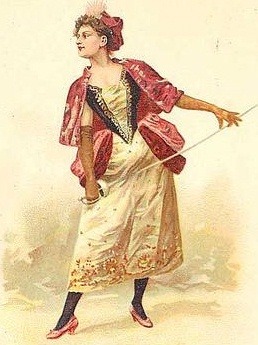
Mademoiselle Maupin
Julie’s father, an accomplished swordsman, was a secretary to King Louis XIV’s Master of Horse, Count d’Armangnac. He educated his only daughter alongside the boys training as court pages, and Julie dressed as a boy and was easily the best fencer in the group.
At age 14 she became d’Armagnac’s mistress, and she was also quickly married to Sieur de Maupin. Neither husband nor lover held her fascination for very long, so she ran away with a fencing master named Séranne. They made a living from fencing demonstrations at local fairs, and when a spectator refused to believe that she was a woman, she simply took off her blouse! Once they arrived in Marseille, she joined the opera company run by Pierre Gaultier and appeared under her maiden name. She left Séranne for the young woman, and you already know her convent story. Once again on the run, and dressed as a man, she was insulted by the Count d’Albert and quickly fought a duel. Apparently, she drove her rapier through his shoulder, and when she asked about his health the very next day, they became lovers and lifelong friends!
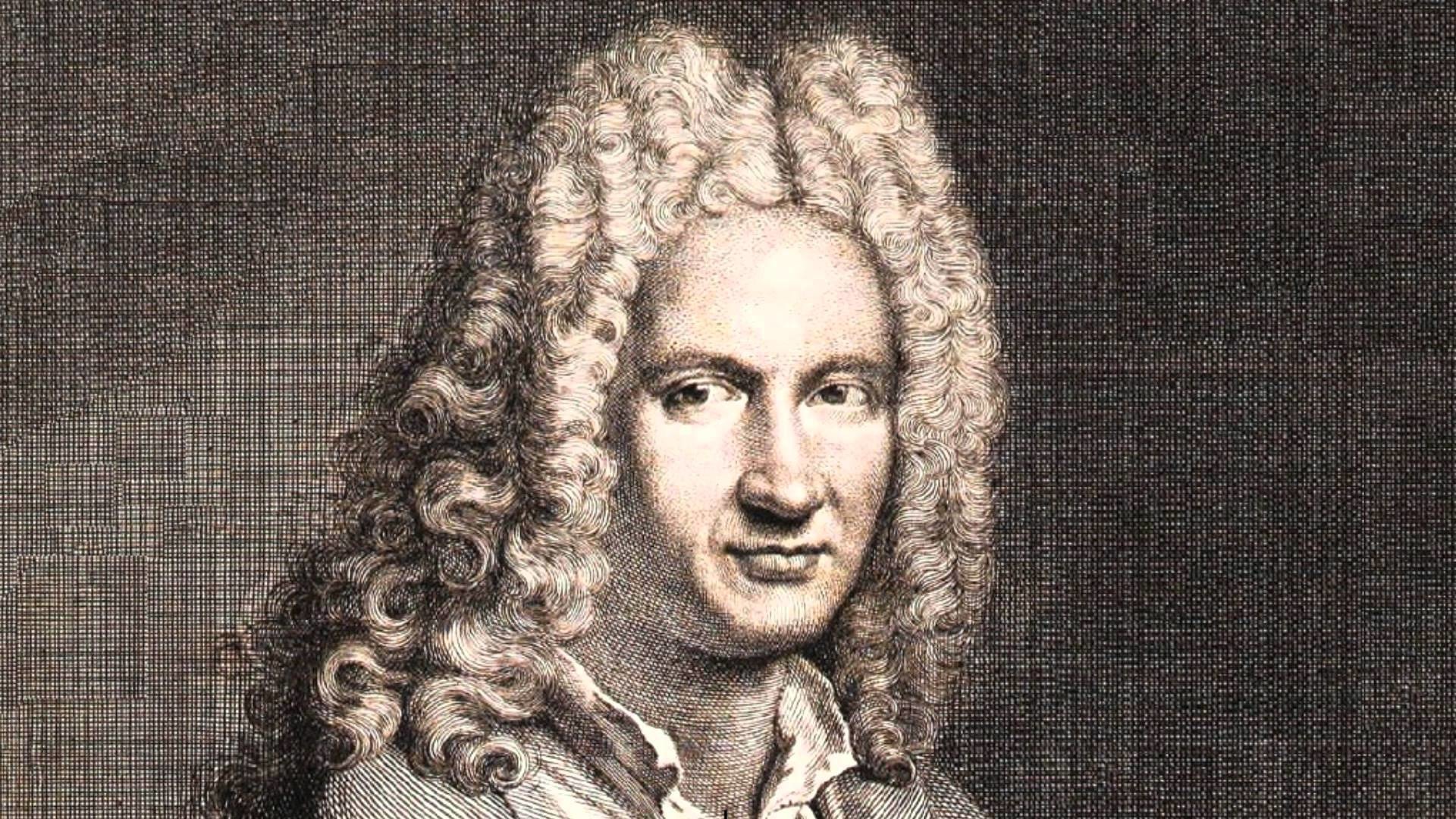
André Campra
Julie’s dream, however, was to become an opera star. As such, she auditioned for the Paris Opéra, was pardoned for her crimes by the King, and by age 17 became a member of one of the world’s greatest musical companies. She appeared in all of the Opéra’s major productions from 1690 to 1694, and achieved lasting musical fame under her stage name “La Maupin.” And she certainly stayed in the limelight with a number of high-profile off-stage scandals. Dressed in men’s clothing, she kissed a young woman at a court ball and was challenged to a duel by three different noblemen. She easily defeated all three, but since duels had been outlawed, she had to flee to Brussels. There, she became the lover of the Elector of Bavaria—who found her entirely too much to handle—and in Madrid she worked as maid to the Countess Marino. Back in Paris, she became infatuated with the soprano Fanchon Moreau, “tried to hill herself, threatened to blow the Duchess of Luxembourg’s brains out, and ended up in court for attacking her landlord.”
In 1703, La Maupin fell in love with the “most beautiful woman in France,” a certain Madame la Marquise de Florensac. According to contemporary accounts, the two women “lived in perfect harmony for two years.” When de Florensac died of a fever in 1705, La Maupin retired from the opera and sought refuge in a convent. She died in 1707 at the age of 33, and one biographer wrote, “destroyed by an inclination to do evil in the sight of her God, and a fixed intention not to, her body was cast upon the rubbish heap.” Théophile Gautier wrote his celebrated novel Mademoiselle de Maupin in 1835, and a number of opera roles were specifically created for her. Among them was the role of “Clorinde” in André Campra’s Tancrède, premiered in Paris in 1702. The plot is set at the time of the Crusades and depicts the tragic love of the Christian knight Tancrède for the Saracen warrior princess Clorinde. In a drama of misunderstandings and impossible love, he ends up killing her in single combat, when she fights him disguised in the armor of another man.” I don’t know about you, but it’s art imitating life, don’t you think?
Subscribe to:
Posts (Atom)
-
The BoholTimes MUSIC can raise someone’s mood, get them excited, or make them calm and relaxed. Music also – and this is important – allow...
-
2,261,443 views May 15, 2019 SUNTORY HALL Munich Philharmonic conducted by Valery Gergiev, Tokyo Suntory Hall Dec 1, 2018 00:05 - 15:5...
-
Yes, this first piano concerto by Tschaikowsky still brings tears into my eyes. Tchaikovsky (or Tschaikowsky) was the second of six survi...


