Johann Nepomuk Hummel (14 November 1778 – 17 October 1837) was an Austrian composer and virtuoso pianist. His music reflects the transition from the Classical to the Romantic musical era.
Please support my channel:
https://ko-fi.com/bartjebartmans
Piano Concerto No.2 in A minor, Op. 85 (1816)
1. Allegro moderato (0:00)
2. Larghetto (15:28)
3. Rondo - Allegro moderato (19:52)
Stephen Hough and the English Chamber Orchestra conducted by Bryden Thomson
Description by Robert Cummings [-]
Even into the twenty first century, Hummel's music is being assessed and reassessed, always with the view that his genius has been consistently underrated. His piano concertos are among his greatest accomplishments, and he might have excelled in the symphony too, had he not taken to heart so seriously his rivalry with Beethoven. Hummel's Second and Third piano concertos are undoubtedly his most popular, though even they have enjoyed paltry few recordings and relatively meager representation in the concert halls.
The A minor Second is cast in three movements: a lengthy Allegro moderato is followed by a very brief Larghetto and a substantial Rondo (Allegro moderato). The first movement opens with a long orchestral introduction wherein the striking main theme is immediately presented by the strings, a theme whose character is both restless and heroic, looking back toward the darker side of Mozart as well as to the contemporary grandiosity of Beethoven. An alternate melody follows, a jovial, proud creation introduced by the flute. When the piano enters, it gives a lighter treatment to the thematic material that is lighter in touch, but not in emotional expressivity. Hummel's development is full of deft elaborations and brilliant piano writing. His orchestration will recall Beethoven's throughout this movement, but his music has an individuality and great beauty, even if his contrapuntal skills fall a bit short of his great rival's.
The short second movement Larghetto serves as a kind of pleasant interlude between the two larger outer panels. The theme here is delicate and graceful in its Classical sweetness, its music having an almost mesmerizing serenity making one wish it would linger beyond its lovely five minutes. The Rondo finale follows without pause, the piano introducing a somewhat exotic rhythmic theme that gradually picks up momentum and richer textures. The music is striking here, the melody instantly sticking in the mind, so much so as to make the alternate material initially sound less interesting by contrast. The more subdued music that alternates with this theme is revealed upon second and third hearing, however, to be just as finely imagined as the opening theme. In the end, this concerto must be assessed as standing on about the same plateau as Beethoven's first two piano concertos.
Monday, April 3, 2023

Legendary Cuban songwriter, composer and pianist gained world fame

Cuban-born, Ernesto Lecuona is the dominant musical force to have come out of the island nation, and without question one of the major contributors to the emergence of Latin music as a power in the world marketplace. Often called 'the Gershwin of Cuba,' he was friendly with George Gershwin and with the composer Maurice Ravel, who once called Lecuona's immortal "Malaguena," "more melodic and beautiful than my own "Bolero." Lecuona was friendly with many of the most influential composers and musical personalities of his moment in time, and his style and use of forms have influenced all Latin music, even the salsa of today.
Ernesto Lecuona was born in Guanabacoa, Cuba, across the bay from Havana, on August 6, 1895, but for an unexplained reason he actually observed his birthday as August 7, 1896. His musical talent was already discernible at age three. Following initial piano studies with his sister, Ernestina, he continued at the Conservatorio Peyrellade with Antonio Saaverda and the famed Joaquin Nin. At 17 he graduated from the National Conservatory of Havana with a gold medal in performance.
He had become a prodigious pianist indeed and his talents were soon on view for the first time outside Cuba when he appeared at Aeolian Hall, New York City in 1916. While his ties to his native Cuba were always strong, this initial performance in New York paved the way for an increasing presence in the United States, both as concert pianist and as composer, which eventually led to his permanent move to Florida in 1960, following the rise to power of the Communist leader, Fidel Castro in 1959.
Lecuona produced a veritable torrent of music during his 70 years, including a number of major pop songs, such as the well-remembered, "Malaguena" the bright and rhythmic, "Siboney," with which one can almost hear the clicking accompaniment of castanets "Always in My Heart" and "Andalucia," better remembered for its Americanized version, “The Breeze and I," which became in the late '30s a popular recording hit by the Jimmy Dorsey Orchestra.
While we honor the late Ernesto Lecuona for his wonderful collection of memorable and tuneful songs, his talents in music-making were literally all over the map. In addition to more than 400 songs, he also created 176 piano pieces, 53 theater works (zarzuelas, operettas, theatrical revues and an opera), 31 orchestral scores, 6 pieces for piano and orchestra, 3 violin works, a trio, 5 ballets, 11 film scores and many incidental arrangements.
Lecuona's work stretched considerably beyond the printed score sheet. He was the co-founder of the Havana Symphony Orchestra, the Lecuona Cuban Boys Band and La Orquesta de la Habana. During the '30s and '40s, he was hired to create a number of motion picture scores for MGM, Warner Bros. and 20th Century Fox, and his score for the 1942 Warner Bros. film Always in My Heart was nominated for an Academy Award. At one time he also served as honorary cultural attaché to the Cuban embassy in Washington. He also gave successful performances in Carnegie Hall.
Lecuona, who had moved permanently to Tampa, Florida in 1960, died three years later of a heart attack while on a trip to Santa Cruz de Tenerife in the Canary Islands. He is buried in the Gate of Heaven Cemetery in Hawthorne, NY.
NEVER LET ME GO (2010) - Rachel Portman - Soundtrack Score Suite
Few films are more irritating than those that use a completely unexplained and unsubstantiated science fiction premise to pursue a narrowly focused dramatic narrative. Mark Romanek's 2010 arthouse film Never Let Me Go, based on the acclaimed Kazuo Ishiguru novel, is a tearjerker no doubt, slowly and solemnly following the doomed lives of a trio of youngsters grown from test tubes for the single purpose of serving as organ donors. There exists in society a sub-class of such youth that are harvested and eventually (and prematurely) put to death as part of a widely accepted organ replacement program that devalues the people being used within it. Complications arise when the most progressive school raising these laboratory children yields three people in a troubled love triangle, forcing society to deal with the possibility (surprise, surprise!) that these youths actually can love and have souls. In its limited initial release, Never Let Me Go was praised for tackling this premise, but many critics admitted that it's a bit too heavily introspective for its own good. The blinding problem with this otherwise compelling story is the total disregard of any addressing of the larger civil rights issues that would never allow such a public practice to exist in today's world. It's one thing to postulate that society will have degraded enough by Bladerunner to accept replicated people with an artificially limited lifespan, but for Never Let Me Go to suggest that an entire class of essentially slaves to the rest of humanity (and ones as attractive as Kiera Knightley, Carey Mulligan, and Andrew Garfield, for that matter) would be generally accepted in the 1960's and beyond is ludicrous. Regardless of America's degrading social mores, the country still has too much empathy to allow an entire class of children, whether grown in tubes or not, to be brainwashed and harvested in such a morbid fashion. Too many questions abound to make Never Let Me Go a viable film, but for those who can suspend logic for a few hours, it's powerfully acted melodrama made complete (no pun intended for those familiar with the concept) by Rachel Portman's equally depressing score. Once considered the mainstream queen of romantic music, replacing both John Barry and Georges Delerue for a short time in the 1990's, Portman has limited her composing schedule in the 2000's as she raises her family. Her musical output in recent years has been reduced to predictable assignments of her choice, usually dealing with deeply developed female characters in a dramatic setting. In this regard, nothing about what she writes for Never Let Me Go should surprise anyone.
Since her work for Infamous in 2006, Portman's next five scores have all resided snugly in her stylistic comfort zone, none really as much so as Never Let Me Go. There is nothing new to be heard here, and it could be argued quite effectively that the film's dulling sense of gloom, largely maintained by extremely slow pacing, is only exacerbated by Portman's contribution. The ensemble is the composer's usual, beginning with strings and layering piano, harp, flute, clarinet, and oboe. Satisfying additions are solo violin and cello, obviously addressing societal alienation. The tone of the score is always harmonic and rooted in respective beauty, only touching upon grim atmosphere in a few cues late. The structures are repetitive and simplistic. Three themes exist, led by Portman's usual, lovely string idea similar in its flow to so many of her past efforts but still attractive none the less.
The first two themes are the selling point of the score on album, and they occupy the first six cues almost exclusively. This dozen or so minutes of early material makes for an extremely and undemanding Portman listening experience, during which the highlights are the various solos. The clarinet and oboe performances in "To the Cottages" and especially "Madame is Coming" are classic Portman.
Sunday, April 2, 2023
Ralph Vaughan Williams - Fantasia on a Theme by Thomas Tallis
Ralph Vaughan Williams (1872-1958), England
Fantasia on a Theme by Thomas Tallis
for Double Stringed Orchestra
David Nolan, Leader
London Philharmonic Orchestra
Bryden Thomson
Japanischer Musiker und Komponist Ryuichi Sakamoto gestorben

Der Komponist und Mitglied der Berlinale-Jury, Ryuichi Sakamoto, starb am 28.03.2023
Für seine Musik zum Film „Der Letzte Kaiser“ (1987) wurde er mit einem Oscar und einem Grammy ausgezeichnet. Jetzt ist der japanische Filmkomponist, Musiker, Schauspieler und Produzent Ryuichi Sakamoto tot. Er starb bereits am vergangenen Dienstag im Alter von 71 Jahren.
Der japanische Komponist und Oscar-Gewinner Ryuichi Sakamoto ist im Alter von 71 Jahren gestorben. Sakamoto sei bereits am 28. März einem Krebsleiden erlegen, teilte sein Management am Sonntag mit. Der Musiker war für seine Musik zum Film „Der Letzte Kaiser“ (1987) mit einem Oscar und einem Grammy ausgezeichnet worden.
Der Musiker galt als Pionier elektronischer Musik und Wegbereiter für Musikrichtungen wie Synth-Pop, House-Musik und Hiphop. Bekannt wurde er allerdings für seine Filmmusik, unter anderem auch für den Film „Furyo – Merry Christmas, Mr. Lawrence“ (1983). In dem Kriegsdrama trat er neben seinem Freund David Bowie auch als Schauspieler auf. Das Lied „Forbidden Colours“ wurde zu einem internationalen Hit.
Sakamoto lebte jahrzehntelang in New York. In seiner Heimat Japan war er ein großer Star, war in der Anti-Atombewegung aktiv und gründete 2011 einen Hilfsfonds, um bei der Tsunami-Katastrophe zerstörte Schul-Klaviere zu ersetzen. 2014 überstand er eine Lungenkrebserkrankung. 2015 komponierte er die Filmmusik für „The Revenant – Der Rückkehrer“. 2018 saß Sakamoto in der Jury der Berlinale.
Anfang 2021 erklärte der Musiker dann, er befinde sich wegen Darmkrebs in Behandlung. Sein Management veröffentlichte mit der Todesnachricht am Sonntag eines von Sakamotos Lieblingszitaten: „Die Kunst ist lang, das Leben ist kurz.“
AFP/wolf
Friday, March 31, 2023
Musical Prayers for Peace
By Georg Predota

© National Today
In such times of deep political and ideological crisis, it is once again the musical community calling for an end to hostilities and musically praying for peace. And at the head of the class stands once more the celebrated cellist Yo-Yo Ma, appointed by the United Nations a “Messenger for Peace.” Yo-Yo Ma has been reaching out to people all over the globe, inspiring them to address the many challenging social issues we face today. In a recent concert with the New York Philharmonic, he performed a work that Pablo Casals often played to protest war and oppression.
Pablo Casals (1876-1973) was one of the greatest cellists of the twentieth century. He had to flee his native Spain in 1939 when dictator Francisco Franco took control at the end of the Spanish Civil War. Together with thousands of other refugees, Casals was housed in a refugee camp in France. “Casals spent much of his time delivering food and clothing to fellow refugees, and he continued to aid them throughout his life.”
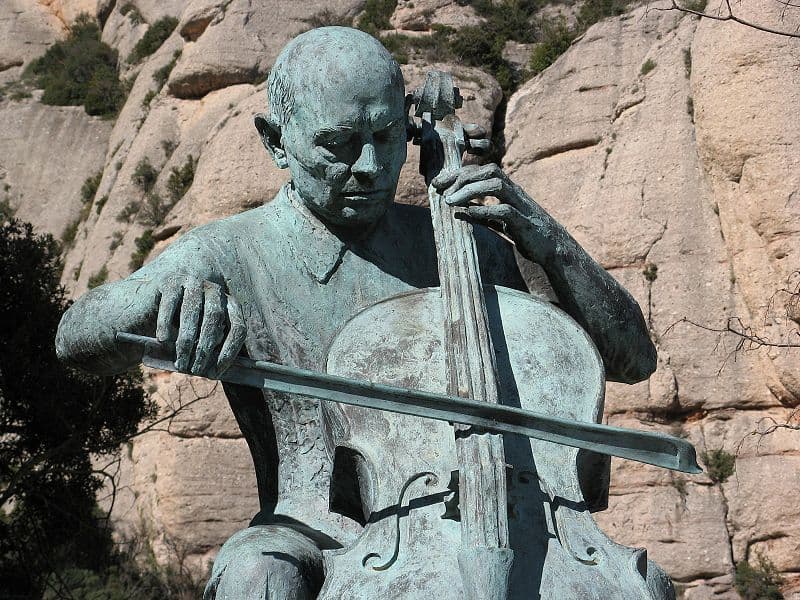
Pablo Casals’ centenary statue
Yo-Yo Ma, at the age of sixteen, played in an orchestra under Casals’ direction. He recalls, “I never forget the way his mind and body would radiate vitality the moment he raised his baton… He saw himself not primarily as a cellist but as a musician, and even more as a member of the human race.” His personal anthem, “The Song of the Birds,” is a traditional Catalan Christmas song and lullaby, and after his exile in 1939, Casals would begin each of his concerts by playing his arrangement for cello.
It might come as a surprise, but the patriotic hymn “Prayer for Ukraine” dates back to 1885, and to a time when Ukrainian culture and language were once again suppressed by the government of Imperial Russia. It has been a very long struggle for independence for Ukraine, as different conquerors have mercilessly fought over this land rich in natural resources and culture. There was a short-lived revolution in 1919 brutally suppressed, and the Soviet occupation inflicted one tragedy after another.
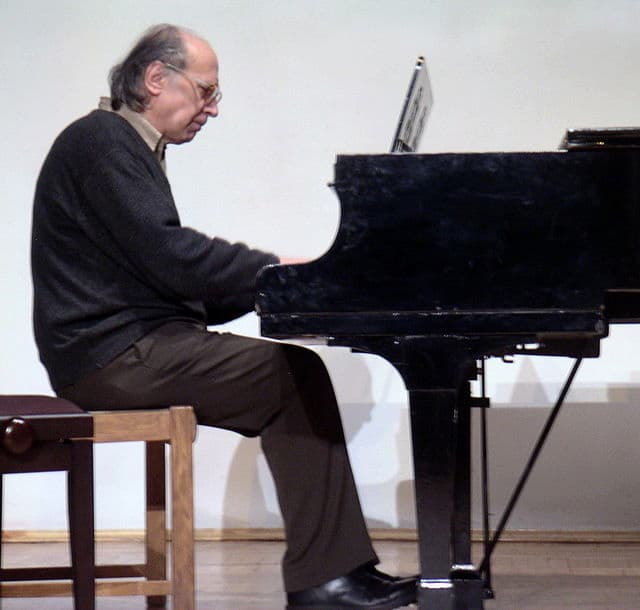
Valentin Silvestrov
During the famine of the 1930s, millions of Ukrainian peasants starved to death because of the criminal policies of Joseph Stalin. The Nazi occupation of Western Ukraine saw the implementation of the “Final Solution,” first applied in cities whose wealth and cultural standing depended entirely on a vast Jewish population. And then there has been this perpetual tug of war over the Crimean Peninsula. Ethnic cleansing at the command of various Russian heads of State was repeated under Stalin, and then once again in 2014 after the Russian occupation. Instead of painting himself as a victim of Western aggression, Vladimir Putin and his shadow puppets should rightfully stand trial for committed war crimes at the International Criminal Court in The Hague.
On 23 February, Anatolii Vasylkovskii took the Ukrainian national chamber ensemble known as the Kyiv Soloists on a regular two-week tour to Italy. One day later, Russian troops invaded Ukraine, and he remembers, “When we arrived in Italy, many of our members phoned their families and heard that there had been bombings.” The focus of the tour changed in an instant, as “we had to spread the message that Ukrainians are peaceful people.” Relying on the solidarity of other ensembles and orchestras, who hosted them in their concert halls and homes, the tour was extended across Europe. Anatolii emphasized, “We want to dedicate these concerts to our families, our country, our army, which are now fighting for the democracy of the whole world.” The Kyiv Soloists want to convey a “message of peace and solidarity with the people of Ukraine and of love for the families and friends they have left behind.” Their performances are no longer simply aimed at cultural exchange and musical enjoyment; they are a form of activism. “Our music-making is now a prayer for peace.”
If I may be permitted, let me add my personal musical prayer for peace by turning to the music of Johann Sebastian Bach. In 1817, a critic called Bach’s Mass in B minor “the greatest work of music in all ages and of all people.”
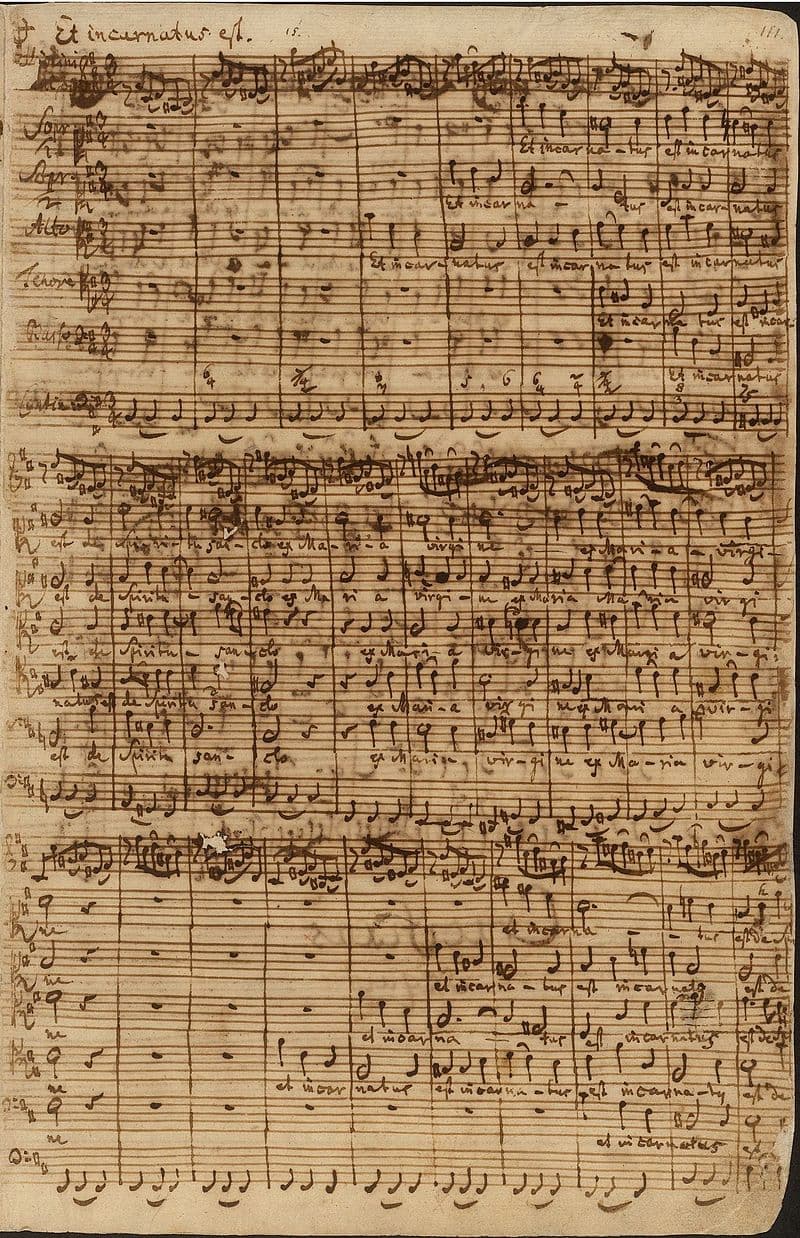
Bach’s B minor Mass, BWV 232
While this kind of assessment might need a bit of clarification, the work is significant because we find a Lutheran composer setting the complete Latin text of the Catholic Mass Ordinary. So, how does a devout Lutheran musically deal with the line in the Creed, “and I believe one holy catholic and apostolic Church?” That particular text receives two melodies sung by the choir simultaneously, and in perfect harmony. One is the traditional melody sung by Roman Catholics, and the other is a Lutheran chorale melody. The language of music, after all, has the distinct ability to console and unite. Let us now join the Bach Collegium Japan in Bach’s short prayer for peace, the “Dona Nobis Pacem” (Grant us Peace) from his B-minor Mass.
Subscribe to:
Posts (Atom)
-
The BoholTimes MUSIC can raise someone’s mood, get them excited, or make them calm and relaxed. Music also – and this is important – allow...
-
2,261,443 views May 15, 2019 SUNTORY HALL Munich Philharmonic conducted by Valery Gergiev, Tokyo Suntory Hall Dec 1, 2018 00:05 - 15:5...
-
Yes, this first piano concerto by Tschaikowsky still brings tears into my eyes. Tchaikovsky (or Tschaikowsky) was the second of six survi...


