It's all about the classical music composers and their works from the last 400 years and much more about music. Hier erfahren Sie alles über die klassischen Komponisten und ihre Meisterwerke der letzten vierhundert Jahre und vieles mehr über Klassische Musik.
Priscilla Presley (left) and daughter Lisa Marie (Instagram)
Rest in peace.
Singer Lisa Marie Presley, daughter of music icon Elvis Presley and Priscilla Presley, died following a cardiac arrest on Jan. 12. She was 54.
Hours before her demise, Priscilla took to Instagram to ask for prayers for her daughter after she eas rushed to the hospital on Thursday. Her post read:
“My beloved daughter Lisa Marie was rushed to the hospital. She is now receiving the best care. Please keep her and our family in your prayers. We feel the prayers from around the world, and ask for privacy during this time. – Priscilla Presley”
Lisa Marie Presley (Facebook)
Fans prayed for Lisa Marie, the only child and daughter of Elvis and Priscilla.
Lisa Marie had four children. She was married and divorced four times, including pop star Michael Jackson and Nicholas Cage.
Elvis Presley and daughter Lisa Marie in her younger years (Facebook)
It was TMZ, a popular entertainment website in the US, which initially reported about the death of the musician.
ADVERTISEMENT
“TMZ broke the story … Lisa was rushed to the hospital after her housekeeper found her unresponsive at her Calabasas home. Her ex-husband, Danny Keough, was there and performed CPR on her until paramedics arrived and took over — they administered at least one dose of epinephrine during resuscitation efforts,” TMZ reported.
Elvis and Priscilla with baby Lisa Marie (Facebook)
Lisa Marie debuted in the music scene with her album “To Whom It May Concern” in 2003. It reached No. 5 in the Billboard Hot 100 album chart.
New research finds that almost half of the world’s top 20 contemporary composers in 2022 were women.
An annual classical music statistics report has found that in 2022, nine of the top 20 most performed living composers were women.
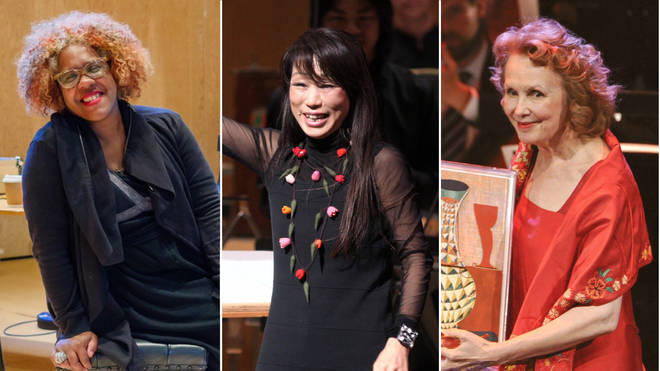
Some of the women composers named in the top 20 include Anna Clyne, Kaija Saariaho, Olga Neuwirth, Unsuk Chin, Anna Thorvaldsdottir, Missy Mazzoli and Errollyn Wallen.
The report, carried out by online classical music magazine Bachtrack, is based on 27,124 listings for performances which took place in 2022.
On the report’s full list of 106 most performed living composers, of 24 the British composers featured on the list, 12 were women, and of the 27 Americans named, 10 were women.
Bachtrack’s 2022 statistics are starkly different from previous figures. In 2014, just one composer in the top 20 most performed living composers was a woman (Sofia Gubaidulina), while three John’s made the cut (John Williams, John Adams, John Rutter).
Just one year earlier in 2013, there wasn’t a single woman in the top 200 list.
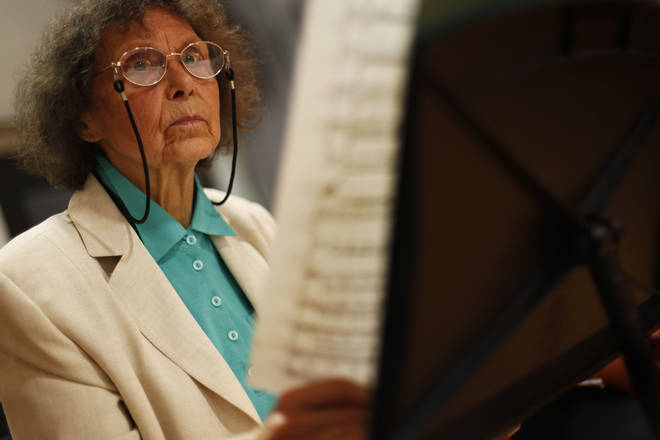
Russian composer Sofia Gubaidulina in a rare US appearance. Picture: Getty
Gubaidulina, now age 91, also appears in the top 20 list for 2022 (the highest woman listed, at number seven) a feat particularly impressive due to her struggle to have her music widely performed during the 20th century.
Living in Soviet Russia, Gubaidulina fell out of favour with the authorities as part of the group, the Khrennikov Seven. These seven composers were condemned by the Soviet Composers Union for writing scores that were in their words, “pointlessness… noisy mud instead of real musical innovation”.
In a 2013 interview with The Guardian however, Gubaidulina explained that being blacklisted and “so unperformed” gave her a sense of “artistic freedom, even if I couldn’t earn much money.
“I could write what I wanted without compromise.”
There’s good news for women in the field of conducting, too. Out of the world’s 100 busiest conductors, Bachtrack names 12 women; another stark difference to previous reports, as in 2013, just one conductor on the same list was a woman (Marin Alsop at No.70).
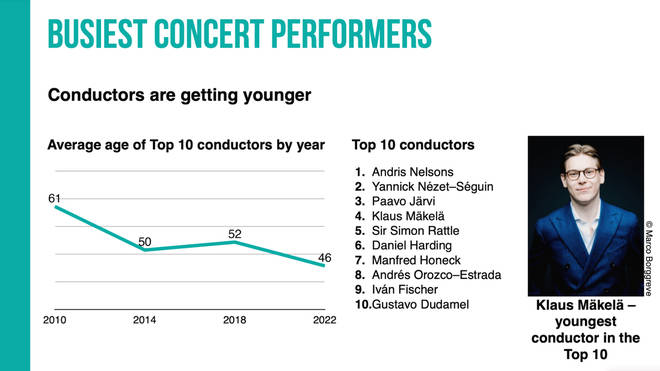
36-year-old Elim Chan is the highest ranking woman at no.29, and she is joined by Karina Canellakis, Nathalie Stutzmann, Mirga Gražinytė–Tyla, Marin Alsop, Dalia Stasevska, Xian Zhang, Gemma New, Simone Young, Joana Mallwitz, Kristiina Poska and Barbara Hannigan. Conductors are also getting younger. 26-year-old Klaus Mäkelä, chief conductor of the Oslo Philharmonic Orchestra, is one of the world’s top ten busiest maestros according to Bachtrack.
The Finnish musician comes in at number four on the list, and is the youngest of the conductors named.
Despite Mäkelä being the youngest, the average age of this list – which features names such as Sir Simon Rattle, Gustavo Dudamel, and Andris Nelsons – is still a pretty spry 46 years old.
In 2010, Bachtrack’s list of the world’s top ten busiest conductors was 61 years old.
The average age of the top ten busiest conductors is now 46 – it had been 61 in 2010. Picture: Bachtrack
Over the last decade, a host of talented young conductors have experienced meteoric rises to fame.
In 2022, one of the pinnacle moments in classical music was the announced appointment of 29-year-old Jonathon Heyward as the new Music Director of the Baltimore Symphony Orchestra – a position previously held by trailblazing conductor, Marin Alsop. Taking over for the 2023/24 season, Heyward makes history as both the youngest, and as the first African-American music director for the orchestra.
“I think as a young conductor at the moment, everything that I’ve been doing is actually pretty much for the first time and it’s often with seasoned players and seasoned orchestras who have probably played the pieces hundreds of times,” Heyward told the Southbank Sinfonia in 2021.
“To work for ensembles also doing it for the first time, it’s nice because it feels like we’re exploring it together on a blank canvas, which is thrilling.”
Dedicated to Méreaux, Czerny's Piano Concerto in a minor is perhaps one of the most virtuosic piano concerti composed in the classical style, Czerny's piano concerto in a minor features a compendium of pianistic techniques developed during the early Romantic era.
David Boldrini - piano
Rami Musicali Orchestra, conducted by Maestro Massimo Belli
(from the album "Czerny & Viotti: Piano Concertos" released under Brilliant Classics).
"The Piano Concerto in A minor, Op 214, was composed in Vienna in 1829 and published the following year. It is dedicated to the French musicologist and composer Amédée Méreaux (1802–1874) who—like Czerny, and his present obscurity notwithstanding—is best known for his piano studies. (His time will come; many of his 60 Études, Op 63, are of great interest and even more difficult to play than those of Alkan.)
Some see the A minor concerto as one of the earliest Romantic concertos penned. To others it is a transitional work with elements of the many brilliant piano and orchestra works already celebrated in this Hyperion series but with many backward glances to the concertos of Hummel, Weber and Field. The first movement’s opening material is used in various guises throughout the work, its solo part described by one writer, Lorenzo Ancillotti, as ‘a true compendium of the technical difficulties that pianists of the time were likely to address’. The initial ideas, incorporating some surprising modulations, eventually subside into a second section (8'43") in A major and D minor.
After a return to the original theme and key, Czerny introduces another subject (12'00"), presented at first in F major. Much of the delicate filigree writing is set an octave above the stave—and brilliant it is, too, as the soloist storms home after what must be one of the longest suspensions in any concerto before the inevitable release back into the tonic.
The adagio second movement is in the dominant key of E major and forms no more than a contrasting link to the finale, a 2/4 rondo marked allegro con anima—‘in a spirited manner’. ‘Spirited’ might be construed as an understatement given the demanding solo part, a relentless succession of semiquaver triplets, dancing arpeggios and scales in thirds designed to astonish and entertain in equal measure. A short chorale episode at 6'30" is the only let up for the pianist as the work bowls towards its conclusion leaving the listener in no doubt as to the key of the concerto."
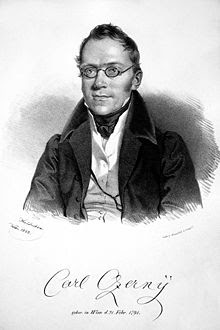
Carl Czerny was an Austrian composer, teacher, and pianist of Czech origin whose music spanned the late Classical and early Romantic eras. His vast musical production amounted to over a thousand works and his books of studies for the piano are still widely used in piano teaching. He was one of Ludwig van Beethoven's best-known pupils.
Carl Czerny was born in Vienna (Leopoldstadt) and was baptized in St. Leopold parish. His parents were of Czech origin; his mother was Moravian. His parents spoke Czech with him. Czerny came from a musical family: his grandfather was a violinist at Nymburk, near Prague, and his father, Wenzel, was an oboist, organist and pianist. When Czerny was six months old, his father took a job as a piano teacher at a Polish manor and the family moved to Poland, where they lived until the third partition of Poland prompted the family to return to Vienna in 1795.
As a child prodigy, Czerny began playing piano at age three and composing at age seven. His first piano teacher was his father, who taught him mainly Bach, Haydn and Mozart. He began performing piano recitals in his parents' home. Czerny made his first public performance in 1800 playing Mozart's Piano Concerto No. 24 in C minor.
Studies with Beethoven
In 1801, Wenzel Krumpholz, a Czech composer and violinist, scheduled a presentation for Czerny at the home of Ludwig van Beethoven. Beethoven asked Czerny to play his Pathétique Sonata and Adelaide. Beethoven was impressed with the 10-year-old and accepted him as a pupil. Czerny remained under Beethoven's tutelage until 1804 and sporadically thereafter. He particularly admired Beethoven's facility at improvisation, his expertise at fingering, the rapidity of his scales and trills, and his restrained demeanour while performing.
Czerny's autobiography and letters give many important references and details of Beethoven during this period. Czerny was the first to report symptoms of Beethoven's deafness, several years before the matter became public. Of his first meeting with Beethoven, he wrote: "I also noticed with that visual quickness peculiar to children that he had cotton which seemed to have been steeped in a yellowish ointment, in his ears."
Beethoven selected Czerny as pianist for the premiere of the former's Piano Concerto No. 1 in 1806 and, at the age of 21, in February 1812, Czerny gave the Vienna premiere of Beethoven's "Emperor" Piano Concerto. Czerny wrote that his musical memory enabled him to play virtually all of Beethoven's piano works by heart without exception and, during the years 1804–1805, he used to play these works in this manner at Prince Lichnowsky's palace once or twice a week, with the Prince calling out only the desired opus numbers. Czerny maintained a friendship with Beethoven throughout his life, and also gave piano lessons to Beethoven's nephew Carl.
Later career
Teacher and composer
At the age of fifteen, Czerny began a very successful teaching career. Basing his method on the teaching of Beethoven and Muzio Clementi, Czerny taught up to twelve lessons a day in the homes of Viennese nobility. His 'star' pupils included Theodor Döhler, Stephen Heller, Anna Sick,Sigismond Thalberg, and Ninette de Belleville. In 1819, the father of Franz Liszt brought his son to Czerny, who recalled:
He was a pale, sickly-looking child, who, while playing, swayed about on the stool as if drunk...His playing was... irregular, untidy, confused, and...he threw his fingers quite arbitrarily all over the keyboard. But that notwithstanding, I was astonished at the talent Nature had bestowed upon him.
Liszt became Czerny's most famous pupil. He trained the child with the works of Beethoven, Clementi, Ignaz Moscheles and Johann Sebastian Bach. The Liszt family lived in the same street in Vienna as Czerny, who was so impressed by the boy that he taught him free of charge. Liszt was later to repay this confidence by introducing the music of Czerny at many of his Paris recitals. Shortly before Liszt's Vienna concert of 13 April 1823 (his final concert of that season), Czerny arranged, with some difficulty (as Beethoven increasingly disliked child prodigies) the introduction of Liszt to Beethoven. Beethoven was sufficiently impressed with the young Liszt to give him a kiss on the forehead. Liszt remained close to Czerny, and in 1852 his Études d'exécution transcendante were published with a dedication to Czerny.
Czerny left Vienna only to make trips to Italy, France (in 1837, when he was assisted by Liszt)[ and England. After 1840, Czerny devoted himself exclusively to composition. He wrote a large number of piano solo exercises for the development of the pianistic technique, designed to cover from the first lessons for children up to the needs of the most advanced virtuoso. (see List of compositions by Carl Czerny).
Death
Czerny died in Vienna at the age of 66. He never married and had no near relatives. His large fortune he willed to charities (including an institution for the deaf), his housekeeper and the Society of Friends of Music in Vienna, after making provision for the performance of a Requiem mass in his memory.[20]
Multi-award-winning conductor Bernard Haitink leads the Royal Concertgebouw Orchestra in the Concertgebouw Amsterdam. They perform Wolfgang Amadeus Mozart’s Haffner Symphony.
Wolfgang Amadeus Mozart composed the Symphony No. 35 in D major, K. 385, known as the Haffner Symphony, in 1782. As early as 1776 he had been commissioned to compose a serenade for the wedding of the Salzburg bridal couple Franz Xaver Späth and Maria Elisabeth Haffner, the daughter of Salzburg's mayor Sigmund Haffner. The Haffner Serenade is Mozart's most extensive serenade (KV 250) and has eight movements.
Six years later, he was to compose another serenade on the occasion of the award of the title of nobility "Edler von Innbachhausen" to Sigmund Haffner Junior. Mozart arranged it as a symphony by omitting the movements 2 to 4 or 5 of the serenade composed for Haffner's wedding, thus creating an independent work.
Bernard Haitink began his conducting career with Netherlands Radio: he became chief conductor of the Netherlands Radio Philharmonic in 1957. Later he was principal conductor of the Royal Concertgebouw Orchestra and held this position for 27 years. Today he is patron of the Radio Philharmonic Orchestra and Honorary Conductor of the Concertgebouw Orchestra.
Bernard Haitink has also been Music Director of the Glyndebourne Festival and the Royal Opera House, Covent Garden, and Chief Conductor of the London Philharmonic Orchestra, the Staatskapelle Dresden and the Chicago Symphony Orchestra. He is an honorary member of the Berlin Philharmonic, the Chamber Orchestra of Europe and since 2019, the Vienna Philharmonic. He has received numerous prizes and awards, including the Gramophone Lifetime Achievement Award.
00:00 Introduction
00:49 Allegro con spirito
09:25 Andante
15:33 Menuetto
18:33 Presto