Tuesday, January 25, 2022

Mommy’s little Darling
By Georg Predota, Interlude
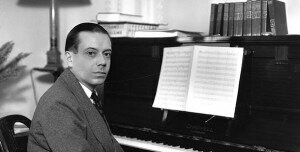
Cole Porter
Credit: http://www-tc.pbs.org/
Young Cole displayed some early musical talent, studying violin at age six and starting piano lessons at age eight. His mom did everything in her powers to vigorously promote her little darling. She subsidized the student orchestra so her son could be the featured violin soloist. When Cole began composing his first songs, mom paid to have them published and numerous copies were handed to family, friends and the local press. She even falsified his school records to make him appear more intelligent and mature for his age. Despite, or because of his overbearing and overprotective mother, Cole really blossomed during his undergraduate studies at Yale University. He became a huge social success, composing almost 300 songs during his tenure. In addition, he furnished the music for six full-scale musical comedies, staged by various University fraternities. When he graduated in 1913, he was unanimously voted the “most entertaining” member of his class. But it was still difficult to escape the wishes of the richest man in Indiana, and at the insistence of his wealthy grandfather, Cole enrolled in the Harvard Law School. Hardly two years into his career as a buddying lawyer, Cole, without informing his grandfather, transferred to the Harvard’s School of Art and Sciences. Eventually he abandoned all academic studies and moved to New York to start his professional musical career.
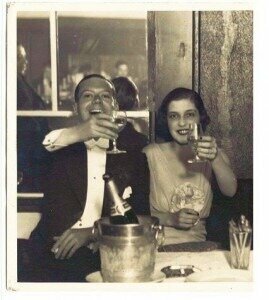
Cole Porter and Linda Lee Thomas
Credit: http://media-cache-ec0.pinimg.com/
At first, his professional life progressed frustratingly slow. He had minor successes in Paris in the early 1920’s, but when he wrote five songs for a show recommended by Irving Berlin, his long-envisioned Broadway career finally became a reality. A number of successful shows were staged in Europe, and by 1930 he was one of the most sought after songwriters on Broadway. In quick succession, Cole wrote the music for an extended number of highly successful shows, and one hit song after another! Just when things could not be any better, tragedy struck. A riding accident crushed both his legs and irrevocably damaged his nervous system. Over the next twenty years, Cole underwent more than thirty operations, and eventually his legs had to be amputated. Unhampered by this personal tragedy, Cole continued to write music for a seemingly endless number of Broadway hits. In 1948, Cole created his masterpiece! Collaborating with Bella and Sam Spewack, he wrote the music and lyrics for the musical Kiss Me Kate. The show opened on 30 December 1948 and ran for an astonishing 1077 performances. It clearly established Cole Porter as one of the greatest American lyricists and songwriters. He conquered Broadway, Hollywood and beyond, producing a “rich and fascinating body of work, characterized by wit and sophistication, with an underlying strain of restless melancholy and loneliness.” He actively shaped a distinct cultural American heritage. Cole Porter died on 15 October 1964.
Monday, January 24, 2022
A Matter of Discretion Franz von Suppé, Therese Merville and Sofie Strasser
by Georg Predota , Interlude
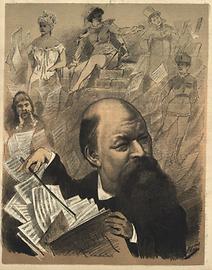
Caricature of Franz von Suppé
In his professional diary under 2 May 1841, Franz von Suppé writes, “First encounter with Therese Merville, my 1st wife.” We do know that Suppé age 22 and Merville age 25 married on 13 October 1841 in Preßburg, currently Bratislava. And we also know that their first daughter Anna was born on 2 February 1842. However, Suppé had already dedicated a song to Therese as far back as June 1838. The “Wiener Theater-Zeitung” reports “Suppé dedicated his setting of Schiller’s poem ‘For Emma’ to Therese Merville, which was published by Mr. Pietro Mechetti, in Vienna.” All very unremarkable, I hear so say, but why would Suppé actually lie about the time he first met his first wife? Well, it seems that Therese Merville had a bit of a reputation. That ill reputation was primarily based on a forty-page manuscript authored in the spring of 1833 by the Viennese municipal chancellor Engelbert Fürst. The ominous and rather verbose title reads, “Something about dealing with Miss Therese Merville, foster daughter of Mr. and Ms. Puchrucker.” And Fürst adds, “Intended as instruction and warning for men.”
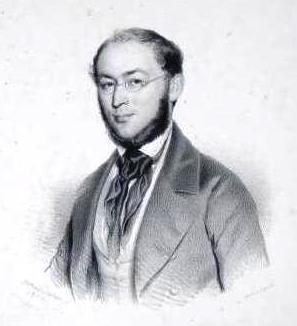
Portrait of Franz von Suppé by Gabriel Decker, 1847
It appears that Mr. Fürst, a man of 35 years-of-age and an amateur singer had fallen deeply in love with Therese Merville, a girl of 17. He “considered her an earthly angel,” but her foster parents did not immediately want to commit to the honorable but poor Fürst, and Therese was allowed to inspect other “applicants for marriage” under the supervision of her foster parents. Therese, so it is reported, “flirted with any and all family guests on the occasion of house concerts and evening entertainments. Engelbert Fürst, a sensitive man who had decided after a long time to propose to Therese, finally withdrew, deeply offended by Therese’s coquetry.”
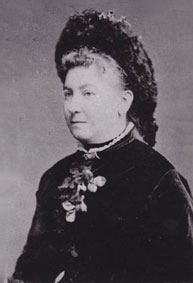
Sophie Strasser
As such, it is not known when, and under what circumstances Franz met Therese, but he clearly wanted this part of his biography kept secret. We know next to nothing about their married life, but by the autumn of 1852 both signed a divorce agreement. It detailed the conditions of separation and settled custody and maintenance payments for their children Anna (1842), Peter (1844) and Therese (1850). Therese von Suppé died on 23 May 1865, and Franz married the singer Sophie Strasser on 18 July 1866.
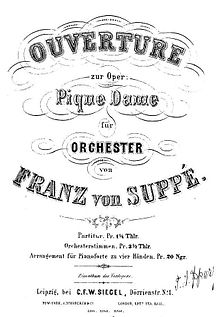
Suppé’s Pique Dame
As we have seen, Franz von Suppé wasn’t always up-front when it came to his private and personal life. And that trend continues in biographies dealing with his second wife. The biographer Otto Keller writes in 1905, “The summer of 1866 also brought a happy turn in the private life of the master. His first wife, from whom he had recently separated, had died on May 23, 1865. A year earlier he had met a lovely girl, Sofie Strasser. She was the daughter of ordinary citizens from Regensburg and was sent to Vienna to train for the stage. She was directed to the music director Suppé, who, since she was without special resources, placed and taught her in the choir of the Karltheater. But he soon saw that the voice was nice, but not enough for larger solo parts.” A closer look confirms, however, that Franz and Sofie had been a couple since at least June 1860, when Sofie worked in the choir of the Theater an der Wien. She was not only Suppé’s muse, but also most likely “the librettist of the opera Pique Dame.”
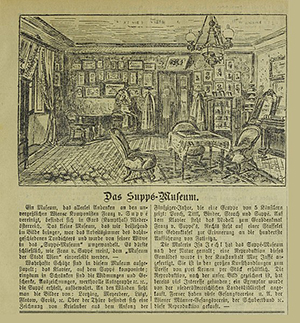
The Suppé Museum on newspaper
Franz and Sophie unofficially had been traveling as husband and wife since 1862. Although the civil courts had granted Franz’s legal divorce from Therese, in the eyes of the Catholic Church he was married “until death do us part.” In order to keep up the social decorum, however, Franz and Sofie von Suppé officially moved their acquaintance date to 1864, with the wedding taking place in 1866. Once again, we have little information about the marriage, but it has been suggested that Sofie was a major inspiration and staunch supporter for her husband’s works.
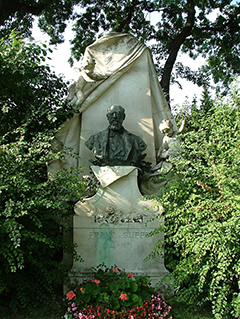
Suppé’s grave at the Zentralfriedhof
After Suppé died on 21 May 1895, his widow became his estate administrator and actively engaged in furthering the legacy of her late husband. She commissioned the young sculptor Richard Tautenhayn to design an artistic Suppé tomb for the honorary grave in the Vienna Central Cemetery. Between 1896 and 1908, she built and managed the Suppé Museum in Gars am Kamp, which she donated to the “City Collections of the City of Vienna” on 13 January 1902. In 1921 she gave the “Gesellschaft der Musikfreunde” the handwritten scores of 47 dramatic and numerous other orchestral and vocal works from Suppés’ estate. Sofie von Suppé died on 15 March 1926 in Vienna, and was buried in her husband’s honorary grave in Vienna’s central cemetery.
Thursday, January 20, 2022
How Beethoven’s iconic ‘da-da-da-dum’ motif was almost lost in a forgotten piano piece
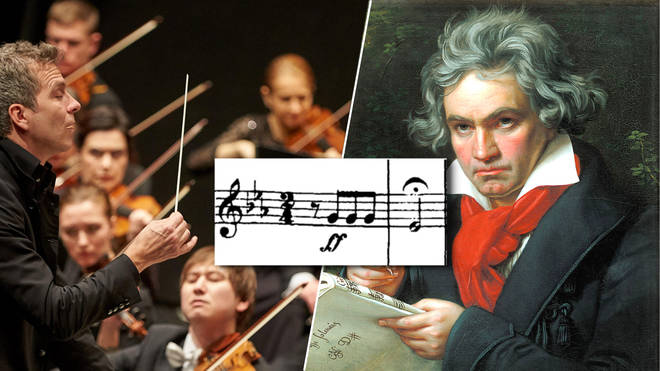


The UK’s leading scholar on Beethoven has found that the famous opening of the Fifth Symphony began life with a totally different purpose...
Classical connoisseur, and music novice alike will recognise the famous four-note opening motif of Ludwig van Beethoven’s Fifth Symphony.
The ominous introductory theme appears in modern media, such as movies, and was also used during the Second World War as a symbol for Victory. The famed ‘da-da-da-dumm’ motif mirrored the rhythm used for the letter V in Morse code (short-short-short-long).
However, the origins of the opening theme have remained relatively unexplored, or understood; until now.
Thanks to the investigations of Professor Barry Cooper, the UK’s leading scholar on the German composer, it’s been revealed that classical music’s most iconic motif was almost simply a subsidiary theme meant for a forgotten piano piece.
In 1804, four years before the Fifth Symphony’s first performance, Beethoven wrote out the sketches of the opening theme of his next symphony.
Scholars have used this manuscript as a source of sketches for the Fifth Symphony however, thanks to Cooper’s further investigation into the score, it is clear that Beethoven was not in fact sketching a symphony – but a piano fantasia.
“It became abundantly clear to me that [these sketches were] part of the projected piano fantasia, which was being sketched immediately above the sketch in question,” explained Cooper. “I studied the page in detail as I am writing a book on ‘The Creation of Beethoven’s Nine Symphonies’.”
Cooper, who is a professor at the University of Manchester, is best known for his books on Beethoven, as well as a completion and realisation of Beethoven’s fragmentary Symphony No. 10.
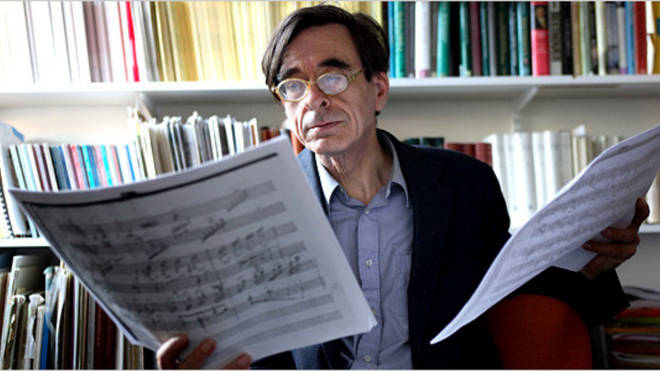
“The fantasia (so-called in the sketch) is in C minor, like the [fifth] symphony. Like most fantasias of the period, it would be based on contrasting sections and ideas, so the opening section is in a slow 3/8, contrasting with the later 2/4 that uses the motif that ended up in the symphony.
“The motif is then developed in the 2/4 section in a symphonic manner – which may be why Beethoven concluded it would work better in a symphony – but using piano textures rather than orchestral ones, and in a different way from how it is developed in the symphony.”
Professor Cooper notes that the find gives us a deeper understanding of how Beethoven worked as a composer.
“The sketch shows that he was prepared to transfer ideas intended for one composition into a completely different one, if it would work better there.”
Cooper surmises that Beethoven felt exactly that way about this motif, and adds the composer “strengthened the motif by placing it at the head of a symphony, and then strengthened it still further by adding dramatic pauses in later sketches and the final version”.
97-year-old pianist, and last surviving pupil of Rachmaninov, signs landmark record deal
At this landmark age, Slenczynska has achieved an astonishing nine-decade long career, having begun performing as a child prodigy in the 1920s.
To mark the occasion, Slenczynska has announced her resigning with the record label, Decca Classics for her first album with the company since the 1960s; Slenczynska’s new solo piano album, My Life in Music is due to be released later this year.
When asked about the album Slenczynska responded, “Whoever heard of a pianist my age making another album?
“Music is meant to bring joy. If mine still brings joy to people, then it is doing what it is supposed to do”.
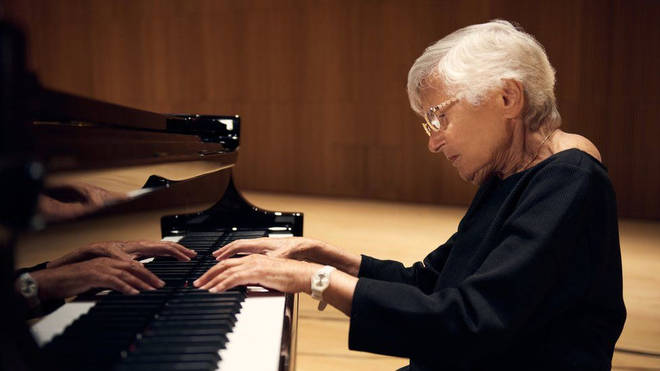
Born in California in 1925, Slenczynska was the daughter of Polish immigrants. She made her concert debut at the age of just four years old, and one year later, performed a work of on television (watch below).
At six, Slenczynska made her European concert debut in Berlin, and now 92 years later, this legendary performer is still enchanting audiences across the globe with her piano skills.
Notably, Slenczynska is considered to be composer-pianist Sergei Rachmaninov’s last living pupil.
It is thought that the young pianist even once stepped in for the great Russian musician at the last minute when he was unable to perform due to an injury.
According to sources, the two would often drink tea together and to this day, Slenczynska wears a Fabergé egg necklace which Rachmaninov is said to have gifted her.
Slenczynska also had connections with another prominent composer, American Samuel Barber, and heard his famed Adagio for Strings before the work even had a title.
Slenczynska has performed for four United States Presidents, including playing a Mozart duet with President Harry S. Truman, and performing at President John F. Kennedy’s inauguration.
During lockdown, Slenczynska uploaded videos of herself performing sonatas to YouTube, to celebrate the German composer’s 250th anniversary.
Despite her age, the pianist is still an active performer and most recently played at Chopin International Festival and Friends in October 2021 in the Polish Embassy in New York. Next month she will be celebrating her 97th birthday with a recital at Lebanon Valley College, Pennsylvania, on 6 February.
Slenczynska’s album, My Life in Music, explores the music of Chopin, a composer who had a heavy influence on the young pianist’s childhood.
According to her memoir, Forbidden Childhood, Slenczynska was made to practise all 24 Études before breakfast every morning by her father, Josef Slenczynski, who was a skilled violinist.
She would subsequently earn a reputation as one of the most celebrated Chopin interpreters of her time.
The album also features music from composers such as Debussy, Grieg and Bach, who all provide memories of her beloved piano mentors and teachers.
Friday, January 14, 2022
Why We Owe “The Flying Dutchman” To A Dog
by Emily E. Hogstad, Interlude

Newfoundland dog
Robber, the giant Newfoundland dog, took to the pit with his master, Richard Wagner.
The twentysomething conductor and composer had recently won a job as music director of the Riga opera, and his dog Robber frequently joined his master at work. At one rehearsal, a bass player accidentally poked Robber in the eye with his bow as he was playing. Robber snarled; the bass player yelled. Wagner, unperturbed, answered, “The dog is a fine critic. He is merely telling you that playing this passage requires more delicacy.”
Robber had slobbered into Wagner’s life by accident. The big black dog used to live in a shop in Riga, and Wagner used to visit him. It wasn’t long before Robber fell deeply in love. At one point, Wagner traveled to the city of Mitau for work, so Robber sat his 160 pound bulk outside Wagner’s door and waited for his idol’s return. The pining dog was so pitiful that Wagner’s landlord actually sent Robber to Mitau. Wagner was deeply moved that the giant shaggy dog had shown such devotion. He wrote in his autobiography, “I…swore to myself, despite all complaints, never again to turn him away.”
Robber had chosen his target wisely. Wagner had a weak spot for dogs and for animals in general. As a child, he and his sister had rescued unwanted puppies from being drowned. As an adult, he would become a vegetarian and antivivisectionist.
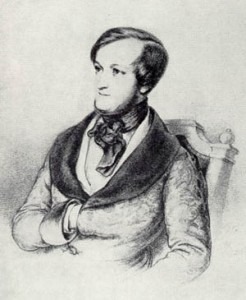
Richard Wagner, ca. 1840
Unfortunately, Robber was the best thing that happened to Wagner in Riga. Two years into his tenure at the opera, Richard and his wife Minna were drowning in debt. His passport had even been confiscated. To avoid jail or exile (or worse), Richard hatched a daring escape plan…that included provisions for his dog! The Wagners’ ultimate destination was Paris, a city where Richard was confident he could find professional success.
The great escape began in the summer of 1839. Robber proved his devotion by running alongside the Wagners’ carriage, his black fur burning in the summer sun. Once they got to the border, Richard and Minna made a run for it during a change in sentry. Remarkably, Robber dutifully followed along, not making a sound. If he had barked and drawn attention to the fugitives, the guards would have shot them all, and the entire history of music would have been a very different thing.
To get from Prussia to Paris without having to abandon Robber, the Wagners hit on a roundabout route. Taking a carriage that distance with a 160 pound dog was impossible, so they decided to sail to London and then travel to Paris. At Pillau, they surreptitiously boarded a ship bound for Britain (somehow they hauled Robber up the side). The voyage began easily enough, but eventually their ship ran into dangerously bad weather. Richard, Minna, and Robber were cooped up in the captain’s cabin. Sailors came staggering down the staircase to fortify themselves with brandy. A seasick Robber barked, slobbered, and vomited. Amazingly, the turmoil of this disgusting voyage served as inspiration for Wagner’s The Flying Dutchman.
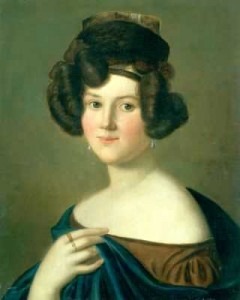
Minna Wagner
Miraculously, the little family arrived intact in London in early August. Wagner wrote of the landfall, “We became pleasurably giddy.” While searching for a hotel room, they were crowded into a hansom cab, “designed only for two passengers to sit opposite each other, and in which we had to place the huge dog across our laps and sticking out both windows.” After the cramped ride, a disgruntled Robber disappeared at the hotel door. The Wagners were devastated, convinced their dog was lost forever – how would he ever find his way home in a strange city, in a strange country? – but a couple of hours later, they caught sight of their big black dog out the window, ambling toward their hotel. Robber had returned.
The good news: they all got safely to Paris. The bad news: they didn’t stay together long. The evidence is murky, but apparently Robber ran off. (Although Wagner, with his penchant for the dramatic, thought he was stolen.) A year later, Richard was crisscrossing Paris, meeting with creditors and trying to pay off bills, when he caught sight of his long-lost dog. Richard was sure Robber recognized him. But the dog regarded Richard warily, and every time they got close, Robber would slip away. An exhausted Richard finally had to give up his pursuit.
That afternoon in Paris was the last time canine and composer ever saw each other. But later in life, in honor of Robber, Wagner acquired another black Newfoundland named Russ. Russ is buried right next to Richard, providing companionship to the great composer even beyond the grave.
-
The BoholTimes MUSIC can raise someone’s mood, get them excited, or make them calm and relaxed. Music also – and this is important – allow...
-
2,261,443 views May 15, 2019 SUNTORY HALL Munich Philharmonic conducted by Valery Gergiev, Tokyo Suntory Hall Dec 1, 2018 00:05 - 15:5...
-
Yes, this first piano concerto by Tschaikowsky still brings tears into my eyes. Tchaikovsky (or Tschaikowsky) was the second of six survi...


