It's all about the classical music composers and their works from the last 400 years and much more about music. Hier erfahren Sie alles über die klassischen Komponisten und ihre Meisterwerke der letzten vierhundert Jahre und vieles mehr über Klassische Musik.
Friday, September 24, 2021
Moved to Tears
Thursday, September 23, 2021
Rossini and His Overtures
by Georg Predota, Interlude

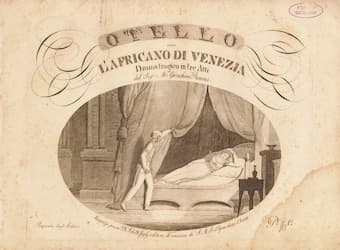
Rossini’s Otello
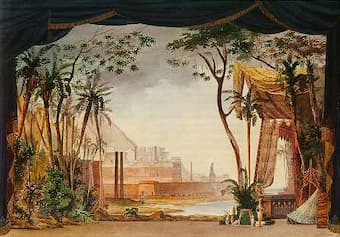
We celebrate Gioachino Rossini (1792-1868) as one of the most successful and popular operatic composers of his time. And although you might never have actually seen or heard a complete Rossini opera, I am sure you know a good many of his overtures. In fact, the overtures have long been staples of the orchestral repertory and much more frequently performed than the operas to which they belong. It is a curious situation in that the reputation of his dramas has never equaled the sweetness “of their melodies, the richness of their harmonies, the brilliance of their orchestration, and the power of their rhythms.” We do know that almost all of his overtures make use of musical elements and melodies that appear somewhere in the opera, which begs the question if Rossini composed the overture before or after he had completed the opera? According to legend, that’s exactly the question a young composer asked Rossini, who described six different ways of composing overtures. Rossini apparently said, “I composed the overture to Otello in a little room in which that most ferocious of all managers, Barbaja, shut me up with a dish of macaroni and told me that he would let me out only after the last note of the overture had been written.” As a point of reference, Otello was first performed in Naples at the Teatro del Fondo in 1816, and the notorious Barbaja was indeed involved. As far as the overture goes, this one was clearly written after the opera had been completed.

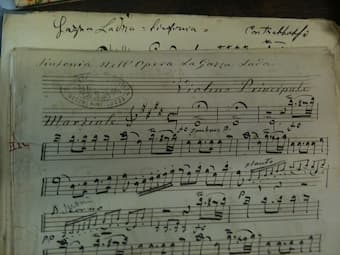
Rossini’s La Gazza Ladra
The same process was apparently at work with the overture to La Gazza Ladra (The Thieving Magpie). Rossini reports that he “wrote the overture to Gazza Ladra, on the very day of the first performance of the opera in the wings of the Scala Theatre in Milan. The manager had put me under the guard of four stagehands who were ordered to throw down the music pages, sheet by sheet, to copyist seated below. As the manuscript was copied, it was sent page by page to the conductor who then rehearsed the music. If I had failed to keep the production going fast, my guards were instructed to throw me in person down to the copyists.” Fortunately, Rossini was able to keep up, and therefore managed to witness the huge success of the opera. Rossini himself was thrilled by his opera and a few days after the première wrote in an excited letter to his mother “that it was so full of music that one could make three or four operas from it,” and that it was “the most beautiful music I have written so far.”

Rossini’s The Barber of Seville
Rossini’s opera buffa The Barber of Seville is primarily known today for its rousing overture. However, the premiere on 20 February 1816 at the Teatro Argentina in Rome was a disaster! The next day Rossini wrote to his mother, “Last night my opera was staged and it was solemnly booed, what mad, what extraordinary things are to be seen in this country. I will tell you that in the midst of it all the music is very fine and already people are talking about its second evening when the music will be heard, something that did not happen last night, from the beginning to the end without the constant noise accompanying the whole performance.” Rossini was entirely correct about the second performance, as it was an unqualified triumph. But how did Rossini compose the famous overture? He writes, “I made my task easier in the case of the overture to the Barber of Seville, which I left unwritten; instead I made use of the overture to my opera Elisabetta, which is a very serious opera, whereas the Barber of Seville is a comic opera.” In fact, the overture is actually twice re-cycled as he had originally written it for the opera Aureliano in Palmira of 1813.

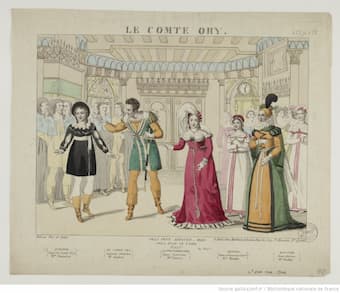
Rossini’s Le Comte Ory
Rossini’s fourth opera for Paris, Le Comte Ory, was first staged at the Paris Opéra in August 1828. Set in thirteenth-century France, the opera deals with the attempts of Count Ory to woo the Countess Adèle, whose husband is away on a crusade. There is much disguising—including hermits and nuns—and everybody manages to run away just before the husband of the Countess returns. The “Introduction” is well matched to the plot, its outer sections suggesting the Count’s cunning exploits, with a martial passage at its heart, the returning opening section ending in the plucked notes of the strings.” How did Rossini go about composing the “Introduction?” According to the composer, “I composed the overture to the Comte Orly while fishing in the company of a Spanish musician who the whole time talked incessantly about the Spanish political situation.” Really doesn’t tell us much about the creative process, but it’s a nice anecdote nevertheless.

Rossini’s William Tell
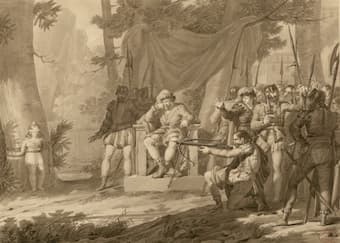
When we talk about instrumental favorites in contemporary concert halls, we invariably stumble across the overture to William Tell. While the opera itself has been largely forgotten, the overture owns much of its popularity to varied incorporations within expressions of popular culture. Let’s not be deceived, however, because the popular appeal of Rossini’s William Tell Overture was instantaneous. It was immediately published independently from the opera, and Franz Liszt promptly fashioned his famous piano transcription. Rossini tells us that he “composed the overture to William Tell in the lodgings on the Boulevard Montmartre filled night and day with a crowd of people smoking, drinking, talking, singing, and bellowing in my ears while I was laboring on the music.”

Rossini’s Mosè in Egitto
101-year-old man with Alzheimer’s shows us all the eternal power of music
By Kyle Macdonald, ClassicFM London
Today, on World Alzheimer’s Day, here’s a beautiful moment to remind us how deeply music runs – in our mind, body and spirit.
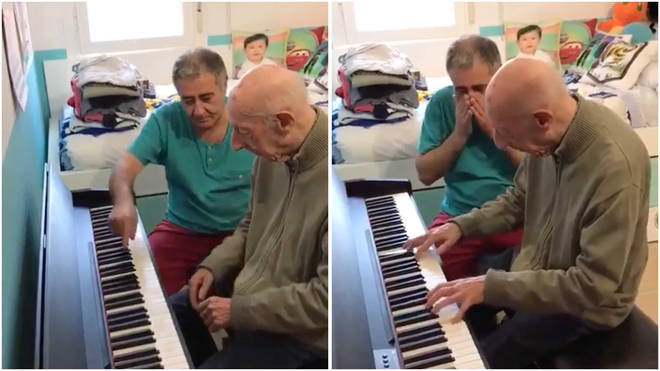
Spanish musician Antonio Cadenas celebrated his 101st birthday in May. He’s a man with a remarkable story and talent, which speaks to the profound power of music-making.
Cadenas has Alzheimer’s Disease, a syndrome that results in a decline of brain functioning and impacts on thinking skills and other mental abilities. Today, 21 September, is World Alzheimer’s Day, an international campaign to raise awareness surrounding the issues faced by people with dementia.
Remarkably, it is possible for musical memories to be stored in different areas of the brain that have been unaffected by the decline.
And incredibly, Antonio can still remember the music and his piano technique. He plays Lagrimas y sonrisas, by Juan D’Arienzo. You can see the music flow through the fingers of the centenarian. It’s powerful and inspiring.
Read more: How playing an instrument benefits your brain
Antonio Cadenas was born in Terque, Spain on May 10, 1919. As a child, his first music lessons came from his mother and priests at a local cathedral.
He served in the military from 1942 to 1946, before continuing music and working as a teacher up until his retirement in the 1980s. He now lives with his son and his family.
Thank you for sharing your music and talent, Antonio.
Wednesday, September 22, 2021
How does music affect the culture of the Filipinos?
Music as a whole can be used as an encouraging or depressing way to look at life. In this sense, it plays a big role in shaping the culture and values of people and the rest of the world. We see this through kundiman - it carries sentiments and emotions that evoke memories and images for Filipinos. These may clash with the outside world, but this clash gives us identity: these cultural imprints are then integrated back into society to create our metamorphosis into another era. So it's not just about tradition; it's also about forging new ground for generations to come.
This ever-evolving system creates such wonderful flavours that we're able to adapt ourselves better than ever before--we learn new things and explore different ways to make the best out of them. Music is one way we express ourselves, and through this method, we show our appreciation for humility and hard work, two values that shape our bustling nation into a happy place worth living in.
So what does music really mean to Filipinos? It simply tells us where we've been and where we could go. It tells a story that everyone can appreciate and relate to, which is why it's a big part of every Filipino culture.
Francisco Buencamino - his music and his life
Monday, September 20, 2021
Music of the Philippines (Filipino: Himig ng Pilipinas)
Music of the Philippines (Filipino: Himig ng Pilipinas) include musical performance arts in the Philippines or by Filipinos composed in various genres and styles. The compositions are often a mixture of different Asian, Spanish, Latin American, American, and indigenous influences.
Notable folk song composers include the National Artist for Music Lucio San Pedro, who composed the famous "Sa Ugoy ng Duyan" that recalls the loving touch of a mother to her child. Another composer, the National Artist for Music Antonino Buenaventura, is notable for notating folk songs and dances. Buenaventura composed the music for "Pandanggo sa Ilaw".
Gong music
Philippine gong music can be divided into two types: the flat gong commonly known as gangsà and played by the groups in the Cordillera region and the bossed gongs played among the Islam and animist groups in the southern Philippines.
Kulintang refers to a racked gong chime instrument played in the southern islands of the Philippines, along with its varied accompanying ensembles. Different groups have different ways of playing the kulintang. Two major groups seem to stand out in kulintang music. These are the Maguindanaon and the Maranaw. The kulintang instrument itself could be traced to either the introduction of gongs to Southeast Asia from China before the 10th century CE or more likely, to the introduction of bossed gong chimes from Java in the 15th century. Nevertheless, the kulintang ensemble is the most advanced form of ensemble music with origins in the pre-colonial epoch of Philippine history and is a living tradition in southern parts of the country.
The tradition of kulintang ensemble music itself is regional, predating the establishment of the present-day Philippines, Indonesia, and Malaysia. It transcends religion, with Buddhist, Hindu Animist, and Christian ethnic groups in Borneo, Flores, and Sulawesi playing kulintangan; and Muslim groups playing the same genre of music in Mindanao, Palawan, and the Sulu archipelago. It is distantly related to thegamelan ensembles of Java and Bali, as well as the musical forms in Mainland Southeast Asia, mainly because of the usage for the same bossed racked gong chimes that play both melodic and percussive.
Hispanic-influenced music
Spain ruled the Philippines for 333 years, and Hispanic influence in Filipino culture is ubiquitous. This influence can be easily seen in folk and traditional music, especially in the Tagalog and Visayan regions, where Spanish influence was the greatest.
Rondalla music
The Rondalla is a traditional string orchestra comprising two-string, mandolin-type instruments such as the banduria and laud; a guitar; a double bass; and often a drum for percussion. The rondalla has its origins in the Iberian rondalla tradition and is used to accompany several Hispanic-influenced song forms and dances.
Harana and Kundiman
The Harana and Kundiman are popular lyrical songs dating back to the Spanish period and are customarily used in courtship rituals. The Harana is rooted in the Mexican-Spanish from Spain, traditional and based on the rhythmic patterns of the habanera. The Kundiman, meanwhile, has pre-colonial origins from the Tagalophone parts of the country, uses a triple meter rhythm, and is characterized by beginning in a minor key and shifting to a major one in the second half. But make no mistake, harana and kundiman are stylistically different. Whereas harana is in 2/4/ time, kundiman is in 3/4. The formula is verse 1 on minor key (e.g. C Minor) followed by verse 2 on parallel major key (C Major) midway through.
In the 1920s, Harana and Kundiman became more mainstream after performers such as Atang de la Rama, Jovita Fuentes, Conching Rosal, Sylvia La Torre, and Ruben Tagalog introduced them to a wider audience.
Tinikling
The Tinikling is a dance from Leyte which involves two individual performers hitting bamboo poles, using them to beat, tap, and slide on the ground, in coordination with one or more dancers who step over and in between poles. It is one of the more iconic Philippine dances and is similar to other Southeast Asian bamboo dances.
Cariñosa
The Cariñosa (meaning "loving" or "affectionate one") is the national dance and is part of the María Clara suite of Philippine folk dances. It is notable for the use of a fan and handkerchief in amplifying romantic gestures expressed by the couple performing the traditional courtship dance. The dance is similar to the Mexican Jarabe Tapatío, and is related to the Kuracha, Amenudo, and Kuradang dances in the Visayas and Mindanao Area.
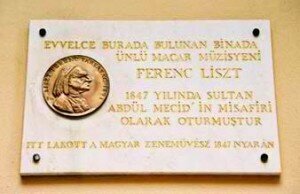
Franz Liszt in Istanbul
by Georg Predota, Interlude

Franz Liszt

Istanbul

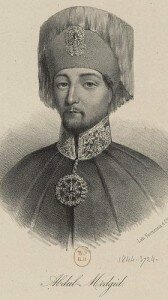
Sultan Abdul-Medgid

Bosphorus

Çırağan Palace in 1840s © Wikiwand
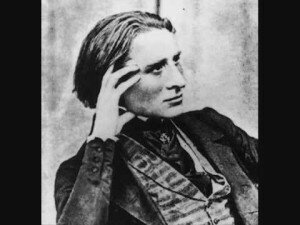
Liszt also gave a number of public concerts, including a musical matinee on 18 June at the Franchini Mansion at Buyukdere. Further private and public concerts were held at the Fethi Pasha Mansion and the Russian Embassy at Pera on 28 June. During this concert, “Liszt saw the panorama of Istanbul from the window and got really excited of seeing the east and the west at the same time. He even thought that he could seen Mount Olympus in the distance.” During his five-week stay, Giuseppe Donizetti hosted Liszt and he arranged accommodations for him at the home of the piano manufacturer Alexander Kommendinger. Donizetti had previously composed two marches for the Sultan, and at Liszt’s request, Donizetti gave him his compositions. “Liszt was in my house,” he writes. “He has just left. He wanted the notes of the two marches I composed for the Sultan. He said he was going to work them into variations sets.” Liszt first played the variations during concerts at Buyukdere on 14 and 15 June. Liszt eventually wrote out the manuscript and gave it to the Austrian ambassador, who passed it to the Minister of Foreign Affairs, who in turn presented it to the Sultan. In return, Liszt received the already mentioned enamel box studded with diamonds. Additionally, the Sultan handed Liszt a special seal, with the name of the composer written in Arabic alphabet with Turkish letters, and we do know that Liszt used it to seal a number of his letters. As it turns out, Istanbul delivered the perfect setting for Liszt to say goodbye to his life as a traveling virtuoso.-
The BoholTimes MUSIC can raise someone’s mood, get them excited, or make them calm and relaxed. Music also – and this is important – allow...
-
2,261,443 views May 15, 2019 SUNTORY HALL Munich Philharmonic conducted by Valery Gergiev, Tokyo Suntory Hall Dec 1, 2018 00:05 - 15:5...
-
Yes, this first piano concerto by Tschaikowsky still brings tears into my eyes. Tchaikovsky (or Tschaikowsky) was the second of six survi...