Friday, July 24, 2026

Twenty Quotes by Women Composers Throughout Classical Music History


In this article, we’ve gathered twenty thought-provoking quotations by women composers, offering a glimpse into both their struggles and their triumphs, with a focus on the issues that tend to be especially relevant for women.
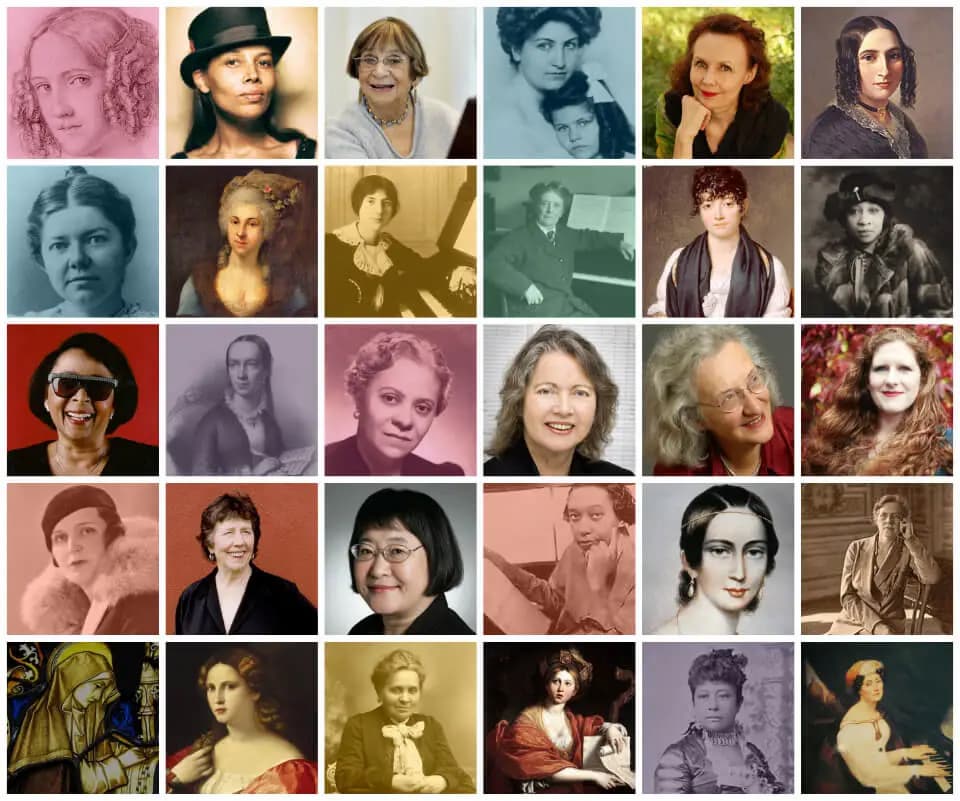
women composers grid

© musicbywomen.org

On Inspiration

Glance at the sun. See the moon and the stars. Gaze at the beauty of the Earth’s greenings. Now, think.

Hildegard von Bingen (1098-1179)  

Composing gives me great pleasure… There is nothing that surpasses the joy of creation, if only because through it one wins hours of self-forgetfulness, when one lives in a world of sound.

Clara Wieck Schumann (1819-1896)   

On the Process of Composing
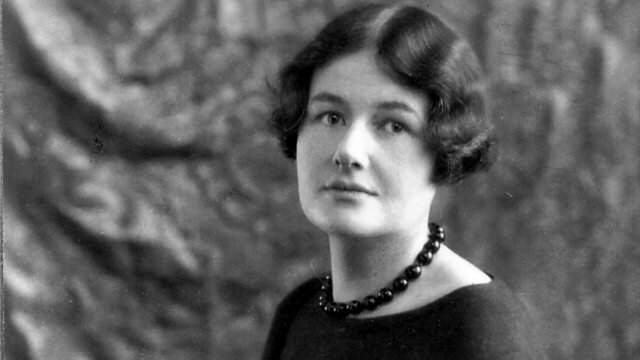
Rebecca Clarke

There’s nothing in the world more thrilling, or practically nothing. But you can’t do it unless – at least I can’t; maybe that’s where a woman’s different – I can’t do it unless it’s the first thing I think of every morning when I wake and the last thing I think of every night before I go to sleep.   

On New Music and the Canon

I think Beethoven needs someone next to him that reminds you the music is vulnerable rather than it’s just a masterpiece and so therefore why should we even bother to think about it. The wonderful thing about new music is the reaction it provokes. “Do I like this or don’t I like it?” The audience is reacting to the music itself. With Beethoven, they don’t do that. 

With any new kind of programming and endeavor, you take a leap of faith that the audiences are going to be into it. I find audiences show up because they want to experience live music, live theater, something that sparks their imagination and soothes their pain. That’s how it functions, really, at the end of the day.  

On Accessibility

You don’t need any specialized education and you don’t need to know anything about the world in which I work. I think my music should be able to speak to you even if you’ve never been to a concert of classical music before.

– Jennifer Higdon (1962-)   

I want my music to be something that people use in order to access parts of themselves. So in that sense, every piece I write is about all emotions at once, about the lines in between. It’s never only about one thing or another. It’s emotionally getting at those things that we can’t really describe – things for which we don’t have labels.

Missy Mazzoli (1980-)  

Music has a unifying effect on the peoples of the world, because they all understand and love it… And when they find themselves enjoying and loving the same music, they find themselves loving one another.

On Piano Playing
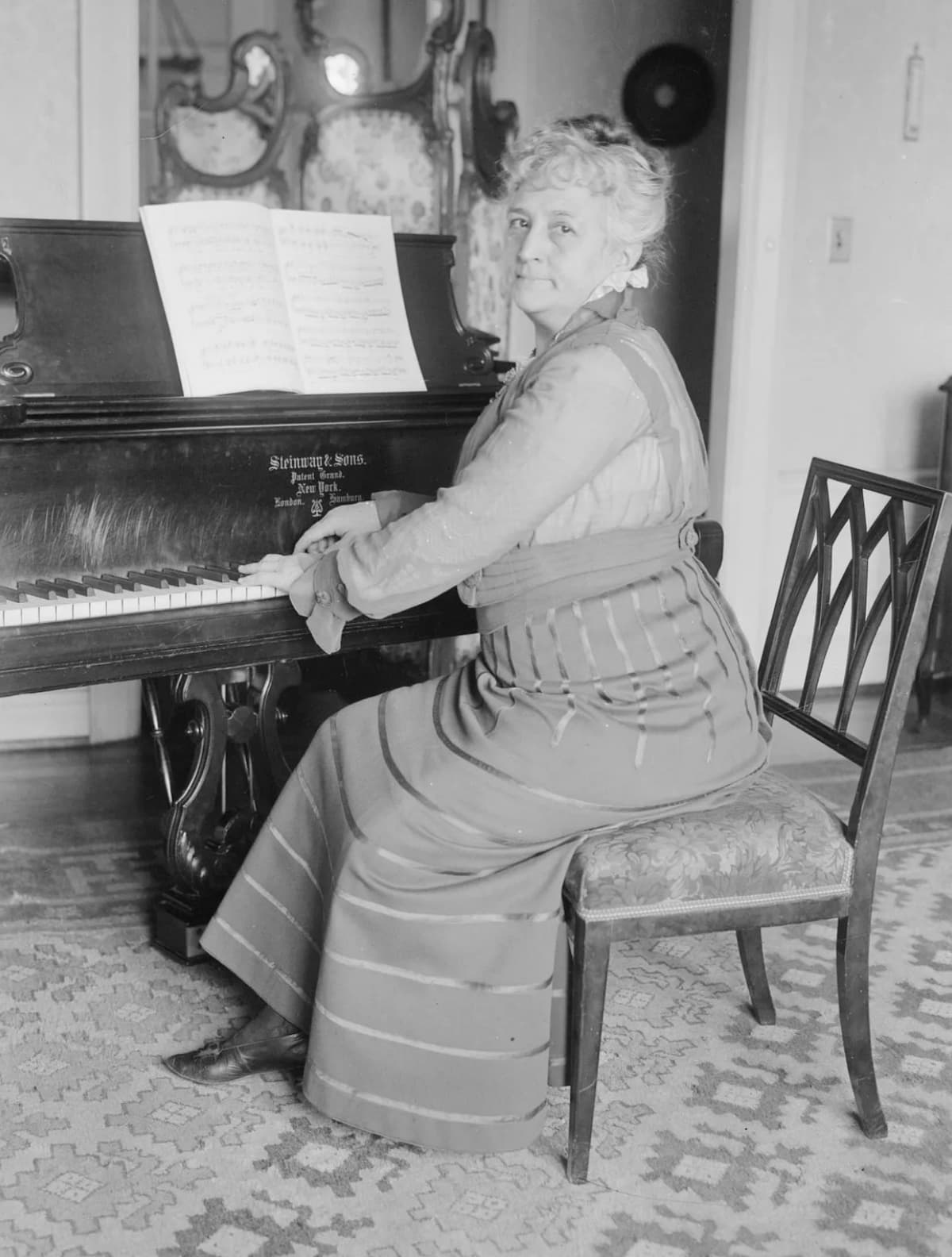
Teresa Carreño

Teresa Carreño

I wish to make my pupils feel that piano playing is easy, not difficult; to make them regard practice as a joy, not a burden; to have them go to the piano as a painter, with a beautiful idea to express, goes to his canvas, takes up his palette and brushes and mixes his colours. But the tension under which so many players labor is dreadful.  

On Sexism

Music is the superlative expression of life experience, and woman by the very nature of her position is denied many of the experiences that color the life of man.

Amy Beach (1867-1944)  

Women are expected to be wives, mothers, and do all the nasty things in the community (oh, I do them). And if a woman is cursed with having talent too, then she keeps apologizing for it… It really is a curse, in a way, because instead of working 12 hours a day like other women, you work 24.  

On Perseverance
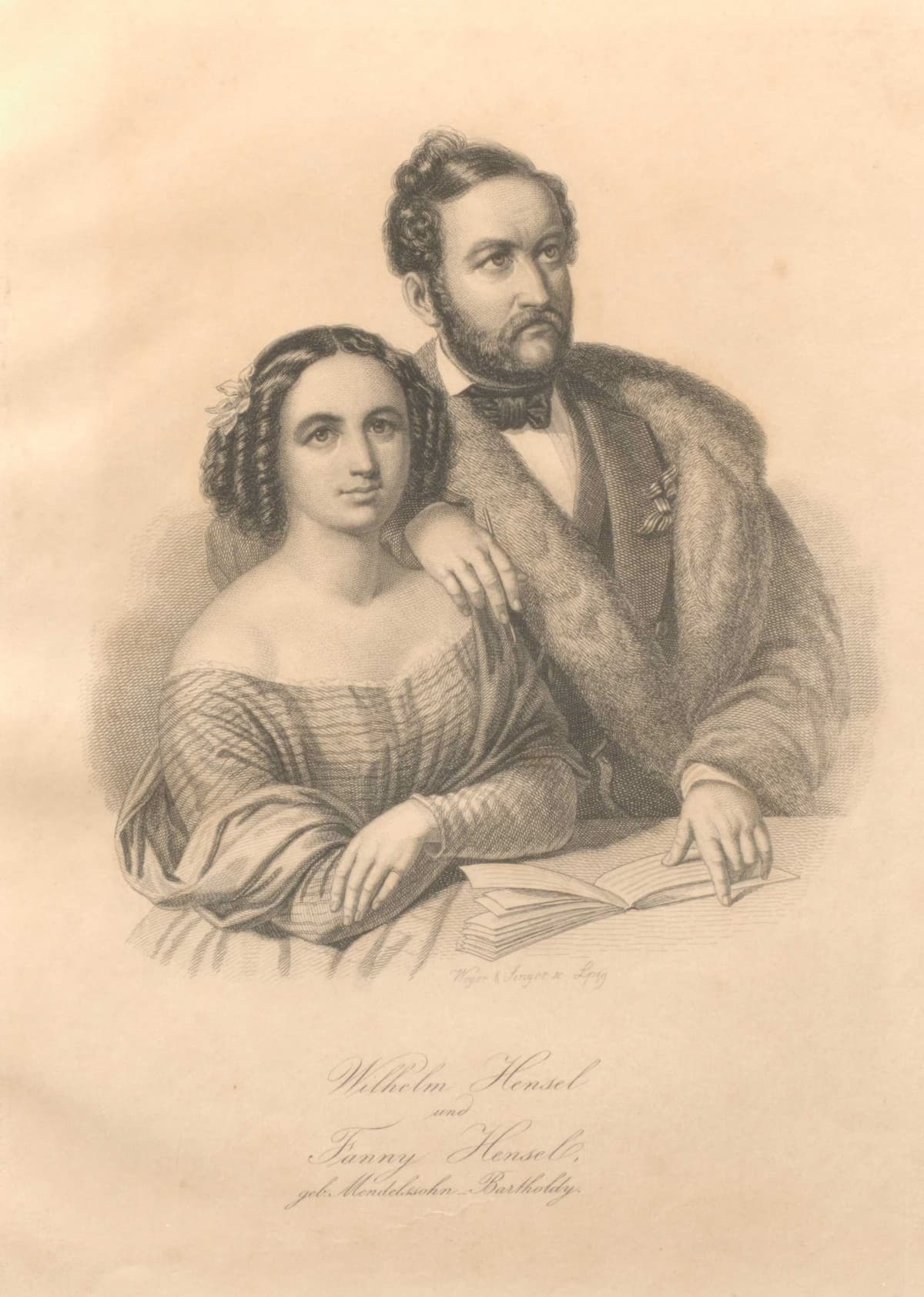
Fanny and Wilhelm Hensel

Fanny and Wilhelm Hensel

It must be a sign of talent that I do not give up, though I can get nobody to take an interest in my efforts.

Fanny Mendelssohn Hensel (1805-1847)   

I have had a very difficult life, you know. Only I do not like to talk about it, because I write happy music as a release. But anyway things were always against me. Whatever happened, it was against me.

Germaine Tailleferre (1892-1983)   

On Bravery

I hate silence when it is time to speak.

Kassia (810-865)   

If your lot makes you cry and be wretched, get rid of it and take another; strike out for yourself; don’t listen to the shriek of your relations…don’t be afraid of public opinion in the shape of the neighbours in the next house, when all the world is before you new and shining, and everything is possible, if you will only be energetic and independent and seize opportunity by the scruff of the neck.

Bettina von Arnim (1785-1859)   

On Ambition

I feel I must fight for [my music], because I want women to turn their minds to big and difficult jobs; not just to go on hugging the shore, afraid to put out to sea.

Ethel Smyth (1858-1944)   

To tell the truth, I struggle with my body to free myself; I want to be fully and wholly to myself; I must triumph, and I give up the idea of living for someone else. The needs of my art create a life that I ought not to forsake.

Marie Jaëll (1846-1925)   

On Racism

One of the most evil effects of racism in my time was the limits it placed upon the aspirations of blacks, so that though I have been “making up” and creating music all my life, in my childhood or even in college I would not have thought of calling myself a composer or aspiring to be one.

Undine Smith Moore (1904-1989)   

On the Future of Music

Since music is making very fast progress thanks to the young composers, I know that I can only take the back seat now, because I can’t outdo myself, and the truly novel things will be invented by the young ones, not by me. But this doesn’t worry me at all. Everyone has their place in the world. I do, or rather I would like to do, what I can do best – and that’s all.

Grażyna Bacewicz (1909-1969)   

I do not believe that the few women who have achieved greatness in creative work are the exception, but I think that life has been hard on women. It has not given them opportunity, it has not made them convincing. A woman has not been considered a working force in the world, and the work that her sex and conditions impose upon her has not been so adjusted as to give her a little fuller scope for the development of her best self. She has been handicapped and only the few through force of circumstances or inherent strength have been able to get the better of that handicap. There is no sex and art. Genius is an independent quality. The woman of the future with her broader outlook, her greater opportunities will go far, I believe, in creative work of every description.   

Baroque Era Music: A Beginner’s Guide

 by Emily E. Hogstad  July 19th, 2026


You almost certainly know more of it than you think. The driving pulse of Bach’s Brandenburg Concertos, the soaring melody of Vivaldi’s Four Seasons, the thunderous chorus of Handel’s Messiah: all of it is Baroque music.

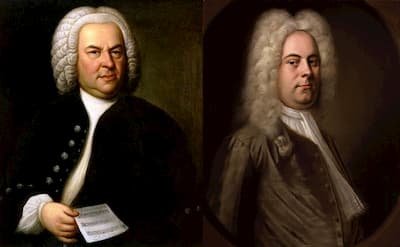
Bach and Handel, two prominent composers in the Baroque period

J.S. Bach and Handel © CMUSE

But what exactly is Baroque music? What does it sound like, and why did it sound that way? Who made it, and who paid for it – and why does any of it still matter today?

This is your guide to one of the most important and fascinating eras in the history of Western music.

What Does the Term “Baroque” Mean?

Scholars believe that the word Baroque may have come from the Portuguese word “barroco,” meaning “flawed pearl.”

It is also possible that the origins of the term date back to the Latin word baroco, a term that had originated in the field of Aristotelian logic, but eventually came to be a derogatory term for anything overly complex.  

Regardless of the exact etymology, the word “Baroque” has come to refer to the style of art, architecture, writing, music, and the like created between 1600 and 1750.

The word “baroque” was essentially a mild insult – meaning overwrought, too complicated – and yet the music (and art) that got labelled that way turned out to be some of the most magnificent ever written.

We wrote an article tracing the fascinating connections between music and the other arts during this time: https://interlude.hk/the-age-of-the-baroque-in-music-and-the-arts/

When Was the Baroque Era?

The Baroque era is commonly described as lasting from 1600 to 1750, although the styles of the surrounding eras bled into early and late Baroque works.

It’s also worth remembering that the era was named after it happened – i.e., nobody was going around in the 1600s and calling themselves a “Baroque composer.”

Why are those dates the ones that scholars have settled on?

The first answer is that 1600 was the year that opera was invented.

The oldest surviving opera, Euridice, composed by Jacopo Peri, was premiered in Florence in October 1600, as part of the wedding celebrations between King Henry IV of France and Maria de Medici.

Opera would become a major subgenre of Baroque music over the next 150 years.   

Meanwhile, the year 1750 marks the death of Johann Sebastian Bach.

For many, Bach’s death is a natural endpoint to use to mark the end of the era, since his compositions marked the intellectual and emotional high-water mark of the Baroque.

J.S. Bach’s composer sons all wrote in a markedly different, more modern style than their father did, signalling an evolution in style.

Bach’s towering legacy, and the impossibility of writing works in a Baroque style that would live up to his, make 1750 feel like the most logical endpoint.

We tracked the fates of Bach’s twenty children – including all of his composer sons – here: https://interlude.hk/what-happened-to-bachs-twenty-children/

What Does Baroque Music Sound Like?

At the heart of most Baroque music is a driving, almost mechanical pulse.

This pulse is created by rapid repeated notes in the cellos, basses, or instruments with similar ranges. They create a foundation for everything else: the harmonies, the melodies, the sudden shifts in dynamics, the moments where the instrumentation drops away or surges forward.  

Sometimes this pulse is provided by a line called the basso continuo, or “continuous bass.” A basso continuo consists of a lower bass line and chords that fill in the texture of the music and provide a bass for the instruments playing melody.

The details of the basso continuo were often left to individual performers and improvisers, providing space for a certain amount of creativity within certain rules and conventions.

Baroque music is also famous for its reliance on improvisation and ornamentations such as trills, turns, and other embellishments – all of which combine to give the music its distinctive decorative quality.

Arguably, the style of these decorations helped lead to Baroque music’s later reputation as being “too complex” or even “a flawed pearl.”

Who Paid For Baroque Music?

Put bluntly, the famous Baroque composers didn’t write for themselves. They all had bosses, and those bosses impacted what – and even how – these composers wrote music.

The Church – especially the Catholic Church – was employing music as part of the Counter-Reformation and its aftermath. Music was seen as a tool of spiritual persuasion, as well as an assertion of institutional and political power.

Bach is an interesting counterpoint here since he worked within the Lutheran tradition rather than the Catholic one. But the basic dynamic – composer as servant within a religious institution – still holds.

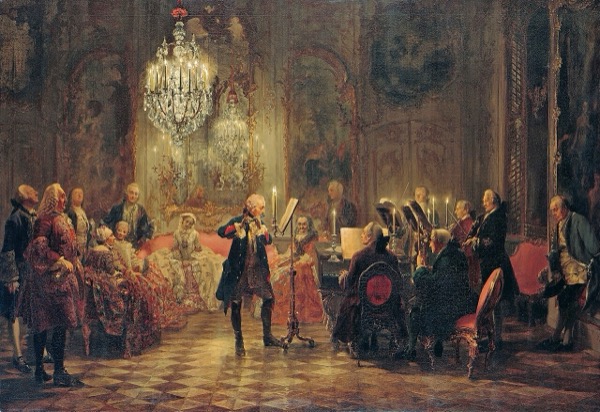
The Flute Concert of Sanssouci

The Flute Concert of Sanssouci

The other category of bosses is leaders of the courts. Kings, princes, and other wealthy European aristocrats employed composers the way they employed painters or architects. Music was used as a status symbol. Having a brilliant court composer demonstrated a ruler’s power, culture, and wealth.

One interesting tension is that these two patrons tended to want slightly different things. For instance, the Church was especially interested in continuing and evolving its long choral music tradition, while the courts became increasingly interested in cultivating innovative instrumental virtuosity.

Yet despite these opposing purposes, somehow the best of the Baroque era composers managed to produce music for both traditions – and in the process, they created work that outlasted all of their bosses.

The Giants of the Baroque Composers

Today, we’ll look at three of the most famous Baroque era composers.

Johann Sebastian Bach (1685–1750). Over the course of his career, he worked for both the church and the court, so he made major contributions to both sacred and secular music.

Bach’s music is complex, planned out in patterns. Some would call it mathematical.

But there’s also always a great humanity to it, and his gift for melody was second to none. Everyone will recognise the melody to Air on the G-string or Jesu, Joy of Man’s Desiring.   

George Frideric Handel (1685–1759). He’s a fascinating contrast to Bach because they were born the same year, in the same region of Germany, but they never met and ended up in completely different worlds.

Bach stayed close to home his whole life, rooted in the Lutheran church tradition. By contrast, Handel’s life was more cosmopolitan. He lived in Italy, then London, writing opera and oratorios for public audiences and royal patrons.

Unlike nearly all of his Baroque colleagues, Handel by and large managed to become his own boss, presenting entrepreneurial performances of his own works.

In the process, he basically invented the form of English language oratorio: a cheaper method to make money during Lent, when fully staged operas weren’t performed. The “Hallelujah Chorus” from his oratorio Messiah is one of the best-known pieces of Baroque music.   

Antonio Vivaldi (1678–1741). There is an old joke about Vivaldi: he wrote the same piece 500 times. There’s some truth to it insofar as his music uses similar forms, styles, and conventions, much like pop songwriters today. But that doesn’t mean he wasn’t inventive within the structural boundaries he observed.

His Four Seasons is a set of four violin concertos, each one depicting a different season in music. After their rediscovery in the early 20th century, they became hugely popular and are now among the most popular pieces of classical music ever written.

Plus, Bach was notoriously fascinated by him, choosing to rearrange some of Vivaldi’s violin works for harpsichord and orchestra – and if Bach was a fan, he can’t have been all that boring.

Vivaldi spent much of his career in Venice, writing for and directing an orchestra of orphaned and illegitimate girls at the Ospedale della Pietà – one of the most unusual and remarkable musical institutions of the era. We wrote about it here: https://interlude.hk/vivaldis-internationally-  renowned-orphanage-orchestra/  

Why Does Baroque Music Still Matter?

People love Baroque music: its vigour, its structure, its inventiveness within stylistic confines.

But it’s also historically important. The Baroque era invented the infrastructure of Western music. It saw the development of the standardisation of the orchestra – the emergence of new genres like the opera, the oratorio, the concerto, and more – and created the language that composers still use to write music today.

It did all that under conditions of institutional constraint and patronage that are foreign to us today.

The miracle isn’t just that the music is beautiful (although, of course, it is that), or that it continues to speak to us long after its composers ever dreamed it would.

The miracle is that so much great Baroque music was made at all, given that it was written so quickly and prolifically by people working on short deadlines, for powerful bosses – who, ironically, are often most famous today for their appearances in the footnotes of music history textbooks.

Music Confronts Humanity and Poses Some Questions

 by Maureen Buja  July 22nd, 2026

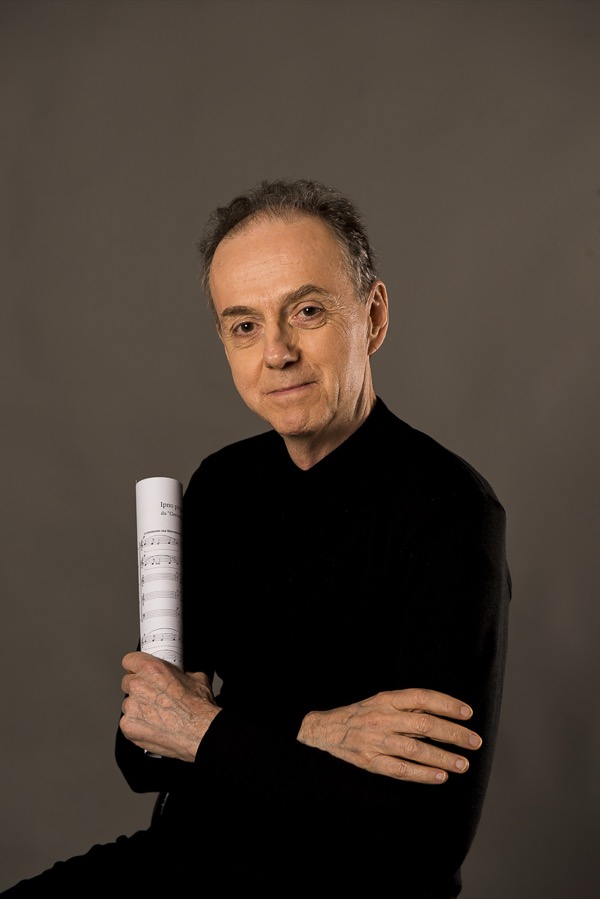
Italian composer Maurizio Guernieri (b. 1962) wanted to explore the world of wind instruments, which he felt, as a string musician, was an unfamiliar corner of the musical world. His 2019 work Musicografie (Images in Music) starts each movement with a quotation that the movement will explore. The texts were created by the composer and pose questions or situations that can be pondered musically.

Maurizio Guernieri

Maurizio Guernieri

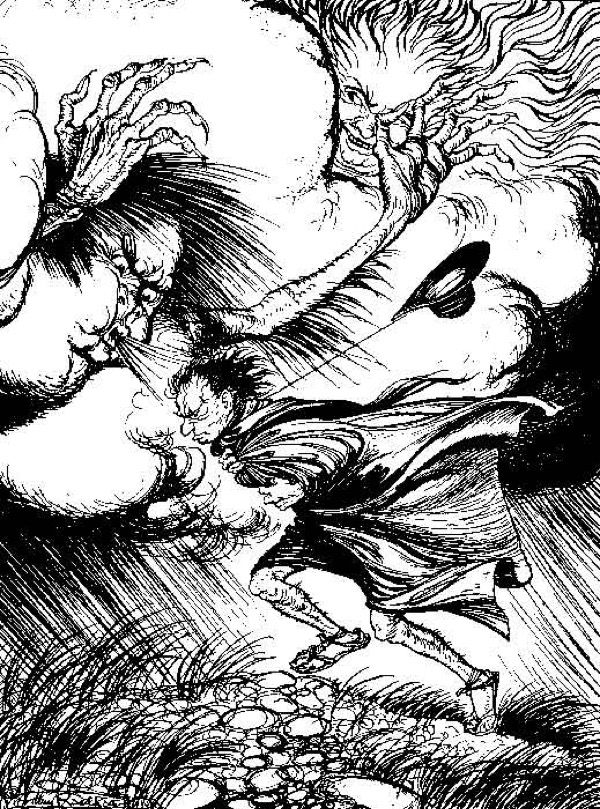
In the Praeludium, the story comes from an Aesop’s fable in which the sun and the wind compete to see which is stronger, choosing a traveller on the road to show their power. The wind blows and makes the poor traveller clutch his coat all the closer to keep warm; the sun shines and makes him take his coat off to luxuriate in the heat. Despite his bluster, the wind is defeated by the sun….

Praeludium
Il vento, con il suo alito possente, voleva dimostrare di essere il più forte…The wind, with its powerful breath, wanted to prove that it was the strongest…

Arthur Rackham: The North Wind and the Sun

Arthur Rackham: The North Wind and the Sun

Each instrument seems to push its particular sound. The traveller is alone, and around him whirls a multiplex of sound and silences.

The student asks his teacher a question, and the answer is larger than either the student or the question. Even in the midst of a crowd, we are always alone.

Solitude
«Ma gli uomini dove si trovano?» chiese curioso l’allievo. «Io non vedo nessuno. Qui nel deserto è pieno di solitudine…» «Siamo sempre soli. Anche in mezzo agli uomini» rispose il Maestro.“But where are the men?” asked the student curiously. “I don’t see anyone. Here in the desert it’s full of solitude…” “We are always alone. Even among men,” replied the Master.

Each instrument plays alone, with little reference to the other ensemble members. The piano thunders in its low register, the flute quivers, and the strings (viola and violoncello) play harmonics and add their own quiver to the flute sound.

A mix of weather and music! Notes fall like rain, forming drops and then rivers until, at the end, even pianos fall from the heights.

Ostinati
Le nuvole si aprono e delicatamente cadono gocce di note. Si forma un crescendo e cadono fiumi di intere scale di note. Poi tutta la musica precipita e piovono pianoforti da altezze incommensurabili…The clouds part, and delicate drops of notes fall. A crescendo forms, and rivers of entire scales of notes fall. Then all the music falls, and pianos rain down from immeasurable heights…

In Pavane, we have our first steps of the dance of life, coming from the sea. In the end, the sea will engulf the world, and we will all dance together.

Pavane
Il mare è l’immensa culla della vita di tutta la natura: si può dire che da lui ogni cosa abbia mosso i primi passi e forse, probabilmente, verso di lui ogni cosa si incamminerà incontro alla fine di tutto.The sea is the immense cradle of life for all of nature: it can be said that everything took its first steps from it, and perhaps, probably, everything will move towards it towards the end of everything.

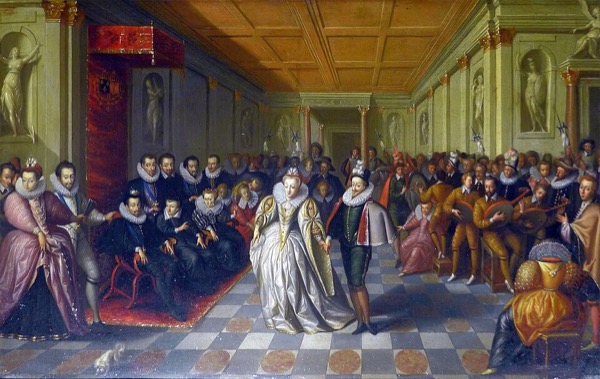
A pavane at the court of Henry III of France, ca 1581 (Louvre Museum)

A pavane at the court of Henry III of France, ca 1581 (Louvre Museum)

In European music, the Pavane was a slow processional dance, designed to show off the magnificent clothes worn at court.

Under the title of Caccia (Hunt), Nature looks at humans and finds them…wanting. What would we do if Nature gave up on us?

Caccia
La senti la Foresta? É strana: silenziosa e viva allo stesso tempo. Consapevole e attenta a ciò che le succede intorno. Direi quasi che capisce molto di più di quanto capiscano gli uomini. E la Foresta li osserva, li scruta, li giudica e sentenzia: «Adesso basta! Se lo procurino loro, l’ossigeno».Can you hear the Forest? It’s strange: silent and alive at the same time. Aware and attentive to what’s happening around it. I’d almost say it understands much more than humans do. And the Forest observes them, scrutinises them, judges them, and pronounces: “Enough! Let them get their own oxygen.”

In a fall of notes, the Forest world comes alive. Complex questions are asked and thought about. The piano speaks for the ground, and the other instruments inhabit the upper branches and speak for those who live there.

In the final movement, we return to the greatest of human creations: the city. Gathered together in towers, the people in the city seem to reach more and more desirously toward the sky, but what is there to reach?

Postludium
La città verticale corre verso il cielo. «Tutto si muove, tutto corre, tutto volge rapido e distratto. Verso dove?»The vertical city races toward the sky. “Everything moves, everything rushes, everything turns quickly and distractedly. Towards where?”

Quick and distracted, the ensemble seems to pursue many different paths towards where?

It’s an interesting idea to pose questions for music to answer. More than just a single reflection on the movement titles, the musical content poses questions for us as well.

In the Praeludium, it isn’t strength that wins the competition, it’s a quiet inner glow.

The Solitude of the individual takes a long time to be understood. At first, the student sees everyone as more alike than different. It’s his teacher who tells him to look beneath the surface and to recognise that the differences between people make each of them alone.

Ostinati, in the plural, makes us rethink the musical idea of an ostinato. Traditionally, it’s a recurring rhythm below the melody, but what if every voice contributes to that idea?

In the Pavane of the sea, the first steps are just as tentative as the final steps. Change doesn’t bring improvement, and slow isn’t always better.

Caccia has an intriguing title: who is involved in the hunt? The Forest can’t move to capture anything, and humans are infamous for pursuing their targets too far. Does the Forest have to help? Not necessarily.

The Postludium questions man’s achievement. What’s the point of creating more and more, higher and higher, if we don’t know what we’re seeking?

Wednesday, July 22, 2026

Focusing on the Unusual: Vivaldi’s Concertos for Viola d’amore


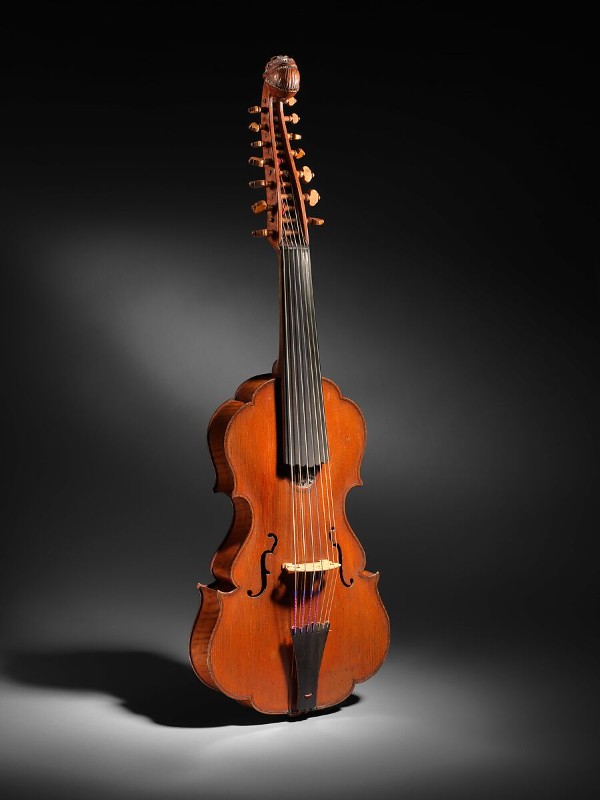
Viola d’amore with 14 strings made by Johannes Florenus Guidantus, 18th century (Metropolitan Museum of Art)

Viola d’amore with 14 strings made by Johannes Florenus Guidantus, 18th century (Metropolitan Museum of Art)    One of Vivaldi’s star pupils at the Ospedale della Pietà was a violinist named Anna Maria. One visitor to the Pietà described her as ‘the finest violinist in Europe’, and Vivaldi wrote many of his violin concertos for her. We believe that at least two of the 8 viola d’amore concertos were written for her because of Vivaldi hiding her initials in the titles: Concerto per viola d’AMore.

By having 6 strings instead of the usual 5 on a regular violin, the viola d’amore was capable of playing some chords and using some barre effects (where you play two strings in quick alternation, with one of them sounding the melody) that were not possible on the violin. Vivaldi, of course, incorporated these effects into his works.

Concertos on unusual instruments were popular in Vivaldi’s world, and he fulfilled that desire with many different kinds of instruments. Being a specialist on the viola d’amore (he was known to play it himself) meant more money to be earned teaching this unique instrument.

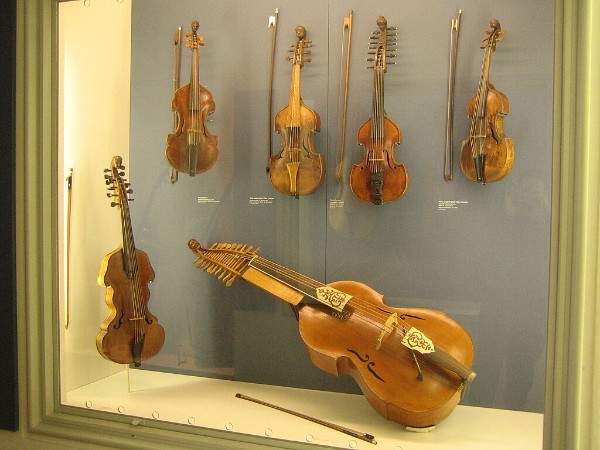
Violas d’amore (top row, 2nd from right, and bottom left) and a viola di bordone (baryton) (bottom right) (Deutsches Museum)

Violas d’amore (top row, 2nd from right, and bottom left) and a viola di bordone (baryton) (bottom right) (Deutsches Museum)


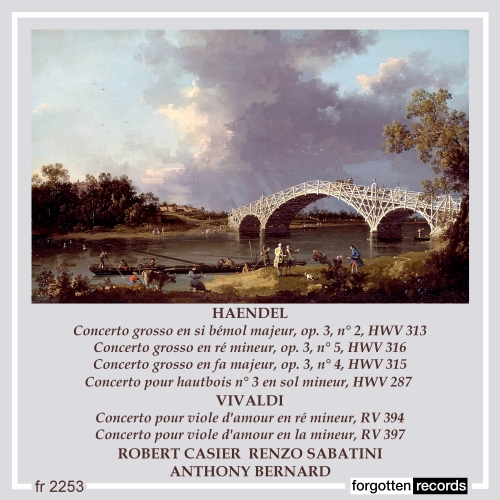
This recording was made in 1950 with Renzo Sabatini as the viola d’amore soloist, playing with Anthony Bernard leading The London Chamber Orchestra.

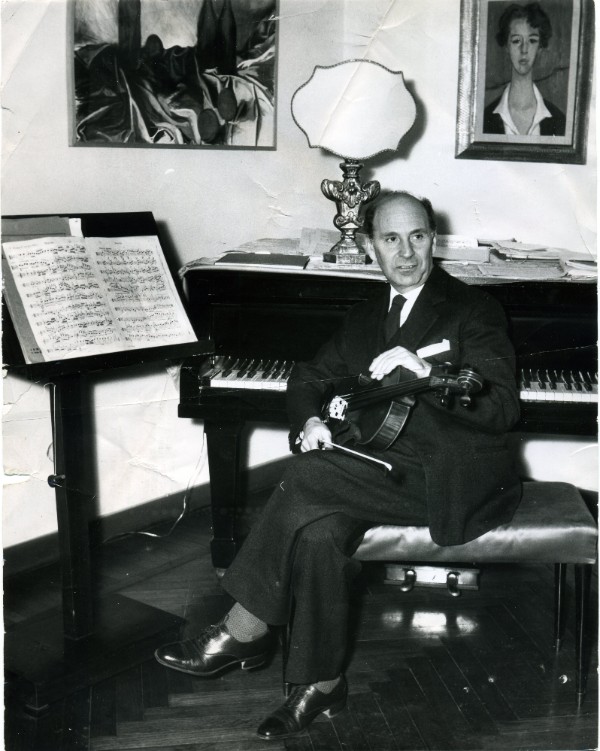
Renzo Sabatini

Renzo Sabatini

Sabatini (1905–1973) studied violin and viola at the Santa Cecilia Conservatory in Rome and toured widely as both a violinist and a viola d’amorist, recording two of Vivaldi’s concertos for Decca. After his concert touring stopped, he became an editor of Baroque Italian music, bringing out works by Ariosti, Asioli, Boccherini, Geminiani, Locatelli, Lorenziti, Pergolesi, SalieriTartini, and Vivaldi, as well as writing his own work. He played a Gasparo da Salò viola and a Capicchioni viola d’amore.

Haendel-Vivaldi-Robert Casier-Renzo Sabatini-Anthony Bernard

Performed by
Renzo Sabatini
Anthony Bernard
The London Chamber Orchestra

Recorded in 1950

Official Website

For more of the best in classical music, sign up for our E-Newsletter

Maria João Pires (Born on July 23, 1944) Chopin’s Inner Music

Born on 23 July 1944 in Lisbon, Portugal, Maria João Pires is one of the most introspective artists of our time. Her playing is a study in poetic refinement that reveals an almost spiritual connection to the music.

Her recordings of Mozart’s piano sonatas balance imagination and spontaneity, while her Schubert interpretations are treasured for their poetic simplicity. If there is one recording, however, that is most closely identified with her artistry, it is surely the 1996 Deutsche Grammophon recording of the complete Chopin Nocturnes.

To celebrate her birthday on 23 July, let us return to this exceptional and award-winning recording, often regarded as one of the finest accounts of Chopin’s Nocturnes ever committed to disc.  

Poetry Before Virtuosity

Distinguishing Chopin’s poetic voice from his virtuosity, Maria João Pires explained that, “Before everything else, Chopin is a poet. It’s very inner music and very deep. I don’t feel at all that it’s for show. Chopin is the deep poet of music. But he also invented this terrible thing called piano recitals. That made me suffer all my life.” (Judd, Poetry of Chopin, 2016)

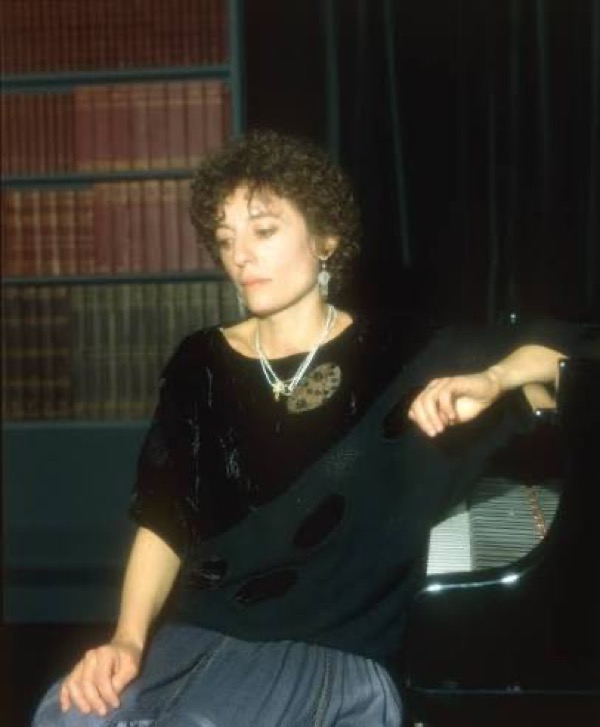
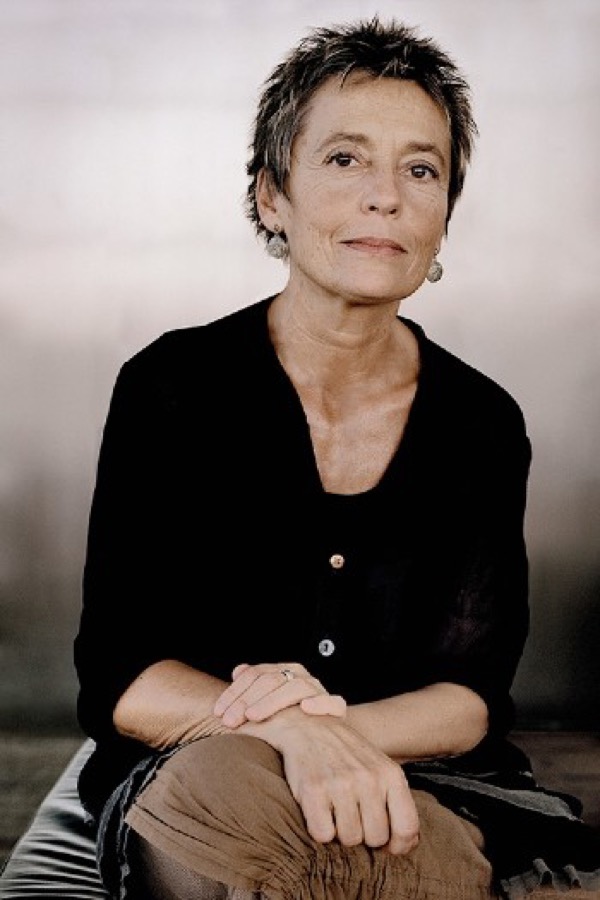
Maria João Pires

Maria João Pires

Pires, who has long felt uncomfortable with the performer-centred culture of the concert stage throughout her life, views Chopin’s music as an expression of profound inner emotions and intimate reflection.

Height of Artistic Maturity

Pires signed an exclusive contract with Deutsche Grammophon in the late 1980s. During the 1990s, DG increasingly presented her as one of its leading pianists, and the Chopin Nocturnes released in 1996 coincided with the height of her artistic maturity.

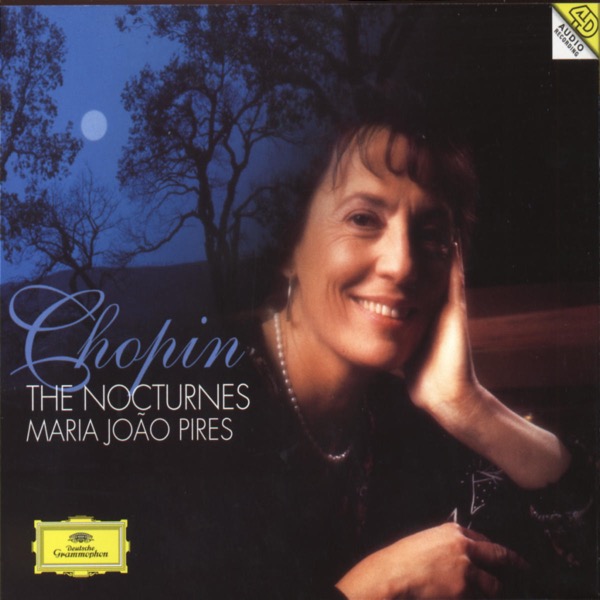
Maria João Pires, Chopin: The Nocturnes (Deutsche Grammophon)

Maria João Pires, Chopin: The Nocturnes (Deutsche Grammophon)

Her interpretation is immediately recognisable for its vocal lyricism and natural rubato. Critics frequently remarked on her ability to sustain long melodic lines and to create an atmosphere of intimacy.

Beyond the Salon

The album was internationally commended, receiving the Record Academy Prize in Tokyo, the CD Compact Award in Barcelona, and the Grand Prix du Disque in 1997. In addition, it was nominated for a Grammy Award and was overwhelmingly admired by critics.

Maria João Pires

Maria João Pires

Bryce Morrison in Gramophone writes, “Passion rather than insouciance is Pires’ keynote.
Here is an intensity and drama that scorn all complacent salon or drawing-room expectations.
How she relishes Chopin’s central storms, creating a vivid and spectacular yet unhistrionic contrast with all surrounding serenity or embalmed darkness.” (Morrison, Gramophone Classical Music Guide, 2010)

Critical Responses

Morrison continues to describe her interpretation as reinforcing a sense of Chopin’s stature and creating a new range of possibilities. “Yet moving ahead, one has no hesitation in declaring Maria João Pires to be among the most eloquent master-musicians of our time.” (Morrison, Gramophone Classical Music Guide, 2010)

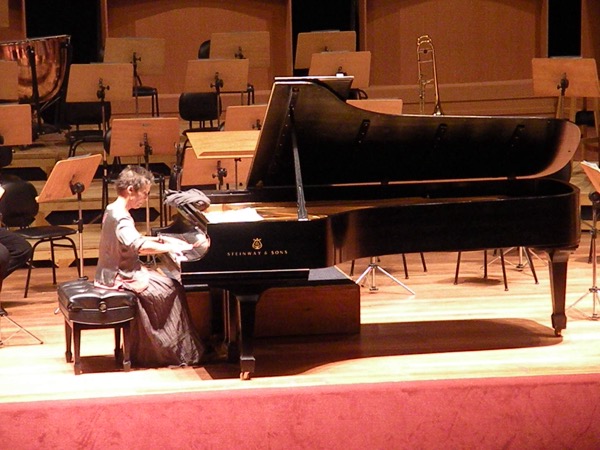
Maria João Pires (photo by Felix Broede / DG)

Maria João Pires (photo by Felix Broede / DG)

However, Pires also received extensive criticism from advocates of historically informed performance practice. By not returning to the manuscripts, she takes liberties with the dynamics and distorts phrases through fluctuating tempi.  

Beauty Beyond Critique

Pires has also been criticised for mistaking passages which should be played strictly in time for recitative, and for unstylishly over-dramatising the musical text. Despite reservations about her interpretative choices, reviews suggest that Pires’ playing stood above much of the competition within the prevailing traditions of Chopin performance.

Three decades after its release, Pires’ recording remains a work of pianistic beauty. It offers sincerity and poetic insight, and an encounter with what she herself called Chopin’s “very inner music.”

Kara Karayev and His Seven Beauties

 by Maureen Buja  July 23rd, 2026


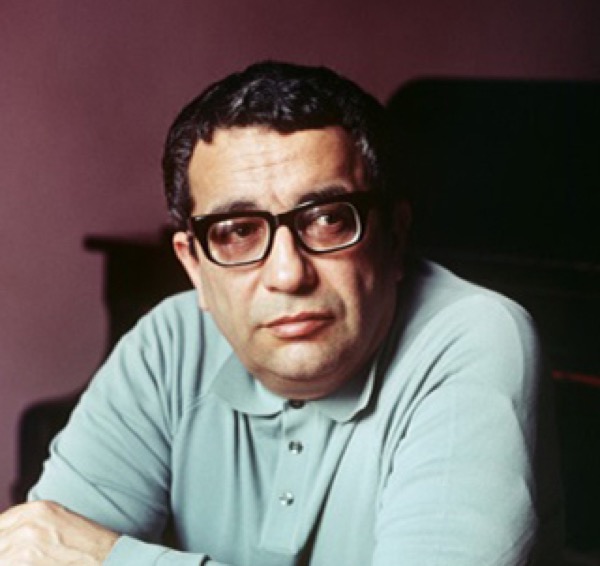
Kara Karayev (Gara Garayev)

Kara Karayev (Gara Garayev)

At the Moscow Conservatory, he was the top student in the class studying with Dmitri Shostakovich, and much of Shostakovich’s influence is evident in Karayev’s musical style, particularly in instrumentation and harmonic language. He wrote across an enormous range of genres: music for plays and musicals, opera, ballet, symphonic and chamber works, romances, cantatas, children’s music, and film music. He saw himself as a native speaker of Azerbaijani music, and that music of both the east and the west came together in him.

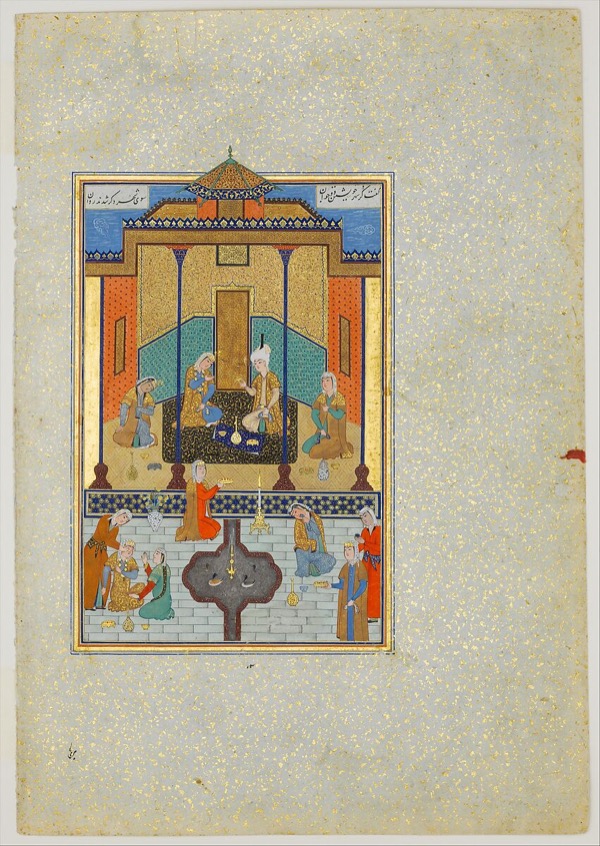
In 1949, Karayev wrote the symphonic suite The Seven Beauties, based on the 12th-century poem by Nizami. In Nizami’s epic poem, completed in 1197, the young warrior Bahram Gur, destined to become ruler of the world, enters a mysterious, locked room to discover the portraits of seven beautiful princesses, each from a different land. When he wins a kingdom and achieves great wealth and power, he remembers the maidens and summons each of them, commissioning the architect Shideh to build seven domed structures – one for each bride. Seven brides and seven days of the week, and each beauty in a separate pavilion in a signature colour, to be visited on ‘her’ day of the week. Each beauty tells the king a story with a moral lesson. Starting the week in the White pavilion, he ends at the black pavilion. Nizami’s mystical poetry illustrates the supremacy of divine love over earthly pleasures.

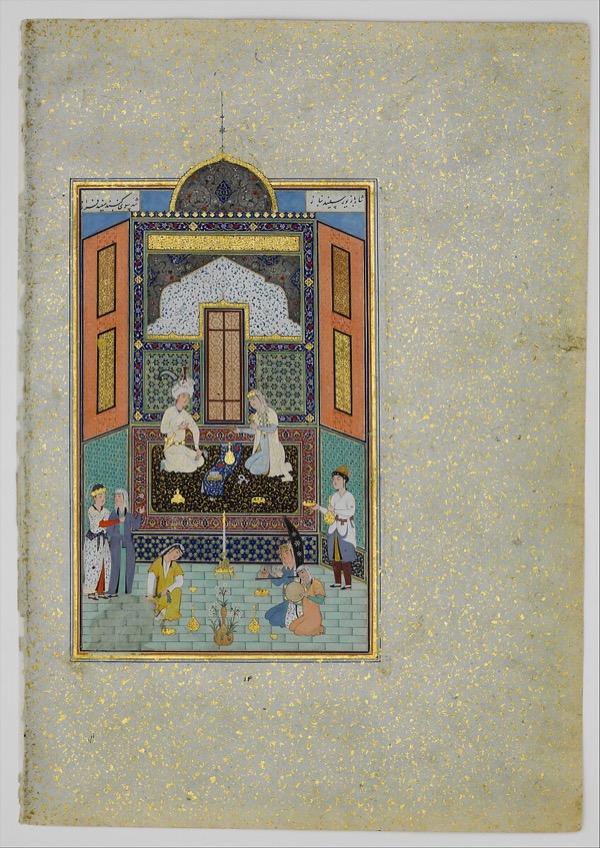
The poetry of Nizami and the story of Bahram Gur have been illustrated for centuries, and below you will see selections from an early 16th-century manuscript from Herat, in present-day Afghanistan.

In 1953, Karayev converted his symphonic suite into a ballet, the first full-length Azerbaijani ballet, The Seven BeautiesThe Seven Beauties Ballet Suite was created from the ballet.

Before any of the beauties are revealed, the ballet opens with a Waltz and Adagio, but not a waltz in the Viennese sense, since the use of percussion and the tonal modulations definitely takes us to the exotic east.

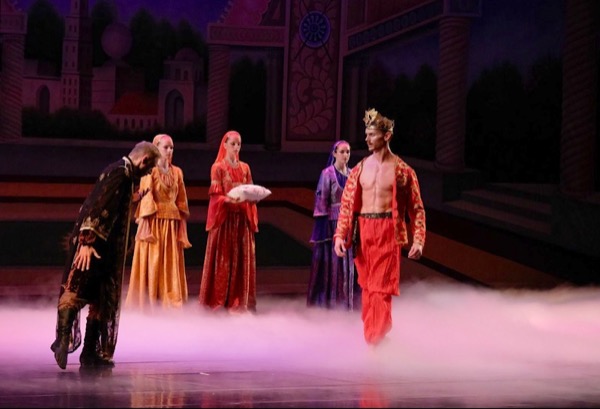
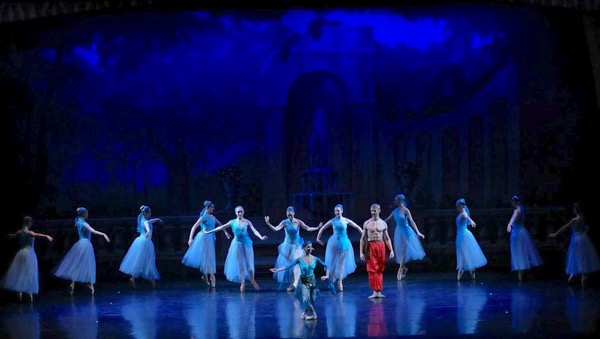
Bahram Gur, 2014 (San Diego Ballet)

Bahram Gur, 2014 (San Diego Ballet)

The whirling Waltz is calmed in a moderate Adagio.

A comedic Dance of the Clowns follows, giving us the equivalent of a scherzo movement.

Now our hero, Bahram Gur, finds the ruined palace where the portraits of the 7 beauties adorn the walls, which forms an Introduction to the seven beauties.

Each princess is from a different region, starting with the beauty from India. The music is given to a solo flute, with a percussion accompaniment.

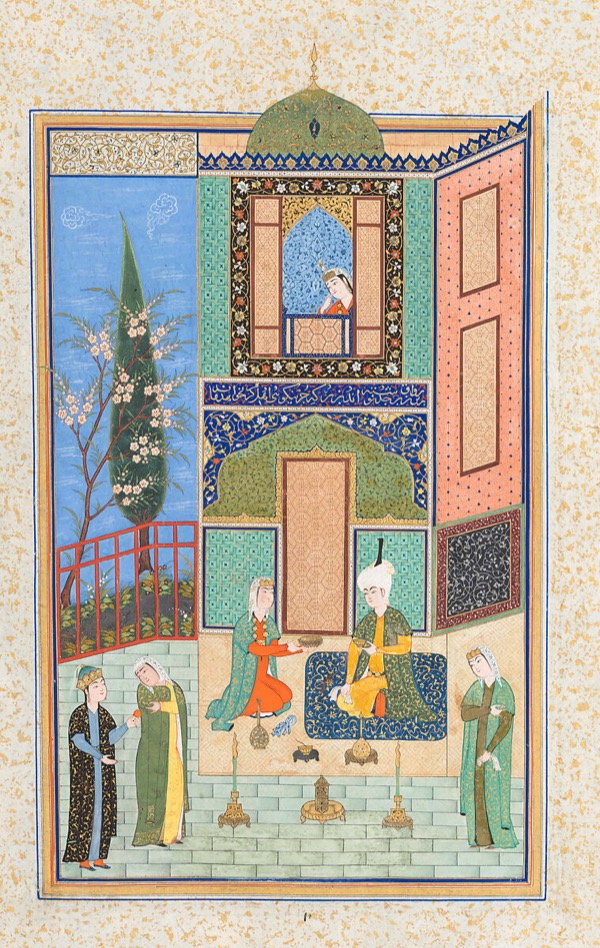
Bahram Gur in the White Palace on Friday, Folio 235 from a Khamsa (Quintet) of Nizami of Ganja, 1524–1525 (Metropolitan Museum, 13.228.7.14)

Bahram Gur in the White Palace on Friday, Folio 235 from a Khamsa (Quintet) of Nizami of Ganja, 1524–1525 (Metropolitan Museum, 13.228.7.14)

The Byzantine beauty is personified by a fast, fiery dance at her entrance and a more subdued exit.

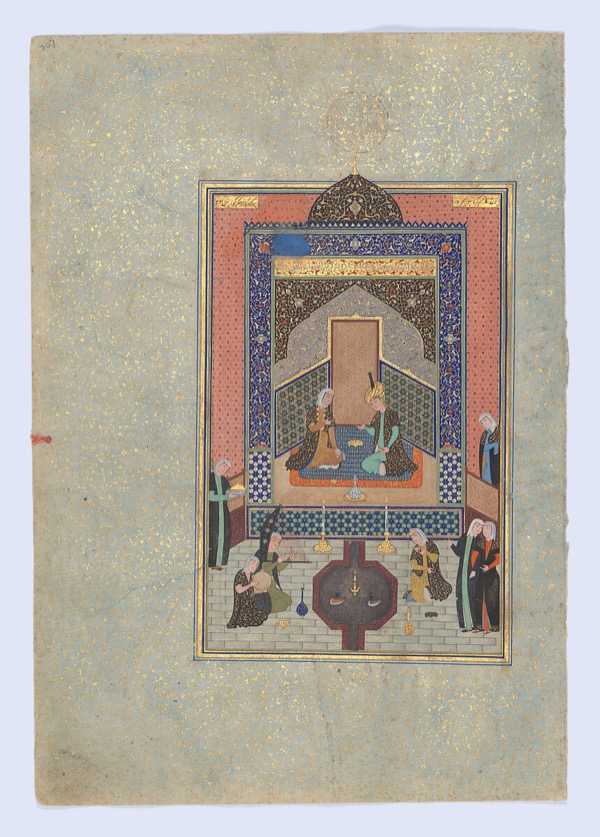
Bahram Gur in the Dark Palace on Saturday, Folio 207 from a Khamsa (Quintet) of Nizami of Ganja, 1524–1525 (Metropolitan Museum, 13.228.7.8)

Bahram Gur in the Dark Palace on Saturday, Folio 207 from a Khamsa (Quintet) of Nizami of Ganja, 1524–1525 (Metropolitan Museum, 13.228.7.8)


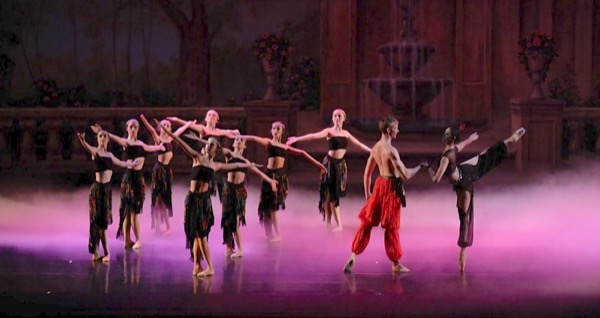
Bahram Gur and the Dark Princess, 2014 (San Diego Ballet)

Bahram Gur and the Dark Princess, 2014 (San Diego Ballet)

The Khorezmian beauty from the Khwarazmian Empire, now part of present-day Central Asia, Afghanistan, and Iran, is also energetic.

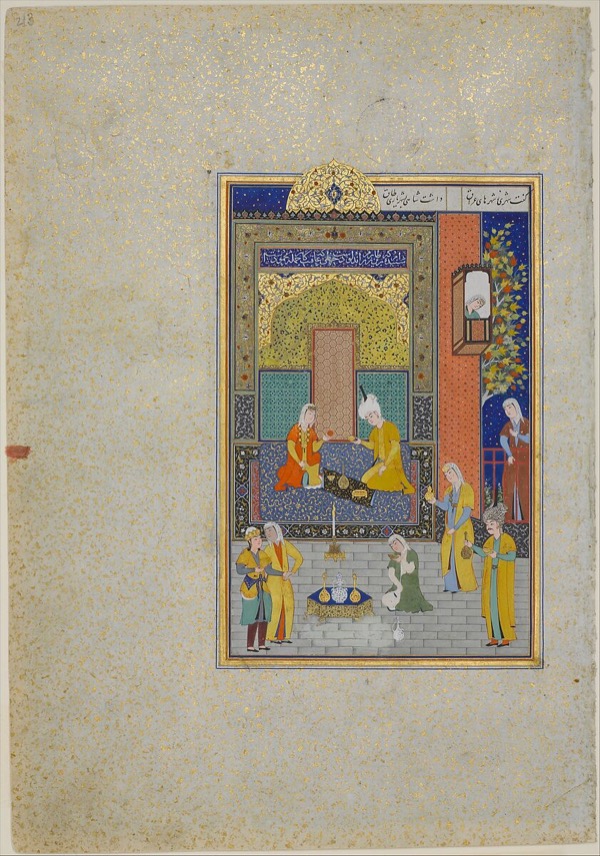
Bahram Gur in the Yellow Palace on Sunday, Folio 213 from a Khamsa (Quintet) of Nizami of Ganja, 1524–1525 (Metropolitan Museum, 13.228.7.9)

Bahram Gur in the Yellow Palace on Sunday, Folio 213 from a Khamsa (Quintet) of Nizami of Ganja, 1524–1525 (Metropolitan Museum, 13.228.7.9)


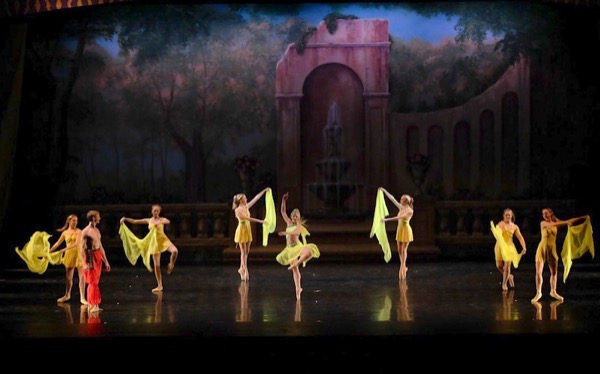
Bahram Gur and the Yellow Princess, 2014 (San Diego Ballet)

Bahram Gur and the Yellow Princess, 2014 (San Diego Ballet)

The Slavonic beauty’s music invokes Russian folksong as its basis.

Bahram Gur in the Green Palace on Monday, Folio 224 from a Khamsa (Quintet) of Nizami of Ganja, 1524–1525 (Metropolitan Museum, 13.228.7.12)

Bahram Gur in the Green Palace on Monday, Folio 224 from a Khamsa (Quintet) of Nizami of Ganja, 1524–1525 (Metropolitan Museum, 13.228.7.12)

The Maghrebian beauty brings us a bolero song style with castanets and Spanish harmonies.

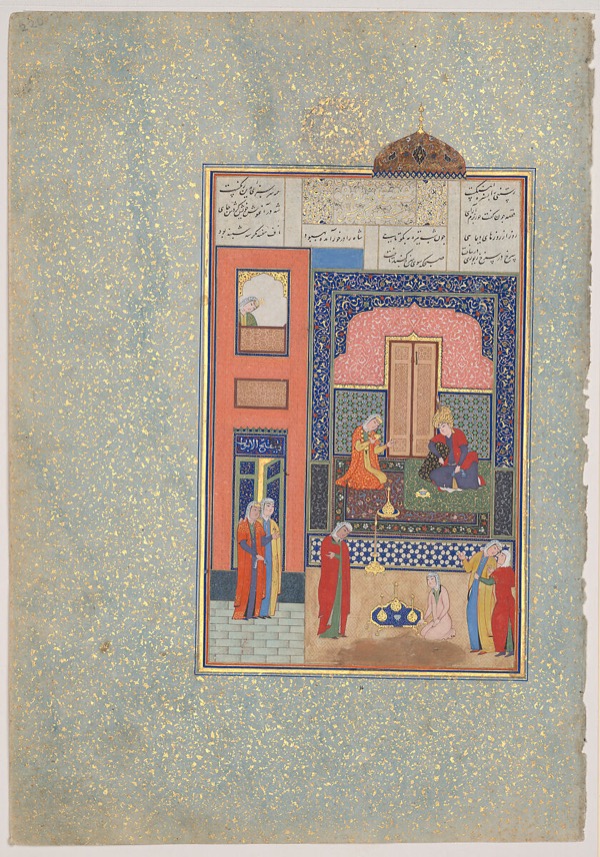
Bahram Gur in the Red Palace on Tuesday, Folio 220 from a Khamsa (Quintet) of Nizami of Ganja, 1524–1525 (Metropolitan Museum, 13.228.7.11)

Bahram Gur in the Red Palace on Tuesday, Folio 220 from a Khamsa (Quintet) of Nizami of Ganja, 1524–1525 (Metropolitan Museum, 13.228.7.11)

The Chinese beauty brings back the flutes, now in a lively dance.

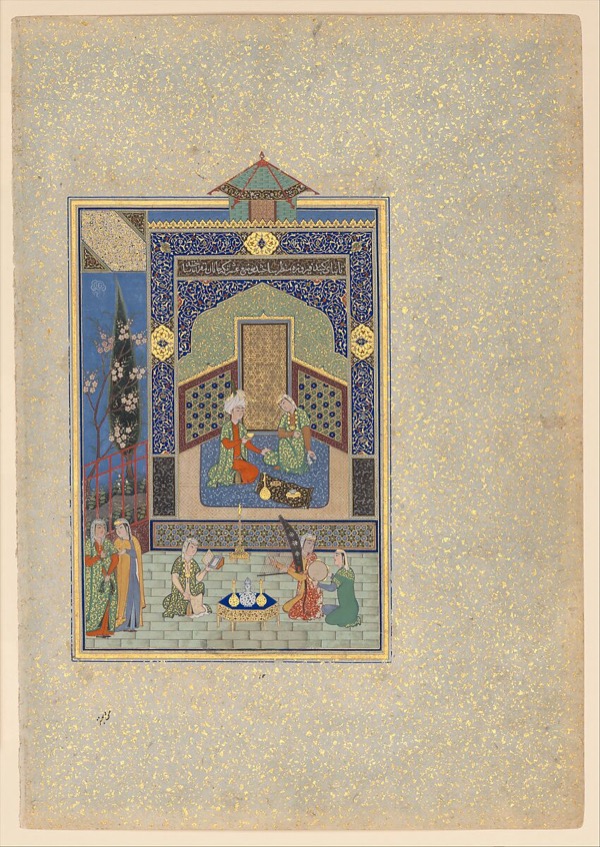
Bahram Gur in the Turquoise Palace on Wednesday, Folio 216 from a Khamsa (Quintet) of Nizami of Ganja, 1524–1525 (Metropolitan Museum, 13.228.7.10)

Bahram Gur in the Turquoise Palace on Wednesday, Folio 216 from a Khamsa (Quintet) of Nizami of Ganja, 1524–1525 (Metropolitan Museum, 13.228.7.10)


Bahram Gur and the Turquoise Princess, 2014 (San Diego Ballet)

Bahram Gur and the Turquoise Princess, 2014 (San Diego Ballet)

The final portrait, called by Karayev The Beauty of Beauties, uses harps and clarinets and places a unique melody in the oboe. The ostinato accompaniment gives the music an almost hypnotic feel. At the same time, there’s a triumphal feel, as though all the beauties in the world have come together as a brightly shining light.

Bahram Gur in the Sandal Palace on Thursday, Folio 230 from a Khamsa (Quintet) of Nizami of Ganja, 1524–1525 (Metropolitan Museum, 13.228.7.13)

Bahram Gur in the Sandal Palace on Thursday, Folio 230 from a Khamsa (Quintet) of Nizami of Ganja, 1524–1525 (Metropolitan Museum, 13.228.7.13)

The ballet closes with The Procession, in a march that opens in the woodwinds and continues using harmonies and rhythms in the style of Prokofiev.

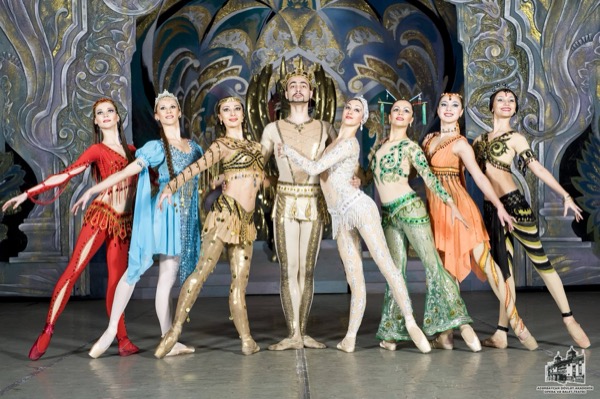
Bahram Gur and his 7 beauties, 2014 (San Diego Ballet)

Bahram Gur and his 7 beauties, 2014 (San Diego Ballet)

Throughout the work, Karayev’s research into music of the Arab-influenced world and his ventures into Albanian, Vietnamese, Turkish, Bulgarian, and African musics all have a place to show in the international beauty brought together by Bahram Gur. As a ballet, it allows the choreographer to use musical styles from across the region for each princess, each reinforced by their individual colours.