Friday, July 3, 2026

The Greatest Violinist of Each Decade of the 20th Century

by Emily E. Hogstad  June 29th, 2026


The process is less about choosing stars and more about understanding what greatness meant in different decades, and how each violinist – and each decade – pushed the art of violin-playing forward.

At the start of the century, the greats were famous for their tone and personal expressiveness. Mid-century, thanks to the diamond-hard virtuosity of Jascha Heifetz, priorities shifted toward technical greatness. Later, the pendulum swung back again: the greats began embodying warmth, humanity, and stylistic chameleonism alongside bulletproof technique.

The following list identifies one violinist per decade who best embodied the dominant values of their time.

1900–1909: Eugène Ysaÿe
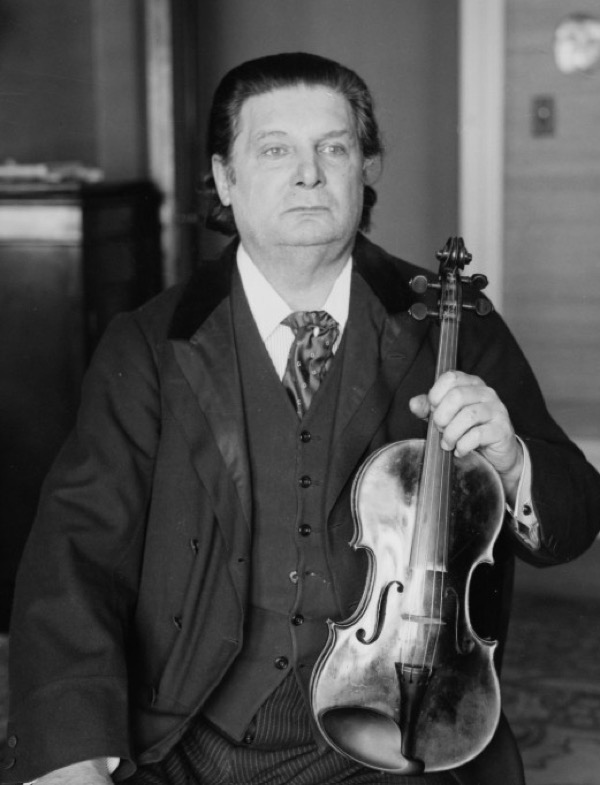
Eugène Ysaÿe

Eugène Ysaÿe   At the turn of the century, Eugène Ysaÿe stood at the centre of European musical life.

His playing fused technical command with unprecedented expressive freedom, laying the foundations of modern violinism and earning him the nickname the King of the Violin.

His approach to phrasing and tone permanently altered expectations of what the violin could express.

During his career, composers such as Franck, Chausson, and Debussy wrote with his sound in mind, resulting in a number of vital contributions to the violin repertoire.

He also wrote an important set of six solo sonatas, works that remain both technically and philosophically demanding for violinists today.

1910–1919: Fritz Kreisler
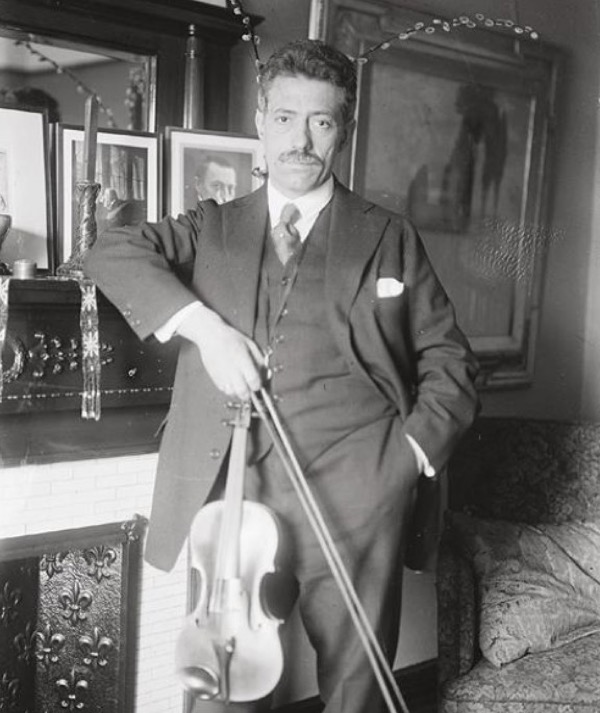
Fritz Kreisler

Fritz Kreisler   Kreisler‘s supremacy in the 1910s was cultural as well as musical.

Many music lovers had their first introduction to violin music through his early recordings – especially the ones of his own beautiful and brief recital pieces like Liebesleid, Liebesfreud, and Caprice Viennois.

He was also famous for his Baroque-style miniatures like his Praeludium and Allegro, which he told audiences were rediscovered scores by obscure composers, but had actually been composed by Kreisler himself.

His famously golden tone, impeccable sense of rubato, and unapologetic Viennese charm shaped early twentieth-century musical taste.

1920–1929: Jascha Heifetz
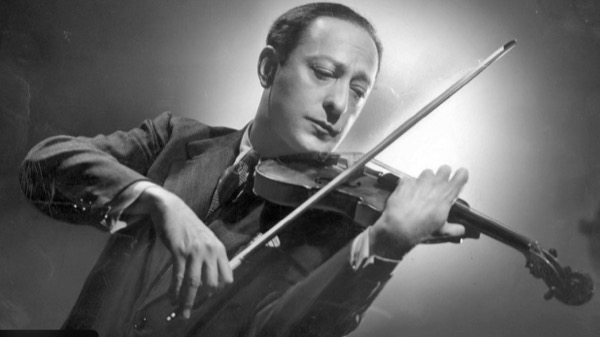
Jascha Heifetz

Jascha Heifetz   No arrival in violin history was more disruptive than Jascha Heifetz. When he first heard a young Heifetz play, Kreisler reportedly quipped that all other violinists might as well break their instruments across their knees.

In the 1920s, Heifetz redefined technical perfection, achieving clarity, speed, control, and precision previously thought unattainable.

From this decade onward, violinists were judged against a new and unforgiving technical standard: Jascha Heifetz’s.

1930–1939: Yehudi Menuhin
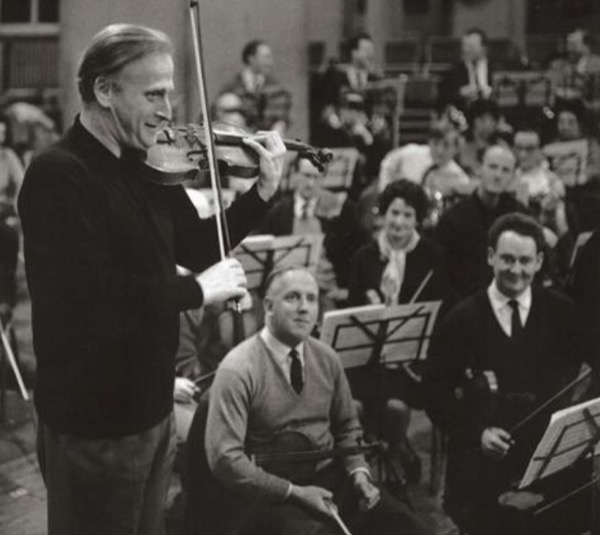
Yehudi Menuhin

Yehudi Menuhin   

While Heifetz remained dominant through the 1930s (and there’s a good case to be made that he was also the most influential violinist for a couple more decades to come), Menuhin came to symbolise something different.

A prodigy of dizzying ability whose seriousness and introspection resonated during the Depression years, Menuhin demonstrated how a solo violinist could become known for his spiritual and even moral depth.

His seriousness and moral authority that emerged in the 1930s would later define his wartime performances, when he performed for Allied troops and concentration camp survivors.

Later in his career, he also became known for his cross-cultural exchanges (he was especially well known for his collaborations with Indian sitarist Ravi Shankar and French jazz violinist Stéphane Grappelli) and supporting young musicians’ careers.

1940–1949: David Oistrakh
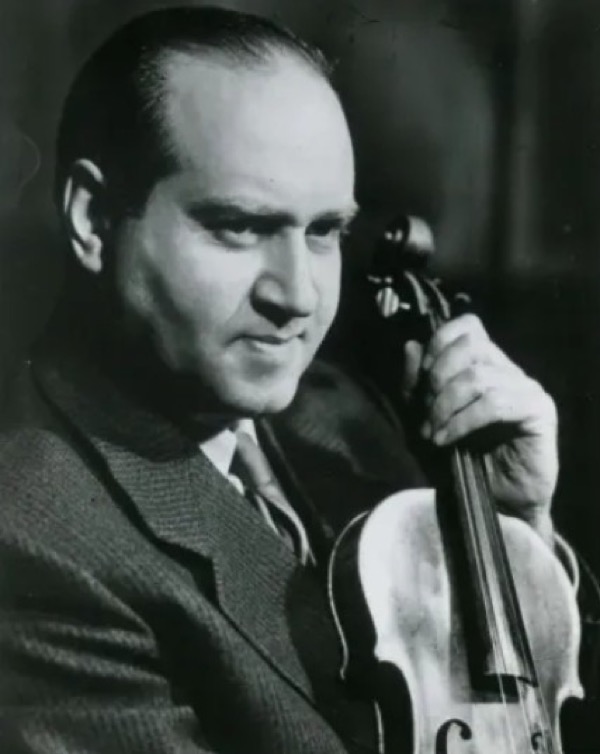
David Oistrakh

David Oistrakh   

The wartime and postwar years demanded a kind of moral and musical gravity from its greatest classical musicians, and the playing of Oistrakh – with his deeply human tone and earnestness – fit the bill.

Oistrakh’s broad tone, architectural phrasing, and moral authority were hugely influential to both Soviet and Western violinists in a musical world fractured by war and politics at the dawn of the Cold War.

His collaborations with Shostakovich (the composer’s shattering first violin concerto, written between 1947-48, was dedicated to him), and his interpretations of Beethoven and Brahms established a model of postwar musical nobility that remains influential to this day.

1950–1959: Nathan Milstein
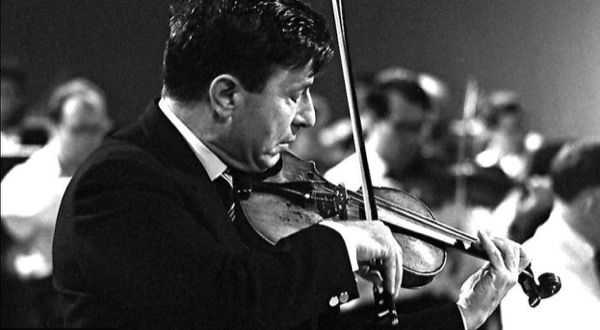
Nathan Milstein

Nathan Milstein   

The 1950s marked a turn toward refinement and stylishness.

Nathan Milstein’s elegance, restraint, and stylistic clarity made him a favourite of the era’s connoisseurs.

His Bach playing, in particular, exerted a particularly long-lasting influence. In those Bach performances and recordings, he favoured structure and line over Romantic excess, helping to usher in a stylish but unsentimental approach to the composer, which hinted at the upcoming historically informed performance practice movement.

1960–1969: Isaac Stern
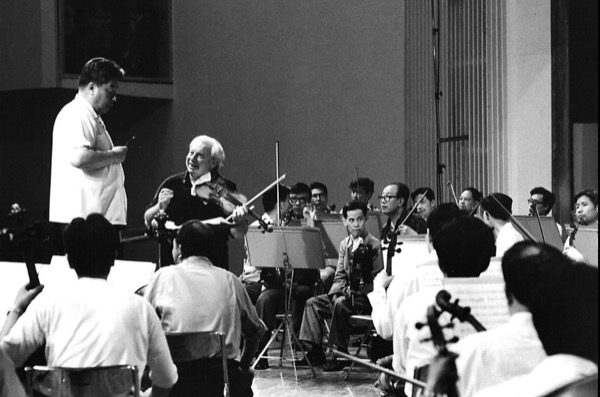
Isaac Stern

Isaac Stern   

By the 1960s, a violinist’s greatness was expected to extend beyond the concert platform. American violinist Isaac Stern followed in Menuhin’s footsteps, emerging not just as a concert violinist but as a cultural statesman.

He championed young artists, made benchmark recordings, and spearheaded the ultimately successful effort to save Carnegie Hall from demolition.

Later, in the 1970s, he even performed international diplomacy, touring China and giving concerts seven years after President Richard Nixon’s first official visit to the country. That tour underlined the country’s growing passion for Western classical music and served as the material for an Oscar-winning documentary, From Mao to Mozart: Isaac Stern in China.

1970–1979: Itzhak Perlman
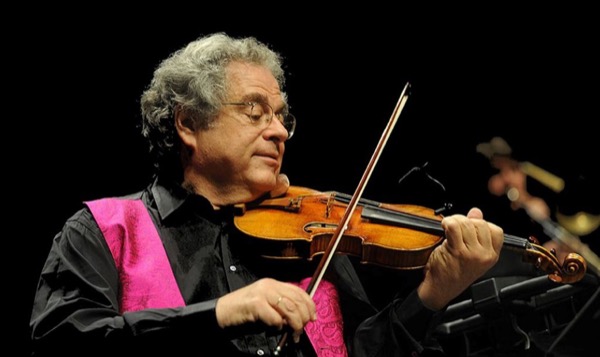
Itzhak Perlman

Itzhak Perlman   

In the 1970s, Itzhak Perlman became one of the most recognisable violinists in the world.

From an early age, he made important appearances on mass media, showing up everywhere from television shows like The Ed Sullivan Show and Mr. Roger’s Neighborhood to soundtracks of major films like Schindler’s List.

His playing combined technical ease with warmth and generosity, contributing his unique charisma and emotional immediacy to concert platforms the world over.

At a time when virtuosity risked emotional coolness after the rise of Heifetz, Perlman helped to popularise a warmth of style and easy accessibility.

1980–1989: Anne-Sophie Mutter
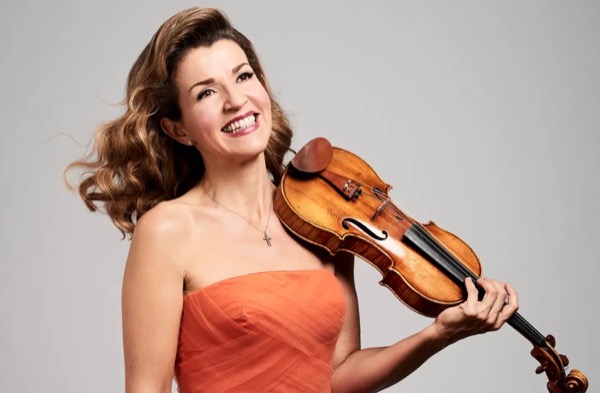
Anne-Sophie Mutter

Anne-Sophie Mutter   

Anne-Sophie Mutter‘s frequent collaborations with Berlin Philharmonic conductor Herbert von Karajan (a major star in classical music in his own right), her technical authority, and her commitment to contemporary composers positioned her at the centre of late twentieth-century violin culture.

She also became famous for performing in shoulderless gowns, creating a modern idea of what a glamorous woman soloist could look like.

At a time when nearly all of the most famous violinists were men, Mutter demonstrated that virtuosity, authority, and visible femininity were not mutually exclusive.

She bridged virtuosity and modernism with rare confidence and individuality.

1990–1999: Gil Shaham
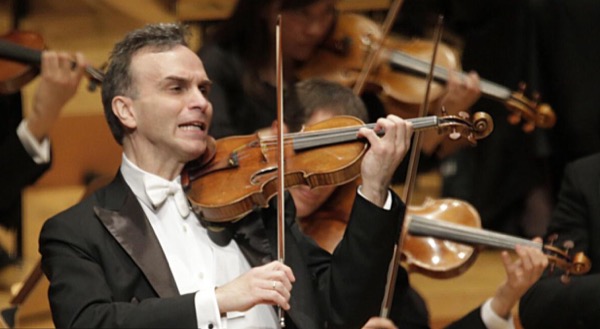
Gil Shaham


By the 1990s, no single ideal of violin-playing dominated in the popular consciousness. Recordings, television channels, and the number of influences on young violin soloists had multiplied.

In this pluralistic landscape, Shaham’s joyful, accomplished, communicative artistry stood out.

His playing built on Stern and Perlman’s approach, rejecting the more austere, aristocratic approach of a Heifetz or Milstein in favour of warmth and accessibility, redefining excellence as something that was technically jaw-dropping but also breathtakingly generous and human.

In a decade whose media was becoming increasingly fragmented, that ethos proved quietly influential. You can see traces of it in the generous and golden-toned violin playing of 21st-century violin stars like James Ehnes, Julia Fischer, and Augustin Hadelich.

Conclusion

Taken together, these violinists trace the evolution of what listeners prioritised from decade to decade: from individual expressivity to technical achievement to cultural authority to emotional connection.

By the end of the century, the art had embraced a number of styles, with no single figure dominating a decade like had happened in past decades.

Still, all of today’s great players – whether consciously or not – stand on the shoulders of the violinists who shaped each decade before them.

Thursday, July 2, 2026

“The only love affair I have ever had was with music.”


“The only love affair I have ever had was with music.”

Maurice Ravel

The history of classical music, however, is full of fabulously gifted individuals with slightly more earthy ambitions. Love stories of classical composers are frequently retold within a romanticized narrative of sugarcoated fairy tales. To be sure, happily-ever-after stories do on rare occasions take place, but it is much more likely that classical romances lead to some rather unhappy endings. Johannes Brahms had an overriding fear of commitment, Claude Debussy drove his wife into an attempt at suicide, Francis Poulenc severely struggled with his sexual identity, and Percy Grainger was heavily into whips and bondage. And that’s only the beginning! The love life of classical composers will sometimes make you weep, or alternately shout out with joy or anguish. You might even cringe with embarrassment as we try to go beyond the usual headlines and niceties to discover the psychological makeup and the societal and cultural pressures driving these relationships. Classical composer’s love stories are not for the faint hearted; they are heightened reflections of humanity at its best and worst. Accompanying these stories of love and lust with the compositions they inspired, we are able to see composers and their relationships in a completely new light.

Debunking the Top 5 Myths About Chopin


These stories are certainly compelling – but they also blur historical reality and oversimplify a complex human life.

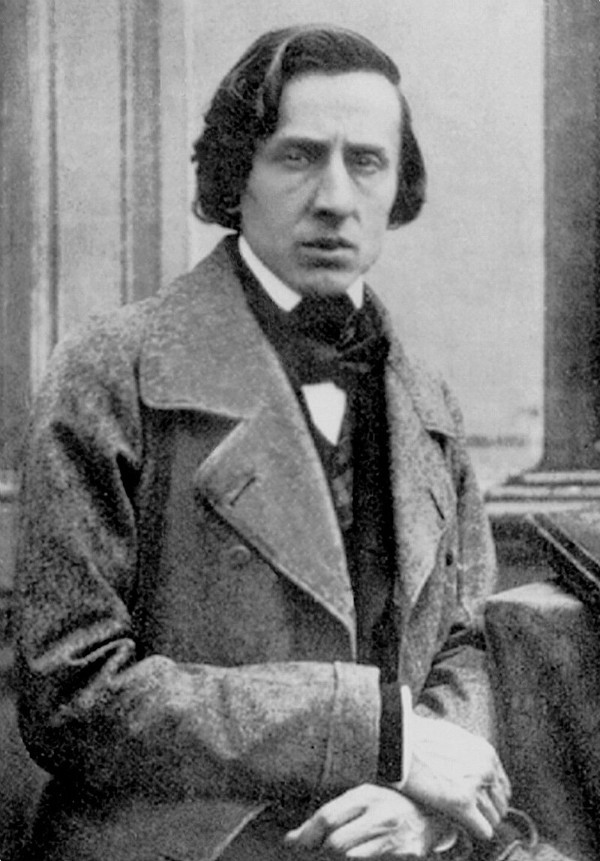
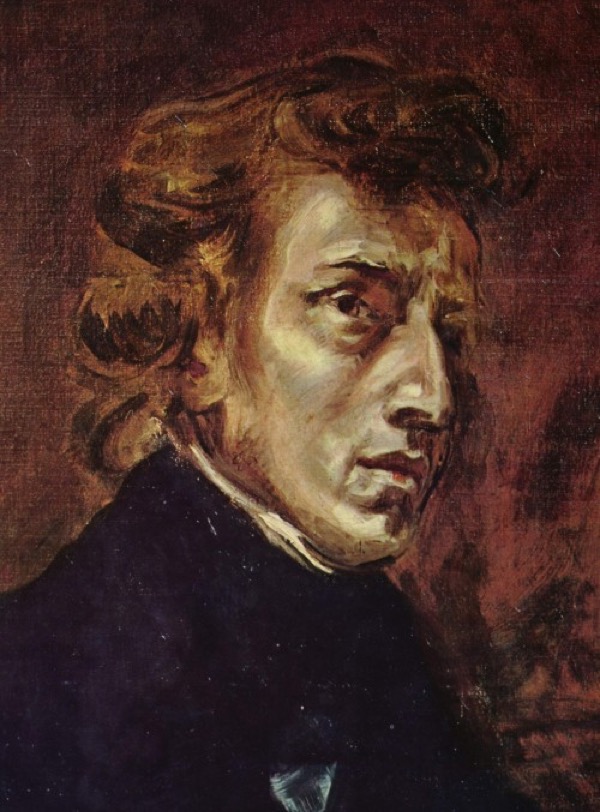
Frédéric Chopin

Frédéric Chopin

By looking at letters, contemporary accounts, and modern scholarship, we can separate the persistent music-history myths from what the historical record actually shows.

Myth 1: Chopin’s only health issue was tuberculosis

Although most historians believe that Frédéric Chopin died of chronic tuberculosis, he also struggled with a number of other illnesses.

When he was a teenager, he suffered from an infection that left his lymph nodes swollen and nearly killed him.

His digestive system also rebelled against fatty foods, although he eventually discovered it could be soothed by honey and oat bran.

In 1835, while living in Paris, he had both laryngitis and bronchitis. Rumours even began spreading in Poland that he’d died.

Other scholars and medical experts have suggested alternative suggestions to a tuberculosis diagnosis, suggesting the possibility of cystic fibrosis or valvular heart disease.

In fact, it’s theoretically possible that he didn’t even have tuberculosis at all and suffered from some other lung issue instead.

Myth 2: Chopin never performed publicly

This myth likely arose because Chopin preferred intimate salon settings over the concert hall. However, he did perform in public on multiple occasions.

As a child prodigy in Warsaw, he played charity concerts, and after settling in Paris, he gave a handful of public recitals.

In fact, over his entire career, Chopin gave roughly thirty public or semi-public concerts. These included his successful Paris debut in 1832 and a final concert tour of England and Scotland in 1848.

This may have been modest by the standards of touring virtuosi like Liszt, but his public performances were far from nonexistent.

That said, contemporaries certainly noted how much more frequently Chopin appeared in salon settings.

But the claim “he never performed publicly” is false. His reputation as a performer was just shaped far more by his salon appearances than by his public concerts.

Myth 3: Chopin’s only moods were melancholic and depressed

Chopin’s music and letters reveal a far more complex personality than the mopey, mournful poet of the piano that is often portrayed in pop culture.

Yes, it’s true that he was prone to bouts of depression, especially during illness or when anguished by news from his occupied Polish homeland. But that wasn’t his only mood.

As a child and teenager, Chopin was remembered as witty, playful, and even mischievous.

One early biographer, Frederick Niecks, noted in his book Frederick Chopin, as a Man and Musician, that Chopin’s behaviour in childhood was marked by “sprightliness, a sparkling effervescence that manifested itself by all sorts of fun and mischief. He was never weary of playing pranks.”

He delighted friends with his jokes and impersonations, and his letters often demonstrated his dry sense of humour.

For example, a teenage Chopin created a spoof newspaper called the “Szafarnia Courier” to amuse his family, and later he wryly described inept doctors “sniffing” and “tapping” at him while trying to diagnose him in Majorca.

In short, over the course of his life, Chopin felt the full range of human emotions. Yes, he was soulful and brooding at times, but he could also be tender, sarcastic, and light-hearted.

The cliché of Chopin as perpetually depressed ignores the lively, personable side he often showed to friends, as well as the vivacity evident in many of his compositions.

Myth 4: Chopin’s relationship with George Sand ruined him. 

Chopin’s nine-year relationship with the novelist George Sand has been both romanticised and maligned. But far from “ruining” him, Sand in many ways provided stability and care that sustained Chopin through difficult years.

They became lovers in 1838, and soon Sand took on a nurturing, almost protective role. She called the ailing composer her “third child,” managed his domestic life, and oversaw his medical care.

At Sand’s country estate in Nohant, Chopin enjoyed some of his most productive summers, composing numerous masterpieces in the tranquil environment she created for him.

Rather than draining his creativity, their union coincided with the writing of many Polonaises, Mazurkas, Ballades, and the Twenty-Four Preludes.

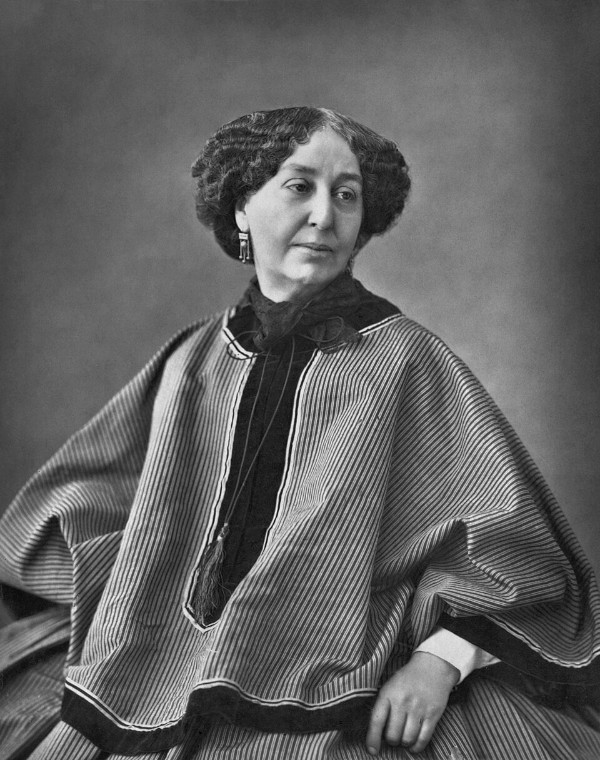
George Sand - Portrait by Nadar (1864)

George Sand – Portrait by Nadar (1864)

It is true that the relationship ended painfully. In 1847, Sand broke with Chopin amid family tensions – namely, a feud involving her daughter, Solange. After Chopin stood up for Solange, Sand felt badly betrayed. This breakup devastated Chopin emotionally, and his health, which was already deteriorating, got worse.

Some of Chopin’s friends bitterly blamed Sand for Chopin’s worsening illness. Modern scholarship, however, views this as an exaggeration; he likely would have gotten sicker regardless of what happened in his love life.

In short, George Sand did not ruin Chopin. On the contrary, she cared for him and inspired him during their years together. Yes, their relationship ultimately soured, but attributing Chopin’s tragic end solely to Sand unfairly oversimplifies the complex personal and medical realities. It was a coincidence, not causation.

Myth 5: Chopin only wrote “salon music.”  

This myth stems from the fact that Chopin composed almost exclusively for solo piano and often in forms suitable for salons (waltzes, mazurkas, nocturnes, and the like).

During the 19th century, some critics dismissed these elegant miniatures as lightweight salon music.

But equating Chopin’s output with trivial parlour fare is a major mischaracterisation.

His contemporaries knew that beneath the graceful surfaces of these pieces lay profound artistry and innovation.

Robert Schumann, for one, famously remarked that “the works of Chopin are cannons concealed amongst flowers” – meaning that even in his delicate mazurkas and waltzes, Chopin smuggled in bold, explosive emotion and subversive expressions of patriotism.

Frédéric Chopin

Frédéric Chopin

Meanwhile, his four Ballades are structurally daring, thematically unified tone poems for piano; his Polonaises (like the “Heroic” Polonaise in A flat, Op. 53) thunder with nationalistic fervour; and his Piano Sonata No. 2 in B flat minor (which includes the famous Funeral March) shows he could handle large-scale forms when he chose.

Even his briefest preludes – slender little wisps of things, lasting only a minute or two – are imbued with sophisticated harmonies, novel textures, and deep feeling.

In short, Chopin should be celebrated as a composer of intimate but profound music rather than dismissed as a writer of lightweight salon pieces.

Conclusion

Taken together, these myths reveal less about Chopin himself than about the stories later generations wanted to tell about him.

Yes, he was physically fragile, but not perpetually incapacitated. Yes, he favoured salons, but he did perform publicly. Yes, he experienced deep melancholy – but he also demonstrated humour, warmth, and playfulness. His relationship with George Sand was complicated, not sheerly destructive, and his piano works, however intimate their scale, are anything but trivial.

Stripped of exaggeration and stereotype, Chopin is revealed to be the sophisticated artist he actually was. Understanding the truth behind these myths allows us to hear his music with fresh ears and a clear mind.

Wednesday, July 1, 2026

Carl Maria von Weber - Beyond the Operatic Legend


The resounding success of Der Freischütz changed the composer, and it also placed this particular opera at the centre of his output. This has come at the expense of Weber’s other remarkable achievements in his richly varied output.

Carl Maria von Weber died on 5 June 1826, and since his biography and Der Freischütz have been examined in considerable detail, let us focus on the composer and the wealth of music beyond the operatic stage that deserves to be heard with more frequency.  

A Composer Takes Shape

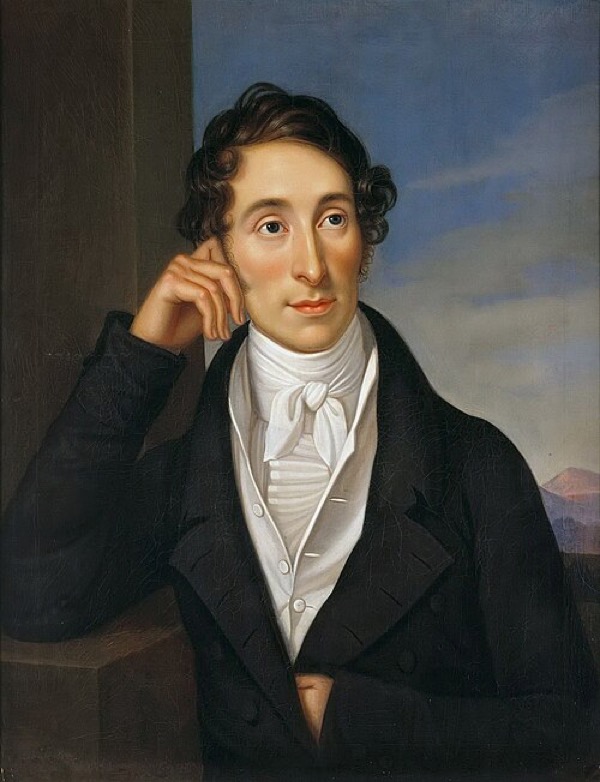
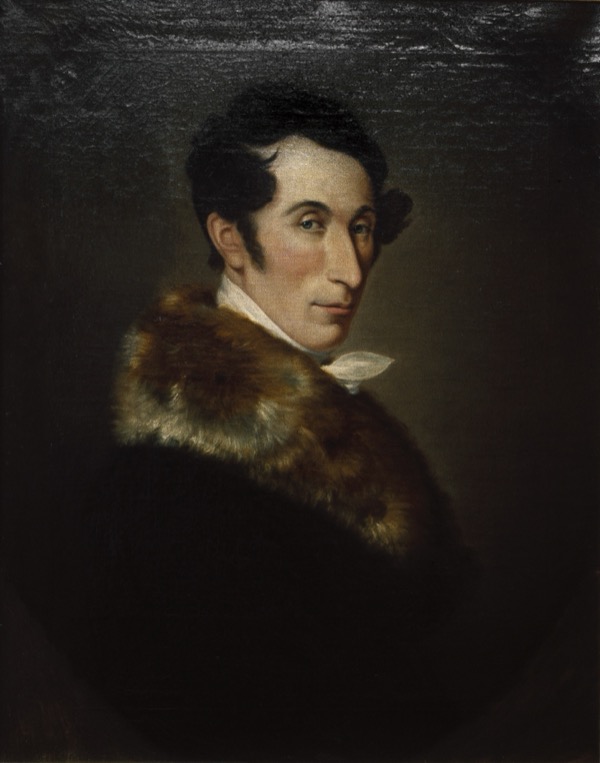
Caroline Bardua: Portrait of Carl Maria von Weber

Caroline Bardua: Portrait of Carl Maria von Weber

In contrast to HaydnMozart, and Beethoven, Weber, the composer, is not really well understood. Well into the 20th century, critical editions of his works, his diaries, correspondence, and writings still did not exist. In addition, most of the music composed before 1802 had also been lost.

Weber was a declared admirer of Mozart and, in fact, related to him, while Haydn seemed to have played a lesser role. During his time in Vienna in 1803-4 he made significant contact with the music of Beethoven and with the opéras comiques of Cherubini, Méhul, Dalayrac, and others.

Also during his time in Vienna, the famed Abbé Vogler taught him harmony, part-writing, and sparked an enduring interest in folk and exotic music. As Michael Tusa writes, “From that time on Weber’s development as a composer was essentially one of constant growth and maturation with no obvious breaks or periods in terms of style or compositional approach.” (Tusa, GMO, 2001)

Unlike Beethoven, Weber seemed to have destroyed most of his preliminary drafts, so it is difficult to gain a clear picture of his decision-making processes. He did borrow ideas from his earlier compositions, and occasionally we find his own comments about composition and aesthetics.  

Brilliance at the Keyboard

Carl Maria von Weber, 1814 (painting by Thomas Lawrence)

Carl Maria von Weber, 1814 (painting by Thomas Lawrence)

Carl Maria von Weber composed instrumental music throughout his life, ranging from the Six Fughettas of 1798 to his 4th Piano Sonata in 1822. We find most major genres of the early 19th century represented, excepting the string quartet and the piano trio.

Weber was an exceptional pianist, and the piano concertos, several variation sets, and the Rondo brillante are directly related to his public performances. In addition, he successfully composed in the newer genres of concert dances for solo piano and concertante works for soloist and orchestra.   

Salon and Concert Hall

Although full of technical challenges, the piano sonatas were designed for private performance, and his contracts with virtuosos led to a number of works, including the concerto written for Baermann and the clarinet. His symphonies and overtures figured prominently into his conducting activities, and most of the surviving chamber music was also composed for public performance.

Weber wrote comparatively little for the fast-growing amateur market, as we find only three sets of four-hand music and six sonatas for violin and piano. We also find a Divertimento for guitar and piano, a set of variations on a gypsy theme, and the “Invitation to the Dance” for solo piano.

The famous “Konzertstück” for piano and orchestra, and the Grand pot-pourri for cello and orchestra, are unusual alternatives to the traditional three-movement concerto, and they might well have been tied to a specific poetic conception.  

Poetry and Song

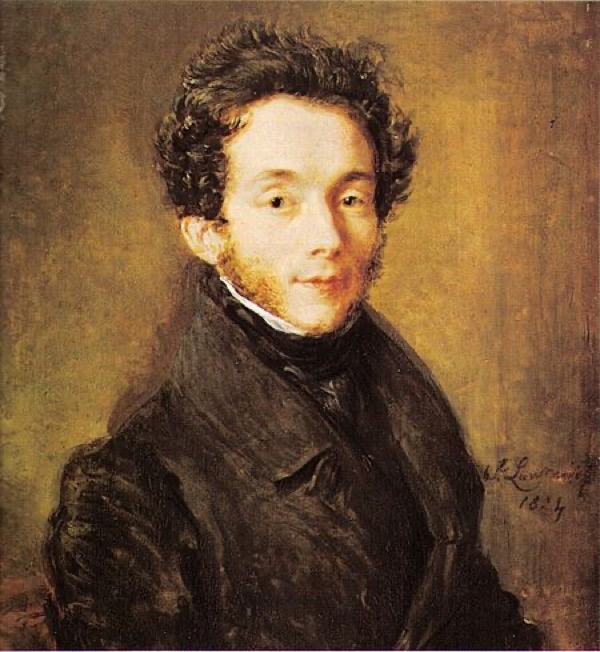
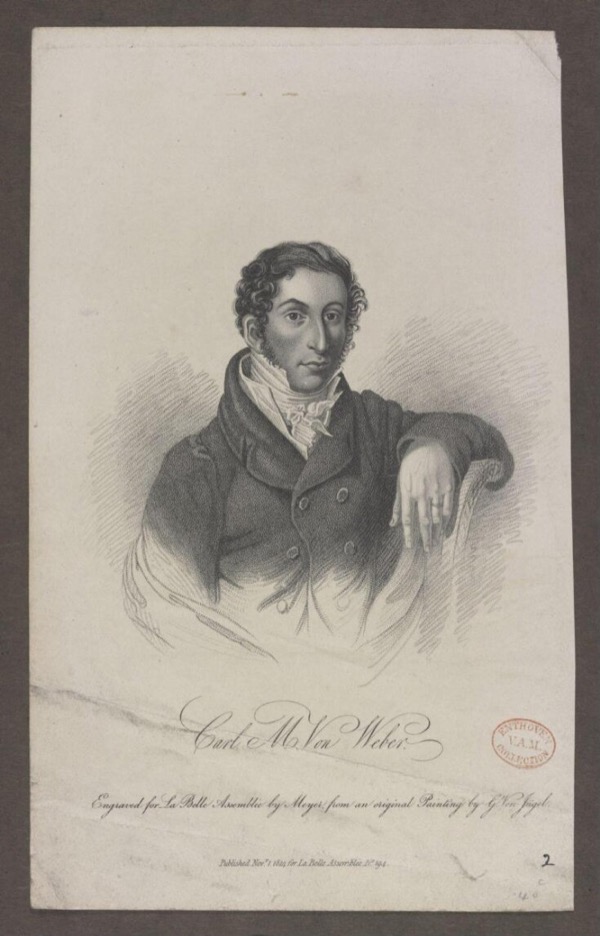
Ferdinand Schimon: Carl Maria von Weber

Ferdinand Schimon: Carl Maria von Weber

Carl Maria von Weber composed roughly 85 Lieder and Gesänge, primarily setting texts of poets with whom he had personal connections. Among his settings of folk poetry, it is not surprising to find excerpts from the Wunderhorn collection.

His German songs do not attempt the depth and intensity of expression we associate with Schubert and later Romantics, but they aim to entertain through wit, sentiment, or poems about the opposite sex.   

Words and Music

We also find songs on the nature of the human condition, and patriotic texts that project the feelings of a well-defined protagonist. “His views on the nature of the lied conventionally emphasize the primacy of the poem and the resultant need for correct declamation and close relationship between verbal and musical syntax.”

Yet he once confided that “the character and inner life of the words occasionally overruled the demands of strict prosody.” (Tusa, GMO, 2001) While Weber is frequently considered a conservative exponent of the genre, Weber’s songs actually demonstrate a remarkably wide variety of formal approaches.   

Dreaming of Italy

Carl Maria von Weber consistently hoped to travel to Italy, and as a result, composed a couple of settings in Italian. Most noteworthy are a number of concert arias written for specific singers, and an Italian cantata composed for a royal wedding in Dresden.

He also composed a large number of ensemble pieces, both with and without piano accompaniment. Duets, trios, and songs with choral refrains occasionally appear in the published song and folksong collections. His most famous choral pieces are six songs for a cappella male chorus, pieces that first accorded Weber widespread acclaim.   

Music for Church and Stage

Carl Maria von Weber

Carl Maria von Weber

Weber composed a substantial number of cantatas and cantata-like pieces, many with religious overtones and celebratory character. Although a devout Catholic who frequently conducted liturgical music, his output of sacred music is small. We only find three complete settings of the Roman Mass.

Between 1809 and 1822, Weber composed music for the spoken theatre and specific productions of long-forgotten plays. Most important is his musical contribution to P. A. Wolff’s Preciosa, commissioned and composed in 1820. The play calls for an unusually large amount of music to characterise the opposed Spanish and gypsy elements in the drama and to take advantage of the singing and dancing talents of the lead actor.

“The play (with Weber’s music) rivalled the popularity of Der Freischütz in the Dresden repertory and was widely disseminated, but with the disappearance of Wolff’s play from the stage Weber’s music has also largely vanished from public consciousness.

Between Enlightenment and Romanticism

Carl Maria von Weber lived in tumultuous times, marked by war, social change, and intellectual upheaval. Like many musicians of his day, he relied extensively on patronage and simultaneously saw the emerging middle-class public as an important stimulus for his art. However, he never composed in a purely commercial manner but attempted to educate this new audience to a higher standard of appreciation.

Scholars have recently questioned Weber’s supposed role as the leading exponent of early Romanticism in music, as the triumphant conclusions of his large-scale vocal and instrumental works have little in common with Romantic alienation, irony, and ambivalence.

Michael Tusa finds, “His works betray a consciousness rooted in Enlightenment optimism and shaped by the Biedermeier desire to restore order to a world shaken by a generation of revolution and war.”

A Legacy Rediscovered

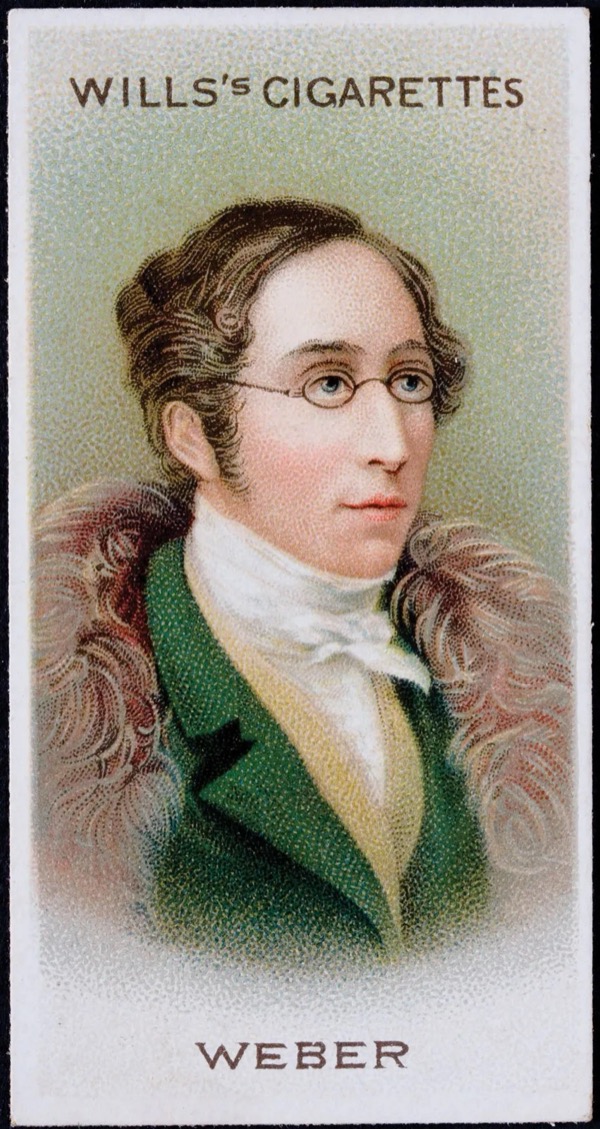
Carl Maria von Weber (cigarette trading card)

Carl Maria von Weber (cigarette trading card)

While Weber’s life and personality, not to mention his international career, resist narrow nationalist interpretations, he nevertheless became a potent symbol of German musical culture.

His influence on later composers was widespread, as he left his mark on MeyerbeerWagnerMendelssohnChopin, and Liszt. And according to one study, he helped Berlioz to find his own way to originality.

As Weber’s reputation gradually faded, much of his music disappeared from the repertory. He was overshadowed by Wagner in opera and by Beethoven as the paradigm of instrumental music, while Schubert overshadowed him in the lied.

Still, Weber never entirely disappeared, and his most passionate advocates in the 20th century turned out to be Debussy and Stravinsky, both recognising qualities in Weber’s music that fashion and historiography had dismissed.

10 Classical Pieces That Hook You in the First 60 Seconds


Some composers prefer to gradually ease their listeners into their piece’s sound world. Others strike like lightning.

Today, we’re looking at the latter type of openings. Within the first 60 seconds, listeners are hooked, whether because of rhythm, volume, atmosphere, or some combination of all of the above.

We’re ranking them in reverse order, saving the most immediately arresting for last.

Music That Brings up Sad Memories

© Psychology Today

10. Johann Sebastian Bach – Brandenburg Concerto No. 3   

We’re starting with the brilliant whirlwind of Baroque perpetual motion that is Bach‘s third Brandenburg concerto.

The first movement instantly launches into interlocking string patterns that feel almost modern in their rhythmic propulsion.

Instead of writing for a typical string ensemble, Bach divides the players into three groups of three, creating nine independent string lines (plus continuo).

That textured propulsion is so effective that you’re hooked and tapping your foot before you’ve had time to analyse what’s happening.

It’s not loud, but it’s striking, and the whirling rhythms immediately get stuck in your head.

9. Wolfgang Amadeus Mozart – Overture to The Marriage of Figaro  

Mozart doesn’t announce himself here; instead, he sets up a murmured string motif and then starts sprinting.

From that opening string motif, the overture bursts into breathless motion, setting the stage for a world of mischief and comic chaos.

Within seconds, the energy feels theatrical. Even listening at home, you can envision the curtain of the opera house rising.

It hooks listeners through its cheeky velocity rather than its profundity – and that virtuosic speed is intoxicating.

8. Maurice Ravel – Daphnis et Chloé, Suite No. 2  

This hook works differently from the others on this list. Instead of grabbing attention with a fast attack, Ravel immerses his listeners in a radiant atmosphere. It feels like sinking into a hot bath.

Ravel composed this music as a ballet, later extracting two orchestral suites from it.

The opening movement of his second orchestral suite – titled “Lever du jour” (“Daybreak”) – begins in a shimmer of sound that gradually blooms into radiant colour.

Over the first minute, the orchestra sound becomes enormous and almost painfully beautiful: luminous, layered, alive.

7. Sergei Rachmaninoff – Piano Concerto No. 2   

Few openings in the repertoire feel as inevitable as the tolling piano chords here.

They begin in the solo piano part, dark and ominous and resonant, each one weightier than the last.

Within 60 seconds, the orchestral strings sweep in with a heartbreaking theme, and the emotional temperature rises dramatically.

Once that theme arrives, the emotional tenor is set, and it becomes impossible to turn away.

6. Edvard Grieg – Piano Concerto   

This is considered one of the great concerto entrances in the repertoire. It features a massive timpani roll, then a cascade of piano chords.

The piano part tumbles down the keyboard in a gesture that feels both virtuosic and defiant.

After that attention-grabbing opening, Grieg immediately launches into a march that is somehow both jaunty and deeply dramatic, setting the stage for the rest of the movement.

5. Sergei Prokofiev – “Montagues and Capulets” from Romeo and Juliet    

This excerpt begins with horror-soundtrack dissonance. After some unforgiving shrieking chords, the low brass and strings start stomping and swinging forward.

The rhythm is famously heavy, ceremonial, and almost brutal.

Within seconds, thanks to that tonal contrast and that forbidding rhythm, Prokofiev establishes the violent world of the ballet: proud and tense and dangerous.

4. Richard Wagner – Overture to The Flying Dutchman   

Wagner‘s opera The Flying Dutchman tells the story of a cursed 17th-century ghost ship.

Writing this overture, Wagner was determined to portray the mood of a storm at sea – and he succeeded.

Stormy strings and brassy surges create immediate turbulence, imitating roaring winds and lashing waves with scrubbing tremolo bow strokes and trumpet fanfares.

3. Igor Stravinsky – The Rite of Spring   

Stravinsky‘s ballet The Rite of Spring made a major splash at its riotous premiere in the spring of 1913.

It opens with a bassoon playing at the tippy-top of its register. The sound is strange, reminiscent of some kind of ancient woodwind instrument. Within seconds, you know you’re somewhere new.

By the time other instruments enter, the tension and sheer strangeness are palpable.

It’s a quieter kind of shock than some of the other pieces on this list, but historically, it’s certainly among the most disruptive 60 seconds in music history.

2. Carl Orff – Carmina Burana   

There’s absolutely no warm-up here. Straight out of the gate, the chorus explodes with full force, with percussion hammering underneath.

It’s overwhelming – almost operatic in scale – and it seizes attention through sheer sonic weight and repetition.

It’s one of the most dizzying openings ever written for orchestra and chorus.

However, the opening movement that we think has the best hook in classical music history…

1. Ludwig van Beethoven – Symphony No. 5   

Four notes. That’s all it takes. Short-short-short-long. Everyone is familiar with it, even those who have never listened to a symphony in their life.

It has since become a cultural shorthand for the idea of “fate knocking at the door.”

More than two centuries after their composition, those first seconds still feel inevitable.

Those first four notes, and the carefully crafted phrases that follow, are among the most memorable first 60 seconds ever written in classical music history.

Conclusion

Across centuries and styles, composers have found countless ways to seize our attention, whether through rhythm, colour, drama, or sheer volume.

But in these ten opening movements, one thing is clear.

Sometimes you don’t need an hour of classical music to be convinced. Sometimes 60 seconds – and the lightning flash of inspiration behind them – are enough.

How Do You Tackle With Performance Anxiety?


performance anxiety music joke
Credit: NPR Classical on Facebook

Featured Post

The Most Overtly Erotic Works in Classical Music

  by  Emily E. Hogstad    May 28th, 2026 Western classical music is often thought of as cerebral or abstract, but throughout its history, co...