Sunday, June 9, 2024
Christina Aguilera - Reflection (2020) (From "Mulan")

To Love You More - Joslin - Celine Dion Cover
Saturday, June 8, 2024
Wonderful Life -Black - Saxophone Cover by @felicitysaxophonist
 / felicitysaxophonist
💻 Website: www.felicitysax.com
🎙️ About the Cover:
Did you know, that the singer Black actually wrote his song Wonderful Life in a moment, when everything was getting bad for him and the song title was actually ironic? With my cover version I wanted to present the importance of finding a little joy in our lives and keeping our focus on staying positive. I aimed to capture the uplifting spirit of the original song while adding my own melodic twist. The song's message has always resonated with me, and I hope my saxophone interpretation brings joy to your day.
📢 Disclaimer:
I do not claim ownership of the original song's copyright. This cover is intended for entertainment purposes only.
/ felicitysaxophonist
💻 Website: www.felicitysax.com
🎙️ About the Cover:
Did you know, that the singer Black actually wrote his song Wonderful Life in a moment, when everything was getting bad for him and the song title was actually ironic? With my cover version I wanted to present the importance of finding a little joy in our lives and keeping our focus on staying positive. I aimed to capture the uplifting spirit of the original song while adding my own melodic twist. The song's message has always resonated with me, and I hope my saxophone interpretation brings joy to your day.
📢 Disclaimer:
I do not claim ownership of the original song's copyright. This cover is intended for entertainment purposes only.Boieldieu Harp Concerto Fragment
Boieldieu, Concerto for Harp and Orchestra.
Julia Rovinsky (harp),
Zubin Mehta and Israel Philharmonic Orchestra
Live from Tel Aviv concert, Israel,17-nov-2006
Friday, June 7, 2024
UP soprano to represent Philippines at World Youth Choir 2024 Alumni Session
Jan Milo Severo - Philstar.com

Pauline Arejola is the sole participant from the Philippines at the World Youth Choir 2024 Alumni Session.
Pauline Arejola via Facebook
KUALA LUMPUR, Malaysia — A soprano from the University of the Philippines (UP) is set to represent the Philippines at the World Youth Choir 2024 Alumni Session.
Pauline Arejola is the sole participant from the Philippines who qualified from over 57 applications from 24 countries.
Arejola is part of the chosen 32 singers by the international jury composed by a jury representative from each of the three World Youth Choir patron organizations: Victoria Liedbergius on behalf of the European Choral Association, Burak Onur Erdem on behalf of the International Federation for Choral Music and Sasho Tatarchevski on behalf of Jeunesses Musicales International.
Arejola shared her excitement about this opportunity.
"Finally, after what seemed almost impossible in this lifetime, I am glad to share with you that I will be representing the Philippines in the World Youth Choir Alumni Session 2024," she said.
She expressed her gratitude for the chance to participate after facing setbacks, including the cancelation of the 2020 session due to the pandemic.
The World Youth Choir 2024 Alumni Session is set to take place in St. John’s, Newfoundland and Labrador, Canada, as part of the inaugural Harbour Voices International Festival of Collective Singing Traditions.
Renowned Swedish conductor Cecilia Rydinger will lead the ensemble with Arejola the only participant from the Philippines.
The program will feature a diverse range of musical works, including classical choral pieces and traditions from Scandinavian and Canadian Indigenous cultures.
Arejola's musical journey is deeply rooted in her education and experiences at the UP College of Music, where she graduated with honors, earning a Bachelor's Degree in Music with a major in Voice in 2018. Under the guidance of esteemed mentors like Prof. Ma. Cecila O. Valeña, she honed her craft and cultivated her passion for music.
Her versatility as a performer spans classical and contemporary operas, as well as musical theater. Beyond her solo endeavors, Pauline has performed with prestigious groups, such as the UP Los Baños Choral Ensemble and Collegium Vocale Manila, with the latter known for recently performing at the 49th International Bamboo Organ Festival.
As she prepares to represent her country on the global stage, she held a special send off-cum-fundraising concert in the Philippines.
Titled "Handog," the concert serves as both a celebration of her musical journey and a thanksgiving.
"This concert is very special to my heart as it represented the culmination of years of my musical journey," Arejola said. "This evening was my 'handog' to everyone who’s been there in that journey!"
The concert featured performances by Arejola herself, accompanied by pianist Darren Vega, and special appearances by Canticum Amoris Music Ministry, DSSTCJ Children's Choir, Mikee Baskiñas and UPLB Choral Ensemble. The event took place last May 18 in the Diocesan Shrine of St. Therese of the Child Jesus in UP Los Baños, Laguna.
The Orchestra in a Box: The Accordion
by Maureen Buja, Interlude

Piano Accordion (Startone 72 MKII)
The button accordion.
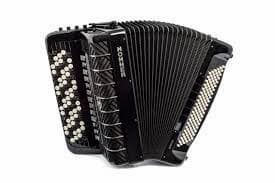
Chromatic Button Accordion (Hohner Mattia IV)
The instrument is held by two straps around the shoulders and is played in front of the body. For most accordions, the same pitch is played when you open or close the bellows, but some instruments will play different notes depending on the direction of the bellows’ motion.
The accordion is a 19th-century instrument invented in Germany by Christian Friedrich Ludwig Buschmann around 1822.
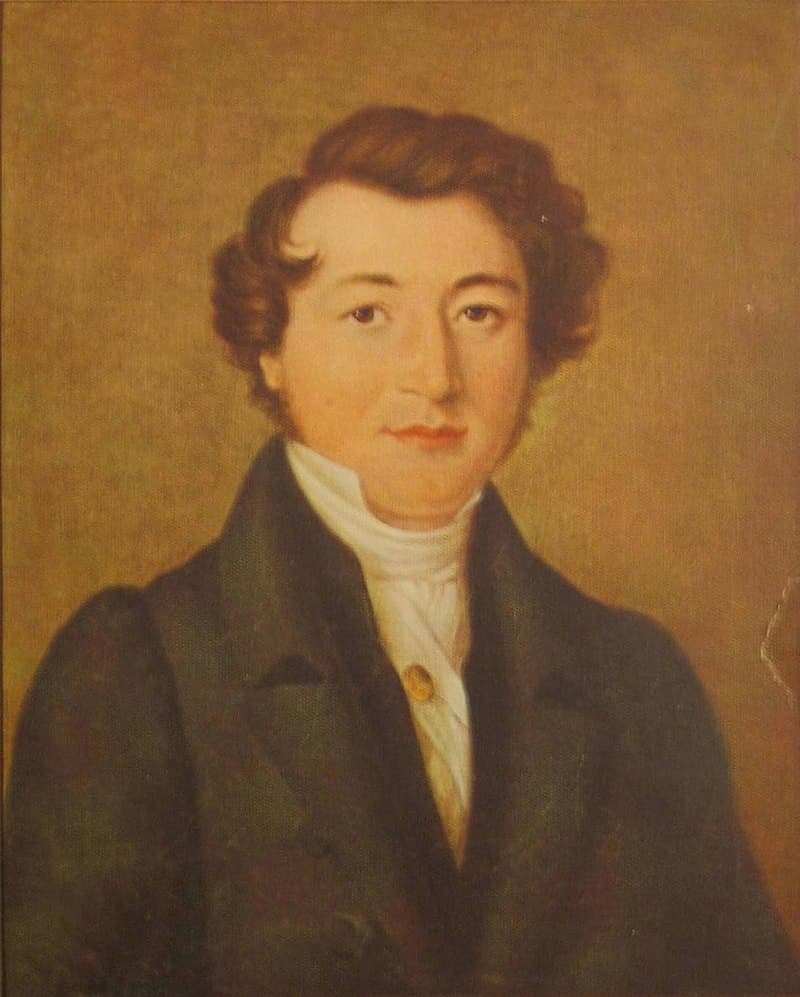
Christian Friedrich Ludwig Buschmann
From Germany, the instrument went to Russia, with the earliest known ones being made in the 1830s. By the late 1840s, two Russian manufacturers were producing some 10,000 instruments a year. By 1828, the instrument was in England and in New York by the mid-1840s.
For classical music, it wasn’t until the 1960s that works for accordion and orchestra were being written, and Poland has been a particular center for this genre.
Bronisław Kazimierz Przybylski’s Concerto polacco was completed in 1973 and is one of the most popular of the accordion concertos.
In Denmark, the composer Per Nørgård has been an important contributor to the genre. His 1964 work, Introduction and Toccata, developed from a first version in 1952 that accordionists agreed as being unplayable on current instruments. The 1964 revision captured the idiosyncratic methods needed for performances.
Maltese composer Charles Camilleri (1931–2009) was also an accordion virtuoso and international performer. His 1968 Concerto for Accordion and String Orchestra was originally intended as a didactic work for his students. The work includes both classical forms (a first movement sonata-allegro) and local references (the main subject of the first movement is close to a Maltese traditional melody). The final movement was intended to be not only a brilliant finish but also a nod to the 12-music of the time.
Finnish composer Erkki-Sven Tüür (b. 1959) had to be urged for five years to consider the accordion as a solo instrument for a concerto. He had to change his thinking of the instrument as purely for folk dances to something that had an orchestral connection. In its upper register, the accordion can sound like the wind instruments, and in its middle register, is closer to the strings and the composer used these sounds in different combinations.
For many people, it was the Tango Nuevo of Astor Piazzolla that brought the accordion (or in Piazzolla’s case, the bandoneon) to the performing stage.
The bandoneon is a middle instrument between the hand-sized concertina and a full accordion. It is named for its inventor, Heinrich Band, who intended it for religious or popular music accompaniment. It made its way to Argentina around 1870, where it became one of the distinctive sounds of tango music.
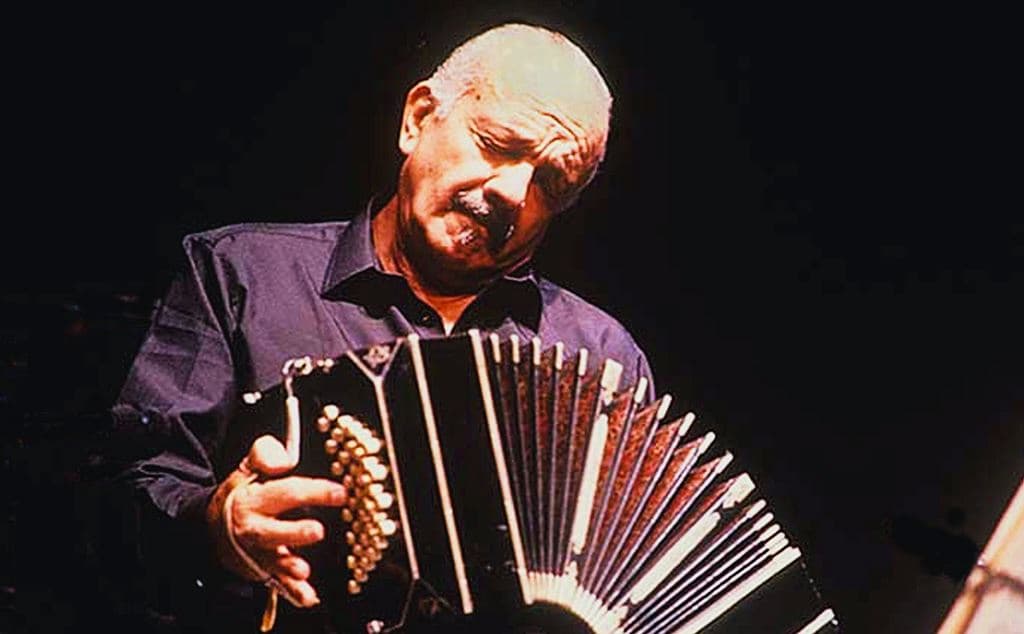
Astor Piazzolla
His Concerto for Bandoneon, Percussion, and String Orchestra of 1979 is very different from the European concertos we’ve heard above—it immediately incorporates the rhythm of tango and its melancholic alternation between major and minor, expressive solo lines and other emotive details.
The accordion has long been associated with France, be it from French accordionists on street corners or the accordionist Yvette Horner, who played her accordion along the route of the Tour du France in the 1950s and 1960s (and who was caricatured in Les Triplettes de Belleville).

Yvette Horner
A new work in the French tradition is Thibault Perrine’s Capriccio for Accordion and Orchestra. The work makes reference to the former music activities on the Place de la Bastille where musicians from the Auvergne encountered accordionists coming up from Italy. Together, they created a new dance music known as the musette and Perrine makes that the center of his work.
The lack of repertoire has made transcriptions central to the performance of classical music by accordionists. Satie’s Gnossienne No. 1, originally for piano, takes on a different life with accordion, vocals, trombone, and three melodicas (another free-reed instrument that mixes the harmonica with a keyboard).

Melodica
Or some Bach for accordion and saxophone.
And Rameau keyboard music arranged for accordion.
Japanese accordionist Mie Miki has been very active in bringing not only Baroque keyboard music to the accordion but also vocal music, such as this Dowland work, arranged for viola and accordion.
As a new instrument to the classical stage, the accordion has had to fight for recognition as a serious instrument. Its versatility in sound, melding with elements of the orchestra, has been a benefit, and as composers begin to understand how many ways it can contribute to the orchestral sound world, its repertoire will grow. Rethink the accordion – it’s more than polkas and popular music. It has become a real voice of serious music.
Subscribe to:
Posts (Atom)
Featured Post
The Most Overtly Erotic Works in Classical Music
by Emily E. Hogstad May 28th, 2026 Western classical music is often thought of as cerebral or abstract, but throughout its history, co...
-
The BoholTimes MUSIC can raise someone’s mood, get them excited, or make them calm and relaxed. Music also – and this is important – allow...
-
2,261,443 views May 15, 2019 SUNTORY HALL Munich Philharmonic conducted by Valery Gergiev, Tokyo Suntory Hall Dec 1, 2018 00:05 - 15:5...
-
by Hermione Lai February 10th, 2026 I will say this upfront, as a pianist who knows exactly how hard this instrument can bite. Yuja ...


