Friday, July 7, 2023

Musical Punctuation Marks

by Frances Wilson, Interlude

Commas, full stops and breaks for breath in music

© Learnfield GmbH

In just the same way, music has its own ‘punctuation marks’ to help the performer shape and communicate the music and the listener to better understand and enjoy the piece. The performer transmits all these punctuation marks to the listener by highlighting them in their playing. Without this, the music will be boring, monotone, lacking in colour, rhythmic vitality and interest. From the very beginning of the music, in fact, even before we play a single note, composers give very clear signals about how they would like the music to sound, and throughout the music there are signs and symbols to tell us how to “punctuate” or shape the music.

tempo markings

© chieyoshinaka.com

General tempo and descriptive markings

These are usually in Italian at the start of the score. For example, allegro (briskly), lento (slowly), cantabile (in a singing style), con fuoco (with fire). Composers may add other markings within the score to indicate specific effects – for example, ritardando (getting slower) or accelerando (speeding up).
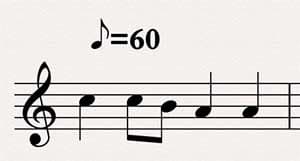
metronome marking example

© Music Theory Academy

Metronome mark

This gives an indication of suggested tempo (speed). Not all music includes a metronome mark on the core: music written before Beethoven‘s time does not because the metronome had not been invented. But metronome marks should not be taken as set in stone; rather, they are for guidance.
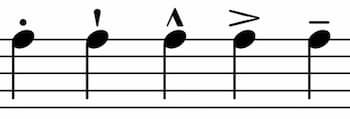
Example of articulation marks. From left to right: staccato, staccatissimo, marcato, accent, and tenuto.

Example of articulation marks. From left to right: staccato, staccatissimo,
marcato, accent, and tenuto. © study.com

Articulation markings

Articulations are signs which ask the performer to do something particular to a note, such as staccato (detached, bouncy), legato (smoothly), accented for greater emphasis. Articulation adds interest and character to specific notes or groups of notes.

understanding dynamics in music

© Hoffman Academy

Dynamic markings

These are signs or words which tell us how loudly or softly to play. For example: crescendo (getting louder gradually), subito piano (suddenly quiet), sforzando (with force), fortissimo (very loud/strong). Just as we use a raised voice or a whisper for specific emphasis in speech, so in music where dynamics are employed to create drama, suggest character or mood, or for declamatory statements, for example.
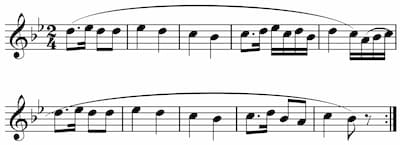
Phrase marks

Phrase marks

Phrase marks

Phrase marks are curved lines which indicate that a group of notes form a musical ‘idea’ or sentence.
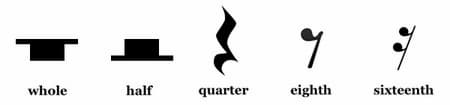
musical rests example

© PowerSchool Learning

Rests

Rests indicate where to be silent. Rests in music create drama, suspense, expectation or delayed gratification.

In his popular Fantasy in D minor, K 397, Mozart utilises all the above-mentioned features to create music of considerable drama and intensity, with rapidly contrasting moods and characters.


Thursday, July 6, 2023

The Way We Were - Lucy Thomas - (Official Music Video)


The Way We Were - Barbra Streisand - Lucy Thomas Cover I hope you enjoy my recording of this beautiful Oscar winning song from the film "The Way We Were" starring the wonderful Barbra Streisand and Robert Redford❤️️ "The Way We Were" was written in 1973 by Marvin Hamlisch, Alan Bergman and Marilyn Bergman the film "The Way We Were" starring Barbra Streisand who also recorded the original version of the song. "The Way We Were" won the Oscar and Golden Globe Award for Best Original Song as well as the Grammy Award for Song of the Year in 1974.

Jose Mari Chan, Pilita Corrales and the sounds from 50 years ago


SOUNDS FAMILIAR - Baby A. Gil - The Philippine Star 

July 7, 2023 | 12:00am


What a coincidence. As Can We Just Stop and Talk a While was playing on the car radio, I saw a huge Jose Mari Chan on the back of a bus hawking insurance, in front of me. It was a nice picture showing a man of a sunshiny personality. It is just what you would expect somebody who has become an enduring symbol of the Filipino-Christmas celebration to look like.


2023 is halfway over. It is now July. Soon JMC will be heard again singing his Christmas in Our Hearts, which has become so much a part of our lives. I like it that a Christmas pop song by a Filipino artist has won popular acceptance and now stands toe to toe with modern foreign carols.


I also like it that Can We Just Stop and Talk a While still gets radio airplay. Would you believe that the recording was released in 1973? That means that the song is now 50 years old.  Its message remains timely and its sparkling arrangement still sounds great.


After the success of his early recordings like Afterglow and Deep in My Heart in 1969, JMC took a break from his music career. It was only in 1973 that he was entice to record again.  The song he did was Can We Just Stop and Talk a While.


The lead cut in the album of the same title, which by the way, also had the beautiful Refrain, Can We Just Stop and Talk a While became a finalist at Tokyo’s Yamaha Popular Song Festival and one of the year’s biggest hits. It was also the beginning of a new phase in JMC’s singing career that would later include big sellers like Beautiful Girl and Constant Change.


I see 1973 as a year of transition for the local music industry. It was on the verge of a massive uprising. The few years before had the Nora Aunor phenomenon, the young combos like RJ and the Riots and the jukebox kings like Eddie Peregrina and Victor Wood.


The first game changers were the young showband The New Minstrels, which scored a big hit out of an old Tagalog song, Buhat. Then, the Spanish and Cebuano speaking mestiza Pilita Corrales followed suit with Kapantay ay Langit.


With such sounds in the air, music lovers became most receptive to the new sounds  themselves. In fact, they were eager to embrace the changes that were afoot in 1973.


A trio of rockers took it upon themselves to record something different, the bluesy ballad Himig Natin. With this song, Mike Hanopol, Wally Gonzales and Joey “Pepe” Smith as the Juan de la Cruz Band introduced Pinoy Rock.


A group of talented young musicians got together to form the Circus Band. Among them were soon to be big stars Basil Valdez, Hajji Alejandro, Pat Castillo, Pabs Dadivas, Tillie Moreno and instrumentalists Gerry Paraiso, Menchu Apostol, Atek Jacinto and Rudy Lozano.


The campus idols Apolinario Hiking Society staged a farewell concert in preparation to joining the corporate world. Some of them did. Three, however, stayed to join showbusiness and became the APO Hiking Society, Jim Paredes, Danny Javier and Boboy Garrovillo. It was the beginning of a hitmaking career that is still going great after 50 years.


Elsewhere, Dennis Garcia, frontman of a band that he named Hotdog, gave a young Assumptionista named Ella del Rosario a sweet ballad titled Pers Lab to record. That song would usher in a revolution that came to be known as the Manila Sound. It was the beginning of the golden age of Filipino pop music.


It feels unbelievable that all these great sounds happened 50 years ago and are still as popular as ever.


And I got to thinking. Which one among today’s hit songs will the people of 50 years in the future be listening to? Hopefully to many of them. What I am sure of though is they will still do their Christmas shopping to the tune of Christmas in our Hearts.

This Land Is Mine – André Rieu


Piano Professor Breaks Down 16 Legendary Pianists’ Techniques


Featured Post

Debunking the Top 5 Myths About Chopin

  Over time, selective anecdotes, early biographies, and nineteenth-century ideals of the “suffering artist” have hardened into familiar cli...