Monday, October 24, 2022
Why Is This Music So Memorable? How to Train Your Dragon

Friday, October 21, 2022
‘Classical Music – Saviour of the Burnt Out?’
By Chris Lloyd, Interlude
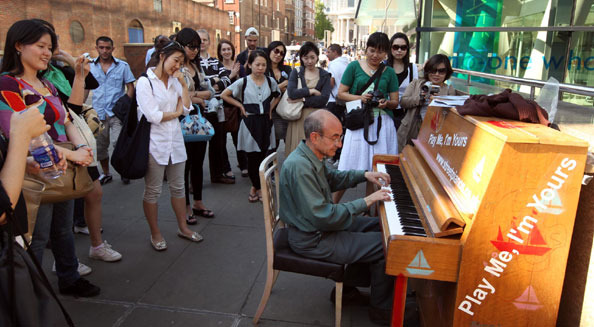
© streetpianos.com
The previous article (Einaudi: The Saviour of Classical Music) was a provocation designed to explore the relationship of a new generation of people to a flourishing genre of music based around relaxing solo piano. Because of the requirements of word scarcity in opinion pieces, I made a quick argument that aside from urging the reader to rethink their public posturing on music they don’t like, suggested that a renaissance is occurring in piano playing, with a large upswell of interest from adults showing an interest in learning the instrument.
I briefly mused on why this could be the case: is it because everyone got that bored of Netflix during global pandemic lockdowns that they looked for other forms of entertainment, and all the local knitting classes were full? Perhaps. But I believe the cause goes deeper, and includes the desire of people to engage with tactile activities (such as knitting, or pottery, or drawing classes) to counter their ever-increasingly digitally-dominated lives; as well as the relaxing and meditative nature of many popular contemporary piano artists. There is a beauty we can all relate to in the act of learning, making, and doing; the feeling of achievement when learning something difficult and complex; or the art of creating something without the pressure of being fantastic at it (i.e. an activity that is counter to their professions); an emotional outlet that one can turn to, to let go/fade out/lose oneself – and probably several more, personally specific reasons. As it turns out, playing piano is a brilliant way to achieve all of these goals.
In a conversation with conductor and academic Leon Botstein, I asked what his prognosis was for classical music makers in a western society who has seen a rapid evolution of entertainment consumption behaviours: e.g. from serialised television, to Netflix binge-watching, to TikTok microprogramming, all in a few short years. Where does this leave us in classical music – an art form that requires focused attention over long periods of time to engage with? Surely we risk becoming even more niche if our art form was completely contrary to audience preferences?
Botstein’s answer was shockingly optimistic: in his view, the vast majority of people are continuously looking for ways to better their experience on earth. These are the people who wake up and decide to train for a marathon, or sign up for yoga and Pilates classes, or learn about meditation or mindfulness, or turn to a vegan diet and eschew single-use plastics. They are looking for something that allows them to engage with themselves and others in a deep way, looking for community, looking for self-betterment. And, as Botstein so joyfully put it – this is exactly what classical music offers people.
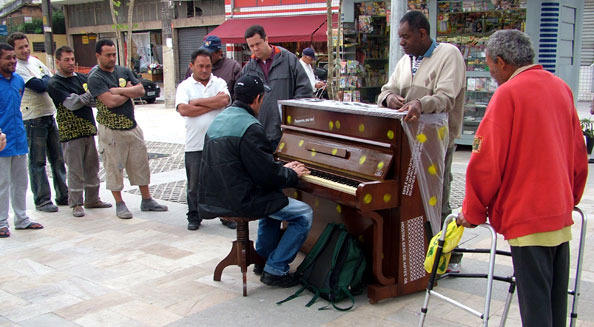
© streetpianos.com
We are standing on a goldmine, a product that time has proven undeniably fantastic; a product that is completely free-to-use (that is, anything outside of copyrighted material); and one that has the potential to add value to a huge amount of people that haven’t come across it yet! If this isn’t a cause for optimism, then I don’t know what is.
The question then becomes simple: what is the method of attracting all of these potential music-engagers and showing them how valuable it can be for their existence? Well firstly, we need to rebrand a bit. The perception of our industry from the outside sucks, period. If you agree that our product is good, then you have to agree that our packaging of it is rubbish by virtue of the fact that most people don’t want to come along to see it. Even the most delicious cake would go stale in a grey sack with a picture of a judgemental grandmother on the front of it.
Then, we need to think of ways to deliver this music that is easier to access on a basic level. We need to make it accessible and relevant to people, where they feel like they want to engage with it because it offers them immediate satisfaction and value. Oh, thanks very much Einaudi and co for creating an audience of people already engaging with the material, and sorry we’ve been such twats these past few years.
There are countless different ways this is being done and thought about: Lie Down and Listen is a London based project by concert pianist Christina McMaster as one of many examples. In my own work with the 1781 Collective I’ve explored the utility of ritual and narrative to design concert programmes that take people on a journey; a recent experience had me in front of roughly one thousand people at the closing set of a large techno festival in Germany – all of whom were on some form of stimulative substance – and my job was to take them down calmly after five days of non-stop raving to a relaxed state where they could begin to accept the reality that the Festival was finishing and they’d have to go to work the next day. A discussion with a colleague last week resulted in a plan for an meditation app which would be ‘Like Headspace, but with Classical Music.’

© meditatia.com
If you think that this can’t be done, just think about the yoga industry. What was ostensibly an extremely esoteric, complex spiritual practice, with thousands of years of complex training required to achieve enlightenment, has now been reinvented as an activity that countless millions of people around the globe engage with daily; from the most basic points of entry (such as Yoga with Adriene which couldn’t be further from what a 19th century Yogi would have imagined of their work); to people travelling around the world for Yoga retreats; becoming Yoga instructors; etc. Our equivalent might be in the person who listens to classical music for relaxing only, to taking piano lessons and going to concerts, to attending piano retreats, etc.
We’ve all bemoaned the albums and playlists of ‘Classical Music for Relaxing’ as a direct predecessor to the notion that ‘classical music is boring’, because as we all know, classical music routinely expresses the entire range of human emotion on a frequent basis, with relaxation only one tiny component of this. I’m not advocating for a use of music purely to help stressed people relax, but instead to use this existing perception to open a channel towards the full potential of music; whilst simultaneously helping guide listeners and enthusiasts to the different levels of engagement they can choose.
We cannot continue to demand that audiences listen to music in only one way – and an outdated, stuffy, and pretentious way at that. Instead, we need to start thinking about how we can take our product and passion to bring it to as many people as possible, and stop judging those who do things differently from us. What if we promoted our art form as a journey with an endless level of depth that one can choose to dive into, and one that can be satisfying at whatever level you choose to engage with? From Ludovico to Ligeti, there’s something for everyone, and everyone is welcome.
John Eliot Gardiner - his music and his life
.jpg)
John Eliot Gardiner stands as an international leader in today’s musical life, respected as one of the world’s most innovative and dynamic musicians, constantly at the forefront of enlightened interpretation.
Sir John Eliot Gardiner is revered as one of the world’s most innovative and dynamic musicians, constantly in the vanguard of enlightened interpretation and standing as a leader in contemporary musical life. His work, as founder and artistic director of the Monteverdi Choir (MC), English Baroque Soloists (EBS) and Orchestre Révolutionnaire et Romantique (ORR), has marked him out as a key figure both in the early music revival and as a pioneer of historically informed performances.
As a regular guest of the world’s leading symphony orchestras, such as the London Symphony Orchestra, Symphonieorchester des Bayerischen Rundfunks, Royal Concertgebouw Orchestra and Gewandhausorchester Leipzig, Gardiner conducts repertoire from the 17th to the 20th centuries. He was awarded the Concertgebouw Prize in January 2016.
The extent of Gardiner’s repertoire is illustrated in the extensive catalogue of award-winning recordings with his own ensembles and leading orchestras including the Vienna Philharmonic on major labels (including Decca, Philips, Erato and 30 recordings for Deutsche Grammophon), as wide-ranging as Mozart, Schumann, Berlioz, Elgar and Kurt Weill, in addition to works by Renaissance and Baroque composers. His many recording accolades include two GRAMMY awards and he has received more Gramophone Awards than any other living artist.
Gardiner has also conducted opera productions; at the Royal Opera House, Covent Garden, at the Vienna State Opera and at Teatro alla Scala, Milan. From 1983 to 1988 he was artistic director of Opéra de Lyon, where he founded its new orchestra.
Recent achievements with the Monteverdi ensembles include the RPS award winning Monteverdi 450 project in 2017, a reprise of the 2000’s famous Bach Cantata Pilgrimage, which toured to some of Europe’s most famous concert halls and churches in 2018, a five-year exploration of Berlioz’s major works to mark the 150th anniversary of the composer’s death, and a landmark performance of Verdi’s Requiem at London’s Westminster Cathedral in aid of Cancer Research UK. In 2019 Gardiner conducted new productions of Handel’s Semele and Berlioz’s Benvenuto Cellini, and gave his debut performances in Colombia, Russia, Brazil, Uruguay, Argentina and Chile. The beginning of 2020 saw Gardiner conduct the ORR in three Beethoven symphony cycles as part of the Beethoven 250 anniversary celebrations, with concerts at Barcelona’s Palau de la Música, New York’s Carnegie Hall, and the Harris Theatre in Chicago. In 2021 he conducted a live streamed performance of Bach’s St John Passion from Oxford’s Sheldonian Theatre, appeared at several of Europe’s most prestigious music festivals, including his 60th concert at the BBC Proms, and performed Berlioz’s sacred oratorio L’enfance du Christ at the Monteverdi Choir & Orchestras new London home, St Martin-in-the-Fields.
An authority on the music of J. S. Bach, Gardiner’s book, Music in the Castle of Heaven: A Portrait of Johann Sebastian Bach, was published in October 2013 by Allen Lane, leading to the Prix des Muses award (Singer-Polignac). Among numerous awards in recognition of his work, Sir John Eliot Gardiner holds several honorary doctorates. He was awarded a knighthood for his services to music in the 1998 Queen’s Birthday Honours List.
Classical pianist gives curious toddler an impromptu piano lesson on train station concourse



This very cute duet has gone viral on TikTok, drawing in new fans for both the street pianist and his young protégé...
Music has the power to surprise you – you never know where that next duet or inspiring collaboration could come from.
Karim Kamar is a contemporary classical pianist & composer from London. He’s performed at some of the country’s most iconic venues, from Ronnie Scotts to the Royal Albert Hall, but his latest viral moment took place on a rather more unusual stage.
Kamar has racked up millions of views across platforms such as , , and for his #StreetPiano performances – where the musician films himself playing impromptu concerts on public pianos.
Pianos in train stations have become surprisingly commonplace across the UK and other countries, as a joyful way for travellers to bring music to each other at the start, middle, or end of their journeys.
In his latest video, Kamar is filmed being adorably ambushed on a piano in London’s St Pancras International train station by a musically curious toddler. What followed was an unexpected duet between the two musicians. Kamar helps the young child up onto the piano stool, lifting them up (both literally and figuratively) so their small hands can reach the massive keyboard.
The classical pianist then takes the toddler’s right-hand, and helps them to start playing the familiar tune of Twinkle Twinkle Little Star. Kamar accompanies them both with chords in his left-hand.
The young (and perhaps first-time) pianist’s joy is evident from the toddler’s expression, and the wonderful duet has left TikTok fans in a similarly giddy-state.
One TikTok viewer commented, “You just created a core memory & maybe inspired the little fellow!!”, while another added “This [interaction has] probably sparked a lifelong love of piano in this little one ❤️”.
Karim Kamar plays piano for people in St Pancras
And it’s not just children who are entranced by Kamar’s performances. Adults are equally impressed by the musician’s prowess. In the above video, Kamar has passersby bringing their daily commute to a standstill just to listen in.
But, if you don’t happen upon Kamar during your next train station journey, you can always follow him on or his for more of his musical adventures.
Thursday, October 20, 2022
Mozart: Piano Concerto No. 23 | Menahem Pressler, Gulbenkian Orchestra & Leo Hussein
Mozart: Piano Concerto No. 23 | Menahem Pressler, Gulbenkian Orchestra & Leo Hussain
5,559 views Oct 20, 2022 “Concerts make me feel alive” – the motto of veteran star pianist Menahem Pressler. As part of the “Pianomania!” concert series, Pressler plays Wolfgang Amadeus Mozart’s Piano Concerto No. 23 in A major together with the Gulbenkian Orchestra under the baton of Leo Hussain. The performance took place in 2018 in the Grand Auditorium at the Calouste Gulbenkian Foundation in the Portuguese capital Lisbon.
00:44 I. Allegro
13:15 II. Adagio
20:06 III. Allegro assai
Wolfgang Amadeus Mozart (1756 – 1791) wrote the Piano Concerto No. 23 in A major, K. 488 in the year 1786 – one of the major Viennese concertos composed by Mozart for his own subscription concerts. It’s one of three piano concertos where Mozart swaps oboes for clarinets. The Piano Concerto No. 23 is regarded as one of Mozart’s most famous works, created at the same time as his opera “The Marriage of Figaro” in the Austrian capital Vienna. Wolfgang Amadeus Mozart lived in the city from 1781-1791 as a freelance composer.
Menahem Pressler was born as Max Pressler in the German city of Magdeburg in 1923. His family is Jewish. He and his parents fled Nazi rule in 1939; going first to Palestine, and then emigrating to the US in 1940. The rest of his family were murdered by the Nazis.
In the year 1946, the young Pressler won the Debussy International Piano Competition in San Francisco, studying thereafter in California. In 1955, he founded the world-famous “Beaux Arts Trio” and remained a member throughout its existence. The ensemble played some 100 concerts between 1955 and 2008 and released more than 50 recordings with different constellations of musicians, before performing its final concert in 2008. Menahem Pressler still gives solo performances to this day.
British national Leo Hussain, born in 1978, is a regular guest at Europe’s major opera houses and concert halls. He’s seen as a leading interpreter of Mozart and is especially fond of works produced during the composer’s years in Vienna. In this concert, he conducts the Portuguese Gulbenkian Symphony Orchestra.
Wednesday, October 19, 2022
The Music Of The Night
The Music Of The Night
2,280,836 views Oct 30, 2018 Provided to YouTube by Universal Music Group
The Music Of The Night · Andrew Lloyd Webber · Gerard Butler
The Phantom Of The Opera
Subscribe to:
Posts (Atom)
Featured Post
The Most Overtly Erotic Works in Classical Music
by Emily E. Hogstad May 28th, 2026 Western classical music is often thought of as cerebral or abstract, but throughout its history, co...
-
The BoholTimes MUSIC can raise someone’s mood, get them excited, or make them calm and relaxed. Music also – and this is important – allow...
-
2,261,443 views May 15, 2019 SUNTORY HALL Munich Philharmonic conducted by Valery Gergiev, Tokyo Suntory Hall Dec 1, 2018 00:05 - 15:5...
-
by Hermione Lai February 10th, 2026 I will say this upfront, as a pianist who knows exactly how hard this instrument can bite. Yuja ...


