Wednesday, October 5, 2022

Tuesday, October 4, 2022
Gregorian - Conquest Of Paradise
My favourite singer from the Gregorian choir group Chris Tickner. He has a wonderful voice what I adore very. But every singer good voice. And of course Amelia Brightman, wonderful voice.
WIND BENEATH MY WINGS (Lyrics) - BETTE MIDLER
WIND BENEATH MY WINGS (Lyrics) - BETTE MIDLER
41,418,739 views Apr 22, 2012 "Wind Beneath My Wings" (sometimes titled "The Wind Beneath My Wings" and "Hero") is the title of a song written in 1982 by Jeff Silbar and Larry Henley. They recorded a demo of the song, which they gave to musician Bob Montgomery. Montgomery then recorded his own demo version of the song, changing it from the mid-tempo version he was given to a ballad. Silbar and Henley then shopped the song to many artists, eventually resulting in Roger Whittaker becoming the first to release the song commercially. It appeared on his 1982 studio album, also titled Wind Beneath My Wings.
Following Whittaker's recording, many other artists recorded the song, including Sheena Easton (who also recorded it in 1982). Easton's version appeared on her 1982 studio album Madness, Money & Music, though it was not released as a single by her record company. She did, however, perform it on The Tonight Show Starring Johnny Carson, The Merv Griffin Show, her HBO live concert special, as well as her NBC television special.
The first year "Wind Beneath My Wings" appeared on music industry trade publication charts in the United States was 1983. Singer Lou Rawls was the first to score a major hit with the song, as his version peaked at #10 on the Billboard Adult Contemporary chart, as well as #60 on the Billboard Hot Black Singles chart and #65 on the main Billboard Hot 100 singles chart. Gladys Knight & The Pips also released a recording of the song in 1983 under the title "Hero", and their version peaked at #64 on Billboard' Hot Black Singles chart[2] while also reaching #23 on Billboard's Adult Contemporary chart. Singer Gary Morris released a country version of the song in 1983 that charted highest on any of the Billboard music charts that year. Morris's version of the song peaked at #4 on Billboard's Hot Country Singles chart, and also later won both the Academy of Country Music and the Country Music Association awards for Song Of The Year.
The highest-charting version of the song to date was recorded in 1988 by singer and actress Bette Midler for the soundtrack to the film Beaches. This version was released as a single in early 1989, spent one week at #1 on the Billboard Hot 100 singles chart in June 1989, and won Grammy Awards for both Record of the Year and Song of the Year in February 1990. On October 24, 1991, Midler's single was also certitifed Platinum by the Recording Industry Association of America for shipment of one million copies in the United States.
"Wind Beneath My Wings" has also been recorded by Kerry Ellis, Colleen Hewett, Lee Greenwood, B.J. Thomas, Willie Nelson, Kenny Rogers, Patti LaBelle, Eddie & Gerald Levert, John Tesh, Judy Collins, Shirley Bassey, Israel Kamakawiwoʻole, Sonata Arctica, Chyi Yu and Perry Como. Donald Braswell II recorded this song on his 2011 album, Unchained. Sergio Franchi recorded this song on his last album, Encore in 1989
.From Wikipedia, the free encyclopedia
Monday, October 3, 2022
Play Always as if in the Presence of a Master
by
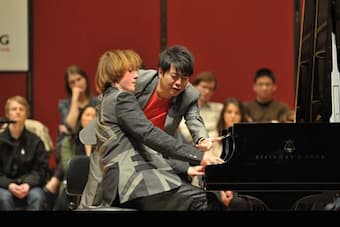
Lang Lang masterclass
The title of this article is a quote from Robert Schumann’s ‘Advice to Young Musicians’, a cornucopia of practical advice and poetic words of wisdom for young people beginning their musical education, which still has plenty of relevance for musicians of all ages and abilities today.
When we see the word “master” in relation to music, most of us immediately think of the “masterclass”, the private lesson in public where participants submit their playing to the scrutiny of a “master teacher” such as Angela Hewitt or Maxim Vengerov. At one time, such classes were quite terrifying for the participants (I remember watching masterclasses with cellist Paul Tortelier on the TV in the 1970s and 80s and he seemed very fierce!), but in these more enlightened times, the masterclass, sometimes rebranded as “workshop”, has become a valuable forum for critique, support and advice, not only from the “master” but also from active listeners – something private lessons do not offer.
Watching a masterclass, especially with high-level players, is an opportunity to watch artists at work. It reveals what musicians do when they practice and often confirms the huge amounts of time and effort which go into refining music – something which is often forgotten when we see musicians performing. One of the most exciting aspects of the masterclass is witnessing breakthroughs and seeing how just a few words from an experienced master teacher can transform the participant’s playing. It’s an exciting and rewarding experience shared by both performers and observers.
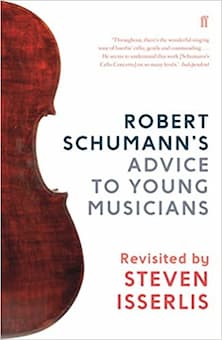
Robert Schumann’s ‘Advice to Young Musicians’
© Amazon
In fact, I don’t believe Schumann was thinking of the masterclass as we know it today in his aphorism, but was actually referring to an attitude of mind which should colour one’s practicing and playing at all times. It is a fact universally acknowledged amongst musicians and music teachers that mindless practice is not only unproductive but also unmusical. But if we play “as if in the presence of a master”, we raise our game. In short, what Schumann is suggesting is that one should always play (and I include “practice” in the word “play”) with all one’s critical and artistic faculties fully alert – mindfully, deeply and beautifully. Repetitive practise is important, for sure, but it should be always be both thoughtful and repetitive – and each repetition should be considered and reflected upon. Taking notice of what one is playing – each phrase, dynamic nuance, subtleties of touch, expression, articulation – will result in more efficient and rewarding practice, leading to the kind of vibrant and authoritative playing one would be happy to present to a master teacher. In effect, one is putting into practice the habits of a master musician; this approach is relevant to from the beginner to the highly advanced player and is one we should carry with us at all times, from the practice room to the performance stage.
For me, Schumann’s comment also suggests one should not fear playing to a master. If you become accustomed to playing with that mindset, what is there to fear?
Subscribe to:
Posts (Atom)
Featured Post
The Most Overtly Erotic Works in Classical Music
by Emily E. Hogstad May 28th, 2026 Western classical music is often thought of as cerebral or abstract, but throughout its history, co...
-
The BoholTimes MUSIC can raise someone’s mood, get them excited, or make them calm and relaxed. Music also – and this is important – allow...
-
2,261,443 views May 15, 2019 SUNTORY HALL Munich Philharmonic conducted by Valery Gergiev, Tokyo Suntory Hall Dec 1, 2018 00:05 - 15:5...
-
by Hermione Lai February 10th, 2026 I will say this upfront, as a pianist who knows exactly how hard this instrument can bite. Yuja ...


