Sunday, August 7, 2022

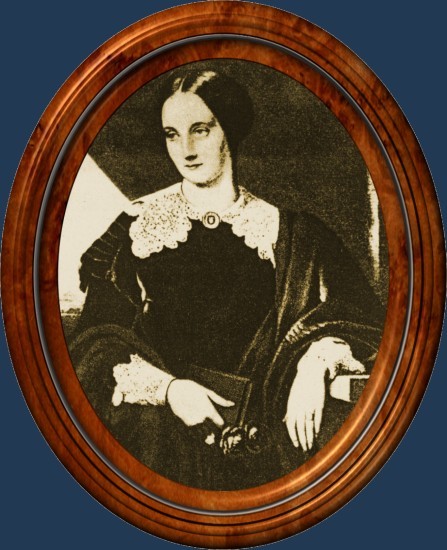
Mantovani - his music and his life


Birth name Annunzio Paolo Mantovani
Also known as Tulio Trapani
Born 15 November 1905
Venice, Veneto, Italy
Died 29 March 1980 (aged 74)
Tunbridge Wells, Kent, England
Genres Light music
Occupation(s) Conductor
Composer
Years active 1939–1980

Annunzio Paolo Mantovani (Italian: [anˈnuntsjo ˈpaːolo mantoˈvaːni]; 15 November 1905 – 29 March 1980) was an Anglo-Italian conductor, composer and light orchestra-styled entertainer with a cascading strings musical signature.

The book British Hit Singles & Albums stated that he was "Britain's most successful album act before the Beatles ... the first act to sell over one million stereo albums and [have] six albums simultaneously in the US Top 30 in 1959"


Biography

Mantovani was born in Venice, Italy, into a musical family.His father, Benedetto Paolo "Bismarck" Mantovani, was a violinist and served as the concertmaster of La Scala opera house's orchestra in Milan, under the baton of Arturo Toscanini. The family moved to England in 1912, where young Annunzio studied at Trinity College of Music in London. After graduation, he formed his own orchestra, which played in and around Birmingham. He married Winifred Moss in 1934, having two children: Kenneth (born 12 July 1935) and Paula Irene (born 11 April 1939). By the time World War II broke out, his orchestra was one of the most popular British dance bands, both on BBC radio broadcasts and in live performances.

He was also musical director for a large number of musicals and other plays, including Noël Coward's Pacific 1860 (1946) and Vivian Ellis's musical setting of J. B. Fagan's And So to Bed (1951).After the war, he concentrated on recording, and eventually gave up live performance altogether. He worked with arranger and composer Ronald "Ronnie" Binge, who developed the "cascading strings" effect (also known as the "Mantovani sound") His records were regularly used for demonstration purposes in stores selling hi-fi stereo equipment, as they were produced and arranged for stereo reproduction. He became the first person to sell a million stereophonic records] In 1952, Binge ceased to arrange for Mantovani but the distinctive sound of the orchestra remained.

Mantovani recorded for Decca and London Records the US arm of the Decca Record Company, exclusively. He recorded in excess of 50 albums on that label, many of which were Top 40 hits. His single tracks included "The Song from Moulin Rouge", which reached number one in the UK Singles Chart in 1953 "Cara Mia" (with him and his orchestra backing David Whitfield) in 1954; "Around the World" in 1957; and "Main Theme from Exodus (Ari's Theme)" in 1960. In the United States, between 1955 and 1972, he released more than 40 albums with 27 reaching the "Top 40", and 11 in the "Top Ten". His biggest success came with the album Film Encores, which attained number one in 1957

Similarly, Mantovani Plays Music From 'Exodus' and Other Great Themes made it to the Top Ten in 1961, with over one million albums sold

Mantovani starred in his own syndicated television series, Mantovani, which was produced in England and which aired in the United States in 1959. Thirty-nine episodes were filmed Mantovani made his last recordings in the mid-1970s.

He died at a care home in Royal Tunbridge Wells Kent.[1] His funeral was held at the Kent and Sussex Crematorium and Cemetery on 8 April 1980.

Music style and influences
The cascading strings technique developed by Binge became Mantovani's hallmark in such hits arranged by Binge as "Charmaine". Binge developed this technique to replicate the echo experienced in venues such as cathedrals and he achieved this goal through arranging skill alone.

Author Joseph Lanza describes Mantovani's string arrangements as the most "rich and mellifluous" of the emerging light music style during the early 1950s. He stated that Mantovani was a leader in the use of new studio technologies to "create sound tapestries with innumerable strings", and that "the sustained hum of Mantovani's reverberated violins produced a sonic vaporizer foreshadowing the synthesizer harmonics of space music." His style survived through an ever-changing variety of musical styles prompting Variety to call him "the biggest musical phenomenon of the twentieth century"

From 1961 to 1971, David McCallum Sr was leader of Mantovani's orchestra. At this time, his son David McCallum Jr was at the height of his fame, prompting Mantovani to introduce his leader to audiences with the quip, "We can afford the father but not the son!"

Mantovani is referred to by name in The Kinks song "Prince of the Punks". He also had a big influence on Brian May, Queen guitarist.

During his lifetime, Mantovani did not always get respect from his fellow musicians. When George Martin first suggested overdubbing Paul McCartney's recording of "Yesterday" with strings, McCartney's initial reaction, according to Martin, was that he did not want it sounding like Mantovani. Martin therefore used a more classical sound, employing a string quartet.

Tchaikovsky: Sleeping Beauty Suite - Alondra de la Parra & Staatskapelle...

Friday, August 5, 2022

Four Phantoms Medley ft. Sarah Brightman | The Phantom of The Opera


2,735,059 views  Oct 20, 2020  Sarah Brightman returns as Christine when she's joined by four legendary Phantom's from years gone by as they sing the show's hit numbers, 'The Phantom of The Opera' and 'Music of The Night' in celebration of 25 years.

Phantom Quartet - Colm Wilkinson, John Owen-Jones, Anthony Warlow, Peter Jöback

Who's your favourite Phantom? 

SONGS

00:00 - The Phantom of The Opera
05:27 - The Music of The Night

From Phantom of The Opera at the Royal Albert Hall (2011): In celebration of the 25th Anniversary of Andrew Lloyd Webber's The Phantom of the Opera, Cameron Mackintosh produced a unique, spectacular staging of the musical on a scale which had never been seen before. Inspired by the original staging by Hal Prince and Gillian Lynne, this lavish, fully-staged production set in the sumptuous Victorian splendour of London's legendary Royal Albert Hall features a cast and orchestra of over 200, plus some very special guest appearances.

James Last (Germany) - Romance (L.v.Beethoven)--Theme from ''Elvira Madi...

Can't Take My Eyes Off You (Stunnig Gimnazija Kranj Symphony Orchestra)


2017 - Invitation to the Dance. Gimnazija Kranj Symphony Orchestra and United Choirs performed this stunning music under the baton of maestro Nejc Bečan.  They played as usual with great spirit and musical excelence. Concert master is Nejc Avbelj. Our youth orchestra set another musical milestone. Concert and film director: Primož Zevnik

You can connect with maestro Nejc Bečan and his work on

https://upbeateditions.com​. 

You can find there his amazing compositions, arrangements. 

"Can't Take My Eyes Off You" is a 1967 single credited to Frankie Valli. The song was among his biggest hits, earning a gold record and reaching No. 2 on the Billboard Hot 100 for a week.] It was co-written by Bob Gaudio, a bandmate of Valli's in The Four Seasons. It was Valli's biggest solo hit until he hit #1 in 1974. The song was written by Bob Crewe and Bob Gaudio.


Solo vocal: Ana Bertoncelj, Ana Koprivnikar, Regina Selan
Arrangement: Marjan Peternel
sound design: Mitja Krže

assistant director and editorial: Juš Hrastnik
concert director: Primož Zevnik


GIMNAZIJA KRANJ SYMPHONY ORCHESTRA 2017
Flutes, pikolo: Vita Benko, Julia Ana Irgelj, Karin Primožič, Ajda Kajdiž, Brina Robinik Kobal, Neža Peternel, Ana Bergant, Neža Čadež, Vito Krajnik, Katjuša Rupnik; Oboa: Ana Souza Leban, Ana Stoschitzky; English Horn: Neža Podbršček; Clarinets: Domen Kos, Peter Franc Letonja, Aiden Franko, Klara Polajnar, Jaka Bodlaj, Hana Grobovšek, Peter Kuder (Es klarinet); Base Clarinet: Nejc Herman; Fagot: Boštjan Žekar, Dejan Rihtarič
Saksofon: Primož Lah, Juš Lesjak, Martin Verbič, Gal Grobovšek; Francoski rog: Mihajlo Bulajić, Tadej Kopitar, Marko Pirc, Aljaž Praprotnik, Jernej Klenovšek; Trobenta: Oskar Šubic, Aleš Klančar, Blaž Avbar, Matej Kravcar; Tubes: Žan Škrjanec, Filip Istenič, Domen Gantar, Urban Turjak, Jakob Istenič (Evfonij); Tuba: Tilen Jelenc; 1. violins: Nejc Avbelj, Leja Meglič, Laura Ana Oman, Ana Poklukar, Maruša Lučič Bolka, Lara Bogataj, Lana Grbič, Katarina Miklavčič, Oskar Longyka, Ana Krpan, Matija Udovič, Kaja Sešek, Anja Šoštarič, Neža Capuder; 2. violins: Tim Skalar Demšar, Veronica Radigna, Ajda Azocar, Ana Sešek, Tonka Pogačnik Pirnat, Mojca Batič, Ana Marija Jurečič, Nežka Starc, Tina Jamšek, Anja Šoštarič, Metka Udovč, Klara Gruden; Viola: Taja Starčič Križnar, Špela Pirnat, Ricardo Azocar, Anuša Plesničar, Neža Papler, Kristijan Dražil, Hana Lavrinc, Petar Njegovan, Anastazija Krenn, Eva Kovačič , 
Violončelo: Ana Zupan, Hana Ekar Grlj, Maruša Bogataj, Nika Vremšak, Katarina Kozjek, Ema Kobal, Romana Šimbera, Tadeja Žele , Arslan Hamidulin, Katarina Minatti; Kontrabas: Miha Firšt, Marie Elaine Malowerschnig, Gašper Livk, Urban Čefarin, Rok Hozjan, Janez Krevel, Karim Zajec; Tolkala: Vid Ušeničnik, Dan Ažman Pistotnik, Marko Jurečič, Filip Okrožnik, Leon Ostanek Jurina, Miha Ogris, Klemen Jelenc, Lenart Kolja Kokalj
Klavir: Liza Rozman, Eva Zupan, Katja Jerič, Vita Naglič
Kitara, bas kitara: Urh Zupan, Luka Štibelj, Emir Ibrakić
Harmonika: Ana Lombar; Harfa: Urša Rihtaršič, Zala Hrastnik

GIMNAZIJA KRANJ MIXED CHOIR (chorus master Erik Šmid)
Sopran: Gaja Šegula, Luna Rozman, Ana Čop, Hana Pristavec, Anita Hudobivnik, Karmen Jošt, Tjaša Ribnikar, Jedrt Mikelj, Karmen Zalokar, Mirjam Šenk, Brina Sitar; Alt: Lana Šumi, Kaja Križaj, Ajda Debelak, Gaja Nemanič, Špela Vovk, Nina Lukan, Meta Logar, Janina Gašperlin, Živa Krajnik, Nika Markun, Tinkara Krišelj, Tajda Škraba, Ema Oblak; Tenor: Maj Čufer, Tevž Sitar, Lovro Krišelj, Tilen Lotrič; Bas: Urban Erzar Frantar, Erazem Pivk, Žan Žnidar, Andraž Rakovec, Marko Zupan, Andrej Svoljšak, Matej Naglič, Matej Logar, Matic Oman, Jernej Šmid

GIMNAZIJA KRANJ GIRLS CHOIR (chorus master Marjeta Oblak)
Sopran: Ema Ažbe, Neža Majnik, Tea Aljaž, Tina Urh, Ana Krek, Neža Šolar, Lea Krampl, Lina Peharc, Nina Žumer, Manca Peternelj, Maja Pogačnik, Evelina Stare, Katja Potočnik, Lara Juvan, Tinkara Torkar, Kim Klančar; Alt: Saša Peterlin, Nika Mali, Kaja Železnikar, Kristina Čop, Ana Žerovnik, Anja Horvat, Eva Kern, Ema Jelenc, Ana Remic, Brina Avsec, Ana Lombar, Rea Legat, Ela Štirn, Ana Bertoncelj, Marija Pogačnik, Ema Soklič, Regina Selan, Lucija Brina Arvaj

Joys and Sorrows of Outdoor Concerts

by Janet Horvath, Interlude 

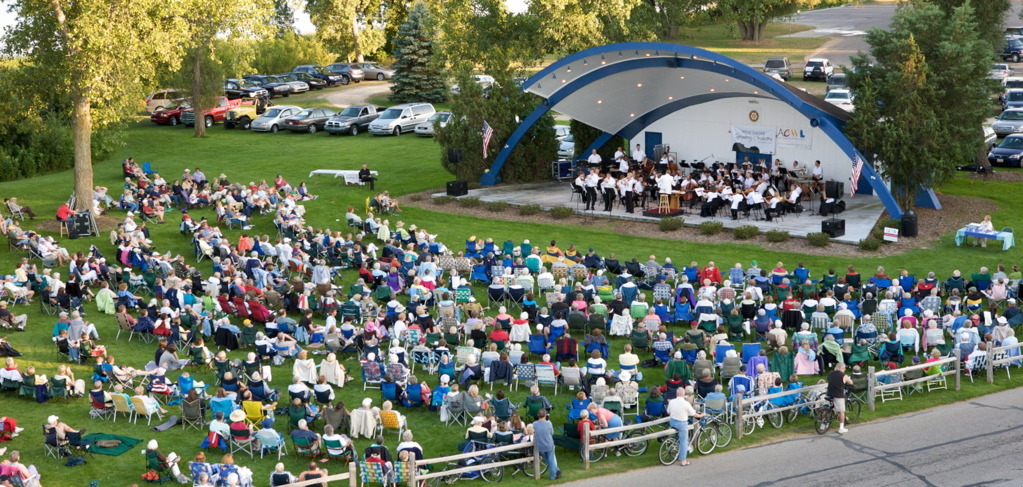
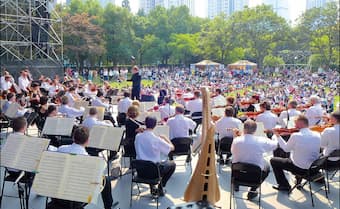
The Prague Symphony Orchestra outdoor performance

The Prague Symphony Orchestra outdoor performance © cleveland.com

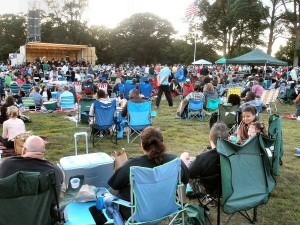
Ah! It’s finally summer festival and outdoor concert time. Families love to picnic while orchestras play in various outdoor venues.

The audiences come to our outdoor performances in droves. They are excited to introduce the orchestra to their children where they can run around freely and dance to the music waving their little arms conducting as it were. I can remember the joys and sorrows of playing outside. Either it was extremely hot with humidity that caused the fingerboard of one of our cellos to melt off, or so cold that we were reduced to wearing mittens with the fingertips cut off! We would often set up right on the grass with barely a shell behind us, exposed to the sun, rain and wind. We had long clothespins to hold the music down and I was the lunger — I’d unclip the page and whip it over while my stand-partner continued playing. Then he would leap up to clip the newly turned page on the left side of the stand — teamwork to say the least. We were ok as long as the stands didn’t blow over as well! Our survival kit had to include the clothespins, sunglasses, cloths to protect our instruments from direct sun, bug spray, seat cushions for the hard folding chairs, a white jacket if it was cold which one could whip off if it was hot, sunscreen, and water bottles.

outdoor classical music concertOne summer black and green thick clouds rolled in and sure enough torrential rains engulfed us. With only one canvas bass case among the 10 players, the bass players took turns rushing each bass to the wooden trunks, which were several feet away behind the meager shell.
Another summer when I was principal cello I performed the famous cello solo in Poet and Peasant Overture, by Franz von Suppé, which I thought I did famously even on my “outdoor” cello. Evidently, a bird thought otherwise and dropped one on my cello. Editorial comment no doubt.

Franz von Suppé: Dichter und Bauer (Poet and Peasant): Overture (London Philharmonic Orchestra; Neville Marriner, cond.)

No concert was complete without Tchaikovsky’s 1812 Overture, and since it was outdoors we used real cannons. One year we played sitting on hay bales in an open field. Everyone was happy but the cows. They were terrified by the noise.

We and many other orchestras always finish with the encore The Stars and Stripes Forever, the famous march of America’s “March King” John Philip Sousa, which always gets the audience clapping in rhythm.

John Philip Sousa: The Stars and Stripes Forever (Royal Artillery Band; Keith Brion, cond.)

Summer outdoor music performanceAs a child Sousa attended band rehearsals with his father. His heartfelt ambition was to play with the local circus band but his parents disapproved so vigorously that he became an apprentice musician with the Marine Band. At the tender age of twenty-six he became the Band’s director. During his tenure Sousa expanded the Band’s repertoire with not only the work of TchaikovskyVerdiWagner and others — Europe’s then contemporary composers — but his own compositions such as President Garfield’s Inauguration March, Semper Fidelis, and The Washington Post. Sousa was extremely popular so much so that he left the Marine Band to start his own band in 1892.
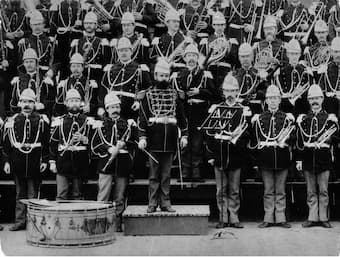
The USA Marine Band with conductor John Philip Sousa

The USA Marine Band with conductor John Philip Sousa © Keystone/Getty Images

While on vacation in Europe four years later, Sousa received word that his band manager, David Blakely, a good friend, had died. Sousa immediately sailed back to the States. The music of The Stars and Stripes Forever began to come to him. Sousa wrote: ” …absorbed in thoughts of my manager’s death and the many duties and decisions which awaited me in New York, suddenly, I began to sense a rhythmic beat of a band playing within my brain. Throughout the whole tense voyage, that imaginary band continued to unfold the same themes, echoing and re-echoing the most distant melody. I did not transfer a note of that music to paper while I was on the steamer, but when we reached shore, I set down the measures that my brain-band had been playing for me, and not a note of it has ever changed.” Sousa’s Band played the march at almost every concert it held after that. Interestingly, Sousa set words to it, but it is rarely performed that way.

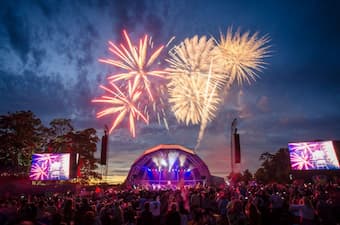
Outdoor classical concert with fireworks

© The Bow and Baton

Usually our outdoor concerts were scheduled to coincide with late summer sunsets for the fireworks displays. The stage managers erected great big tall lights so we could see our music. Sure enough, as soon as it became dark, out came the insects. We could see them swarming around the lights and descending on us juicy unsuspecting victims. We couldn’t stop playing to swat a mosquito that had landed on us in the middle of Tchaikovsky! Sometimes we would have the opportunity in a bar or two of rest to hit a couple of them with our bows while they crawled on our music. One year a child came running up to the stage to spray bug repellant on our exposed ankles while we continued our playing and flailing.

Despite years of promises from the sponsors, as soon as the fireworks trigger person heard The Stars and Stripes Forever he invariably launched the fireworks, usually right behind the orchestra shell. We hurried frantically to pack up our instruments while cinders landed on us. The noise of course was deafening both from the booms and the ooohs and aahhhs of the crowds.

Some festivals have fancy facilities like Tanglewood in Massachusetts, home of the Boston Symphony, where there is a permanent stage and benches for seating the audience. The orchestra has air conditioning blowing up from the floor and a roof over their heads, good chairs and lighting, and a backstage. Audiences can purchase picnic baskets filled with everything one would want for dinner including wine! Santa Fe Opera is a state-of-the-art outdoor facility too as is the Aspen Festival. In Europe there are many festivals some with indoor facilities. The famous Verbier Festival’s main hall The Salle des Combins seats 1700. Each row is on a separate tier, which guarantees and excellent view of the stage. Improvements to the soundproofing and heat insulation make this a very high quality non-permanent venue. Others include Flanderies Musicales de Reims, and Granada International Festival of Music and Dance and many others (you can check on the festivals section for more information.)

Next summer we look forward to the throngs who love hearing the orchestra outside and in!

When the Hero isn’t Quite Heroic

The Clueless Heroes in Classical Operas


Throughout most of the opera, there are certain tropes that repeat and repeat: the heroine will die of some wasting disease (La Bohéme, La Traviata, etc.), the hero will save the day (Die Zauberflöte), and so on. There are some operas, however, where it’s the idiot or the simpleton who saves the day.


Richard Strauss: Guntram

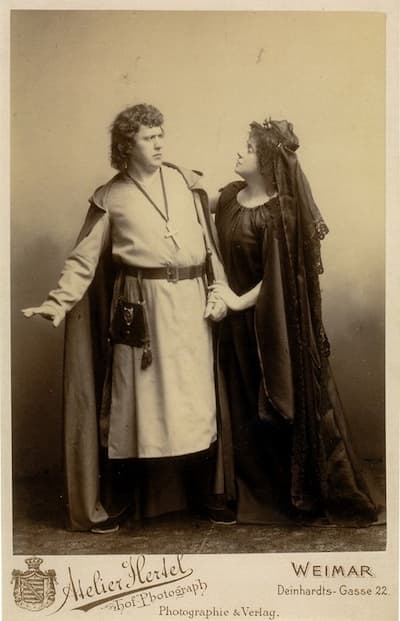
In Richard Strauss’ unsuccessful opera Guntram, our title character is a minstrel. He first dissuades duchess Freihild from drowning herself. He then goes to her husband, Duke Robert, a grasping tyrant, and sings a song to peace and generous rulers, which doesn’t go over very well, and then urges rebellion against the duke. The duke attacks our minstrel, who turns out to be a knight-minstrel and slays the duke. While imprisoned, Guntram realizes that, although he spoke of liberation, he was really acting out of love for Freihild. He decides that in atonement, he will spend the rest of his life in solitude, while gazing upon the benevolent reign of Freihild.

Guntram (Heinrich Zeller) and Freihild (Pauline de Ahna), 1894, Weimar

Guntram (Heinrich Zeller) and Freihild (Pauline de Ahna), 1894, Weimar


Richard Wagner: Siegfried

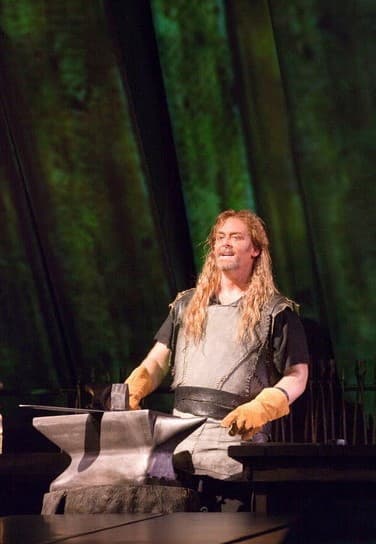
This is Strauss at his most Wagnerian, and the minstrel (perhaps standing in for the composer) was an unusual hero for an opera. However, if we look at Wagner, we have another idiot hero. Siegfried is a boy from the forest. Raised by Mime the dwarf, Siegfried despises his foster father and declares that he only stays until Mime tells him about his childhood. Mime tells him about Sieglinde and Siegmund and how Sieglinde died giving birth to Siegfried. Only Siegfried, the ‘one who knows no fear,’ can forge the great sword Nothung and after slicing Mime’s anvil in half, goes off to fight Fafner, the dragon left over from the first Ring opera.

Jay Hunter Morris as Siegfried (Metropolitan Opera)

Jay Hunter Morris as Siegfried (Metropolitan Opera)

Siegfried, raised only by Mime, is such an innocent that when he gets to his pre-destined role in this opera, rescuing Brünnhilde from the ring of fire her father has imprisoned her in, that he unwittingly utters the funniest line in the entire Ring cycle: “Das ist kein Mann!” (That is no man!), as he removes her armour. He’s one of the rare slices first, ask questions later opera heroes.


Modest Mussorgsky: Boris Godunov

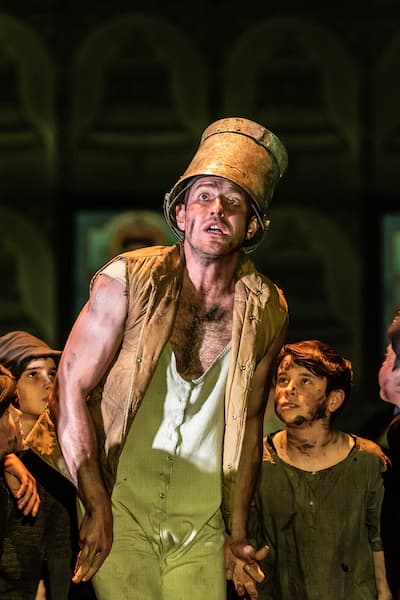
The opera Boris Godunov has a character called a ‘yuródivïy,’ i.e., a fool for Christ. These Holy Fools act intentionally foolish, to ‘conceal their perfection from the world.’ The yuródivïy appears in Act IV, chased by children and singing a nonsense song. As the Pretender readies himself for his march on Boris, the yuródivïy sings a song predicting the difficulties that the country will soon face (Flow, flow, bitter tears!).

Sam Furness as the Holy Fool in Boris Godunov, 2019 (The Royal Opera) (Photo by Clive Barda)

Sam Furness as the Holy Fool in Boris Godunov, 2019 (The Royal Opera) (Photo by Clive Barda)


Wolfgang Amadeus Mozart: Die Zauberflöte

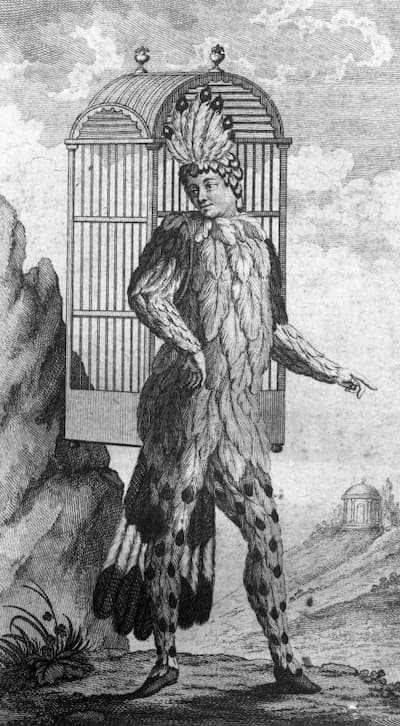
In Mozart’s Die Zauberflöte, we have the unique character of Papageno. A bird-catcher by profession, he’s seemingly half-bird himself.

Emanuel Schikaneder, librettist of Die Zauberflöte, shown performing in the role of Papageno as shown in the first edition of the libretto

Emanuel Schikaneder, librettist of Die Zauberflöte, shown performing in the role of Papageno as shown in the first edition of the libretto

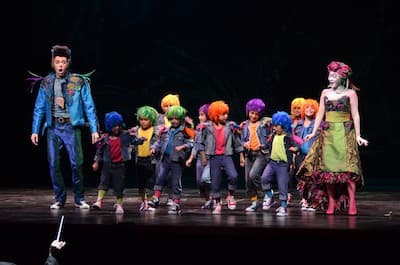
He’s not above lying to Tamino about how he killed the fearsome serpent, but when he’s pressed into service for our hero, he’s the first one to actually discover the kidnapped Pamina. Through the trial sequence, despite being told over and over to be silent, he can’t keep still. Banished from the test, he is saved by the appearance of his own half-bird woman, Papagena. We know that Tamino and Pamina will have a difficult intellectual life but that the two simpletons, Papagena and Papageno are only intending to have many, many, many children.

Papageno (Jonathan Michie) and Papagena (Hye-Jung Lee) and children (Florida Grand Opera)

Papageno (Jonathan Michie) and Papagena (Hye-Jung Lee) and children (Florida Grand Opera)


Giuseppe Verdi: Falstaff

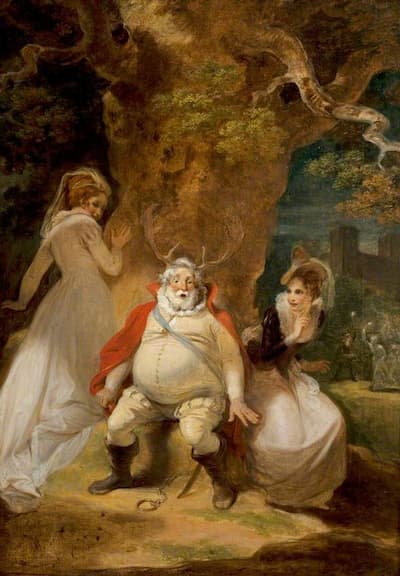
We could also consider Verdi’s Falstaff as the idiot hero – used to a life of pleasure when he hung around with Prince Hal, he’s no longer the center stage when Hal becomes King Henry. His attempts to seduce women end with him being thrown in the river with the laundry and his forest appearance as the ghost of Herne the Hunter, complete with stag horns.

Robert Smirke: Fallstaff with his horns

Robert Smirke: Fallstaff with his horns


Idiots and half-men, religious fanatics and social innocents – all have their place in the world of opera.

Featured Post

Yuja Wang wore a heart rate monitor in Rachmaninov marathon, with astonishing results

4 April 2024, 17:03 | Updated: 5 April 2024, 15:58 Yuja Wang’s heart rate results revealed, after marathon Rachmaninov performance.  Picture...