Friday, June 3, 2022

Frederick Delius - Song of Summer


Frederick Delius, in full Frederick Theodore Albert Delius, (born January 29, 1862, Bradford, Yorkshire, England—died June 10, 1934, Grez-sur-Loing, France), composer, one of the most distinctive figures in the revival of English music at the end of the 19th century.


The son of a German manufacturer who had become a naturalized British subject in 1860, Delius was educated at Bradford Grammar School and the International College, Isleworth, London. After working as a traveler for his father’s firm, he went in 1884 to Florida, U.S., as an orange planter and devoted his spare time to musical study. In 1886 he left Florida for Leipzig and there underwent a more or less regular musical training and became a friend of the Norwegian composer Edvard Grieg. Two years later he went to live in Paris, and from 1897 he made his home at Grez-sur-Loing (Seine-et-Marne), near Paris, with the painter Jelka Rosen, whom he married in 1903. Some songs, an orchestral suite (Florida), and an opera (Irmelin) were all written before he had a work published, that being Legend for violin and orchestra (1893). These were followed by more ambitious works that aroused considerable interest, especially in Germany, during the first decade of the 20th century. Three of his six operas (Koanga, 1895–97; A Village Romeo and Juliet, 1900–01; and Fennimore and Gerda, 1908–10) and several of his larger choral and orchestral works (Appalachia, 1902; Sea Drift, 1903; Paris: the Song of a Great City, 1899) were first heard in Germany. Later his reputation spread to England, mainly through the persuasive advocacy of Sir Thomas Beecham, who was his finest interpreter.

Night and Day and Delius

by Maureen Buja , Interlude

Frederick Delius: 2 Pieces for Small Orchestra - Summer Night on the River

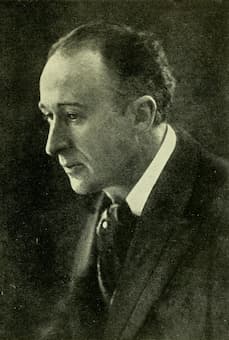
Frederick Delius (1907)

Two works written in close proximity give us two different times of day. Frederick Delius (1862-1934) was a quiet master of the tone poem. Summer Night on the River (1912) is part 2 of his Two Pieces for Small Orchestra (part 1 is On Hearing the First Cuckoo in Spring) and conveys us to a quiet night scene. The river flows by, with occasional leaves or flowers, on the sound of woodwinds. In its quietness and need for dynamic shading, it’s regarded as one of the most difficult of Delius’ scores to perform.

His tone painting is done at a whisper, with small colours appearing in the shadows to the side and just catching your ear as they disappear. It takes all the colours of the day and begins to dilute them.

The matching piece, A Song Before Sunrise, was written in 1918. From the beginning, with his marking of “Freshly” instead of a more traditional tempo marking, Delius has given us the clue to the potential of the day. The rhythm carries us forward and releases us into our new dawn.

Delius was master of the miniature tone poem. These two works, just 7 and 5 minutes long, capture in their sound times of the day that are so elusive. A summer night can be one of a perfect temperature, and when sitting by the river and watching the light so gradually fail, it can be a magical time, as captured by Delius. Before sunrise, on the other hand, is all about potential and what the day can become.

Dream a bit with Delius – his aesthetics are of the most delicate colours and feelings.

Thursday, June 2, 2022

From Children’s Tales to Scenes from Childhood

by Maureen Buja  , Interlude

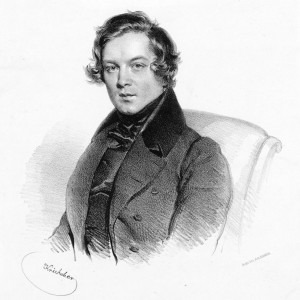
Robert Schumann, lithograph by Josef Kriehuber, 1839

Robert Schumann, lithograph by Josef Kriehuber, 1839

Written about children, but not written for children, the collection of short piano pieces entitled Kinderszenen (Scenes from Childhood) by Robert Schumann was a gift to Clara Wieck in 1838, two years before they were finally married. The final 13 pieces were chosen from a set of 30 pieces, the remaining 18 published later in Op. 99 and Op. 124.

Originally, Kinderszenen, Op. 15 was to be published together with the 8 Noveletten, Op. 21, as a work called Kindergeschichten (Children’s Tales) but Schmann changed his mind and separated them. In a 1838 letter to Clara when he sent her the pieces, Robert wrote that they were an answer to her comment ‘that sometimes I seemed to you like a child….’ He told her to laugh at the titles but to take their performance seriously: ‘They will amuse you, but you will have to forget yourself as a virtuoso.’

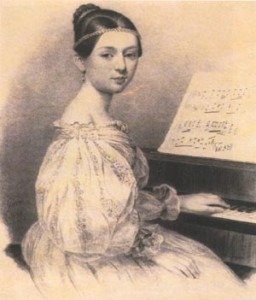
Clara Wieck at the paino

Clara Wieck at the paino

The titles take us to the land of children:

No. 1. Von fremden Landern und Menschen (Of Foreign Lands and People)
No. 2. Curiose Geschichte (A Strange Story)
No. 3. Hasche-Mann (Catch-as-catch-can)
No. 4. Bittendes Kind (Pleading Child)
No. 5. Glückes genug (Happy Enough)
No. 6. Wichtige Begebenheit (An Important Event)
No. 7. Träumerei (Dreaming)
No. 8. Am Camin (By the Fire-side)
No. 9. Ritter vom Steckenpferd (Knight of the Hobby-horse)
No. 10. Fast zu ernst (Almost Too Serious)
No. 11. Furchtenmachen (Frightening)
No. 12. Kind im Einschlummern (Child Falling Asleep)
No. 13. Der Dichter spricht (The Poet Speaks)

But this is a land as observed by an adult and observed from a distance. The opening piece, Of Foreign Lands and People, serves as the key to the work, with its opening theme appearing in various guises throughout the other pieces.


If we listen to the same piece in other hands, we can hear how much interpretation can change the work.


Brendel’s vision seems much more dutiful than the world of the imagination summoned by Argerich.

The best known of the 13 pieces is the middle one: No. 7, Traumerei (Dreaming). Every child who learns to play it thinks he’s gotten a vision into the world of Schumann, but in the hands of a virtuoso, the role of rubato (a slight speeding up and slowing down of the tempo) gives us a much more dreamlike quality to the work.


Overally, the pieces are not technically demanding, but it is the quality of expression and the sensitivity of the performer to that expression that is key. It is important to remember that the titles are not the story, but only an indication meant to guide the performer. When we look at the final piece, No. 13, The Poet Speaks, we can finally see that these Scenes from Childhood are not scenes as seen by a child, but scenes as remembered by ‘The Poet,’ and therein lies the difference.

Wednesday, June 1, 2022

Best Songs in D Minor

by Hermione Lai , Interlude

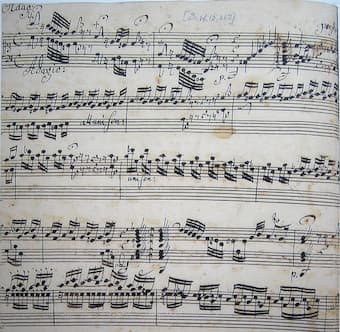
Bach's Toccata in D minor 18th century copy by Johannes Ringk

Bach’s Toccata in D minor 18th century copy by Johannes Ringk

Sometimes, I really don’t understand the descriptions assigned to particular keys. When it comes to D minor, we can read that it represents “dejected womanhood which broods on notions and illusions.” I guess it’s a pretty fancy and period description of a scorned woman in love? Others have said that D minor “expresses a subdued feeling of melancholy, grief, anxiety, and solemnity.” Whatever the case may be, some of the most famous and popular classical pieces ever are written in D minor. And here is my list of personal bests.

Bach: Toccata and Fugue in D minor

I can tell you that it was not a very easy choice because of all the gorgeous compositions in D minor that I have to leave out. However, for me it’s all starting with the Toccata and Fugue in D minor by Johann Sebastian Bach. Today that song is used in a variety of popular media, ranging from film, video games and ringtones. But the association today is not melancholy or a scorned woman in love, but sheer terror. This association with horror and Halloween first appeared in a 1962 film adaptation of “The Phantom of the Opera.” It just goes to show that specific associations are easily formed in connection with visual media, but the D minor Toccata and Fugue is still a most powerful composition, and certainly one of the best songs in D minor. 

Mendelssohn: Piano Trio No. 1 in D minor
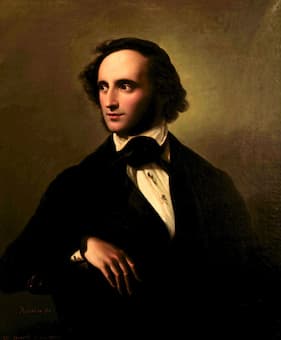
Portrait of Felix Mendelssohn by Wilhelm Hensel, 1847

Portrait of Felix Mendelssohn by Wilhelm Hensel, 1847

Felix Mendelssohn learned a lot from the music of Bach. In fact, he was responsible that the music of Bach found its rightful place on the world’s concert stages. Mendelssohn looked at the styles and compositional techniques of the past and developed a highly personalized music style. Not everybody was enthusiastic for Mendelssohn to go back in time, and Berlioz once said, “Mendelssohn paid too much attention to the music of the dead.” And the always-punchy critic and playwright George Bernard Shaw compared Mendelssohn to a senile academy professor whose exercises in a dead musical language “are as trivial as they are tedious.” Then as now, it’s difficult to please the critics. Mendelssohn complete his piano trio in D minor in 1839, and Robert Schumann wrote in his review that “Mendelssohn is the Mozart of the 19th century, the most illuminating of musicians.” There is a good bit of melancholy yearning in the opening movement, and the slow “Andante” is actually a song without words that turns to passion. The scherzo is light and airy, and it all ends with a passionate rondo. For me personally, this is one of the most powerful and best songs in D minor ever. 

Mozart: Requiem
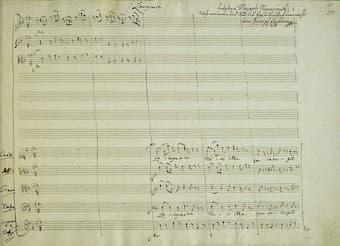
Mozart's Requiem

Mozart’s Requiem

Since the key of D minor is supposed to express grief and solemnity, it’s not surprising to find a good number of Requiems in that category. Composers who have written Requiems include BrucknerRegerFauré, and probably most famously, Wolfgang Amadeus Mozart. The passionate lover of music, Count Franz von Walsegg commissioned the work for his twenty-year old wife Anna, who had sadly passed away.

The Count was a fellow Freemason, but as we all know, Mozart himself died before he could complete the composition. Sorry to disappoint all fans of the movie Amadeus, but Salieri had nothing to do with the Requiem or with Mozart’s death. Mozart’s wife Constanze hired several composers to finish the piece and deliver it to the Count. Constanze did suggest that her husband actually believed that he was writing the requiem for his own funeral. Whatever the case may be, it is one of the most powerful classical compositions I know, and it certainly is one of the best songs in D minor.


Haydn: Symphony No. 80 in D minor
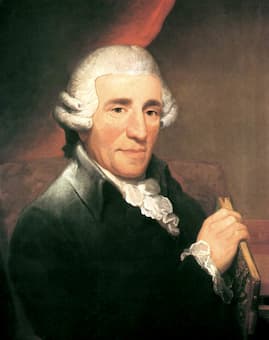
Joseph Haydn

Portrait of Joseph Haydn by Thomas Hardy, 1791

D minor seemed to have been a highly popular key for composing large-scale symphonies. We have symphonies No. 1 by Dohnányi, IvesRachmaninoff and Richard StraussProkofiev and Balakirev wrote their 2nd symphonies in D minor, the same key used by Bruckner in his symphonies No. 3 and No. 9. Dvořák composed his symphonies No. 4 and No. 7 in D minor, and there are also symphonies by SchumannShostakovichSibeliusVaughan WilliamsGlazunov, and of course the monumental symphony No. 9 by Beethoven. Which one is actually my favorite? To tell the truth, I really can’t decide. So I went back to the father of the symphony, Joseph Haydn, and I found a delightful storm and stress symphony in D minor. His 80th symphony probably dates from 1784, and for some reason it does not have a nickname. However, it is a symphonic gem and Haydn showed everybody coming after him what was actually possible in a symphony. And it is for that particular reason that Haydn’s 80th is my representative for symphonies in D minor. 

Rachmaninoff: Piano Concerto No. 3 in D minor, Op. 30
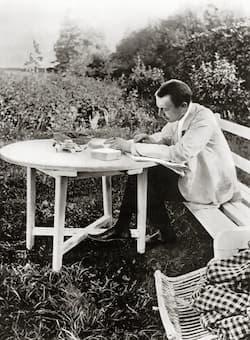
Rachmaninoff's Piano Concerto No. 3 in D minor and more classical music in the key of D minor

Rachmaninoff proofing a manuscript

Some composers are actually rather difficult to read. Sergei Rachmaninoff was clearly one of the last great pianist-composers in a long tradition stretching back to Mozart, Beethoven, Liszt and Brahms. He proudly suggested that “a composer’s music should express the country of his birth, his love affairs, his religion, the books which have influenced him, and the pictures he loves… My music is the product of my temperament…” Rachmaninoff was fiercely egotistic in artistic matters, but also frequently depressed without any specific cause. Very few people ever heard him laugh, and only occasionally did he crack a rare smile. He was often grave in expression and mannerism, and seemed to have been stuck in prolonged periods of philosophical longing and melancholy. Almost sounds like Rachmaninoff could be considered the poster child for D minor. And wouldn’t you know it, he did write a great number of works in that particular key, including the fabulous 3rd piano concerto. It is without doubt one of the all-time best songs in D minor. As you can tell, the key of D minor was really popular with composers, and I have tried to find my favorite songs; what is yours? Next time, I will take a look at the best songs in the cheerful key of B-flat major.

Tuesday, May 31, 2022

Jacques Ibert - his music and his life


Jacques Ibert - Divertissement | | Cristian Măcelaru | WDR Sinfonieorchester

Jacques Ibert was born in Paris in August 15 th 1890. His mother, an accomplished pianist, provided violin, then piano lessons for Jacques, despite his father’s wishes that his son follow in his business profession. From the beginning, Jacques always was more interested in free improvisation on the piano than concentration on technique and repertory.


After deciding to become a composer, his cousin ,Manuel de Falla, encouraged him in this field.


After graduating from secondary school in 1908, he delayed entering the Paris Conservatoire in order to help his father, whose family business had suffered a financial setbacks.


While working there, his plans switched from music to acting, an interest stimulated by meeting actors ,singers, artists and writers during the family’s earlier travels. His interest in theatre would be remain important for him throughout life.


Finally in 1911, Ibert entered the Paris Conservatoire,  and was taught by Pessard , Gédalge, and Vidal. Among his classmates were Darius Milhaud and Arthur Honegger, with whom he would work later on several occasions. His father unhappy about his music studies, had withdrawn financial support, so Ibert earns his  living by working as an accompagnist and writing light piano pieces and popular songs under a pen name. His previous skill improvisation became useful when he was employed as a pianist at sillent movie théâtres where he composed  scores  to fit the action on the screen. He later was to write over sixty film scores for sound movies.


World war I interrupted Ibert’s studies at the Conservatoire .He joined an army medical unit, and was decorated with the Croix de Guerre by the French government.


Shortly after returning to the Conservatoire, Ibert stood for the competition for the Premier Grand Prix (Prix de Rome). He won the prize,which meant living up to three years in Rome at the Villa Medici, in October 1919.


During his stay   at the Villa Medici, from February 1920 to May 1923  Ibert produced some of his best known works such as « La Ballade de la Geôle de Reading » and « Escales »..


In 1937 Ibert was named Director of L’Académie de France à Rome, the first musician to hold this post. He was responsible for administrative duties and supervision of the Prix de Rome winners. He held the position until 1960., although World War II forced him to leave Rome for a few years.


In 1955, Ibert was appointed General Administrator of the Réunion des Théâtres Lyriques nationaux (the combined management of Paris Opera and Opera Comique).

In 1956, he was elected to the Académie des Beaux Arts of the Institut de France. He died in  February 5th  1962.

Sunday, May 29, 2022

Germaine Tailleferre - her music and her life


Born in Paris on April 19th 1892, French composer Germaine Tailleferre began her studies at the Paris Conservatory in 1904, despite her father’s opposition and her equal ability in art. She studied primarily with Eva Sautereau-Meyer. She was a pianistic prodigy with a phenomenal memory for music which led to her winning many prizes. In 1913, she met Auris, Honegger and Milhaud whilst studying in Georges Caussade’s counterpoint class. Eric Satie was so impressed by her 1917 work Jeux de plein air for two pianos that he described her as his ‘musical daughter’, and through this relationship, Tailleferre’s reputation was substantially advanced. When Les Six was formed in 1919-20, she became its only female member. Her abilities at the harpsichord and affinity for the styles of music originally composed for the instrument stood her in excellent stead as the neo-classicism of Stravinsky began to grow in popularity, though her works retained an influence of Fauré and Ravel. 


Unfortunately, Tailleferre’s circumstances in through much of the rest of her life meant that she never gained much of the same acclaim as the other members of Les Six. After two very unhappy marriages, she found her creative energies drained and due to financial issues was almost unable to compose if not for commission, leading to many uneven and quickly composed works. Moreover, her lack of self-esteem and sense of modesty held her back from publicising herself to a fuller extent. In spite of this, some of concerti of the 1930s saw some success and she was often approached to compose for film. Throughout her career she continued to compose music for children which some writers have suggested helped to retain the spontaneity, freshness and charm that characterises her finest works.

Saturday, May 28, 2022

Darius Milhaud - his music and his life


Darius Milhaud (4 September 1892 – 22 June 1974) was a French composer and teacher. He was a member of 'Les Six' and one of the most prolific composers of the twentieth century. His compositions are influenced by jazz and make use of polytonality. 

Milhaud studied at the Paris Conservatory where he met his fellow group members Arthur Honegger and Germaine Tailleferre. Milhaud (like his contemporaries Paul Hindemith, Gian Francesco Malipiero, Bohuslav Martinů and Heitor Villa-Lobos) was an extremely rapid creator, for whom the art of writing music seemed almost as natural as breathing. His most popular works include Le bœuf sur le toit (ballet), La création du monde (a ballet for small orchestra with solo saxophone, influenced by jazz), Scaramouche (for Saxophone and Piano, also for two pianos), and Saudades do Brasil (dance suite). 


His autobiography is entitled 'Notes sans musique' (Notes Without Music), later revised as 'Ma vie heureuse' (My Happy Life). The Milhaud family left France in 1939 and emigrated to America in 1940 where he secured a teaching post at Mills College in Oakland, California. From 1947 to 1971 he taught alternate years at Mills and the Paris Conservatoire, until poor health compelled him to retire. He died in Geneva aged 81.

Featured Post

Yuja Wang wore a heart rate monitor in Rachmaninov marathon, with astonishing results

4 April 2024, 17:03 | Updated: 5 April 2024, 15:58 Yuja Wang’s heart rate results revealed, after marathon Rachmaninov performance.  Picture...