Saturday, July 19, 2014

What were the daily routines of the great composers?

Night owls or early birds - how did Mozart, Tchaikovsky and Richard Strauss structure their day? Their habits in composing, breakfast, socialising and exercise are plotted against those of other great minds in this look at the daily routines of famous creative people. 

In this infographic, the website podio.com has condensed the daily routines of some of history's great creative minds. The hourly habits of Darwin, Freud, Voltaire, Beethoven and others are broken down and plotted against each other in the ultimate diary of genius. 

Beethoven shows how he can power through a long morning's composition on some strong coffee. It's clear that Mozart's compositional muse often visited late at night, after he had been out drinking wine with friends. 


Richard Strauss had a tightly scheduled and disciplined day. No composer listed here comes close to the disciplined early-riser novelist and playwright Honoré de Balzac, who set his alarm clock for 1am. A big fan of Nick Bailey's show, possibly. 
Click on the image for a closer, interactive view...
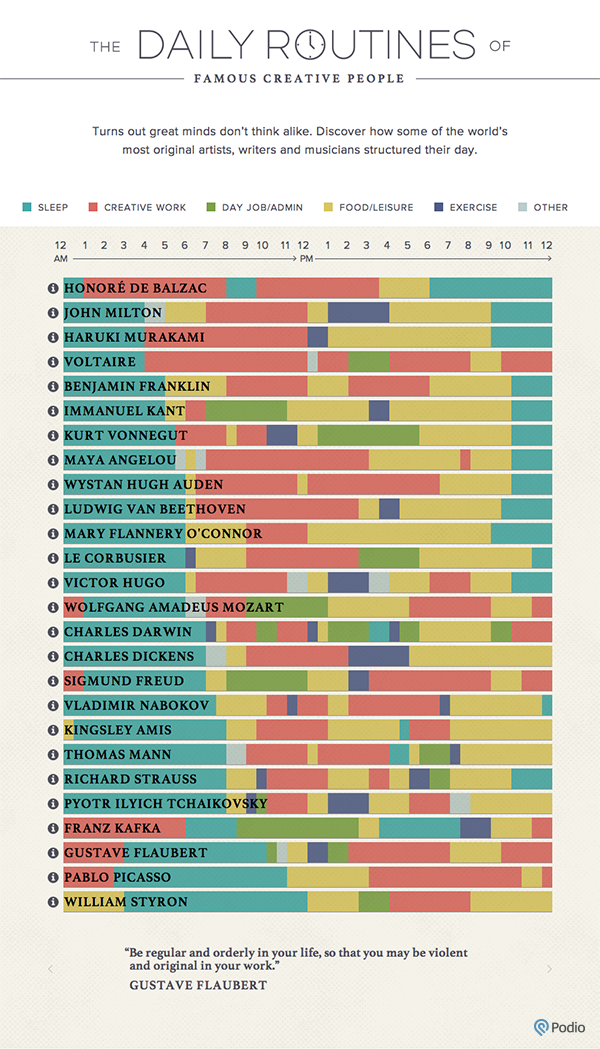
Want to develop a better work routine? Discover how some of the world's greatest minds organized their days.
Click image to see the interactive version (via Podio).

Discover Music


(C) ClassicFM, London 2014

Friday, July 11, 2014

Arthur Nikisch - His Music and His Life

Arthur Nikisch was born in Lebeng Szent Miklos/Hungary on October 12, 1855 and became a violine student of Joseph Hellmesberger (1828-1893) at the Viennese Conservatory. For his compositions, Nikisch received several outstanding rewards. He was a real sound magnician without philosophical or rather aesthetical resources.

Through an incredible tone color and sonority, Nikisch reached a unique musical experience. Together with his wife Amelie, his compositions such as "My Aunt, Your Aunt" (1911) or "Daniel in the Lion's Hollow" (1914) remained popular until today.

Nikisch's son Mitja (1899-1936) became a very blessed pianist.

Nikisch passed away in Leipzig/Germany on January 23, 1922.

Friday, July 4, 2014

The Ten Worst Things About Playing the Cello

Cellists, we feel your pain. But not enough to help when you're stuck in the ticket barriers at the station. Here are the worst things about being you... 

Pachelbel canon score

1. Even the case is a joke

"No, there's not a bomb in there. No it's not a guitar. Yes, I do wish I'd taken up the flute."

mad


2. Pachelbel has it in for you

Doesn't matter how many grade exams you've passed, these eight little notes played over and over again are the only ones you'll need. Better start tuning those low F sharps now.

Pachelbel's canon is every song


3. Transport

Does it fit in your Fiat Punto? Of course it doesn't. And good luck trying to get it through the ticket barriers on the train. Not to worry, there's bound to be a way to get such a dainty instrument from A to B...

http://hugelolcdn.com/i/253953.gif
(via reddit)

4. Did we mention, transport?

Don't even get us started on trying to bring the thing on a plane. Yes, you will have to buy a seat for it. No, you can't claim extra gin 'for your cello'.

cello on plane


5. Your instrument will almost certainly maim you

If wasn't hard enough trying to fly with the enormous chunk of carved wood, try explaining the lethal 9-inch metal spike you're forced to carry around at all times. Which, incidentally, will ruin all your laminate flooring, make millions of tiny holes in your carpets, and slip on every conceivable concert stage. Good luck with that.
http://37.media.tumblr.com/tumblr_m6nsbzoMJI1rv4c4zo1_400.gif
(via Encyclopaedia Dramatica)


6. Concert dress

You can be as careful as you like, but you'll somehow always manage to smear sticky white rosin all over your miniskirt shorts regulation black concert trousers. There's only one way round it:

bad stock photos


7. Thumb position

Take up the cello, they said. It doesn't sound scratchy like a violin, they said. Until, of course, you get really good and you have to start playing actual notes with your THUMBS.

cello thumb position


(via Sandygocellolessons)

8. That bit in the Fauré Elegie

Congratulations! You've graduated from Pachelbel's Canon and you're finally a fully-fledged cello-playing genius. Now prepare yourself for humiliation and defeat as you fall off the fingerboard during recitals.

http://www.gurl.com/wp-content/uploads/2014/03/lindsay-facepalm.gif
(via mrwgifs)


9. String injuries

It's pretty much 100% guaranteed that your C string WILL snap in your face/lacerate your arms/take your eye out while you're sitting on stage in front of everyone. Just be thankful you don't play the double bass.

http://cdn.instructables.com/FDN/TXHF/GBBH8Q1H/FDNTXHFGBBH8Q1H.MEDIUM.jpg
(via Instructables)


10. This guy

Why CHELLO THERE!

Cello geek


(With ClassicFM London).


Wednesday, July 2, 2014

Joseph Haydn - His Music and His Life

Franz Joseph Haydn
Of humble origins, Franz Joseph Haydn (March 31, 1732 - May 31, 1809) was born in the village of Rohrau, near Vienna. When he was eight years old he was accepted into the choir school of Saint Stephen's Cathedral in Vienna, where he received his only formal education. Dismissed from the choir at the age of 17, he spent the next several years as a struggling free-lance musician. He studied on his own the standard textbooks on counterpoint and took occasional lessons from the noted Italian singing master and composer Nicola Porpora. In 1755 Haydn was engaged briefly by Baron Karl Josef von Furnberg, for whom he apparently composed his first string quartets. A more substantial position followed in 1759, when he was hired as music director by Count Ferdinand Maximilian von Morzin. Haydn's marriage in 1760 to Maria Anna Keller proved to be unhappy as well as childless.

The turning point in Haydn's fortunes came in 1761, when he was appointed assistant music director to Prince Pal Antál Esterházy; he became full director, or Kapellmeister, in 1762. Haydn served under the patronage of three successive princes of the Esterházy family. The second of these, Pal Antál's brother, Prince Miklós Jozsef Esterházy, was an ardent, cultivated music lover. At Esterháza, his vast summer estate, Prince Miklós could boast a musical establishment second to none, the management of which made immense demands on its director. In addition to the symphonies, operas, marionette operettas, masses, chamber pieces, and dance music that Haydn was expected to compose for the prince's entertainment, he was required to rehearse and conduct performances of his own and others' works, coach singers, maintain the instrument collection and music library, perform as organist, violist, and violinist when needed, and settle disputes among the musicians in his charge. Although he frequently regretted the burdens of his job and the isolation of Esterháza, Haydn's position was enviable by 18th-century standards. One remarkable aspect of his contract after 1779 was the freedom to sell his music to publishers and to accept commissions. As a result, much of Haydn's work in the 1780s reached beyond the guests at Esterháza to a far wider audience, and his fame spread accordingly.

After the death of Prince Miklós in 1790, his son, Prince Antál, greatly reduced the Esterházy musical establishment. Although Haydn retained his title of Kapellmeister, he was at last free to travel beyond the environs of Vienna. The enterprising British violinist and impresario Johann Peter Salomon lost no time in engaging the composer for his concert series in London. Haydn's two trips to England for these concerts, in 1791-92 and 1794-95, were the occasion of the huge success of his last symphonies. Known as the "Salomon" or "London" symphonies, they include several of his most popular works: "Surprise" (#94), "Military" (#100), "Clock" (#101), "Drum Roll" (#103), and "London" (#104).

In his late years in Vienna, Haydn turned to writing masses and composed his great oratorios, The Creation (1798) and The Seasons (1801). From this period also comes his Emperor's Hymn (1797), which later became the Austrian national anthem. He died in Vienna, on May 31, 1809, a famous and wealthy man.

Haydn was prolific in nearly all genres, vocal and instrumental, sacred and secular. Many of his works were unknown beyond the walls of Esterháza, most notably the 125 trios and other assorted pieces featuring the baryton, a hybrid string instrument played by Prince Miklós. Most of Haydn's 19 operas and marionette operettas were written to accommodate the talents of the Esterháza company as well as the tastes of his prince. Haydn freely admitted the superiority of the operas of his young friend Wolfgang Amadeus Mozart. In other categories, however, his works circulated widely, and his influence was profound. The 107 symphonies and 68 string quartets that span his career are proof of his ever-fresh approach to thematic materials and form, as well as of his mastery of instrumentation. His 62 piano sonatas and 43 piano trios document a growth from the easy elegance suitable for the home music making of amateurs to the public virtuosity of his late works.

Haydn's productivity is matched by his inexhaustible originality. His manner of turning a simple tune or motive into unexpectedly complex developments was admired by his contemporaries as innovative. Dramatic surprise, often turned to humorous effect, is characteristic of his style, as is a fondness for folkloric melodies. A writer of Haydn's day described the special appeal of his music as "popular artistry", and indeed his balance of directness and bold experiment transformed instrumental expression in the 18th century.

Haydn's signature

Monday, June 30, 2014

Emil Waldteufel - His Music and His Life

Emil Waldteufel was born in Strasbourg/France on December 9, 1837 and became a ball conductor at the court of Napoleon III and a chamber pianist of the Emperor Eugenie, married to Napoleon III in 1853.

Waldteufel "transplanted" the Vienna Waltz to Paris. He composed pretty much as the King of Waltz Johann Strauss, but Waldteufel never reached the same melody volume and profoundation.

Among his famous workds which are still on air from time to time are the waltzes "Schlittschuhlaeufer" (The Skater) and "Sirenenzauber" (Siren's Magic) as well as "Espana".

Emil Waldteufel passed away in Paris on February 16, 1915.

Incredible Classic Music Decor for your Home

Piano bookcase

Struggling to find a use for all the pianos you have lying around the house? (Of course you are.) Why not cut the strings, varnish the shell, and hang a grand piano on the wall as a set of musical shelves? Picture: Tina Baine

(C) by Classic FM


Monday, June 23, 2014

Carl Maria von Weber - His Music and His Life

Carl Maria (Friedrich Ernst Freiherr) von Weber (November 18, 1786 in Eutin/Germany - June 5, 1826 in London) was a German composer and key figure in the early Romantic period. He is considered to be the founder of German Romantic opera. He experienced a restless and fidgety youth. Mozart's youth traveled pale against that. 

Von Weber started with piano lessons in 1792, and, in 1797, musical theory with the great Joseph Haydn (1732-1809). The first composition Six Fughetten has been published in 1798.

Invitation to a dance (1819) and the Concert for piano and orchestra (1821) became concessions of arising "program music", the difference to "absolute music".

A child prodigy, and touring piano virtuoso as a boy, Weber grew up in a musical family. From an early age, he had a fascination for opera. His major operas are Der Freischütz (1821), Euryanthe (1823), and Oberon (1826). Weber died in London of consumption less than two months after the premiere of Oberon. When his body was finally returned to Germany for burial, the eulogy was delivered by Richard Wagner.


Featured Post

The Most Overtly Erotic Works in Classical Music

  by  Emily E. Hogstad    May 28th, 2026 Western classical music is often thought of as cerebral or abstract, but throughout its history, co...