Sunday, January 12, 2025

Saturday, January 11, 2025
Live from the Factory Floor: The 5 Browns - Rhapsody in Blue
In the 5th installment of Steinway's “Live from the Factory Floor” concert series, The 5 Browns visited the historic Steinway factory in Astoria, NY to perform in front of the 350+ craftspeople that work on building the world's best pianos. The 5 Browns – Ryan, Melody, Gregory, Deondra and Desirae – all attended New York’s Juilliard School. In fact, they became the first family of five siblings ever accepted simultaneously. The 5 Browns tour extensively and have performed in numerous venues including the Grand National Theater in China, Suntory Hall in Japan and, in the United States, The Kimmel Center in Philadelphia, Symphony Hall in Chicago and Alice Tully Hall in New York City.
In this clip, from the group's visit to the New York factory on October 2, 2015, they played their unique 5 piano version of "Rhapsody in Blue" by Steinway Artist Immortal George Gershwin.


Friday, January 10, 2025
Song of the Fireflies’ an ode to mentors who change lives through music
By: Jessica Ann Evangelista

‘Song of the Fireflies’ | Image: Screengrab from YouTube/Culturtain Musicat Productions
“Song of the Fireflies,” true to its title, is a love letter to mentors who have ignited light and dreams in their mentees. With its uplifting message and moving finale, the film resonates as a sentimental celebration of perseverance and the transformative power of music.
Based on a true story, “Song of the Fireflies” follows a provincial teacher, Alma (Morissette Amon, in her big-screen debut), who transforms the Loboc Children’s Choir into an internationally acclaimed singing group despite coming from a small town.
One of the strongest aspects of the film is obviously its music. The choir’s renditions are heartwarming, especially during their climactic performances. From small-town competitions to international stages, the choir’s journey is punctuated by musical numbers that reflect the children’s growth and bond as a group.
The film excels in portraying the triumphs and challenges of the children and their mentor, as they are depicted with an authenticity that tugs at the heartstrings. The last frame, in particular, a clip of the real teacher Alma, leaves a lasting impression, serving as a testament to the power of mentorship in shaping young lives.
However, the movie does falter in pacing. The beginning feels stagnant, taking too long to establish the characters, while the middle section occasionally drags with predictable subplots. Despite these challenges, the story does pick up toward the end, delivering a moving payoff.
by Emily E. Hogstad
But how much of this story is real, and how much of it is just mythologizing?
Today we are looking at the real story behind the love affair between George Sand and Frédéric Chopin.
George Sand’s Childhood and Marriage
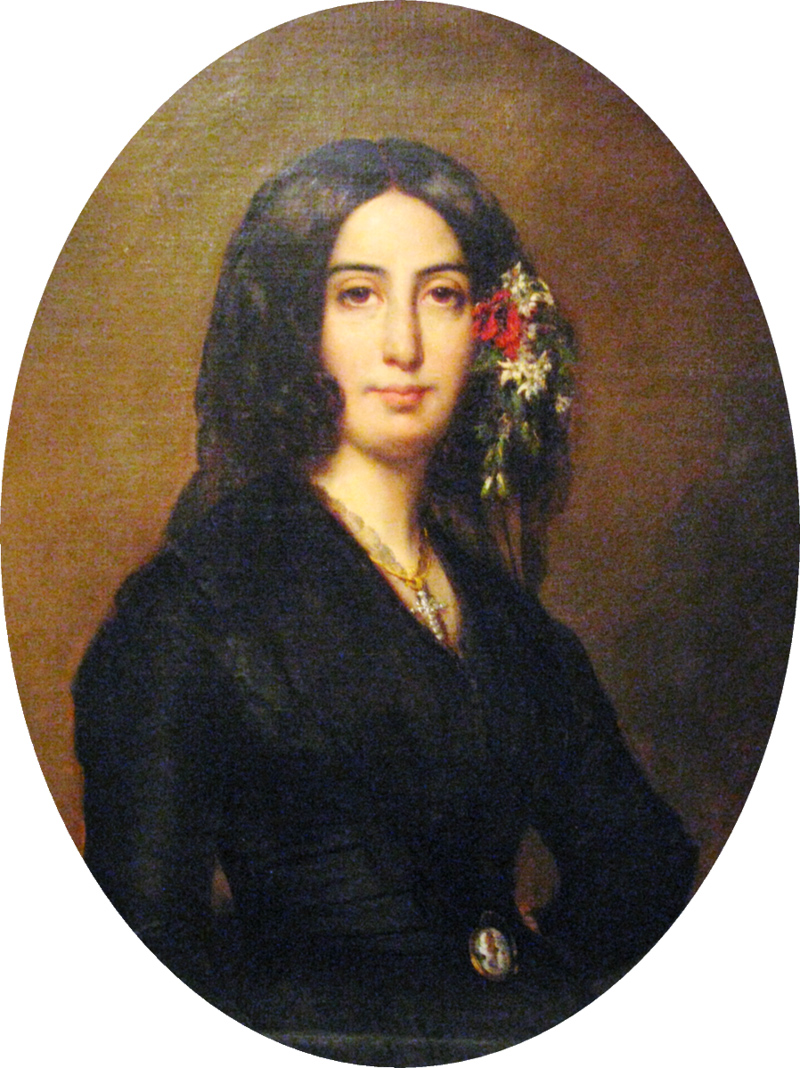
George Sand
Amantine Lucile Aurore Dupin de Francueil was born on 1 July 1804 in Paris.
As a girl, she lived with her grandmother at the family manor house in Nohant, roughly three hundred kilometers from Paris.
In 1821, her grandmother died, and Aurore inherited the manor. The house at Nohant became a home base for her throughout her life.
In 1822, at the age of eighteen, Dupin married a man named Casimir Dudevant, whose biggest accomplishment in life ended up being George Sand’s ex.
They had two children together: a son named Maurice in 1823 and a daughter named Solange in 1828. (That said, Solange’s paternity is questioned.)
After almost a decade, the marriage deteriorated. Mrs. Dudevant left her husband in 1831 and, scandalously, began seeing other men. In 1835, she separated from him legally and took custody of her two young children.
George Sand’s Writing Career
In her twenties, the former Mrs. Dudevant embarked on romantic relationships with a wide variety of accomplished artistic men, including novelist Jules Sandeau, writer Prosper Mérimée, dramatist Alfred du Musset, and others. (She also developed intense romantic feelings for actress Marie Dorval. The two would remain friends for the rest of their lives.)
The former Mrs. Dudevant’s writing career began in the early 1830s, when she began collaborating on stories with her lover Jules Sandeau. They signed their joint efforts “Jules Sand.”
It quickly became obvious that she was a very talented writer. In 1832, at the age of twenty-eight, she wrote a novel on her own and published it under the pseudonym George Sand.
It wasn’t long before this divorced mother of two was one of the most respected authors in Europe. Her work was actually more popular in England than either Hugo’s or Balzac’s!
As her career progressed, she didn’t restrict herself to just novels: she also wrote literary criticism, theatrical works, political commentary (she was a socialist), and more.
The Meeting of George Sand and Frédéric Chopin
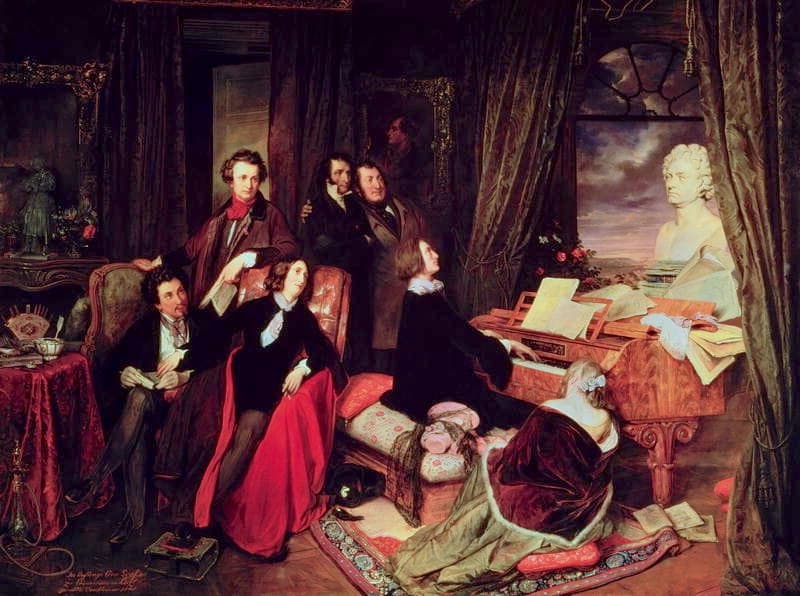
Josef Danhauser: Franz Liszt Fantasizing at the Piano
Apparently, Sand was intrigued by Chopin even before they met. It is believed she encouraged their mutual friend Franz Liszt to arrange an introduction.
On 24 October 1836, in the salon of fellow author (and Liszt’s mistress) Marie d’Agoult, George Sand and Frédéric Chopin met each other for the first time.
Chopin was initially repulsed by Sand, reportedly asking Liszt, “Is she really a woman?”
Despite this rocky first impression, Sand still remained intrigued by him.
It seems they were not close before 1838. In May of that year, she asked a mutual friend in a letter if he was still engaged (at one point, he had been betrothed to his former pupil Maria Wodzińska). If so, Sand wrote, she would back off. However, it turns out that the relationship with Wodzińska was well and truly over.
It’s unclear exactly how, but eventually Chopin and Sand became friends, and then lovers.
Their Trip to Majorca
To celebrate their new partnership, Sand planned a trip to Majorca, Spain, over the winter of 1838. She was hopeful that the change in climate would help Chopin’s declining health.
The trip started off on a high note. “The sky is like turquoise, the sea is like emeralds, the air as in Heaven,” he wrote in a letter.
Chopin ended up composing some of his best-known works in Majorca, including his 24 Preludes. The work tied most closely to this place in time is undoubtedly the Raindrop Prelude, said to be inspired by the rain dripping off the eaves of their lodgings.
Frédéric Chopin: Prelude in D flat major Op. 28 No. 15
The trip became a struggle when, as the Raindrop Prelude suggests, the winter weather turned damp. Instead of improving, his health deteriorated. The couple’s gloomy accommodations didn’t help matters: they had sought refuge in a deserted monastery in Valldemossa.
Soon Catholic locals began viewing the unmarried divorcée and her invalid partner with suspicion. The couple’s reputation grew even worse when rumors spread that Chopin’s cough would spread communicable disease. In the end, the locals grew so impossible to work with that Sand was eventually forced to lug a handcart to the capital city of Palma just to load up on basic supplies.
Their nightmare came to an end ten weeks after they arrived, but unfortunately their return voyage to Barcelona occurred during rough seas, and Chopin suffered from seasickness on the way home.
Life in France
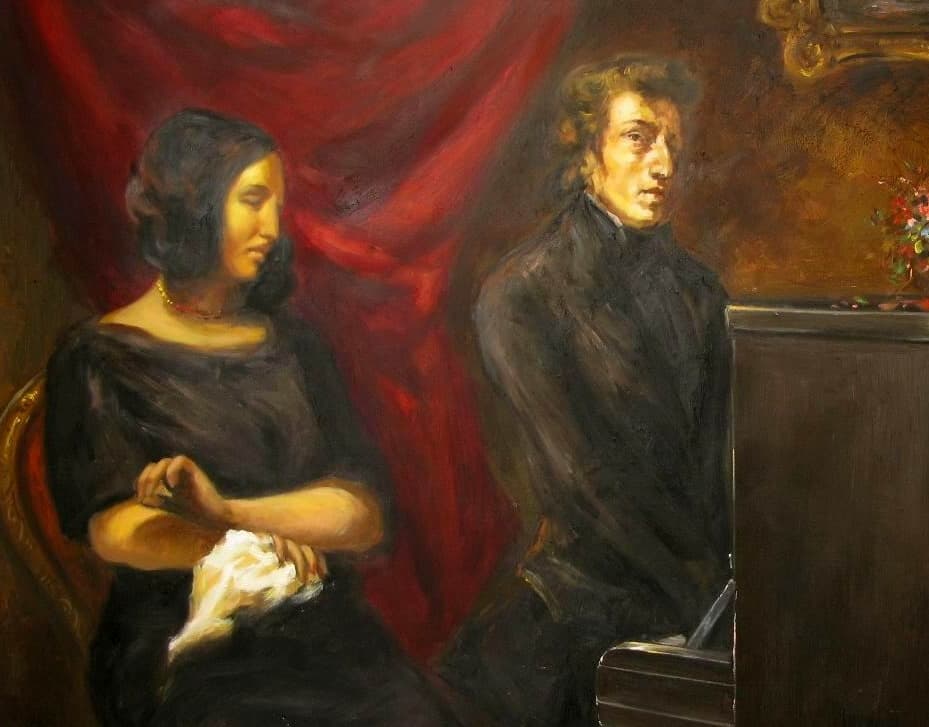
Portrait of Frédéric Chopin and George Sand by Eugène Delacroix
A much more agreeable destination turned out to be Sand’s country home in Nohant. Chopin and Sand settled into a schedule of spending half the year in Nohant and the other half in Paris (albeit in separate apartments).
Although they never officially moved in together full-time, in 1842, they did take the step of renting adjacent apartments.
Chopin ended up writing many great works at Nohant. Today the home is a museum.
The Breakup
So why did these two titans of the Romantic Era break up?
One blow was Sand’s novel Lucrezia Floriani, which starred a sickly Eastern European prince being cared for by Lucrezia, the protagonist. The Polish Chopin grew increasingly resentful of this particular creative choice, feeling that his health troubles had become nothing but grist for Sand’s creative mill.
A second blow came when Chopin sided with Sand’s daughter, Solange, in various fierce mother-daughter arguments. Sand interpreted Chopin’s loyalty to Solange as his being in love with her. It didn’t help matters that Sand’s other child, Maurice, didn’t like Chopin, either.
Ultimately, after almost a decade together, the two great artists split up for good.
On July 28, 1847, Sand wrote to him: “Goodbye, my friend. May you soon be cured of all your ills, as I hope that now you may be…. If you are, I will offer thanks to God for this fantastic ending of a friendship which has, for nine years, absorbed both of us. Send me your news from time to time. It is useless to think that things can ever again be the same between us.”
Backlash to the Breakup
Sand herself predicted the backlash that would come: “His own particular circle will, I know, take a very different view [of the breakup],” she wrote. “He will be looked upon as a victim, and the general opinion will find it pleasanter to believe that I, in spite of my age, have got rid of him in order to take another lover…” Her predictions about public opinion turned out to be cannily accurate.
It’s also noteworthy that their relationship is often boiled down – wrongly – as one between nurse and caretaker. In his own writings, Liszt, for whatever reason, enjoyed emphasizing Chopin’s weakness and medical troubles, and therefore Sand’s role as his patient helper. However, Sand seemed to chafe against the idea. The relationship was simply more complex than that. She wrote of the Majorca disaster, “It was quite enough for me to handle, going alone to a foreign country with two children…without taking on an additional emotional burden and a medical responsibility.”
Sand and Chopin’s Final Meeting
Both Chopin and Sand left accounts of their final meeting. Comparing them is fascinating.
“I saw him again briefly in March 1848,” Sand wrote in her autobiography. “I clasped his trembling, icy hand. I wanted to talk to him; he vanished. It was my turn to say he no longer loved me.”
Chopin, on the other hand, wrote a longer account in a March 1848 letter to Solange: “Yesterday… I met your Mother in the doorway of the vestibule….” He asked whether Sand had any news about Solange, and let Sand know that Solange had had a baby, since mother and daughter weren’t on good terms at the time. He “bowed and went downstairs.” Then he decided he had more to say, so he asked a servant to bring her to him again. They talked some more. “She asked me how I am; I replied that I am well, and asked the concierge to open the door.”
Chopin died a little more than a year later. Sand opted not to attend his funeral. She lived many more years and wrote many more books.
Despite that tragic end to their love affair – or maybe because of it – George Sand and Frédéric Chopin remain one of the most iconic couples of the Romantic Era.
Unleashed Passion: Olga Scheps
The highly acclaimed pianist Olga Scheps was born on 4 January 1986 in Moscow, but she moved to Germany at a young age. She won several local competitions and played her debut performance with orchestra at the age of 14. Since then, she has gained widespread recognition for her delicate yet powerful touch and deep emotional connection to the music.

Olga Scheps
Scheps is particularly praised for her lyrical phrasing, refined dynamic control, and her ability to navigate complex works with both technical precision and expressive depth. Her skilful blending of elegance and sensitivity provides for performances that are both intellectually stimulating and emotionally resonant.
As a critic wrote, “her versatility, along with her ability to convey the emotional essence of each composer, has solidified her as one of the leading pianists of her generation.” To celebrate her birthday on 4 January, we decided to feature 5 of her most outstanding performances.
Frédéric Chopin: Ballade No. 3, Op. 47
Olga Scheps brings a distinct artistic voice to Chopin’s music. Known for her ability to create a profound emotional connection with the listener, her performances are marked by elegance and restraint but also by a sense of passionate intensity. She doesn’t shy away from the dramatic moments in Chopin’s works, but she never allows them to overwhelm the lyrical beauty of the pieces. I suppose we could call her approach thoughtful, as she seeks to reveal the inner essence of the music rather than relying on showy gestures.
Scheps has been widely praised for her Chopin interpretation. She is often noted for her ability to communicate the full emotional range of Chopin’s works. As a critic wrote, “her delicate phrasing, virtuosic execution, and deep emotional understanding of Chopin’s style have made her a leading interpreter of his music today.”
Ludovico Einaudi: Una Mattina

Olga Scheps brings a deep emotional connection to Ludovico Einaudi’s music, skilfully balancing its meditative calm with moments of emotional intensity. Her use of rubato enhances the lyrical nature of the melodies, making her performances feel intimate and personal. Technically, she excels in executing the repetitive motifs of Einaudi’s minimalist style with precision and fluidity, avoiding monotony while maintaining a natural flow.
Scheps also demonstrates exceptional sensitivity to tone and dynamics, playing with clarity and delicacy and adapting her touch to bring out both the subtle harmonies and emotional peaks of the music. Her recordings of Einaudi have received positive reviews, as she underscores the fine balance between simplicity and expressiveness, “making her performances of Einaudi’s works both captivating and moving.”
Ludwig van Beethoven: Piano Concerto No. 3 in C minor, Op. 37
In her Beethoven interpretations, Scheps is highly praised for her clarity of playing, her emotional depth and the intellectual rigour of her approach. Beethoven’s wide range of emotional extremes and technical challenges is a natural fit for Scheps, whose playing blends expressive lyricism with precise technique.
She is particularly praised for her ability to balance the grandeur of Beethoven’s works with an intimate, thoughtful approach, bringing both strength and sensitivity to the compositions.
Scheps easily captures the full range of Beethoven’s emotional and intellectual landscapes. Her ability to handle the complexities of Beethoven’s music while maintaining a sense of lyricism and expressiveness makes her, according to critics, “one of the most compelling interpreters of the composer’s works today.”
Erik Satie: 3 Gnossiennes
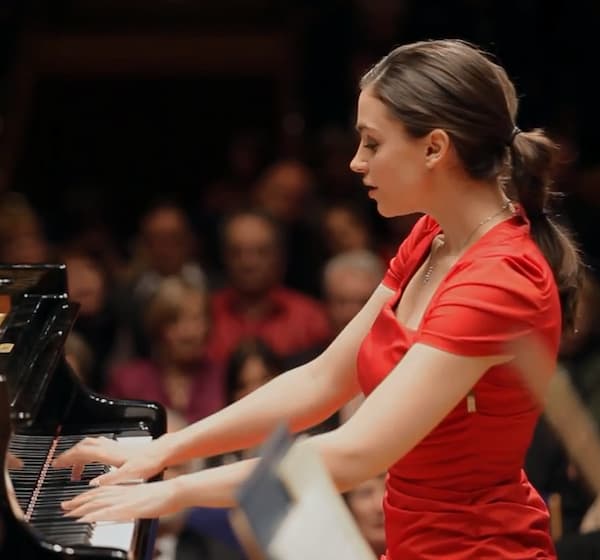
Schep’s refined and sophisticated reading of Erik Satie has been appreciated by critics and audiences alike. According to critics, “she is able to capture the essence of Satie’s minimalist style without making the music feel dry or overly repetitive.” Her performances are frequently praised for their clarity, sensitivity, and lyrical beauty, and they stand out for their poise, emotional depth, and sensitive touch.
Franz Schubert: Wanderer Fantasie, D. 760

I have left the best for last, as Scheps’ interpretation of Franz Schubert is highly praised for its elegance, emotional depth, and sensitivity. The complex emotional landscapes of Schubert’s music are particularly well-suited for Scheps’ temperament, for her refined touch and expressive phrasing. She has the uncanny ability to penetrate the soul of Schubert’s music, capturing both its delicate beauty and underlying melancholy.
A critic writes, “there is a profound understanding of the music’s subtle harmonic shifts, which she navigates with sensitivity and intelligence. Whether in the wistful beauty or lyrical expansiveness of Schubert’s music, Scheps’ interpretations of Schubert are always filled with natural grace and expressive honesty.”

Subscribe to:
Posts (Atom)
Featured Post
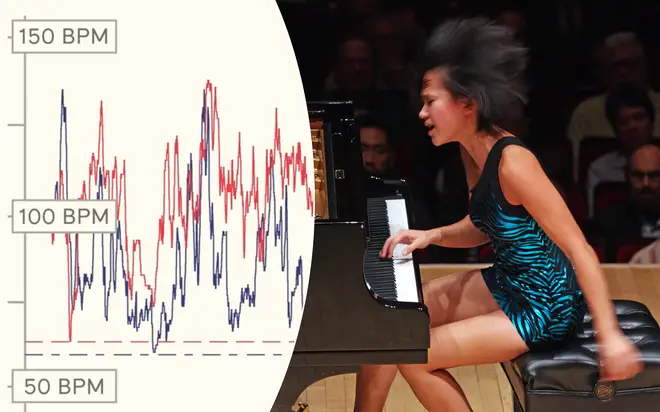
Yuja Wang wore a heart rate monitor in Rachmaninov marathon, with astonishing results
4 April 2024, 17:03 | Updated: 5 April 2024, 15:58 Yuja Wang’s heart rate results revealed, after marathon Rachmaninov performance. Picture...