Saturday, October 5, 2024

Carlos Chavez - his music and his life


Carlos Antonio de Padua Chávez y Ramírez (13 June 1899 – 2 August 1978) was a Mexican composer, conductor, music theorist, educator, journalist, and founder and director of the Mexican Symphonic Orchestra. He was influenced by native Mexican cultures. Of his six symphonies, the second, or Sinfonía india, which uses native Yaqui percussion instruments, is probably the most popular.


Biography

National Conservatory of Music, México City

The seventh child of a criollo family, Chávez was born on Tacuba Avenue in Mexico City, near the suburb of Popotla. His paternal grandfather, José María Chávez Alonso, a former governor of the state of Aguascalientes, had been executed by the French Army in April 1864. His father, Augustín Chávez, who died when Carlos was barely three years old, invented a plough that was produced and used in the United States.

Carlos had his first piano lessons from his brother Manuel, and later on he was taught piano by Asunción Parra, Manuel Ponce, and Pedro Luis Ozagón, and harmony by Juan Fuentes. His family often holidayed in Tlaxcala, Michoacán, Guanajuato, Oaxaca, and other places where the cultural influence of the Mexican indigenous peoples was still very strong.

In 1916, Chávez and friends started a cultural journal, Gladios, and this led to his joining the staff of the Mexico City newspaper El Universal in 1924. In the succeeding 36 years he was to write over 500 items for this paper.

After the Mexican Revolution and the installation of a democratically elected president, Álvaro Obregón, Chávez became one of the first exponents of Mexican nationalist music with ballets on Aztec themes

In September 1922, Chávez married Otilia Ortiz and they went on honeymoon to Europe, from October 1922 until April 1923, spending two weeks in Vienna, five months in Berlin, and eight or ten days in Paris. During the latter visit he met Paul Dukas. Some months later, in December 1923, Chávez visited the United States for the first time, returning in March 1924. Chávez again went to New York City in September 1926 and stayed there until June 1928. Upon his return to Mexico, Chávez became director of the Orquesta Sinfónica Mexicana (Mexican Symphonic Orchestra), later renamed Orquesta Sinfónica de México (Mexico's Symphonic Orchestra); the country's first permanent orchestra, started by a musicians' labor union. Chávez was instrumental in taking the orchestra on tour through Mexico's rural areas.[citation needed]

In December 1928, Chávez was appointed director of Mexico's National Conservatory of Music—a position he held for a total of five years (until March 1933, and again for eight months in 1934). In that capacity, Chávez spearheaded three Spanish: academias de investigación, two concerned with collecting and cataloguing indigenous music and its literature, and the third to study the uses of old and new scales.

In 1937, Chávez published a book, Toward a New Music, which is one of the first books in which a composer speaks about electronic music. In 1938, he conducted a series of concerts with the NBC Symphony Orchestra, during a period of absence by the orchestra's regular conductor, Arturo Toscanini. In 1940 he produced concerts at New York's Museum of Modern Art, and by 1945, Chávez had come to be regarded as the foremost Mexican composer and conductor.

From January 1947 until 1952, Chávez served as director-general of the National Institute of Fine Arts. In his first year, he formed the National Symphony Orchestra, which supplanted the older OSM as Mexico's premier orchestra and led to the disbanding of the older ensemble. Throughout all this time, Chávez maintained a busy international touring schedule.


Chávez's tomb in the Panteón de Dolores, Mexico City

In May 1953 he was commissioned by Lincoln Kirstein, director of the New York City center of Music and Drama, for a three-act opera to a libretto by Chester Kallman based on a story by Boccaccio, to be titled The Tuscan Players. Intended to be finished in August 1954, it was first postponed to April 1955, but only finally completed in 1956, by which time the title had been changed twice, first to Pánfilo and Lauretta, then to El amor propiciado. The City Center waived its rights to the first performance, which was given under the title Panfilo and Lauretta in the Brander Matthews Theatre at Columbia University in New York on 9 May 1957, under the baton of Howard Shanet. Stage direction was by Bill Butler, scenic design by Herbert Senn and Helen Pond, and costumes by Sylvia Wintle. The principal singers were Sylvia Stahlman, Frank Porretta, Craig Timberlake, Mary McMurray, Michael Kermoyan, and Thomas Stewart. The opera would be revised twice more and the title changed again to Los visitantes (The Visitors), for productions in 1968 and 1973, in Mexico City and Aptos, California, respectively. From 1958 to 1959 he was the Charles Eliot Norton professor at Harvard University, and the public lectures he gave there were published as a book, Musical Thought.

From 1970 to 1973, Chávez served as the music director of the Cabrillo Festival of Contemporary Music. His orchestral composition Discovery (1969) had previously been commission by the Festival and was first performed there.[citation needed]

Failing health and financial setbacks forced Chávez to sell his house[when?] in the Lomas de Chapultepec neighborhood of Mexico City and move in with his daughter Anita in Coyoacán, in the fringes of the Mexican capital, where he died quietly on 2 August 1978, his wife having died in April.

Chávez's manuscripts and papers are housed in the Music Division of the New York Public Library for the Performing Arts and in the National Archive of Mexico, in Mexico City.


Musical style

Chávez's music does not fall into clear stylistic periods, but rather cumulates elements in a process of continual synthesis. The juvenilia, up to 1921 and consisting primarily of piano compositions, is essentially Romantic, with Robert Schumann as the main influence. A period of nationalistic leanings was initiated in 1921 with the Aztec-themed ballet El fuego nuevo (The New Fire), followed by a second ballet, Los cuatro soles (The Four Suns), in 1925.

During his time in New York City between 1924 and 1928, Chávez acquired a taste for the then-fashionable abstract and quasi-scientific music, as is reflected in the titles of many of his compositions written between 1923 and 1934: Polígonos for piano (Polygons, 1923), Exágonos for voice and piano (Hexagons, 1924), 36 for piano (1925), Energía for nine instruments (Energy, 1925), Espiral for violin and piano (Spiral, 1934), and an unfinished orchestral score titled Pirámides (Pyramids).

The culmination of this period was the ballet H. P. (i.e., Horse Power), also known by the Spanish title Caballos de vapor (1926–31). H. P. is a colorfully orchestrated score of ample dimensions and dense, compact atmosphere, notable for its dynamism and vitality, revealing the influence of Stravinsky and at the same time returning to folkloric and popular elements, with dances such as the sandunga, tango, huapango, and foxtrot.Such nationalisms would appear through the 1930s, notably in the Second Symphony (the Sinfonía índia of 1935–36, one of the few works by Chávez to quote actual Native-American themes), but only sporadically in later compositions. Diego Rivera designed the sets and costumes for the ballet's premiere in Philadelphia in 1932.

Although this early period saw the creation of the Sonatina for violin and piano (1924), it was only in the 1930s that Chávez returned to another of the main musical interests of his maturity, prefigured in the juvenilia: the traditional genres of the sonata, quartet, symphony, and concerto. He composed six numbered symphonies. The first, titled Sinfonía de Antígona (1933), was reworked from incidental music for Jean Cocteau's Antigone, an adaptation of Sophocles' tragedy. In it, Chávez sought to create an archaic ambiance through the use of modal polyphony, harmonies built on fourths and fifths, and a predominant use of wind instruments.

In the fourth of his Norton lectures of 1958–59, titled "Repetition in Music",[15] he described a mode of composition already observable in many of his compositions since the 1920s, in which "The idea of repetition and variation can be replaced by the notion of constant rebirth, of true derivation: a stream that never comes back to its source; a stream in eternal development, like a spiral ..."[16] A notable early example of this method is Soli I (1933), the first work acknowledged by the composer to have been consciously organized according to this principle. It only became a regular feature, however, beginning with Invención I for piano (1958), and subsequently in most of his instrumental compositions of the 1960s and 1970s: Invención II for string trio (1965), Invención III for harp (1967), Soli II for wind quintet (1961), Soli III for bassoon, trumpet, viola, timpani, and orchestra (1969), Soli IV for brass trio (1966), Cinco Caprichos for piano (1975), and the late orchestral works Resonancias (1964), Elatio (1967), Discovery (1969), Clio (1969), and Initium (1970–72).[17]

Summertime - Teresa Mai


Sinfonía India | Orquesta Sinfónica Nacional de México (Carlos Chávez) HD


Friday, October 4, 2024

On This Day 5 October: Jacques Offenbach Died

by Georg Predota, Interlude

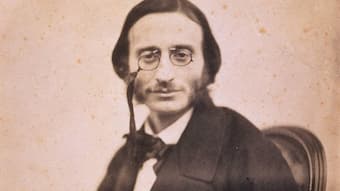
Jacques Offenbach

Jacques Offenbach

Medically speaking, gout is a form of inflammatory arthritis “characterized by recurrent attacks of a red, tender, hot and swollen joint, caused by deposition of monosodium urate monohydrate crystals.” Basically, this means that the patient has persistently elevated levels of uric acid in the blood, resulting from a combination of diet, other health problems, and genetic factors. The ailment was historically known as “the disease of kings” or “rich man’s disease,” and it tended to carry a mild moral stigma, as it “supposedly indicated that the patient habitually over-indulged in good living.” And while the disease is easily treated today, acute attacks of gout were rather common throughout the ages. A 17th-century physician writes, “the sufferer would wake in the night with such exquisite pain, that he could not bear the weight of the bed sheet or the jar of a person walking across the room. Fever, restlessness, dyspepsia, and irritability would follow… The condition of the patient would deteriorate over time, resulting in death from renal failure.” In the case of Jacques Offenbach, who died on 5 October 1880, the cause of death was established as heart failure brought on by acute gout. 

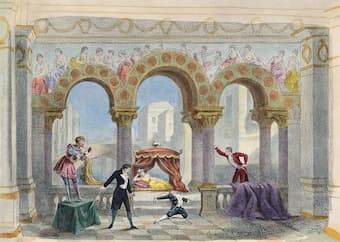
Giulietta act from the 1881 première of Jacques Offenbach's Les contes d'Hoffmann

Giulietta act from the 1881 première of Les contes d’Hoffmann

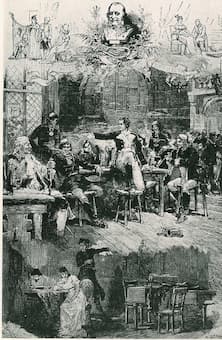
Since Offenbach had a long-standing bad cough, which he tried to cure with frequent trips to various spas, doctors have suggested that he “also had a low-grade tuberculous condition of the lungs.” When Offenbach returned to Paris from a highly successful tour of the United States in 1876, giving a series of more than 40 concerts in New York and Philadelphia, he set to work on the score of the fantastic opera Les contes d’Hoffmann. He had first seen the play, written by Barbier and Michel Carré in 1851, and now an adaptation was handed to Offenbach by Barbier. The composer had a premonition that he would not see the work completed and staged, but he did attend some rehearsals. Already seriously ill, he was brought to the theatre in a wheelchair. Shortly before his death he wrote to a colleague, “Hurry up and stage my opera. I have not much time left, and my only wish is to attend the opening night.” In the event, he died on 5 October 1880, with the manuscript in his hand.

Jacques Offenbach: Les contes d'Hoffmann

Jacques Offenbach: Les contes d’Hoffmann

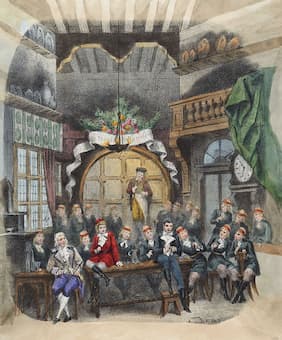
Les contes d’Hoffmann is based on three short stories by E. T. A. Hoffmann, who is also the main protagonist of the story. Set in Germany and Italy in the early 19th century, the Prologue finds the poet Hoffmann in a tavern near the opera house in Nuremberg. He is waiting for the opera singer Stella, who sent him a letter that she will join him after her performance finishes. However, Councilor Lindorf, who also loves Stella, steals the letter. While Hoffmann is waiting, he tells his friend Nicklaussee about his past lost loves.

Olympia act from the 1881 première of Jacques Offenbach's Les contes d'Hoffmann

Olympia act from the 1881 première of Les contes d’Hoffmann

In Act I we meet Olympia, a life-sized mechanical doll. Invented by the mad scientists Spalanzani and Coppelius, they also sell Hoffmann a pair of magic glasses that lets him perceive Olympia as human, and he falls in love with her. One day, Coppelius gets angry and breaks the doll. Act 2 features the sickly singer Antonia, and her father forbids her to sing. Hoffmann falls in love with her, but then Dr. Miracle advises Antonia to sing, causing her death. In Act 3, Hoffmann falls in love with the courtesan Giulietta, and is convinced that she returns his affections. However, Giulietta seduced him under orders from Captain Dapertutto, who promises her a diamond if she steals Hoffmann’s reflection from a mirror. Once she succeeds in getting Hoffmann’s reflection, she immediately abandons the poet. The Epilogue returns us to the tavern in Nuremberg, and a drunk Hoffmann tells Stella to go away. As she departs with Lindorf, Nicklausse reveals that she is the Music reclaiming Hoffmann as a poet. “Everyone learns from love, and learns from tears.”

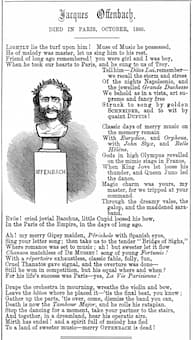
Elegy to Jacques Offenbach in the illustrated English magazine, Punch.

Elegy to Offenbach in the illustrated
English magazine, Punch.

Offenbach died four months before the premiere, after completing substantial portions of the piano score and orchestrating the prologue and first act. Offenbach’s son Auguste, with help from Ernest Guiraud, completed the work, and the premiere took place at the Opéra-Comique on 10 February 1881. That particular completion appears to have been far removed from the composer’s intentions as various manuscripts were subsequently discovered after World War II. These sources include rough drafts, outlines, and fair copies completed in Offenbach’s hand, as well as vocal parts made by his copyists. These discoveries led to the publication of a brand-new edition, and additional discoveries with a newly paired emphasis on authenticity spawned further revisions of the musical text. The musical world was led to believe that the 1992 edition by Michael Kaye, first performed at the L.A. Opera, would be the definitive text. However, additional authentic music was discovered and published in 1999. Finally, in 2011, two competing publishing companies, in France and Germany, respectively, decided to “release a joint edition reflecting and reconciling the research of recent decades.” Only time will tell if this definitive edition of Les contes d’Hoffmann will need to undergo further revisions and changes in the future.

Who Was Mozart’s Real Musical Father?

by Janet Horvath, Interlude

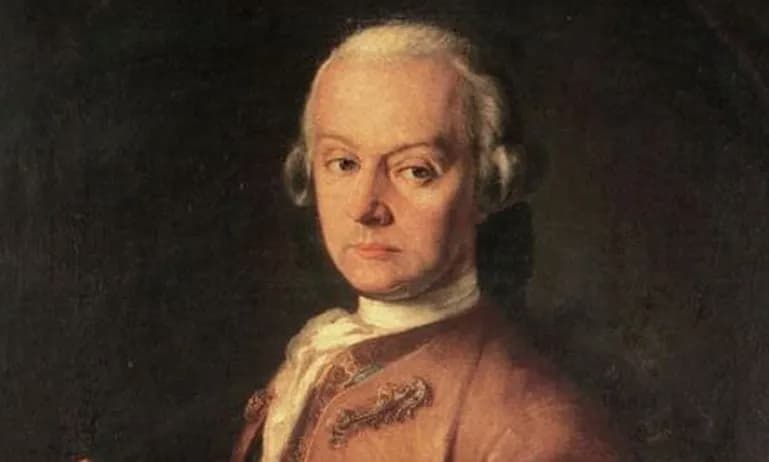
Leopold Mozart

Leopold Mozart © stringsmagazine.com

Wolfgang met many illustrious musicians while traveling in Europe and encountered the music of George Frideric Handel, Johann Sebastian Bach, Joseph Haydn, and Johann Christian Bach. Wolfgang’s friendship and musical kinship with Johann Christian (J.C.) Bach became pivotal.

Both Wolfgang Amadeus Mozart and Johann Christian Bach, were sons of famous musicians. J.C., the youngest son of Johann Sebastian Bach, was born in Leipzig. The elder Bach was by then fifty years old and in 1750, when J.C. was a young teenager, Johann Sebastian passed away. J.C. traveled to Berlin to live with his older brother and to further his studies in composition and on the keyboard with him, the eminent composer Carl Philipp Emanuel Bach. Johann Christian soon developed into an accomplished performer and composer in his own right. He began to travel widely, eventually settling in Italy.

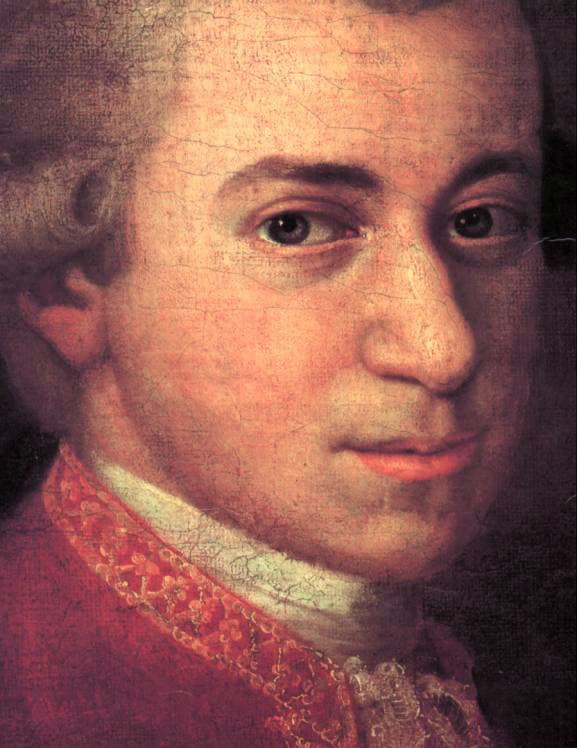
Portrait of Mozart by Johann Nepomuk della Croce

Portrait of Mozart by Johann Nepomuk della Croce

Captivated by the new musical style he heard in the operatic music there—lyrical, charming, and effortless that shied away from the serious counterpoint of baroque music, J.C. began perfecting Stile galant. It was the music of the future, which introduced simple, graceful phrases that highlighted the melody. Johann Christian’s successful first operas were composed in this elegant style.

Appointed to the position of Music Master to Queen Charlotte, he moved to London in 1762. His reputation increased after writing several successful operas. In 1764 “The English Bach” met and mentored the young eight-year-old Wolfgang and the two enjoyed improvising on the harpsichord. Nannerl, Mozart’s sister, wrote in her letters that Bach would sit Mozart in front of him at the keyboard. J.C. played one bar, then Mozart would elaborate on the next bar, ‘and in this way they played a whole sonata, and someone not seeing it would have thought that only one man was playing’.

Mozart’s predilection for wind instruments originates with J.C Bach. The latter thought the winds should be featured; they should carry the melody and not simply double melodic lines. In fact, J.C. Bach’s earliest opera was the first to include clarinets.

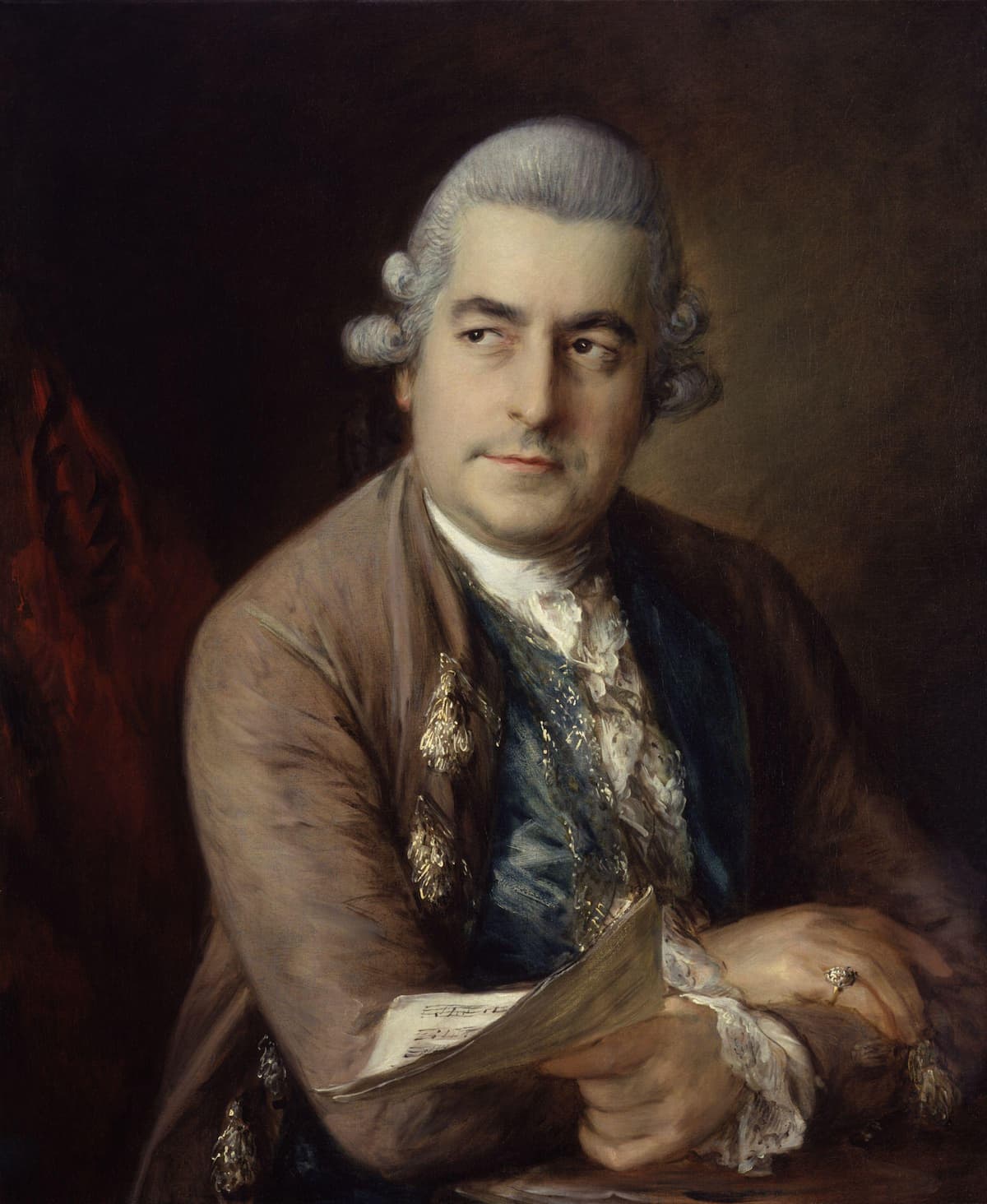
Portrait of Johann Christian Bach (1735-1782) in 1776 by Thomas Gainsborough

Portrait of Johann Christian Bach in 1776 by Thomas Gainsborough ©

Bach’s keyboard style also greatly influenced Mozart. Naturally Mozart and his sister played keyboard duets throughout their childhood, and Mozart’s sparkling and enchanting compositions for piano four hands and for two pianos will always be celebrated. Piano duos or works for piano four hands are performed on one piano and differ from compositions that are written specifically for two pianos. Mozart wrote his Fugue in C minor K. 426, and his Sonatas in D major K. 448 and in C major K. 545 for two pianos, and many other composers from Ravel to Liszt, and Brahms to Rachmaninoff followed suit.

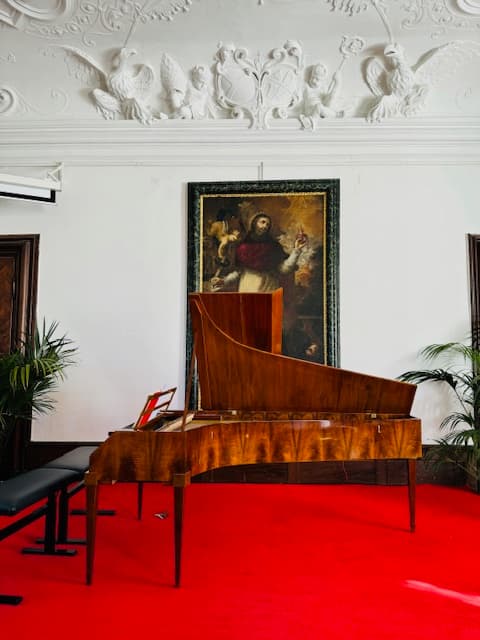
Duo Pleyel concert

At the Duo Pleyel concert

It was enlightening to hear the two composers, Mozart and J.C. Bach, juxtaposed, and to hear Bach’s influence firsthand in a recent concert by Duo Pleyel in Austria at the spectacular 12th century abbey Klosterneuburg, in Augustinus Hall. Pianists Alexandra Nepomnyashchaya and Richard Egarr presented a program entitled “Mozart’s Real Musical Father” that alternated Piano Duets by W. A. Mozart and those by J.C. Bach. They performed on a replica of Chopin’s preferred piano, a Pleyel built in 1848.

The duo opened the concert with the Mozart Sonata for Piano 4 Hands in D Major, K. 381. I think you’ll agree the first movement Allegro could not be more beguiling. Within the movement the interlocking melodies alternate from the major and minor key effortlessly, moving from charm to mystery, and from affecting to poignant.


Stift Klosterneuburg

Stift Klosterneuburg

A delightful duo by Johann Christian Bach followed, the Sonata for Piano Duet in A major Op. 18, No. 5. The duo is only two movements. The allegretto is expressive and lyrical, with the two pianos evenly matched singing through beautiful scale passages and ornaments, certainly an example of Stile galant and the compositional style Mozart would emulate.


Mozart’s Five Variations in G Major for Piano Duet, K. 501 was next on the program. Mozart’s wizardry in this brief work of only 7 minutes, is riveting. He highlights and embellishes the initial enchanting melody first in eight notes, then in triplets in the lower piano line, then in sinuous sixteenth notes in the higher register. It’s followed by a slow and weightier variation in the minor key. More virtuosic flourishes follow before the simple version from the introduction returns towards the end and fades out gracefully. It’s masterful.


acciacatura

Acciacatura

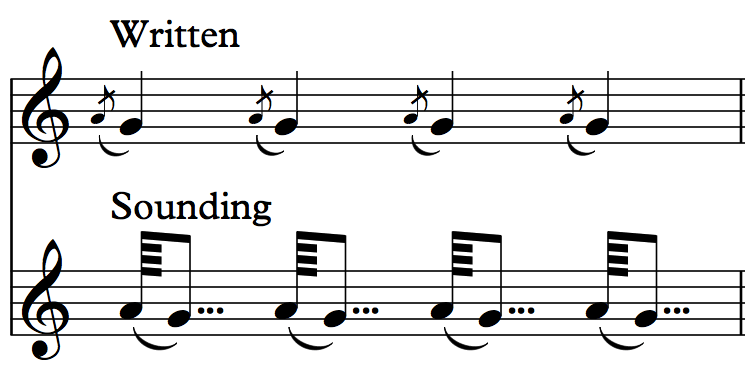
The Sonata for Piano 4 Hands in F Major, K. 497 by Mozart begins with an exquisite Adagio before it embarks on a lighthearted Allegro di molto. What could be more beautiful than this opening? Mozart composes with such brilliant panache. Listen for the acciaccaturas – grace notes played as quicky as possible before the main note with the emphasis on the main note, as if little birds are chirping—as well as the speedy turns—a four-note pattern where the main note is played, then the note above, followed by the main note again, and then the note below, and is notated by a sideways ‘S’ symbol.

J.C. Bach Sonata for Piano Duet in F Op. 18, No. 6 followed, a work of only two movements, an Allegro, and a Rondeau-Allegro, which is an animated movement featuring unison playing and short cadenzas. One can hear many similarities in style that Mozart later adopted and perfected.

The concluding piece on the program, W.A. Mozart Sonata for Piano Duet in B-flat, K 358, begins with a lively and vivacious Allegro that highlights scales and unison passages in each of the two parts.

The third movement, a captivating Molto presto, features long passages of repeated notes, light and quick staccato notes, sparkling ornaments, rhythmic accents on the offbeats, low register bombast, all in merely three minutes. It must be so much fun to play, and lovely to listen to.

To hear these piano duos and to see the parallels between the composers in this most enjoyable program was illuminating, and evidence of the musical kinship between J.C. Bach and W. A. Mozart.

Final concert from the movie - Music of the Heart


Pianist in tears!!!. Most moving piano performance.


Pianist Nobuyuki Tsujii bursts into tears when he plays at Carnegie Hall his own composition "Elegy for the Victims of the Tsunami of March 11, 2011 in Japan".

Featured Post

Yuja Wang wore a heart rate monitor in Rachmaninov marathon, with astonishing results

4 April 2024, 17:03 | Updated: 5 April 2024, 15:58 Yuja Wang’s heart rate results revealed, after marathon Rachmaninov performance.  Picture...