Track List:
00:01 Somewhere In Time
03:03 Old Woman
05:55 Journey Back In Time
10:25 Day Together
16:32 Rhapsody/Paganini
19:24 Is He The One
20:15 Man Of My Dreams
24:21 Return To Present
28:33 Theme (Roger Williams)
by
© Jordan Mixson on Unsplash
Too often it seems that we view learning, studying, practising and performing music as a kind of fight. People talk about “doing battle with Beethoven” or “fighting the fear” (of performing) as if one must take up arms against unseen, powerful forces.
Beethoven: Violin Concerto in D Major, Op. 61 – III. Rondo: Allegro
It’s true that learning new repertoire can be a Herculean task, and practising can feel like a form of captivity, the same page of music confronting one day after day, coupled with the sense that one has hardly moved forward from the previous day’s practising. It is also true that in order to learn any repertoire properly, and deeply, we must spend inordinate amounts of time sweating the small stuff – all the details in the score, the directions and signposts the composer gives us to navigate the keyboard and produce a coherent path of sound to take the listener on a unique journey into the composer’s own inner landscape, while also to enabling us to make our own interpretative choices about how we will perform the music.
There is no alternative to the hard graft of learning new work in depth: working, with pencil and score, cutting through the music to the heart of what it is about. Living with the piece to find out what makes it special, studying style, the contextual background which provides invaluable insights into the way it should be interpreted and performed. The endless striving to find the emotional or spiritual meaning of a work, its subtleties and balance of structure, and how to communicate all of this to an audience as if telling the story for the very first time.
Studying, practising performing and ultimately sharing music, the musician’s “work”, should not feel like a battle or a mountain summit that must be conquered. I know many musicians, professional and amateur, who have personal strategies to prevent this sense of struggle. Spending time with the score away from the instrument can be particularly helpful, familiarising the shape and architecture of the music on the page, and imagining the sound in one’s head, without the added distraction of the geography of the piano keyboard, for example. For very complex music, I like to leave the score, or copies of the score, around the house – on the dining table, by my bedside, so that I see the score regularly, often many times during the day. When I come to place it on the music desk, it already feels comfortable, even if I have yet to touch the piano’s keys.
Practising is an act of doing, creating, living with the music. It defines who we are as musicians and gives us a reason for being. A positive, open minded approach to practising can remove the feelings of toil and travail. Making friends with the music brings joy, pleasure and excitement to practising. We should live and breathe our work, beginning every practise session with the question “What can I do that’s different today?”.
This excitement and affection for our music is very palpable when we perform – audiences sense and appreciate it – and it brings the notes to life with vivid colour and imagination.
by
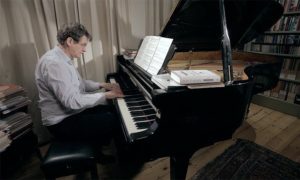
Alan Rusbridger
The adult ‘returner’ pianist
I’m a returner pianist – and maybe, if you’re reading this article, you are too and therefore what follows will resonate with you. Or perhaps you are thinking of taking up the piano again after a long absence (as I did), in which case you should definitely read on…..
I played at a piano club recently and during the coffee break someone asked me if I was “a professional pianist”. This gave me a momentary glow of pride and ego – evidently I had played well and “made an impression” – and I know that many amateurs dream of reaching the dizzy heights of ‘professional standard’ in their playing. It’s one of the things that keeps us motivated to practice; alone with that box of wood and wires we dream of playing to a full house at the Wigmore or Carnegie Hall.
So I replied that no, I was an amateur pianist, an adult ‘returner’ and that I had given up the piano at the age of nineteen when I left home to go to university, returning to it just shy of my fortieth birthday with an all-consuming passion for the instrument, those who play it and its vast and varied literature.
When you tell people you’ve taken up the piano again they always ask, “Are you any good?” And I never know quite what to say. Some days when my spirit and fingers are in sympathy with each other, I think I make a reasonable sound. On other days, spirit and fingers aren’t on speaking terms and the result is fumbling, dismal, depressing.
– Alan Rusbridger, journalist and amateur pianist
The world of the adult amateur pianist is a curious one – at once rich, vibrant and varied, but also obsessive, anxious and eccentric and when I put out a call for contributions to this article, I was deluged with responses as varied, fascinating and moving as the literature of the instrument we play. What follows are just a few of the responses, but what they demonstrate is that, while there are some obvious common threads, the reasons for returning to and playing the piano are often deeply personal and hugely meaningful, and that a passion for the piano is all-consuming. Never forget that the word “amateur” derives from the Old French word meaning “lover of” from the Latin amator: all the amateur pianists I meet and know play the piano because they love it and care passionately about it. Love drives commitment to the instrument – amateur pianists are possibly the most dedicated practicers – and many amateurs are absorbed by a compelling need to get better, to progress, to master. It’s a lonely road to travel, but those who commit to the journey do so willingly, and it’s an ongoing process, one which can provide immense satisfaction, stimulation and surprising creativity.
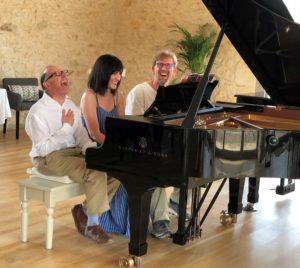
Amateur pianists at La Balie piano summer course
That is not to say that professional pianists don’t love the piano too – of course they do, otherwise they wouldn’t do it, but a number of concert pianists whom I’ve interviewed and know personally have expressed a certain frustration at the demands of the profession – producing programmes to order, the travelling, the expectations of audiences, promoters, agents etc, which can obscure the love for the piano. Because of this, professionals are often quite envious of the freedom amateur pianists have to indulge their passion, to play whatever repertoire they choose and to play purely for pleasure.
Now, back to those inspiring adult returners…..
My primary reason for returning was that both my parents had lived the last ten or twelve years of their lives with advancing dementia, as well as some second degree relatives. I thought the best way to really work my brain was to go back to playing music. The secondary reason was to help relieve stress which was something my piano teacher had told me I would need at some point in my life……For me, having started to suffer the lacunar strokes in my family history which have a type of dementia related to them, I keep hold on the fact that the part of the brain that works with music is usually the last to fail. I still feel that playing the piano is probably one of the best avenues to take to keep working the brain. Apart from that I simply love playing again.
– Eleanor
It was the death of an uncle which prompted me to return to the piano. He was very musical, and after he died my other uncle asked me whether I would like his piano, a rather fine Steinway grand which had been in the family for ages. However, grand pianos are somewhat incompatible with the three bedroom semi in which I live, but it did remind me how much I’d enjoyed the piano. I was lucky enough to be left some money in his will, and with that I bought a Yamaha upright with silent system fitted. I wanted a proper acoustic, but I have young children so a silent system means I can practice at night after they are in bed. I have lessons once a fortnight and they are completely indispensable for my enjoyment.
– Sarah
I studied music at university and did two years of a performance major but struggled with various chronic injuries and dropped out as a result (I had two operations and had seen many medical specialists in attempt to resolve these problems). I then “sold my soul” to capitalism and started a business, following which I continued along a corporate career. I had always dreamed of getting back into playing but my schedule was punishing and not at all conducive to playing. I started to play again and unfortunately ended up with RSI (tennis elbow) which swiftly ended my return to playing. Then a few years later I managed to extricate myself from the corporate world and…..I managed to start playing again and although I had some niggles from the RSI, was able to play around 0.5 – 1 hrs a few days a week. I also started going for lessons with [a teacher who] focussed very much on reducing tension…..and I realised how much of my injuries came down to poor technique and tension. I wish a greater emphasis had been placed on this when I was a music student because while [my teacher] helped me find a much more natural, comfortable way to play, it was already too late and my RSI flared up again to the point where a few minutes of playing would leave me in agony for days. It was devastating after so long of trying to be in a position to have the time to play that I wasn’t able to. A few years later (whilst consistently seeing medical specialists and trying various approaches) I managed to have a breakthrough in which I was able to slowly start playing again, a few minutes every second day and was able to gradually build up. This was a useful exercise in that I had to be more focussed on practising effectively given the limited time available. Despite being told by numerous doctors that I wouldn’t play again, I’m now able to play for up to an hour on some days. This has been sufficient to learn some new repertoire and to perform in some amateur meet-up groups which has really been a wonderful experience. In fact, once I was able to let go of the inner critic (as a former music student, the inner critic remains highly developed even though one’s technical ability wanes without practice!), I couldn’t believe how much I enjoyed playing. It would have never have occurred to me all those years ago when I dropped out of university that I’d be able to derive so much enjoyment out of playing as an amateur.
– Ryan
I originally started piano lessons aged 13, of my own volition; I’d had one of those 80s electronic keyboards that were all the rage back then, and wanted to progress to something more substantial. My progress was very slow, however, and ultimately not very fulfilling. I managed to pass my Grade 1 but found the exam experience stressful. I think a lot of it had to do with the prescriptive way children are typically taught: everything was just scales, sight reading and set pieces that weren’t especially fun or engaging to play. Nearly twenty years later, I was in a piano bar on holiday, and the pianist was playing modern music set to piano. It was beautiful, and I felt a sense of regret that I had abandoned such a beautiful instrument. On returning home, I did a spot of research and found that digital pianos had come on a long way in the intervening years and were now touch-sensitive with weighted keys and even a sustain pedal. I took the plunge, ordered a decent model (the Yamaha P115) and signed up for lessons with a local teacher. It’s been a wonderful decision, and I have fallen in love with playing. It’s still small steps, but I practice regularly and have actively witnessed improvement in my own playing.
– Colin
I discovered classical music as a teen (Bach) and started taking lessons. I wanted to be a composer, and eventually became a composition major at a local university. Having started late, and not having received family support and good advice from those who did support me, I let my insecurities defeat me, and I ended up getting a degree in English. Decades later, we inherited a spinet from a relative, and I found my passion once again. I finally have a good teacher, and am making progress toward being the pianist I wanted to be.
– Bob
My piano journey has been relatively straightforward compared to some of the accounts of other adult returner pianists, but we are all on our own personal path, some of us supported by teachers, others choosing to “go it alone”, but all driven by a common, consuming passion for the piano.
by Georg Predota
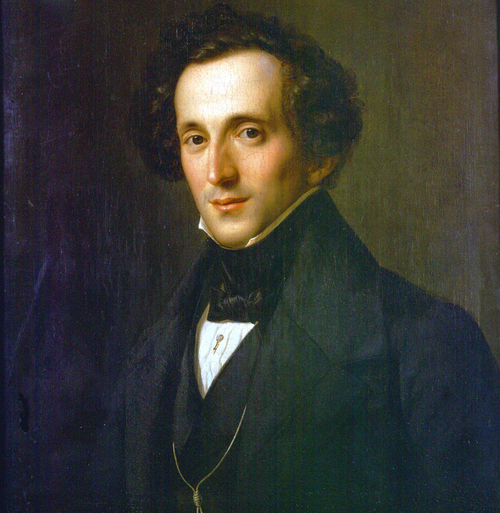
Felix Mendelssohn
When Felix Mendelssohn (1809-1847) died at the incredibly young age of thirty-eight, he simply had not yet made arrangements for literally hundreds of unpublished musical manuscripts and artworks, alongside thousands of personal letters to and from the composer. During his lifetime, and for a short period thereafter — with a large number of music published during a period of two years following his death — Mendelssohn was almost universally lauded musical genius. What is more, Mendelssohn was also the artistic director and chief conductor of The Gewandhaus (Garment House) in Leipzig, a venue that has long been recognized as one of the most important performing centers in Europe. Under his tutelage and leadership, the Gewandhaus Orchestra became a cultural institution. Mendelssohn not only initiated the revival of music by Bach, Handel, Haydn and Mozart, he also assured that his brand of musical historicism was disseminated throughout Europe and beyond. With the help of Richard Wagner who declared “Judaism the evil conscience of our modern civilization” in his 1850 treatise Judaism in Music, Mendelssohn and his music were quickly subjected to deliberate and systematic forms of historical revisions. And when Wagner declared Mendelssohn’s music “an icon of degenerate decadence,” publishers far and wide declined to make his manuscripts and letters public.
Of course, Wagner was not able to completely erase or dismiss Mendelssohn’s influence on Germanic arts, nor was he able to excise him from music-historical memory. This, of course, led to serious irritation within the propaganda machinery of Nazi Germany, and his name was promptly added to various lists of forbidden artists. At that time, according to Stephen Somary, founder and artistic director of the Mendelssohn Project, “a majority of Mendelssohn manuscripts — both published and unpublished — were housed in the basement of the Berlin State Library. They were smuggled to Warsaw and Krakow during the winter of 1936/37, and when the city fell under Nazi control in 1939, they were hurriedly smuggled out again and disbursed to locations wide and far between.” Following WWII, the majority of manuscripts remained buried behind the Iron Curtain. Haltingly, various unknown versions and unknown compositions were discovered and made available in one form or another.
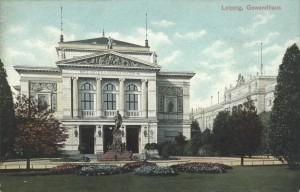
The Gewandhaus
Initially, these efforts focused on works Mendelssohn composed before his 14th birthday, pieces that had originally been presented at private concerts at the Mendelssohn home. Among them various sonatas for viola and for violin, religious choral music, numerous piano compositions and even a fourth opera. But it also included a succession of concertos, among them a concerto for piano and string orchestra in A minor (1822) and two concertos for two pianos and full orchestra in E and A-flat, originating from 1823 and 1824, respectively.
The concerto for violin, piano and string orchestra in D minor was composed for an initial private performance with his best friend and violin teacher Eduard Rietz. On 3 July 1822, Mendelssohn revised the scoring, adding timpani and winds and the premiere of this version was apparently performed on the same day. For reasons detailed above, it remained unpublished until 1960, when the Astoria Verlag in Berlin issued a miniature score, edited and arranged by Clemens Schmalstich. In 1966, Theodora Schuster-Lott and Frieder Zschoch prepared a scholarly edition for the Deutsche Verlag für Music as part of the new Mendelssohn complete edition, “which was engraved, but never published except in a reduction by Walter-Heinz Bernstein for violin and two pianos.” Finally, in 1999 the 1960 miniature score was reissued in a scholarly edition with the wind and timpani parts added. And just in case you are wondering, the A-minor Piano Concerto of 1822 had until recently been unavailable in any edition, and the Concerto for two pianos and orchestra in E major, composed as a birthday gift for his sister Fanny, had to wait until 2003 before audiences could get a listen to the original version.
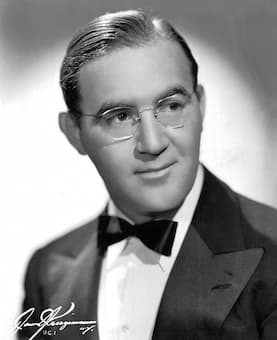
Benny Goodman, 1942
After having made his name in jazz, clarinetist Benny Goodman set out to make his name in classical music, feeling that he was likely to leave a longer impression in classical music than in jazz. To fill that need, he started commissioning works, with the net result being a body of modern music for clarinet that is unmatched.
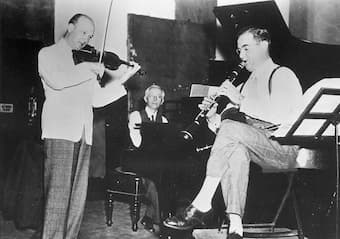
Szigeti, Bartók and Goodman in rehearsal
His first commission was undertaken to help a music who was having financial problems. In 1938, at the instigation of the violinist Jozsef Szigeti, Benny Goodman commissioned Béla Bartók for a double concerto for clarinet and violin. Bartók, Szigeti, and Goodman made their premiere at Carnegie Hall in January 1939 with a work entitled Rhapsodies for Clarinet and Violin: Verbunkos and Sebes. The trio recorded the work in 1940 after Bartók had written a new middle movement. It had a new title: Contrasts, based on Bartók’s feeling that the trio did not employ instruments that had sonorities that would easily blend. Through the work, the violin and clarinet trade fragments of melodies, with one instrument supplying a rhapsodic accompaniment to the other.
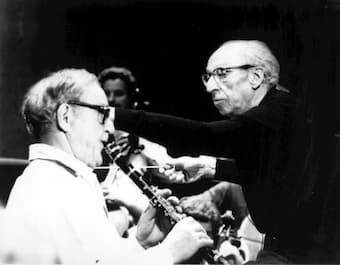
Aaron Copland conducting the Los Angeles Philharmonic,
with Benny Goodman (by David Weiss)
With that start, Goodman continued to meet composers and commission works. Sometimes it worked and sometimes it didn’t: his commission of a clarinet concerto from Benjamin Britten in 1942. Only the first movement was completed and it was filled out and orchestrated much later by Colin Matthews, being published under the title of Movements for a Clarinet Concerto only in 2008. The composer Ingolf Dahl started a double concerto for Goodman and seems to have nearly completed it, but the work has vanished. A concerto was commissioned from William Walton but nothing is known about it.
Lost works aside, the works that do survive include clarinet concertos by Milhaud (1941), Hindemith (1947), Copland (1947-48), and Malcolm Arnold (1974), a sonata for clarinet and piano by Francis Poulenc (1962), and titled works including Revue for Clarinet and Orchestra by Alex North (1946) and Derivations by Morton Gould (1955).
Prelude, Fugue, and Riffs by Leonard Bernstein (1949) had been written for the band leader Woody Herman but he was between bands at the time and Goodman played the premiere, gradually being identified with the work.
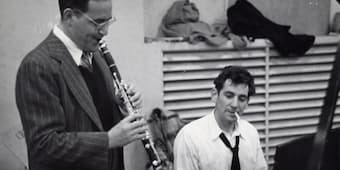
Bernstein and Goodman in rehearsal, 1951
Composers were faced with a quandary in their writing – do they do something that’s purely classical or do they consider including anything from Goodman’s jazz side in their writing? For Morton Gould in Derivations for Clarinet and Band, the jazz side pulled strongly, resulting in a final movement that, as the composer says, is ‘…meant to go like a shot. Its accumulating barrage of jazz-oriented ostinatos and motifs attempts to give the drive and feel of jazz improvisation.’
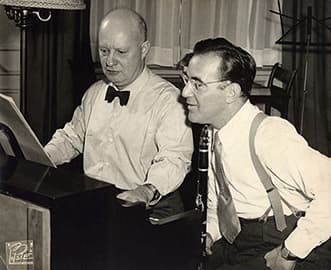
Paul Hindemith and Benny Goodman, ca. 1947
The fact that he commissioned a work did not guarantee that he would play it. He pushed Darius Milhaud for a clarinet concerto and exclusive performing rights for 3 years, but in the end never performed or recorded the work. It was given its first performance in 1946 by clarinetist Richard Joiner with the Marine Band at the Marine barracks in Washington, D.C.
Hindemith and Goodman started meeting in 1941 but because of the war, Goodman suspended all activities, including commissioning German composers until much later. It wasn’t until 1947 that the commission discussions were renewed. The first performance didn’t go well and Goodman didn’t play the work again until 1955, where critics said they would have liked the work better if Goodman had been free to improvise that than tie himself to the work. In the end, however, perception of the work has changed to recognize its value.
Of all the work that Goodman commissioned, three works stand out: Bartók’s Contrasts, Copland’s Concerto, and Hindemith’s Concerto. All are significant contributions to the clarinet literature and to the music of the 20th century.


