Wednesday, August 6, 2014

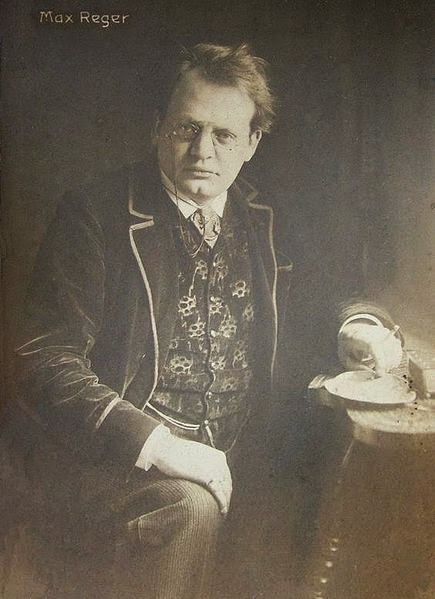
Max Reger - His Music and His Life

The German Max Reger was born in Brand, Fichtelgebirge on March 19, 1873.

Reger experienced an incredible career up to becoming Court Conducter in Meiningen/Germany. The daily contact with a proficient orchestra trained Reger's sense, mind and meaning for colorful instrumentation.

As piano virtuoso, Reger sent his listeners into raptures because of a wonderful fine and delicate finger touch. 

In my opinion Reger is the most unterrated piano composer ever. "Varations and Fugue on a theme by Bach" is probably his most famous piano work. "Thinking in fugues" - that's why his organ compositions belong to German music treasures. But also his chamber music repertory remained as unsurpassable rich. Even being a devote Catholic, Reger enriched also other creeds with varied church and organ music works.

Max Reger's lifestyle has been described as "full of deeply moral earnestness". He passed away in Leipzig on May 11, 1916.

Henry Purcell - His Music and His Life

The British Henry Purcell was born 1659 in London. He became a Westminster Abbey organist, joined the Royal Orchestra and started as Royal Court Composer in 1683.

Purcell's compositions showed "early English classic music's apex". He composed more then 50 drama plays - among them were Shakespeare's "Richard II", "Storm" or "A midnight's summer dream".

The opera "Dido and Aeneas" (1689) was a simple casual job for a girls boarding school but became a real "great opera" with an overture in French style, a prologue and three acts. "Dido and Aeneas" was his summit and also the end of the so-called Early English Opera.

His "King Arthur" (written in 1691) and "Fairy Queen" (written one year later) premiered only 1964 (!) in Germany.

Purcell's composition work contains welcome songs, anthems, suites for strings and much more. Purcell passed away in London on November 21, 1695.

Monday, July 28, 2014

The Best Conductor Insults

Conductor insults

Arturo Toscanini

(C) ClassicFM 2014

Sunday, July 27, 2014

Siegfried Ochs - His Music and His Life

The German Siegfried Ochs was born in Frankfurt/Main on April 19, 1858. He initially studied chemistry but later switched to music.

In 1882, Siegfried Ochs formed the Philharmonic Choir Berlin, which is still existing until today. Ochs especially supported choral works of Johannes Brahms.

In 1894, Ochs organized a concert contending of compositions by Anton Bruckner and Hugo Wolf. Both composers attended this event personally.

Literary works such as "Der deutsche Gesangverein" (1923, The German Choral Society") - or "Geschehenes - Gesehenes" (1922, Events and Insights) are also very remarkable. Ochs' humoristic compositions can be listened on air very seldom unfortunately.

Siegfried Ochs passed away in Berlin on February 6, 1929.

Saturday, July 19, 2014

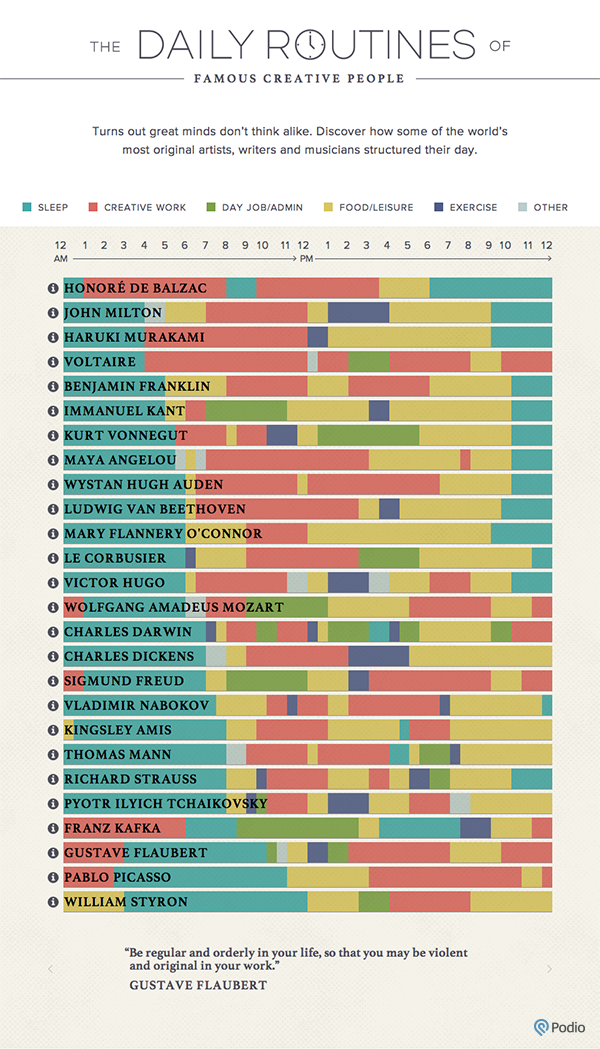
What were the daily routines of the great composers?

Night owls or early birds - how did Mozart, Tchaikovsky and Richard Strauss structure their day? Their habits in composing, breakfast, socialising and exercise are plotted against those of other great minds in this look at the daily routines of famous creative people. 

In this infographic, the website podio.com has condensed the daily routines of some of history's great creative minds. The hourly habits of Darwin, Freud, Voltaire, Beethoven and others are broken down and plotted against each other in the ultimate diary of genius. 

Beethoven shows how he can power through a long morning's composition on some strong coffee. It's clear that Mozart's compositional muse often visited late at night, after he had been out drinking wine with friends. 


Richard Strauss had a tightly scheduled and disciplined day. No composer listed here comes close to the disciplined early-riser novelist and playwright Honoré de Balzac, who set his alarm clock for 1am. A big fan of Nick Bailey's show, possibly. 
Click on the image for a closer, interactive view...
Want to develop a better work routine? Discover how some of the world's greatest minds organized their days.
Click image to see the interactive version (via Podio).

Discover Music


(C) ClassicFM, London 2014

Friday, July 11, 2014

Arthur Nikisch - His Music and His Life

Arthur Nikisch was born in Lebeng Szent Miklos/Hungary on October 12, 1855 and became a violine student of Joseph Hellmesberger (1828-1893) at the Viennese Conservatory. For his compositions, Nikisch received several outstanding rewards. He was a real sound magnician without philosophical or rather aesthetical resources.

Through an incredible tone color and sonority, Nikisch reached a unique musical experience. Together with his wife Amelie, his compositions such as "My Aunt, Your Aunt" (1911) or "Daniel in the Lion's Hollow" (1914) remained popular until today.

Nikisch's son Mitja (1899-1936) became a very blessed pianist.

Nikisch passed away in Leipzig/Germany on January 23, 1922.

Friday, July 4, 2014

The Ten Worst Things About Playing the Cello

Cellists, we feel your pain. But not enough to help when you're stuck in the ticket barriers at the station. Here are the worst things about being you... 

Pachelbel canon score

1. Even the case is a joke

"No, there's not a bomb in there. No it's not a guitar. Yes, I do wish I'd taken up the flute."

mad


2. Pachelbel has it in for you

Doesn't matter how many grade exams you've passed, these eight little notes played over and over again are the only ones you'll need. Better start tuning those low F sharps now.

Pachelbel's canon is every song


3. Transport

Does it fit in your Fiat Punto? Of course it doesn't. And good luck trying to get it through the ticket barriers on the train. Not to worry, there's bound to be a way to get such a dainty instrument from A to B...

http://hugelolcdn.com/i/253953.gif
(via reddit)

4. Did we mention, transport?

Don't even get us started on trying to bring the thing on a plane. Yes, you will have to buy a seat for it. No, you can't claim extra gin 'for your cello'.

cello on plane


5. Your instrument will almost certainly maim you

If wasn't hard enough trying to fly with the enormous chunk of carved wood, try explaining the lethal 9-inch metal spike you're forced to carry around at all times. Which, incidentally, will ruin all your laminate flooring, make millions of tiny holes in your carpets, and slip on every conceivable concert stage. Good luck with that.
http://37.media.tumblr.com/tumblr_m6nsbzoMJI1rv4c4zo1_400.gif
(via Encyclopaedia Dramatica)


6. Concert dress

You can be as careful as you like, but you'll somehow always manage to smear sticky white rosin all over your miniskirt shorts regulation black concert trousers. There's only one way round it:

bad stock photos


7. Thumb position

Take up the cello, they said. It doesn't sound scratchy like a violin, they said. Until, of course, you get really good and you have to start playing actual notes with your THUMBS.

cello thumb position


(via Sandygocellolessons)

8. That bit in the Fauré Elegie

Congratulations! You've graduated from Pachelbel's Canon and you're finally a fully-fledged cello-playing genius. Now prepare yourself for humiliation and defeat as you fall off the fingerboard during recitals.

http://www.gurl.com/wp-content/uploads/2014/03/lindsay-facepalm.gif
(via mrwgifs)


9. String injuries

It's pretty much 100% guaranteed that your C string WILL snap in your face/lacerate your arms/take your eye out while you're sitting on stage in front of everyone. Just be thankful you don't play the double bass.

http://cdn.instructables.com/FDN/TXHF/GBBH8Q1H/FDNTXHFGBBH8Q1H.MEDIUM.jpg
(via Instructables)


10. This guy

Why CHELLO THERE!

Cello geek


(With ClassicFM London).


Featured Post

The Most Overtly Erotic Works in Classical Music

  by  Emily E. Hogstad    May 28th, 2026 Western classical music is often thought of as cerebral or abstract, but throughout its history, co...