Total Pageviews

Showing posts with label Klassische Musik. Show all posts

Wednesday, January 1, 2014

Pastorale d'ete by Arthur Honegger - His Music and His Life


The French Arhur Honegger has been born in Le Havre on March 10, 1892 as a son of Swiss parents. He studied with Andre Gedalge (1856-1926) and Charles-Marie Widor (1845-1937).

Honegger's compostion works couldn't be dictated by conglomeration-tendencies. Honegger remainded incredible and unique, catholic-mysterious and as a great composer of mythical stories, adapted in "King David" (1921), "Johanna - burned of the shike" (1938, German version premiered 1947) or the dramatic psalm, also entitled "King David" (1941).

The Biblical drama "Judith"(1925) or "Oedipus Rex" (1926) became real composition challenges because of Igor Stravinsky.

Honegger's fifth symphony entitled "Di Tre Tre" is already incredible, because of all movements and an ending with a drumbeat.

Arthur Honegger passed away in Paris on November 27, 1955.

Monday, December 30, 2013

Happy New Year 2014 - Frohes Neues Jahr 2014


HAPPY NEW YEAR 2014 AND THANKS TO ALL FOR STAYING TUNE ON THIS BLOG!

FROHES NEUES JAHR 2014 UND HERZLICHEN DANK AN ALLE LESERINNEN UND LESER DIESES BLOGS!

Tuesday, December 3, 2013

Franz Schubert - His Music and His Life


Born on January 31, 1797, in Himmelpfortgrund, Austria, Franz Peter Schubert, the son of a schoolmaster, received a thorough musical education and won a scholarship to boarding school. Although he was never rich, the composer's work gained recognition and popularity, noted for bridging classical and romantic composition. He died in 1828 in Vienna, Austria.
 
Quotes

"A mind that is too easy hides a heart that is too heavy."
– Franz Schubert

Early Life

Born on January 31, 1797, in Himmelpfortgrund, Austria, Franz Peter Schubert demonstrated an early gift for music. As a child, his talents included an ability to play the piano, violin and organ. He was also an excellent singer.

Franz was the fourth surviving son of Franz Theodor Schubert, a schoolmaster, and his wife, Elisabeth, a homemaker. His family cultivated Schubert's love of music. His father and older brother, Ignaz, both instructed Schubert early in his musical life.

Eventually, Schubert enrolled at the Stadtkonvikt, which trained young vocalists so they could one day sing at the chapel of the Imperial Court, and in 1808 he earned a scholarship that awarded him a spot in the court's chapel choir. His educators at the Stadtkonvikt included Wenzel Ruzicka, the imperial court organist, and, later, the esteemed composer Antonio Salieri, who lauded Schubert as a musical genius. 

Schubert played the violin in the students' orchestra, was quickly promoted to leader, and conducted in Ruzicka's absence. He also attended choir practice and, with his fellow pupils, practiced chamber music and piano playing.

In 1812, however, Schubert's voice broke, forcing him to leave the college, though he did continue his instruction with Antonio Salieri for three more years. In 1814, under pressure from his family, Schubert enrolled at a teacher's training college in Vienna and took a job as an assistant at his father's school.

Young Composer

Schubert worked as a schoolmaster for the next four years. But he also continued to compose music. In fact, between 1813 and 1815, Schubert proved to be a prolific songwriter. By 1814, the young composer had written a number of piano pieces, and had produced string quartets, a symphony, and a three-act opera.

Over the next year, his output included two additional symphonies and two of his first Lieds, "Gretchen am Spinnrade" and "Erlkönig." Schubert is, in fact, largely credited with creating the German Lied. Boosted by a wealth of late 18th-century lyric poetry and the development of the piano, Schubert tapped the poetry of giants like Johann Wolfgang von Goethe, showing the world the possibility of representing their works in musical form.

In 1818, Schubert, who had not only found a welcome audience for his music but had grown tired of teaching, left education to pursue music full-time. His decision was sparked in part by the first public performance of one of his works, the "Italian Overture in C Major," on March 1, 1818, in Vienna.

The decision to leave school teaching seems to have ushered in a new wave of creativity in the young composer. That summer he completed a string of material, including piano duets "Variations on a French Song in E minor" and the "Sonata in B Flat Major," as well as several dances and songs.


Franz Schubert is considered the last of the classical composers and one of the first romantic ones. Schubert's music is notable for its melody and harmony.

Composer Franz Schubert received a thorough musical education and won a scholarship to boarding school. Although he was never rich, the composer's work gained recognition and popularity, noted for bridging classical and romantic composition. He died in 1828 in Vienna, Austria.

 Franz Peter Schubert demonstrated an early gift for music. As a child, his talents included an ability to play the piano, violin and organ. He was also an excellent singer.

Franz was the fourth surviving son of Franz Theodor Schubert, a schoolmaster, and his wife, Elisabeth, a homemaker. His family cultivated Schubert's love of music. His father and older brother, Ignaz, both instructed Schubert early in his musical life.

Eventually, Schubert enrolled at the Stadtkonvikt, which trained young vocalists so they could one day sing at the chapel of the Imperial Court, and in 1808 he earned a scholarship that awarded him a spot in the court's chapel choir. His educators at the Stadtkonvikt included Wenzel Ruzicka, the imperial court organist, and, later, the esteemed composer Antonio Salieri, who lauded Schubert as a musical genius. Schubert played the violin in the students' orchestra, was quickly promoted to leader, and conducted in Ruzicka's absence. He also attended choir practice and, with his fellow pupils, practiced chamber music and piano playing.


In 1812, however, Schubert's voice broke, forcing him to leave the college, though he did continue his instruction with Antonio Salieri for three more years. In 1814, under pressure from his family, Schubert enrolled at a teacher's training college in Vienna and took a job as an assistant at his father's school.


Schubert worked as a schoolmaster for the next four years. But he also continued to compose music. In fact, between 1813 and 1815, Schubert proved to be a prolific songwriter. By 1814, the young composer had written a number of piano pieces, and had produced string quartets, a symphony, and a three-act opera.


Saturday, November 23, 2013

Paul Hindemith: Trauermusik (1936) - His Music and His Life


The German Paul Hindemith was born in Hanau nearby Frankfurt/Main on November 16, 1895 and studied with Arnold Mendelsohn (1855-1933) and Bernhard Sekles (1872-1934).

Hindemith became the first important composer coming from a string instrument since Ludwig Spohr (1784-1859). In 1915, Hindemith became concert master at the Frankfurt Opera.

Since 1922, Paul Hindemith started his incredible career as the founder of the New German Classical Music. His operas "Murders - Women Hope" (1921) and "Sancta Susanna" (also 1921) have been witnesses of Hindemith's assault on classical music. The radicalizing "Piano Suite 1922" has been denied categorically. Hindemith's compositions have been remained as a matter of taste. His book "A Composer's World - Horizons and Limitations", published in 1952, seems like a stylish report or even justification.

Paul Hindemith passed away on December 28, 1963 in Frankfurt/Main. 


Saturday, November 16, 2013

Karl Amadeus Hartmann- His Music and His Life


The German Karl Amadeus Hartmann was born in Munich on August 2, 1905 and came from a Silesian painter family. Hartmann studied with Hermann Scherchen (1891-1969) and Anton von Webern (1883-1945).

Hartmann is a figure unique in German music - the only composer to stay put and defy Adolf Hitler for the duration of the Third Reich.

"Unending was the stream, unedning the misery', unending the sorrow, "wrote Hartmann at the head of a fresh sheet of paper, on which, over the following tense days, he composed a piano sonata titled "27th April 1945"; its opening rhythm dictated by the shuffling feet of the final victims of Nazi tyranny.

Hartmann's First Symphony (1940) "composed in spirit and adoration to Zoltan Kodaly" came into being from a symphonic fragment with the lyric of the North American poet Walt Whitman (1819-1892).

The "Concerto Funebre" (funebre=funeral) for solo violin strings was composed during the first four days of World War II in 1939. Hartmann's Fourth Symphony required only the celli and basses.

His Seventh Symphony became one of the Highlights during the 34th World Music Festival 1960 in Cologne/Germany.

Hartmann's last composition has been the "Chant Scene" for baritone and orchestra with words from "Sodom and Gomorrah" by Jean Giraudoux, the French poet, who lived from 1882-1944.

Karl-Amadeus Hartmann, who impressed through musical picture imagination and colors, passed away on December 5, 1963, also in Munich.


Karl Amadeus Hartmann, Concerto Funebre

Sunday, October 27, 2013

Karl Goldmark - His Music and His Life


Karl Goldmark, also known originally as Károly Goldmark and later sometimes as Carl Goldmark ; May 18, 1830, Keszthely – January 2, 1915, Vienna) was a Hungarian composer.

Life and career


Goldmark came from a large Ashkenazi Jews|Jewish family, one of 20 children. His father, Ruben Goldmark, was a chazan to the Jewish congregation at Keszthely, Hungary. Karl Goldmark's older brother Joseph Goldmark became a physician and was later involved in the Revolutions of 1848 in the Austrian Empire|Revolution of 1848, and forced to emigrate to the United States. Karl Goldmark's early training as a violinist was at the musical academy of Sopron (1842–44). He continued his music studies there and two years later was sent by his father to Vienna, where he was able to study for some eighteen months with Leopold Jansa before his money ran out. He prepared himself for entry first to the Vienna Technische Hochschule and then to the University of Music and Performing Arts, Vienna|Vienna Conservatory to study the violin with Joseph Böhm and harmony with Gottfried Preyer. The Revolutions of 1848|Revolution of 1848 forced the Conservatory to close down. He was largely self-taught as a composer. He supported himself in Vienna playing the violin in theatre orchestras, at the Carlstheater and the privately supported Viennese institution, the Theater in der Josefstadt, which gave him practical experience with orchestration, an art he more than mastered. He also gave lessons: Jean Sibelius studied with him briefly. Goldmark's first concert in Vienna (1858) met with hostility, and he returned to Budapest, returning to Vienna in 1860.

To make ends meet, Goldmark also pursued a side career as a music journalist. "His writing is distinctive for his even-handed promotion of both Brahms and Wagner, at a time when audiences (and most critics) were solidly in one composer's camp or the other and viewed those on the opposing side with undisguised hostility." (Liebermann 1997) Johannes Brahms and Goldmark developed a friendship as Goldmark's prominence in Vienna grew. Goldmark, however would ultimately distance himself because of Brahms' prickly personality.

Among the musical influences Goldmark absorbed was the inescapable one, for a musical colorist, of Richard Wagner, whose anti-semitism stood in the way of any genuine warmth between them; in 1872 Goldmark took a prominent role in the formation of the Vienna Wagner Society. He was made an honorary member of the Gesellschaft der Musikfreunde, received an honorary doctorate from the Eötvös Loránd University|University of Budapest and shared with Richard Strauss an honorary membership in the Accademia Nazionale di Santa Cecilia|Accademia di Santa Cecilia, Rome.

Goldmark's opera Die Königin von Saba ("The Queen of Sheba"), Op. 27 was celebrated during his lifetime and for some years thereafter. First performed in Vienna on 10 March 1875, the work proved so popular that it remained in the repertory of the Vienna State Opera|Vienna Staatsoper continuously until 1938. He wrote six other operas as well (see list).

The Rustic Wedding Symphony ( Ländliche Hochzeit ), Op. 26 (premiered 1876), a work that was kept in the repertory by Thomas Beecham|Sir Thomas Beecham, includes five movements, like a suite composed of coloristic tone poems: a wedding march with variations depicting the wedding guests, a nuptial song, a serenade, a dialogue between the bride and groom in a garden, and a dance movement.

His Violin Concerto No. 1 (Goldmark)|Violin Concerto No. 1 in A minor, Op. 28, was once his most frequently played piece. The concerto had its premiere in Bremen (city)|Bremen in 1877, initially enjoyed great popularity and then slid into obscurity. A very romantic work, it has a Magyars|Magyar march in the first movement and passages reminiscent of Antonín Dvorák|Dvorák and Felix Mendelssohn|Mendelssohn in the second and third movements. It has started to re-enter the repertoire, through recordings by such prominent violin soloists as Itzhak Perlman and Joshua Bell. Nathan Milstein also championed the work and Milstein's recording of the Concerto (1963) is widely considered the definitive one.
Goldmark wrote a second violin concerto, but it was never published.

A second symphony in E-flat, Op. 35, is much less well-known. (Goldmark also wrote an early symphony in C major, between roughly 1858 and 1860. This work was never given an opus number, and only the scherzo seems to have ever been published.)

Goldmark's chamber music, in which the influences of Robert Schumann|Schumann and Felix Mendelssohn|Mendelssohn are paramount, although critically well received in his lifetime, is now rarely heard. It includes the String Quintet in A minor Op. 9 that made his first reputation in Vienna, the Violin Sonata in D major Op. 25, two Piano Quintet s in B-flat major Opp. 30 and 54, the Cello Sonata Op. 39, and the work that first brought Goldmark's name into prominence in the Viennese musical world, the String Quartet in B-flat Op. 8 (his only work in that genre).

Goldmark also composed choral music, two Suites for Violin and Piano (in D major, Op. 11, and in E-flat major, Op. 43), and numerous concert overture s, such as the Sakuntala Overture Op. 13 (a work which cemented his fame after his String Quartet), the Penthesilea Overture Op. 31, the In the Spring Overture Op. 36, the Prometheus Bound Overture Op. 38, the Sappho Overture Op. 44, the In Italy Overture Op. 49, and the Aus jungendtagen Overture, Op. 53. Other orchestral works include the symphonic poem Zrínyi, Op. 47, and two orchestral scherzos, in E minor, Op. 19, and in A major, Op. 45.

Karl Goldmark's nephew Rubin Goldmark (1872–1936), a pupil of Antonín Dvorák|Dvorák, was also a composer, who spent his career in New York.

Goldmark died in Vienna and is buried in the Zentralfriedhof (Central Cemetery), along with many other notable composers.

Many of his autograph manuscripts are in the collection of the National Széchényi Library, with "G" catalogue numbers attached to various works (including those without opus number.)

Karl Goldmark - Sakuntala Overture, Op. 13 (1865)

Saturday, October 19, 2013

Alexander Glassunoff - His Music and His Life

ALEXANDER KONSTANTINOVICH GLAZUNOV  

Born on August 10, 1865 in Saint Petersburg


Glazunov, a pupil of Rimsky-Korsakov, received encouragement also from Belyayev, an influential patron and publisher, whose activities succeeded and largely replaced the earlier efforts of Balakirev to inspire the creation of national Russian music. Glazunov joined the teaching staff of the St Petersburg Conservatory in 1899 and after the student protests and turmoil of 1905 was elected director, a position he retained until 1930 (although from 1928 he had remained abroad, chiefly in Paris, where he died in 1936). His music represents a synthesis between the Russian and the so-called German—the technical assurance introduced by the Rubinstein brothers in the Conservatories of St Petersburg and of Moscow in the middle of the century.


Orchestral Music
In addition to his nine symphonies and a variety of other orchestral works, Glazunov wrote a Violin Concerto, completed in 1904, when he was at the height of his powers as a composer. The symphonies have won less popularity, but the symphonic poem Stenka Razin, written in 1885, retains a place in national repertoire.

Ballets
Glazunov’s ballets include Raymonda, first staged in St Petersburg in 1898, with choreography by Marius Petipa. Les Ruses d’amour followed in 1900, with The Seasons in the same year. He orchestrated music by Chopin for Les Sylphides. The choreographer Fokin also made use of Stenka Razin for a ballet of that name.

Chamber Music
Chamber music by Glazunov includes seven numbered string quartets, the last written in 1930, and a series of works for other instrumental ensembles, including a String Quintet and a Saxophone Quartet. 

Piano Music
Glazunov’s piano music includes, among more serious works, a number of quite pleasing examples of salon music, for which there was always a ready public in his day.

Passed away on March 21, 1936 in Paris/France.

Tuesday, September 24, 2013

Wednesday, September 11, 2013

Anton Dvorak - His Music and His Life


Born:

September 8, 1841 - Nelahozeves, nr Kralupy

Died:

May 1, 1904 – Prague

Dvorak Quick Facts:

  • Johannes Brahms once wrote a letter praising and exulting Dvorak’s music; they later became great friends.
  • After moving to America in 1892, Dvorak spent his summer vacation in the small town of Spillville, Iowa in 1893, because of it’s mainly Czech population.
  • Dvorak’s greatest musical success was achieved by the world premier of his New World Symphony in Carnegie Hall on December 3, 1893.

Dvorak's Family Background:

Dvorak’s father, Frantisek was a butcher and an innkeeper. He played the zither for fun and entertainment, but later played it professionally. His mother, Anna, came from Uhy. Antonin Dvorak was the oldest of eight children.

Childhood Years:

In 1847, Dvorak began taking voice and violin lessons from Joseph Spitz. Dvorak took to the violin quickly and soon began playing in church and village bands. In 1853, Dvorak’s parents sent him to Zlonice to continue his education in learning German as well as music. Joseph Toman and Antonin Leihmann continued to teach Dvorak violin, voice, organ, piano, and music theory.

Teenage Years:

In 1857, Dvorak moved to the Prague Organ School where he continued to study music theory, harmonization, modulation, improvisation, and counterpoint and fugue. During this time, Dvorak played the viola in the Cecilia Society. He played works by Beethoven, Mendelssohn, Schumann, and Wagner. While in Prague, Dvorak was able to attend concerts playing works by Liszt conducted by Liszt himself. Dvorak left the school in 1859. He was second in his class.

Early Adult Years:

In the later summer months of 1859, Dvorak was hired to play viola in a small band, which later became the building blocks of the Provisional Theater Orchestra. When the orchestra formed, Dvorak became the principal violinist. In 1865, Dvorak taught piano to the daughters of a goldsmith; one of whom later became his wife (Anna Cermakova). It wasn’t until 1871 when Dvorak left the theater. During these years, Dvorak was privately composing.

Mid Adult Years:

Because his early works were too demanding on the artists who performed them, Dvorak evaluated and revamped his work. He turned away from his heavy Germanic style to a more classic Slavonic, stream-line form. Besides teaching piano, Dvorak applied to the Austrian State Stipendium as a mean for income. In 1877, Brahms, very much impressed by Dvorak’s works, was on the panel of judges who awarded him 400 guldens. A letter written by Brahms about Dvorak’s music brought Dvorak much fame.

Late Adult Years:

During the last 20 years of Dvorak’s life, his music and name became internationally known. Dvorak earned many honors, awards, and honorary doctorates. In 1892, Dvorak moved to America to work as the artistic director for the National Conservatory of Music in New York for $15,000 (nearly 25 times what he was earning in Prague). His first performance was given in Carnegie Hall (the premiere of Te Deum). Dvorak’s New World Symphony was written in America. On May 1, 1904, Dvorak died of illness.

Selected Works by Dvorak:

Symphony
  • Symphony No. 1, c minor - 1865
  • Symphony No. 2, B flat Major - 1865
  • Symphony No. 3, E flat Major - 1873
  • Symphony No. 4, d minor - 1874
  • Symphony No. 5, F Major - 1875
  • Symphony No. 6, D Major - 1880
  • Symphony No. 7, d minor - 1885
  • Symphony No. 8, G Major - 1889
  • Symphony No. 9, New World Symphony, e minor - 1893
Choral Works
  • Mass in D Major - 1887
  • Te Deum - 1892
  • Requiem - 1890

Thursday, September 5, 2013

Gaetano Donizetti - His Music and his Life


A native of Bergamo (born November 29, 1797), Donizetti was, for nearly a decade after the early death of Bellini in 1835, the leading composer of Italian opera. He had his first success with Zoraida di Granata in 1822. There followed a series of nearly sixty more operas and removal to Paris, where Rossini had been induced to settle to his profit. His final illness confined him to a hospital in France for some 17 months, before his return to Bergamo, where he died in 1848. Donizetti was not exclusively a composer of opera, but wrote music of all kinds, songs, chamber music, piano music and a quantity of music for the church.

The opera Anna Bolena, which won considerable success when it was first staged in Milan in 1830, provides a popular soprano aria in its final Piangete voi? Deserto in terra, from the last opera, Dom Sébastien, staged in Paris in 1843, has been a favourite with operatic tenors from Caruso to Pavarotti. The comedy Don Pasquale, staged in Paris in 1843, is a well-loved part of standard operatic repertoire, as is L’elisir d’amore (The Elixir of Love), from which the tenor aria Una furtiva lagrima (A hidden tear) is all too well known. Mention should be made of La Favorita and La Fille du régiment (The Daughter of the Regiment), both first staged in Paris in 1840 and sources of further operatic recital arias. Lucia di Lammermoor, based on a novel by Sir Walter Scott, provides intense musical drama for tenors in the last act Tomba degl’avei miei (Tomb of My Forebears).

Donizetti passed away on April 8, 1848 also in Bergamo.

Wednesday, August 28, 2013

Claude Debussy - His Music and His Life


Claude Debussy was born into a poor family in France  on August 22, 1862, but his obvious gift at the piano sent him to the Paris Conservatory at age 11. At age 22, he won the Prix de Rome, which financed two years of further musical study in the Italian capital. After the turn of the century, Debussy established himself as the leading figure of French music. During World War I, while Paris was being bombed by the German air force, he succumbed to colon cancer at the age of 55.

Quotes

"Music is the space between the notes."
– Claude Debussy-


Achille-Claude Debussy was born on August 22, 1862, in Saint-Germain-en-Laye, France, the oldest of five children. While his family had little money, Debussy showed an early affinity for the piano, and he began taking lessons at the age of 7. By age 10 or 11, he had entered the Paris Conservatory, where his instructors and fellow students recognized his talent, but often found his attempts at musical innovation strange.

In 1880, Nadezhda von Meck, who had previously supported Russian composer Peter Ilich Tchaikovsky, hired Claude Debussy to teach piano to her children. With her and her children, Debussy traveled Europe and began accumulating musical and cultural experiences in Russia that he would soon turn toward his compositions, most notably gaining exposure to Russian composers who would greatly influence his work.

In 1884, when he was just 22 years old, Debussy entered his cantata L'Enfant prodigue (The Prodigal Son) in the Prix de Rome, a competition for composers. He took home the top prize, which allowed him to study for two years in the Italian capital. While there, he studied the music of German composer Richard Wagner, specifically his opera Tristan und Isolde. Wagner’s influence on Debussy was profound and lasting, but despite this, Debussy generally shied away from the ostentation of Wagner’s opera in his own works.

Debussy returned to Paris in 1887 and attended the Paris World Exhibition two years later. There he heard a Javanese gamelan—a musical ensemble composed of a variety of bells, gongs and xylophones, sometimes accompanied by vocals—and the subsequent years found Debussy incorporating the elements of the gamelan into his existing style to produce a wholly new kind of sound.

The music written during this period came to represent the composer's early masterpieces—Ariettes oubliées (1888), Prélude à l'après-midi d'un faune (Prelude to the Afternoon of a Faun; completed in 1892 and first performed in 1894) and the String Quartet (1893)—which were clearly delineated from the works of his coming mature period.

Debussy's seminal opera, Pelléas et Mélisande, was completed in 1895 and was a sensation when first performed in 1902, though it deeply divided listeners (audience members and critics either loved it or hated it). The attention gained with Pelléas, paired with the success of Prélude in 1892, earned Debussy extensive recognition. Over the following 10 years, he was the leading figure in French music, writing such lasting works as La Mer (The Sea; 1905) and Ibéria (1908), both for orchestra, and Images (1905) and Children's Corner Suite (1908), both for solo piano.

Claude Debussy passed away on March 25, 1918.He lost his battle with rectal cancer at his Paris home. Aged 55, Debussy was universally acknowledged as one of the most important musicians of his time. His harmonic innovations had a profound influence on subsequent generations of composers, and by creating new genres and revealing a range of timbre and color he developed a highly original musical aesthetic. 

Friday, August 23, 2013

Arcangelo Corelli - His Music and His Life

Arcangelo Corelli was born February 17, 1653, in Fusignano, Italy. He studied violin with Bassani at the Music school in Bologna. In Rome he studied composition under Matteo Simeoni, the singer of the pope's chapel. Corelli established himself as composer and violinist in the 1670s. In 1672 he made a sensational debut in Paris, then successfully toured Euripean capitals. In 1678-1680 Corelli was in the service of Queen Christina of Sweden, who had taken up residence in Rome after her abdication. In 1681 Corelli was the court musician for the Prince of Bavaria.

Back in Rome Corelli composed and dedicated music to his aristocratic patrons, such as, Queen Christina, Cardinal Pamphili, Francesco II the Prince of Modena, Cardinal Ottoboni, who was Pope Alexander VIII from 1689-1691. Corelli gained recognition for the nice tone of his playing and for his elegant presentation. He was very attractive, well-mannered, and known for his talent for creating a special ambiance. Corelli was well received in the highest circles of the aristocracy. He was the permanent leader of the famous Monday concerts at the palace of Cardinal Ottoboni, where he also resided for the most part of his life.

His rivalry and partnership with Georg Friedrich Haendel was legendary. Corelli was a great musician, but not a virtuoso. As it may be seen from his writings he never wrote or played above D on the highest string. Once Corelli refused to play the melody to the high A in the Handel's oratorio. Then Handel himself played the melody to the highest A, making Corelli very upset. Handel made a visit of respect to the great Corelli, as they both resided at the palace of Cardinal Ottoboni in 1708-1710. Handel also continued the tradition of Corelli's Concerti Grossi.

Corelli developed Concerto Grosso into a form of secular entertainment for the aristocracy. He used the idea of a musical competition between two groups of musicians during the Concerto. A smaller group has only two violins and a cello, while the larger group is the full orchestra. At the beginning of concerto each group presents their beautiful theme with arrangements. During the course of the concerto both groups develop musical interaction and their melody lines become intertwined until they reach mutual culmination in the climax of the grand finale.

Many of Corelli's Concerti Grossi were based on the beautiful flowing melodies from his own violin sonatas. Corelli composed violin sonatas for his solo performances before his high patrons. Corelli's dynamic markings in all of his written music show his use of traditional terrace method of forte and piano dynamics. While unmarked, crescendo and diminuendo were left to be played intuitively between the extremes of piano and forte. Corelli also liberated the accompanying parts from restrictions of the counterpoint rules.

Corelli was a highly reputable teacher of music and composition. Besides giving music lessons to his aristocratic patrons, he taught such composers as Francesco Geminiani and Pietro Locatelli. His strong influence was recognized by Antonio Vivaldi who became Corelli's successor at the palace of Cardinal Ottoboni. Johann Sebastian Bach studied Corelli's compositions. A remarkable tribute to Corelli was made by Serge Rachmaninoff in his concerto for piano and orchestra titled 'Rhapsody on a theme of Corelli' (aka.. Corelli Variations, Opus 42,1931).

Arcangelo Corelli died on January 8, 1713, in Rome and was laid to rest in the Pantheon of Rome.

Corelli's Concerti Grossi may be heard in film soundtracks as well as in numerous recordings of the Baroque music and in live concert performances.


Sunday, August 18, 2013

Domenico Cimarosa - His Music and His Life

The Italian Domenico Cimarosa was born on December 17, 1749 in Naples as a bricklayer's and laundry helper's son.


At the age of 12, Cimarosa became an intellectual student of Francesco Durante (1648-1755), Alessandro Scarlatti (1660-1725), Antonio Sacchini (1730-1786), and Nicola Piccini (1728-1800). Especially spiritual compositions dominated in Cimarosa's life.

Suddenly charming insrumental works showed a master of compositions. In 1772, Cimarosa published his first opera comique - indisputable a masterwork. That opera has been remained as untitled and as a stage play without title role. Unbelievab he coule, but true!

Later, also in Rome,Milan, Vienna and Dresden/Germany, Cimarosa published innumerable operas and put even Nicola Piccini in the shade. In 1787, Climarosa moved to Saint Petersburg, but he couldn't survive the harsh Russian climate.

In 1792 - eight years after Wolfgang Amadeus Mozart's death - the Austrian capital Vienna celebrated the premiere of "Il matrimonio segreto" (The Secret Marriage). That opera became Cimarosa's greatest success. In Naples, "The Secret Marriage" has been on stage 167times.

An Italian cheerfulness and preciousness composition with a solo of the wrong-headed Cimarosa was "Il Maestro di Capello".

In 1799, Cimarosa was sentence to death because of plot participation. He passed away in Venice on January 11, 1801 alegedly because of poisoning. But even today, nobody knows the reall story of his death.

Saturday, August 10, 2013

Luigi Cherubini - His Music and His Life

Born on September 14, 1760 in Florence, the great Italian composer Luigi Cherubini receceives his first teaching by his father. The Earl of Toscana, Italy, later the Emperor Leopold II, sent Cherubini to Venice, where he studied together with Guiseppe Sarti (1729, Faenza - 1802, Berlin).

Since 1780, Cherubini composed innumerable operas. He received incredible appreciations in most of all places in Italy. 1784 London followed. 1786 Pisa in Italy. The opera "Demophoon" (1789) became a great success after Napoleon's regency.

"La doiska" (1791), "Eliza" (1794), "Medee" (1797), and "Les Deux Journees" (The Two Journeys, 1800) came into being. Many more beautiful compositions followed. The "Oratorio f-major" has been composed 1808. The opera "Ali Baba" got its premiere only in 1963 (!) in Essen/Germany.

The native born Italian Cherubini lived most of the time in France - connected mostly with German classical music. He passed away in Paris on March 15, 1842.

Tuesday, July 23, 2013

Anton Brucker - His Music and His Life


Anton Bruckner, born near Linz on September 4, 1824, is known chiefly as a symphonist. He trained as a school-teacher and organist, and served in the second capacity in Linz until moving in 1868 to Vienna to teach harmony, counterpoint and organ at the Vienna Conservatory. His success as a composer was varied in his lifetime, his acceptance hampered by his own diffidence and his scores posing editorial problems because of his readiness to revise what he had written. He was nine years the senior of Brahms, who outlived him by six months. Bruckner continued Austro-German symphonic traditions on a massive scale, his techniques of composition influenced to some extent by his skill as an organist and consequently in formal improvisation. 


Orchestral Music
 
Bruckner completed nine numbered symphonies (10 if the so-called Symphony ‘No. 0’, ‘Die Nullte’ is included). The best known is probably Symphony No. 7, first performed in Leipzig in 1884; the work includes in its scoring four Wagner tubas, instruments that were a newly developed cross between the French horn and tuba. Symphony No. 4 ‘Romantic’ has an added programme—a diffident afterthought. All the symphonies, however, form an important element in late-19th-century symphonic repertoire

Choral Music

Bruckner wrote a number of works for church use, both large and small scale. Among the former are the Te Deum, completed in 1884, and various settings of the Mass, including the well-known Mass No. 2 in E minor.


The premiere of Bruckner's 9th symphony was 1903 (after his death on October 11, 1896 in Vienna), "dedicated to our Beloved Lord".


“It is to God that I must give account”

Anton Bruckner

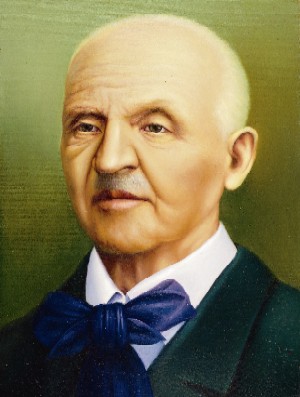
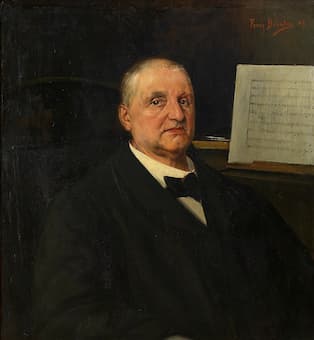
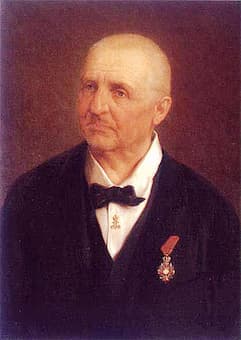
Anton Bruckner, 1889

125 years ago, on 11 October 1896, Anton Bruckner (1824-1896) died from acute heart disease brought on by persistent alcoholism. His funeral took place in the Karlskirche in Vienna on 14 October, and his remains were transferred to the crypt in the monastery of St. Florian near Linz, Austria. Even after his death, Bruckner took center stage in the cultural wars of late 19th-century Vienna. “Admirers described him as an unpretentious, modest man and a daring innovator who shied away from no enterprise.” While his detractors did recognize his originality, “they found nothing of value in the work of a modest Viennese church musician who lived a solitary dreamlike existence without ambition and who had been dragged into the limelight by an excessive Wagnerian cult.” Today, Bruckner is primarily remembered for his symphonies and sacred compositions, and as the “master-builder of cathedrals in sound,” we recognize him as a composer having exerted a lasting and crucial influence on the works of Gustav Mahler. Son of a schoolmaster and church organist, Bruckner was born in the village of Ansfelden—near the city of Linz—on 4 September 1824. The eldest of 11 children, he was admitted to the Augustinian monastery of St. Florian as a chorister, where he participated in its rich musical activities.

St. Florian not only imparted a solid musical education, it also firmly established his devotion to Roman Catholicism. Throughout his life, Bruckner was a devoutly religious man who kept a log of his daily devotions, and prayed before each performance. He is even thought to have experienced religious visions. It is said “there is no composer in the 19th century who was rooted so firmly in a lived, heart-deep devoutness, to whom prayer, confession, sacrament, and profession were vital elements.” His faith in the spiritual journey towards the afterlife became a process that decisively shaped his compositional imagination as he channeled profound spiritual messages that elevated music to the level of an undistracted prayer. His initial career path, however, had nothing to do with music, as he became a teaching assistant in Windhaag near Freistadt. An additional teaching appointment saw him at Kronstorf an der Enns, but eventually he returned to St. Florian for 10 years to work as a teacher and an organist.


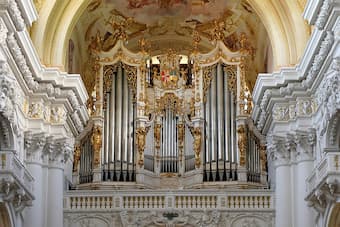
St. Florian Monastery Bruckner Organ

St. Florian Monastery Bruckner Organ

As a composer, Bruckner was largely self-taught and only started to composing seriously at age 37. He took composition lessons from the German cellist and conductor Otto Kitzler, who introduced him to the music of Richard Wagner. He also became a student of the famous Vienna music theorist Simon Sechter, who instructed him in music theory and counterpoint.

Anton Bruckner

Anton Bruckner

When Sechter died in 1868, Bruckner reluctantly took up the appointment of professor of harmony and counterpoint at the Vienna Conservatory, and subsequently as the Emperor’s court organist. His complete admiration for Richard Wagner elicited deep-seated resentment within Vienna’s musical and critical circles, and for a while, the Vienna Philharmonic Orchestra refused to perform his works. Habitually plagued by debilitating periods of low self-esteem, Bruckner was ill prepared for the acidic and highly competitive musical environment of imperial Vienna. He presented a wide and easy target for music critics, journalists and composers alike. Bruckner’s highly idiosyncratic and expansive musical style was mercilessly criticized, with a critic claiming, “Bruckner simply composes like a drunkard!”


Anton-Bruckner-Museum

Anton-Bruckner-Museum

Given such harsh professional assessments, it is not surprising that Bruckner was prone to suffer from devastating insecurities that made him endlessly revise and correct his compositions. He allowed outside influences to shape the content of his music and relied for editorial assistance on a number of former students. Their “authorized” involvement with his scores has become one the thorniest issues to haunt the composer’s legacy. Bruckner never felt at home in Vienna. He retained his peasant speech and social clumsiness throughout, and had the disastrous inclination to fall in love with teenage girls. His distracting compulsions ranged from obsessive preoccupation with financial security to a morbid fascination with corpses. Bruckner was painfully unaware of the intellectual and political currents of his day, and he exhibited a “Neanderthal male chauvinism that even his admirers found remarkable.”

Otto Böhler: Anton Bruckner arrives in heaven

Otto Böhler: Anton Bruckner arrives in heaven

Bruckner composed music that was simultaneously naïve and complex. Yet, once he had found his compositional path, the musical world did not know what to do with it. The conductor Wilhelm Furtwängler pointedly stated, “Bruckner did not work for the present. In his art he thought only of eternity and he created for eternity. In this way he became the most misunderstood of the great musicians… Bruckner is one of those geniuses who have appeared but seldom in the course of European history, whose destiny it was to render the transcendent real and to attract, even to compel, the element of the divine into our human world.”

Monday, July 22, 2013

Ferruccio Busoni - His Music and His Life

The Italian Ferruccio Busoni was born in Florenz on April 1, 1866. His father was also an Italian, but the father of Busoni's mother was a German.

At the age of 7, the child prodigy Busoni performed on stage for first time. At the age of 9, incredible piano performances in Vienna followed. When hes was 12, he conducted a symphony orchestra. At 15, Busoni became the youngest member of the Bologna Music Academy in Italy.

Busoni has been remembered as restless and have been all over the world. The cosmopolitan composer's biography shows really all colors of life: piano teacher in Leipzig,Germany; he married in Sweden; be became a chairman in Mosow; Boston followed; an artistic trip to Berlin; he became a General Director of Liceo musicales in Bologna, and much more... .

During World War I, Busoni lived in Switzerland. His glory and fame came through an incredible virtuoso. Bach's organ compositions had been arranged for piano by Busoni.

(To be continued!)

Friday, July 12, 2013

Max Bruch - His Music and His Life

The German Max Burch was born on January 5, 1838 in Cologne. His mother was his first emotional music teacher.

At the age of 11, Bruch composed his first classical piece, simple entitled as OPUS 1. When he became 14, his first symphony premiered in Cologne. 

After his father's death, Bruch got an insatiable thirst to travel around the whole world, which facilitated him many important and fruitful meetings with society personalities from politic, culture and clergy.

His ever best stage play, the opera "Lorely", premiered 1863 in Mannheim, Germany. Melodic and tuneful folksong atmosphere and E. Geibel's soft-emotional script are the reasons of this never forgotten highlight of Max Bruch.

Bruch's most valid orchestral works have been his "First violin Concerto in g-minor" from 1868; "The Scottish Fantasy" and -one of my favourites- "Variations Kol Nidrei for cello and orchestra".

He received innumerabe honors, praises and musical awards. Even being very contrapuntally, Bruch remains as a very special classic composer in the hearts of real music lovers.

Bruch passed away in Berlin on October 2, 1920.