by Georg Predota, Interlude
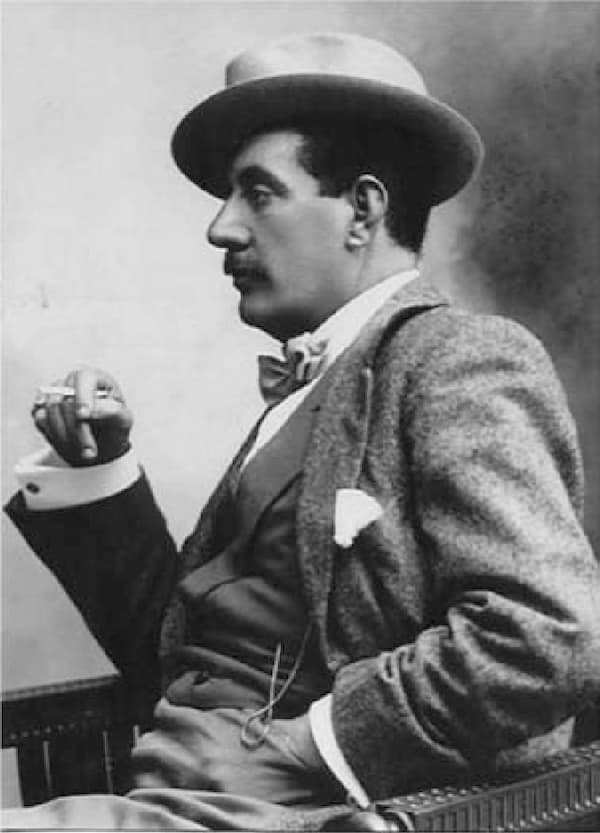
Giacomo Puccini
One of the most important and influential composers in the history of opera, Giacomo Puccini (1858-1924) produced works of emotional depth, melodic beauty, and rich orchestration. Bringing a new level of realism and expressiveness to the genre, Puccini’s masterworks are famous for their vivid characterisations and the ability to convey complex human emotions.
As Michele Girardi writes, “Puccini revolutionised Italian opera by mastering the orchestra and introducing bold harmonic progressions, aligning with European trends rather than traditional Italian styles. His innovative blending of lyrical vocal lines with intricate orchestral textures produced tender moments of sublime vocalism nestled within the passionate “verismo” style.” On the occasion of Puccini’s birthday on 22 December, let us explore this revolutionary composer through his music.
Giacomo Puccini: Turandot, “Nessun Dorma”
Early Days
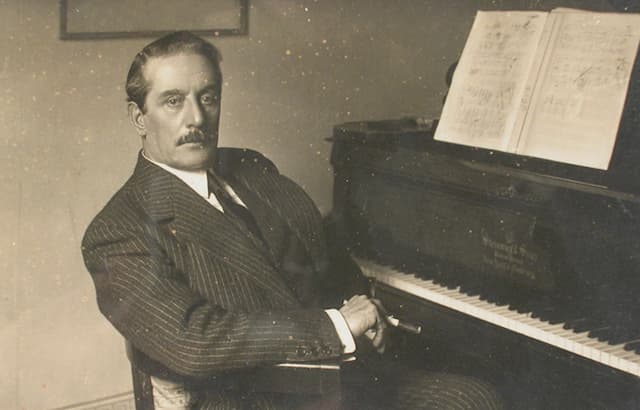
Giacomo Puccini
Giacomo Puccini, born on December 22, 1858, in Lucca, Italy, was part of a prominent musical family that had held the position of maestro di cappella for over a century. His father, Michele, was a church organist and choirmaster who died when Puccini was only six, marking a significant turning point in his life. Despite early academic struggles, including a reputation for being a bit of a troublemaker, Puccini pursued music under his uncle and later at the Pacini School of Music, eventually earning a diploma in 1880.
Giacomo Puccini continued his studies at the Milan Conservatory, composing his first Mass and submitting the Capriccio Sinfonico, a work that earned him recognition, as his graduation project. His first opera, Le Villi, dates from 1884 and was the result of a collaboration with poet Ferdinando Fontana. Puccini continued to revise and expand the opera, and the final version was issued in 1889. In terms of harmonic delicacy and dramatic orchestration, it laid the foundation for his future opera career.
Giacomo Puccini: Le Villi, “Torna ai felici di”
Edgar and Beyond

Giacomo Puccini’s Edgar
Based on a poem by Alfred de Musset, Puccini’s next opera Edgar premiered at La Scala in 1889. Lacking dramatic cohesion and despite a number of revisions, the work was poorly received and ultimately was Puccini’s only true failure. However, Puccini clearly learned his lesson and Manon Lescaut of 1893 became a great success. The libretto underwent a rather complicated development until librettist Luigi Illica strengthened the score and improved the drama.
A scholar writes, “drawing from Wagner’s idea of the leitmotif and combining it with the Italian dramma in musica, Puccini advanced the integration of music and drama.” In other words, Puccini uses recurring themes to represent the emotions and destinies of his characters, as Manon’s theme is repeated throughout the opera, symbolising the heroin’s fate and relationship with her lover. According to scholars, “Puccini’s skilful use of symphonic structures and thematic relationships in Manon Lescaut pushed the boundaries of the operatic genre.”
Giacomo Puccini: Manon Lescaut, “Sola perduta abbandonata”
Realism and La Bohème
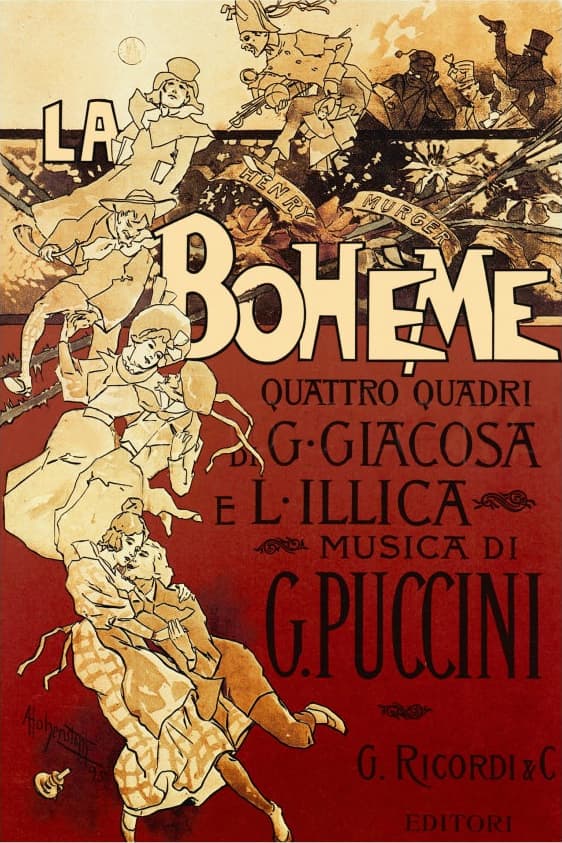
Giacomo Puccini’s La Bohème
La Bohème is based on Henri Murger’s Scènes de la vie de Bohème, a collection of loosely related stories all set in the Latin Quarters of Paris. Puccini collaborated with librettists Illica and Giacosa to create a seamless integration of text and music. In fact, a good many people consider it Puccini’s finest libretto. La Bohème, premiered in 1896, stands out for its blend of realism and poetry. Puccini moved beyond traditional operatic forms by using continuous music to reflect everyday life.
Puccini uses lyrical melodies, varied orchestration, and recurring motifs to deepen emotional and narrative impact. The opera’s realism is highlighted in the second scene with dynamic and fast-paced action as cinematic events bring the environment to life. A scholar writes, “a cyclical structure elevates the personal tragedy to a universal level, leaving the sorrow fixed in the timeless realm of art.” In Bohème, Puccini was able to achieve that perfect balance of realism and romanticism, of comedy and pathos, which makes it one of the most satisfying works in the operatic repertory.
Giacomo Puccini: La Bohème, “Quando m’en vo”
Realism and Tosca
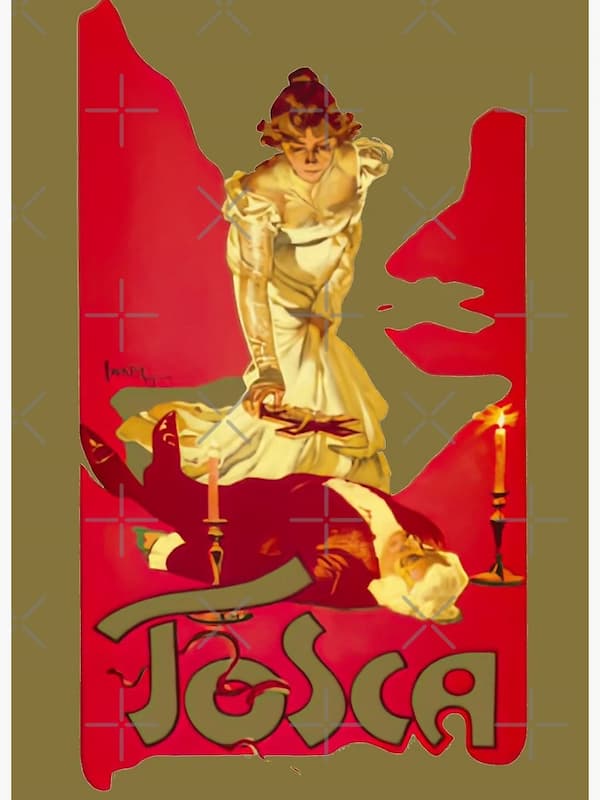
Giacomo Puccini’s Tosca poster
In Tosca, Puccini focused on personal conflicts rather than social status. The story pits the passionate opera singer Floria Tosca and the painter Mario Cavaradossi against the heinous chief of police, Baron Scarpia. The opera explores the fleeting nature of Tosca and Cavaradossi’s love against a backdrop of political and religious conflict. The operatic realism is grounded in historical details and in the choice of three famous Roman locations.
Tosca is the most Wagnerian of Puccini’s operas. It musically relies on a web of musical leitmotivs, providing glimpses of a character’s thoughts and emotional state. Puccini’s musical language, featuring diatonic melodies and successions of unrelated chords, perfectly complements the theatrical and dramatic aspects of the work, and his blending of dramatic realism with modern operatic technique “marked his entry into the 20th century.”
Giacomo Puccini: Tosca, “Vissi d’arte”
The Exotic
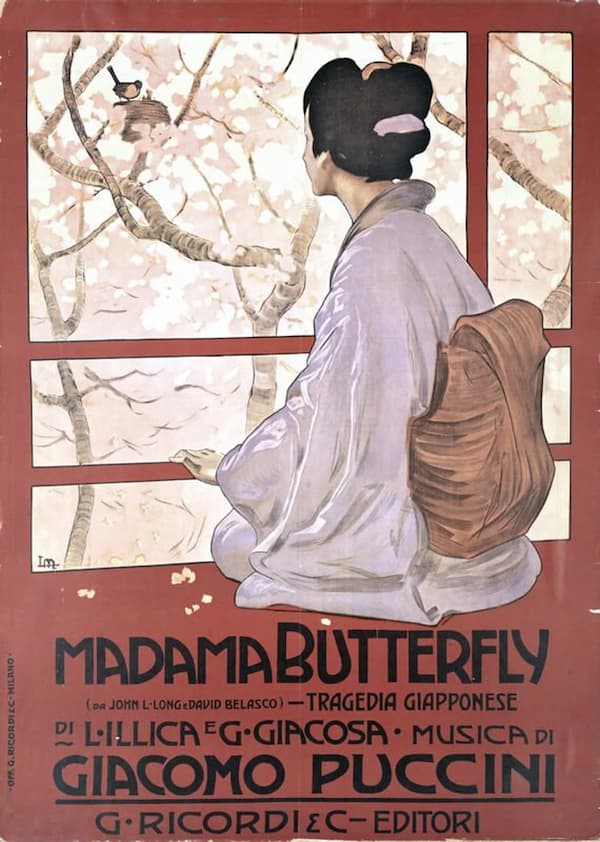
Giacomo Puccini’s Madame Butterfly
Puccini saw the one-act play Madame Butterfly, written and produced by the American playwright David Belasco in London in 1900. Drawn to the emotional depth of the story, Puccini crafted a powerful exploration of love, delusion, and tragedy. In terms of music, Puccini was striving for a sense of Japanese authenticity, engaging in exhaustive research to find, or at least approximate that sense of musical identity.
In all, Puccini revised his Butterfly for a grand total of five times, with the 1907 version considered to be his final say. In Butterfly, Puccini found a wonderful balance between the sentimental and the overwhelming, as moments of great delicacy alternate with emotional outbursts. The conflict is both personal and cultural, and through his unforgettable melodies, not to mention his sophisticated style of orchestration that cleverly aligns specific instrumental groups and orchestral timbres to match distinct dramatic moments, Puccini’s timeless creation will continue to resonate on a variety of psychological and cognitive levels.
Giacomo Puccini: Madama Butterfly, “Vogliatemi bene”
Evolution
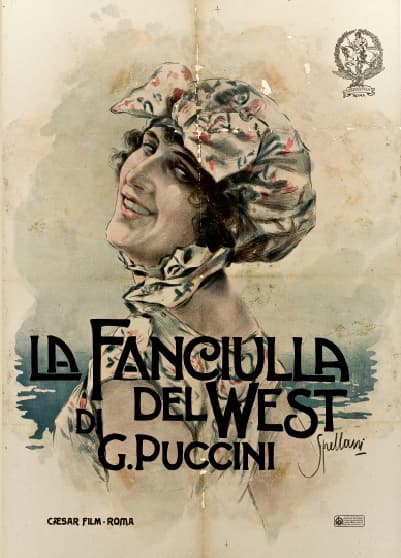
Giacomo Puccini’s La fanciulla del West poster
Puccini called his opera La fanciulla del West (The Girl of the West) his “greatest work.” The work had been seven years in the making and originated during a period of severe family strife. As his long-time collaborator Luigi Illica had died in 1906, Puccini struggled to find a replacement. Puccini was also looking for new directions as he had grown disillusioned with conventional opera genres. A scholar writes, “La fanciulla departs from his earlier operas’ reliance on strict realism and instead delves into more symbolic, emotional expression.”
The opera’s dramatic complexity, innovative use of orchestration, and its departure from rigid realism show a composer at the height of his powers, experimenting with new ways to connect with modern audiences. Clearly, he was not able to please everyone as a good many commentators suggested that Puccini’s music represented a debasement and cheapening of pure Italian values. And his considerable fame abroad was seen as proof that the composer had “wilfully sacrificed national character for cheap commercial exploitation.”
Giacomo Puccini: La fanciulla del West, “Ch’ella mi creda libero e lontano”
Unity
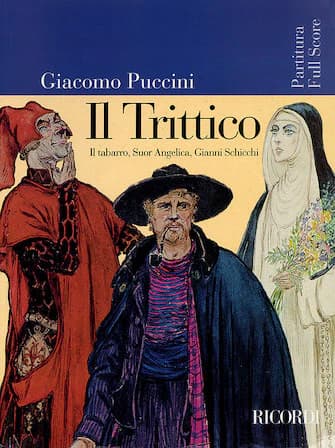
Giacomo Puccini’s Il Trittico recording cover
After the success of La fanciulla and La Rondine, Puccini eagerly explored this convergence of theatre and music. He began work on a one-act opera in 1913, however, he ended up with a collection of three one-act operas entitled Il Trittico. Comprising Il Tabarro (The Cloak), Suor Angelica (Sister Angelica), and Gianni Schicchi, Puccini attempted to draw together three different operatic genres, the dramatic, sentimental and comic, respectively, in a single project.
In Il trittico, Puccini shows himself to be the undisputed master of musical-dramatic continuity. This continuity becomes apparent within both the constraints of each singular one-act opera, as well as spanning a whole evening of operatic entertainment. This fascinating exploration of contrasting genres continues to be “one of the most innovative and complex works in the operatic canon.”
Giacomo Puccini: Gianni Schicchi, “O mio babbino caro”
Final Effort
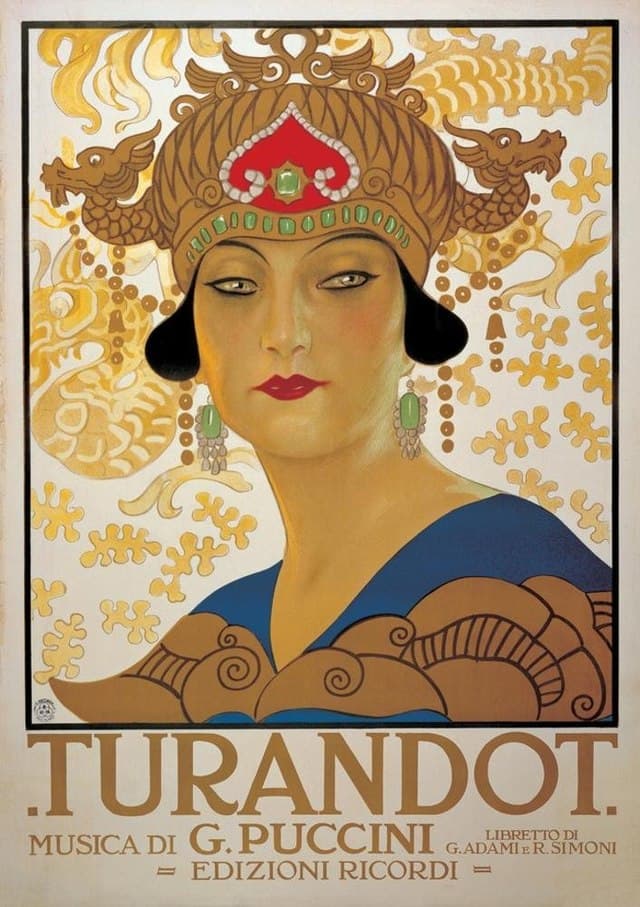
Poster of Turandot‘s performance
Puccini began working on his opera Turandot in the winter of 1919/20, urging his librettists Adami and Simoni to supply him with an Italian translation of Schiller’s adaptation of Carlo Gozzi’s play. Depicting distant lands and customs was a centuries-old musical tradition and Puccini demanded to “find a Chinese element to enrich the drama and relieve the artificiality of it, and to make use of Chinese syllables to give it a Chinese flavour.”
Puccini, once again, looked for a sense of authenticity in this musical characterisation. He visited a former diplomat in China, who owned a music box of genuine Chinese tunes. Three melodies from this music box ultimately found their way into the operatic score. Puccini left his last and most ambitious project unfinished, and Turandot has been described as “the last great Italian opera.”
However, much of the work is not Italian, as it draws on other cultures. Yet, it is in no way authentically Chinese either. A scholar writes, “it is a Western projection of the East, rife with contradictions, distortions, and racial stereotypes, and yet is also one of the most exhilarating and impressive works ever to take the operatic stage.”



 Some of the best Baroque music for Christmas is connected to some really interesting characters and stories. Take for example the Cardinal Pietro Ottoboni, a man sworn to celibacy by the church. But the Cardinal had other ideas, as he loved pomp and sensual pleasure. Nobody knows how many mistresses wandered through the Cardinal’s bedroom, but rumors suggested that he had between 60 and 70 children. The Cardinal was also a lover of the arts and specifically music, and he constructed himself a theatre. He also wrote his own opera and oratorio texts, and asked various composers to set them to music. Ottoboni was surely a major eccentric, and he surrounded himself with an extended circle of queer artists. He thought that being queer made artists more creative, and among his hires was the violinist and composer Arcangelo Corelli (1653-1713). Corelli and his lover Matteo Fornari soon became the star attractions as they came up with a new kind of music, which they called “concerto.” All that means is that a bigger orchestra contrasts a small group of performers or soloists. Maybe the Cardinal Ottoboni asked Corelli to compose him a “Christmas Concerto.” Nobody knows if that was actually the case, but the last movement has a beautiful pastoral quality. When Antonio Vivaldi first heard this piece he excitedly wrote, “Concerto, fatto per la note di natale” (Concerto composed for Christmas Eve.) It is one of the most touching Baroque instrumental pieces for Christmas, and a wonderful way to say Merry Christmas musically.
  For the final selection of the best Baroque music for Christmas, I have selected the Christmas Cantata by Alessandro Stradella (1643-1682). He was one of the most versatile and lively Italian composers in his day. He enjoyed a colorful and dazzling career as a freelance composer who managed to make countless enemies along the way. He tried to embezzle money from the Roman Catholic Church, and he had a weak spot for married women or the mistresses of the powerful and mighty. One evening while walking away from a little encounter, two assassins attacked him. By sheer luck he managed to survive the attack, but he was not that lucky a couple of years later when his life was tragically ended at the age of 42. A shadowy assassin stabbed him to death, having been hired by a jealous husband. Stradella was a highly sought after composer and none of his personal scandals affected the demand for his music. A group of wealthy patrons even provided him with a house, food, and a servant in addition to a generous yearly stipend. And we can certainly hear Stradella’s passion in his Christmas Cantata, first heard on Christmas Eve. Just listen to the beautiful pastoral atmosphere throughout the piece. There is no fake theatre, but just an emotional prayer from the Virgin Mary to her son. I guess we can all use a prayer during these unsettling times, and wherever you are in the world, may the best of Baroque Christmas music lift your spirits.