Total Pageviews

Friday, February 21, 2025

Variations on the Goldberg I

by Maureen Buja, Interlude
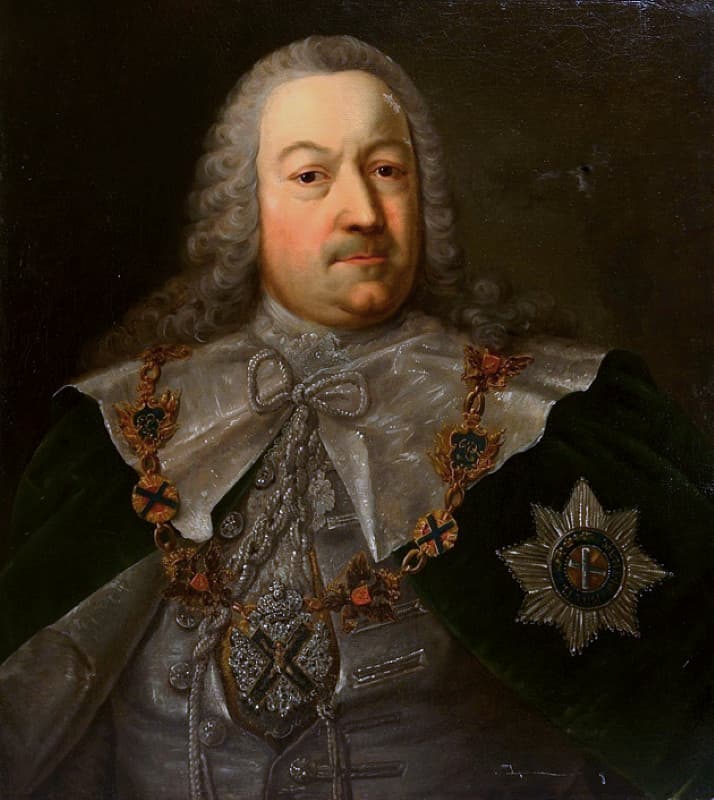
Herman Karl von Keyserlingk

Herman Karl von Keyserlingk

Count Keyserlingk discovered the extremely talented Goldberg when the boy was only age 10 and sponsored him to study with both Johann Sebastian Bach and his oldest son, Wilhelm Friedmann. According to Forkel, writing in 1802, ‘Count Keyserlingk was often ill and suffered from nights of insomnia. During such periods, Goldberg, who lived in his house, had to spend the nights in the next room to play for him. Once the Count told Bach that he would like for his Goldberg some harpsichord pieces of such a light and cheerful character that he, Keyserlingk, could be entertained a little during his sleepless nights. Bach thought that he could best fulfil this wish by writing variations…. The Count later called them only “his” variations. He could never get enough of them, and for a long time, whenever sleepless nights came, he always repeated: “Dear Goldberg, play me one of my variations”.’

Bach composed the work with the idea of Goldberg as the performer, but rumours to the contrary aside did not dedicate the work to either Goldberg or Keyserlingk. The Goldberg Variations takes its name from Goldberg as its first performer.

Goldberg was a talented performer from an early age, and after his study with W.F. and J.S. Bach, his own compositions showed their influence. As the young Goldberg took up the new galant style, his compositions also anticipated works by J.S.’s son, C.P.E. Bach. Goldberg died at the age of 29 of tuberculosis and was declared to be a great loss to the Dresden court. Being in close proximity to his teacher, J.S. Bach, who had been appointed ‘Royal Court Composer’ to the Dresden Court in 1736, Goldberg disparaged his own compositions, often tearing them up, but current reassessment of works such as his harpsichord concertos has done much to show him as an outstanding composer, albeit one who died too young.

The Goldberg Variations, as published in the Clavier-Übung IV, noted the quality of the work: ‘Keyboard exercise, consisting of an ARIA with diverse variations for harpsichord with two manuals. Composed for connoisseurs, for the refreshment of their spirits…’.
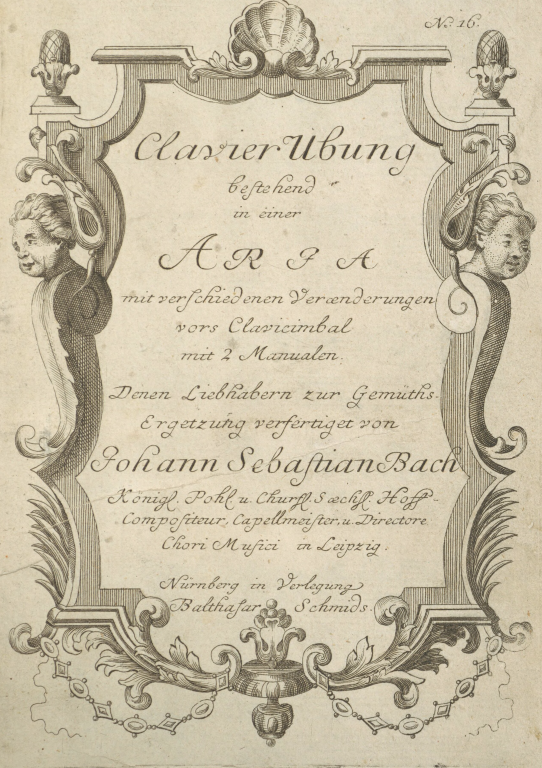
Title page of Clavier-Ubung IV

J.S. Bach: Clavier-Übung IV, 1741, title page

As described on the title page, the work is a variation set, beginning with an original aria composed by Bach and followed by 30 variations. The aria first appears in 1725 in the Clavierbüchlein copied by Bach’s second wife, Anna Magdalena, and opens with a chaconne bass in its first 8 bars. 

The variations that follow ‘are derived from the harmonic structure and the bass line of the aria and are grouped in threes, every third variation a canon at a higher numerical interval, with the final variation a quodlibet, a hotch-potch seemingly remote from the original aria, which follows in conclusion’.

When heard on harpsichord, the work has a slightly different feel than the more common modern piano recordings. The softness of the piano is replaced by the more brittle sound of the plucked harpsichord, which may explain why Goldberg was described as playing it from a room separate from that holding the insomniac Count. 

We will be looking at the other versions of this work, i.e., the Goldberg in the hands and sounds of other instruments. As a teaser for what will be coming next, here’s the first variation done not by a keyboard instrument but by a vocal group:

SLIXS – “Quer Bach” – Goldberg Variationen, BWV 988, Variation Nr. 1 

This performance is by the German group SLIXS, who describe themselves as an ‘a cappella band’, and who bring all sorts of modern styles to our Baroque familiar.

Sunday, February 16, 2025

Music is my life


What YOUR favorite composer says about you!


Saturday, February 15, 2025

Brahms - Piano Concerto No. 2 in B-flat major (Hélène Grimaud)


Friday, February 14, 2025

Francisco Beltran Buencamino, Sr. - his music and his life


Francisco Beltran Buencamino Sr

Francisco Beltran Buencamino was born on the 5th of November, 1883 in San Miguel de Mayumo, Bulacan. He is the sixth of ten children of Fortunato Buencamino and Luisa Beltran. His father was a church organist and band master, and his mother, a singer. Francisco was married to Pilar Luceno and they had two children, both of whom also took up music. 

Francisco first learnt music from his father. At age 12, he could play the organ. At 14, he was sent to study at the Liceo de Manila. There, he took up courses in composition and harmony under Marcelo Adonay. He also took up pianoforte courses under a Spanish music teacher. He did not finish his education as he became interested in the sarswela. 

In the early 1900s, Francisco Buencamino taught music at the Ateneo de Manila and at the Centro Escolar de Senoritas. At the latter, he founded the Conservatory of Music and was its head until 1938. At the same time, he also handled music lessons at the Liceo de Manila. He founded the Buencamino Music Academy in 1930. It was authorized by the Department of Public Instruction to grant music degrees. Some of his pupils were Nicanor Abelardo, Ernestina Crisologo, Estela Velasco, Beatrice Alba, and Amelia Hidalgo. In the 1940s, he started working as a musical director. He also composed music for films produced by Sampaguita Pictures, LVN and Excelsior. For a time, Francisco Buencamino frequently acted on stage. He also collaborated on the plays written and produced by Aurelio Tolentino. The Philippine Music Publishers, which Buencamino established, undertook the printing of his more important compositions, but it was not a successful venture. 

Some of the sarswelas he wrote are: "Marcela" (1904), "Si Tio Celo" (1904) and "Yayang " (1905). In 1908, the popularity of the sarswela started to wane because of American repression and the entry of silent movies. Francisco Buencamino then turned to composing kundimans. 

One of his earliest compositions is "En el bello Oriente" (1909), which uses Jose Rizal's lyrics. "Ang Una Kong Pag-ibig", a popular kundiman, was inspired by his wife.  In 1938, he composed an epic poem which won a prize from the Far Eastern University during one of the annual carnivals. His "Mayon Concerto" is considered his magnum opus. Begun in 1943 and finished in 1948, "Mayon Concerto" had its full rendition in February 1950 at the graduation recital of Rosario Buencamino at the Holy Ghost College. "Ang Larawan" (1943), also one of his most acclaimed works, is a composition based on a Balitaw tune. The orchestral piece, "Pizzicato Caprice" (1948) is a version of this composition. Many of his other compositions were lost during the Japanese Occupation, when he had to evacuate his family to Novaliches, Rizal. 

As a musical director, he was involved in anumber of movies such as "Mabangong Bulaklak", "Ang Ibong Adarna", "Mutya ng Pasig", and "Alitaptap". 

Francisco Buencamino died on the 16th of October, 1952. in the same year, he was given a posthumous Outstanding Composer Award by the Manila Music Lovers Society. 

Additional Information: Pianist Cecile Licad, is his grand niece. Composers Willy Cruz, Lorrie Ilustre and Nonong Buencamino, and actor Noni Buencamino are his grandnephews. 

Note: I've lost the original sources for this post. But they can all be surely found in the College of Music Library, University of the Philippines, Diliman, Quezon City. 

One day we'll see...


May be a doodle of text that says '130tBIRTH 130th BIRTH ANNIVERSARY Jovita Fuentes NATIONAL ARTIST FOR MUSIC February 15, 1895 보 NCCA BAGONG HOPI LIPIRAS'
The nation celebrates the 130th Birth Anniversary of National Artist Jovita Fuentes.
Long before Lea Salonga made her mark on Broadway, Jovita Fuentes had already captivated audiences with her portrayal of Cio-Cio San in Giacomo Puccini’s Madame Butterfly at the Teatro Municipale di Piacenza in Italy. Her performance was celebrated as the "most sublime interpretation of the role." This achievement is particularly noteworthy given that it occurred during a period when the Philippines and its people were largely unknown in Europe. Prior to this, Fuentes was teaching at the University of the Philippines Conservatory of Music in 1917 before relocating to Milan in 1924 to pursue advanced vocal studies.
After eight months of rigorous training, she made her stage debut in Piacenza. Subsequently, she undertook a series of musical performances across Europe, portraying characters such as Liu Yu in Puccini’s Turandot, Mimi in Puccini’s La Bohème, Iris in Pietro Mascagni’s Iris, and the title role in Salome, which was personally offered to her by composer Richard Strauss. Additionally, she was honored with the remarkable title of “Embahadora de Filipinas a su Madre Patria” by Spain in recognition of her accomplishments.
To read more about NA Fuentes, please visit: https://ncca.gov.ph/.../national-artists.../jovita-fuentes/