Total Pageviews

Wednesday, March 18, 2026

When textiles step onto the stage

 When textiles from our communities step onto the stage, they carry more than beauty — they carry stories, heritage, and the hands that made them.

Grateful to Dr. Rina Baluyut Angeles and The Giving Bridge Initiative for the opportunity to bring Mindanao’s living textile traditions to “For the Children,” their very first fundraising benefit concert.
Dr. Rina wore a gown made from contemporary handwoven Maguindanao Inaul, honoring a tradition that continues to evolve through the artistry of our weavers.
For National Artist for Music Ryan Cayabyab’s Barong, we collaborated with women weavers from Sibagat, Agusan del Sur, developing a textile from pinukpok abaca and embroidering it with a Karanda-inspired motif from the Maguindanao Inaul — a meeting of fibers, cultures, and communities across Mindanao. Many thanks to the women weavers of Sibagat and VM Maria Liza Lamanilao Evangelista.
Projects like this remind us that fashion can be a bridge — connecting artisans, culture, and contemporary expression while creating opportunities for community-based creative enterprises.
Because when we wear our textiles, we wear our stories.
Weaving culture, empowering communities, designing the future.


Tuesday, March 17, 2026

10 pieces of classical music that will 100% change your life


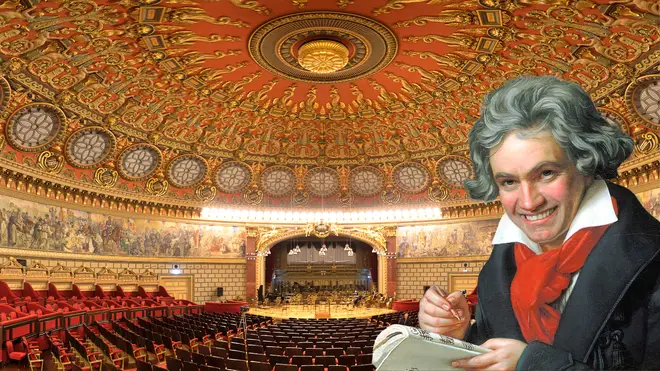
10 pieces of classical music that will change your life (pictured: Romanian Athenaeum)
10 pieces of classical music that will change your life (pictured: Romanian Athenaeum). Picture: Alamy
Classic FM

By Classic FM

Hold on to your hats – if you haven’t heard any of these musical works of genius, your life is about to be changed 10 times in a row.

Classical music can calm nerves, fire up the senses and spark creativity. It can also be uniquely life-affirming.

Here are the 10 major works we recommend you devote some time to. With the depths of their passion and beauty, we think they have the power to move everyone – with life never being quite the same afterwards.

Read more: 30 greatest classical composers of all time

  1. J.S. Bach: St Matthew Passion

    What is it?
    It’s one of two ‘Passion’ oratorios that have survived since Bach died (he could’ve written up to five), but it’s also become one of his most celebrated pieces. The original title is Passio Domini nostri J.C. secundum Evangelistam Matthæum (the ‘J.C.’ stands for Jesus Christ, which is maybe a bit familiar for someone he hadn’t met… but we’ll let him off).

    Why it will change your life:
    If you thought that Baroque music mostly dealt with plinky-plinky harpsichords, the St Matthew Passion will change mind. There are biblical proclamations of impending apocalypse littered throughout, and for each of them, Bach works in some sort of crushing atonality or strange chord, as if he’s wincing with pain each time it happens. This is such a human experience, composed at a time when human experiences weren’t chief among the aims of most Baroque composer composers.

    Read more: 10 of Bach’s all-time best pieces of music

    Bach - St Matthew Passion BWV 244 - Van Veldhoven | Netherlands Bach Society

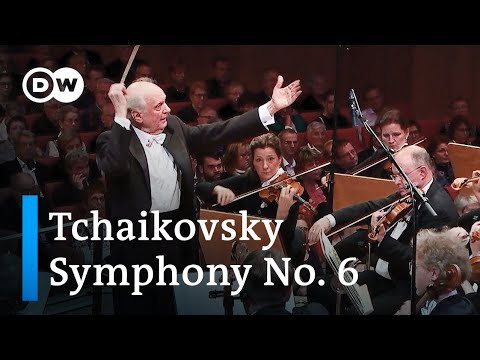
  2. Tchaikovsky: Symphony No. 6

    What is it?
    Tchaikovsky’s final symphony, nicknamed ‘Pathétique’. The premiere performance was given just nine days before the composer died.

    Why it will change your life:
    Tchaikovsky was surely one of the most personally troubled of the great composers – and this symphony was essentially the outpouring of many of his issues, in a way. Many initially thought it was a lengthy suicide note, others pointed to the composer’s torment over his suppressed sexuality, while some thought it was just a tragic, sad, glorious and indulgent artistic expression. But the reason it’ll stay with you forever is that all of these contexts work in their own way, but it never detracts from how magisterial the music itself is. It’s a lesson in the very best ways of expressing emotions through music.

    Read more: 10 of Tchaikovsky’s all-time best works

    Tchaikovsky: Symphony No. 6, 'Pathetique' | Dresden Philharmonic & Marek Janowski

  3. Mahler: Symphony No. 2

    What is it?
    Massive, that’s what it is. Mahler’s Symphony No. 2 (known as the ’Resurrection’) is a 90-minute attempt to put the whole nature of existence into a piece music. So pretty ambitious.

    Why it will change your life:
    If you think any bit of music over three minutes long is a bit indulgent and full of itself, this single piece will convince you that sometimes it’s completely worth spending an hour and a half on one musical concept – even if it is a huge concept. No other composer could’ve made it more entertaining (listen out for death shrieks!), or more rewarding. The epic final few minutes are a stupidly generous reward on their own, but getting there is half the fun.

    Read more: A detailed explanation of how Mahler’s Symphony No. 2 is a heart-shattering work of genius

    Mahler - Symphony No. 2 'Auferstehung' - Mariss Jansons | Concertgebouworkest

  4. Beethoven: Grosse Fuge

    What is it?
    One of the last pieces Beethoven wrote for string quartet, one of his celebrated ‘Late’ quartets. It’s a one-movement experiment in structure that was universally hated when it was first composed.

    Why it will change your life:
    It’s proof that not only can critics and audiences get it really, really wrong, but also that it’s all about interpretation. You can actually hear the struggle and the effort it must have taken to compose, which means it’s not always a relaxing listen, but few pieces in history have so nakedly shown how a composer can throw absolutely everything into a single work. And, in the end, it was hugely influential to serialist composers of the 20th century with none other than Igor Stravinsky proclaiming it a miracle of music. How about that for delayed gratification?

    Read more: Definitively the 20 greatest Beethoven works of all time

    Beethoven: Grosse Fuge, Op. 133 (Danish String Quartet)

  5. Mozart: Requiem

    What is it?
    The piece that Mozart wrote on his deathbed, in a furious fever. Well, if the movies are to be believed, anyway.

    Why it will change your life:
    From the opening Introitus, the mournful tone is set. It might just be us, but doesn’t it actually sound like Mozart is scared of death here? Aside from being spooky as anything, the Requiem is a haunting patchwork of things. Completed by one of Mozart’s pupils, Franz Süssmayr, it’s become a legendary mystery and the perfect way to end the story of one of history’s most celebrated geniuses – in other words, not end it all. What an enigma.

    Read more: 10 life-changing pieces of music by Mozart

    Mozart : Requiem (Orchestre national de France / James Gaffigan)

  6. Monteverdi: Vespers

    What is it?
    It’s Baroque genius Claudio Monteverdi’s defining work, a gigantic noise that some argue bridged the gap between the Renaissance and the early Baroque periods.

    Why it will change your life:
    It makes you realise that just because something’s really old, it doesn’t mean it’s automatically boring, or simply lauded because it was ‘groundbreaking’. Make no mistake about it – Monteverdi’s Vespers are hugely entertaining on their own terms. For starters, it’s simply enormous in scale. If you want to be crude about it (and we do) then you could describe it as Monteverdi taking church music to the opera, with all the drama that implies. Trumpets, drums, massive choruses, florid vocal lines… this really is the greatest hits of the early Baroque.

    Monteverdi's Vespers of 1610

  7. Elgar: Cello Concerto

    What is it?
    The only cello concerto that Edward Elgar wrote, and one of the most famous concertos of all time.

    Why it will change your life:
    It’s proof that intense emotion can come from the most unlikely of people. We don’t want to get all mushy on you, but there’s something spectacularly English about how the ultimate stiff-upper-lipped curmudgeon, Edward Elgar, was able to convey his emotions in music rather than in words or actions. His private life was surprisingly tumultuous (that’s another story), and in pieces like the Cello Concerto it’s as if the gasket has blown and Elgar is finally able to let out all the pent-up emotion in a focused blast.

    Cellist Sébastien Hurtaud plays Elgar Cello Concerto (3rd movement)

  8. Wagner: The Ring Cycle

    What is it?
    It is everything.

    Why it will change your life:
    Realising for the first time that the world of opera could actually be this immersive is a very, very special feeling. Wagner’s whole four-opera cycle has a terrible reputation as simply ‘that exhausting long opera’ – but that perception couldn’t be further from the truth. The Ring Cycle is a fundamentally unhinged work of staggering genius, and the peak of operatic indulgence, excess and excellence. Ignore at your peril.

    Metropolitan Opera Orchestra – Wagner: Ride of the Valkyries - Ring (Official Video)

  9. Max Richter: Vivaldi: Recomposed

    What is it?
    A radical, beautiful re-invention of Vivaldi’s Four Seasons concertos, by modern indie-classical composer Max Richter.

    Why it will change your life:
    Listening to Vivaldi: Recomposed is like discovering an old jumper that you used to love has magically, miraculously lost all its bobbly bits and is actually at the height of fashion. What Richter manages to do so incredibly well is to subtly sneak in delightful additions, tweaks and reinventions to a classic you already know extremely well, and freshen it up not just for the modern era, but for the eras to come too.

    Recomposed by Max Richter - Vivaldi - The Four Seasons, 1. Spring (Official Video)

  10. Gorecki: Symphony No. 3

    What is it?
    Possibly the most emotionally draining piece of music ever written.

    Why it will change your life:
    There’s a reason Polish composer Henryck Górecki called his third symphony the Symphony of Sorrowful Songs. Each movement features a solo soprano singing texts inspired by war and separation, but it’s the second movement that really stands out. The text is taken from the scribblings on the wall of a Gestapo cell during the Second World War and, as you can imagine, it’s pretty harrowing stuff – but Górecki makes it sound so transcendental that it’s hard to believe it was written in such dire circumstances. He said himself that he wanted the soprano line “towering over the orchestra”, and it certainly does that.

    Henryk Górecki on his Symphony No. 3

For more great classical music, enjoy our Classic FM Hall of Fame playlist on Global Player.

Friday, March 13, 2026

John Cage - his music and his life

John Cage
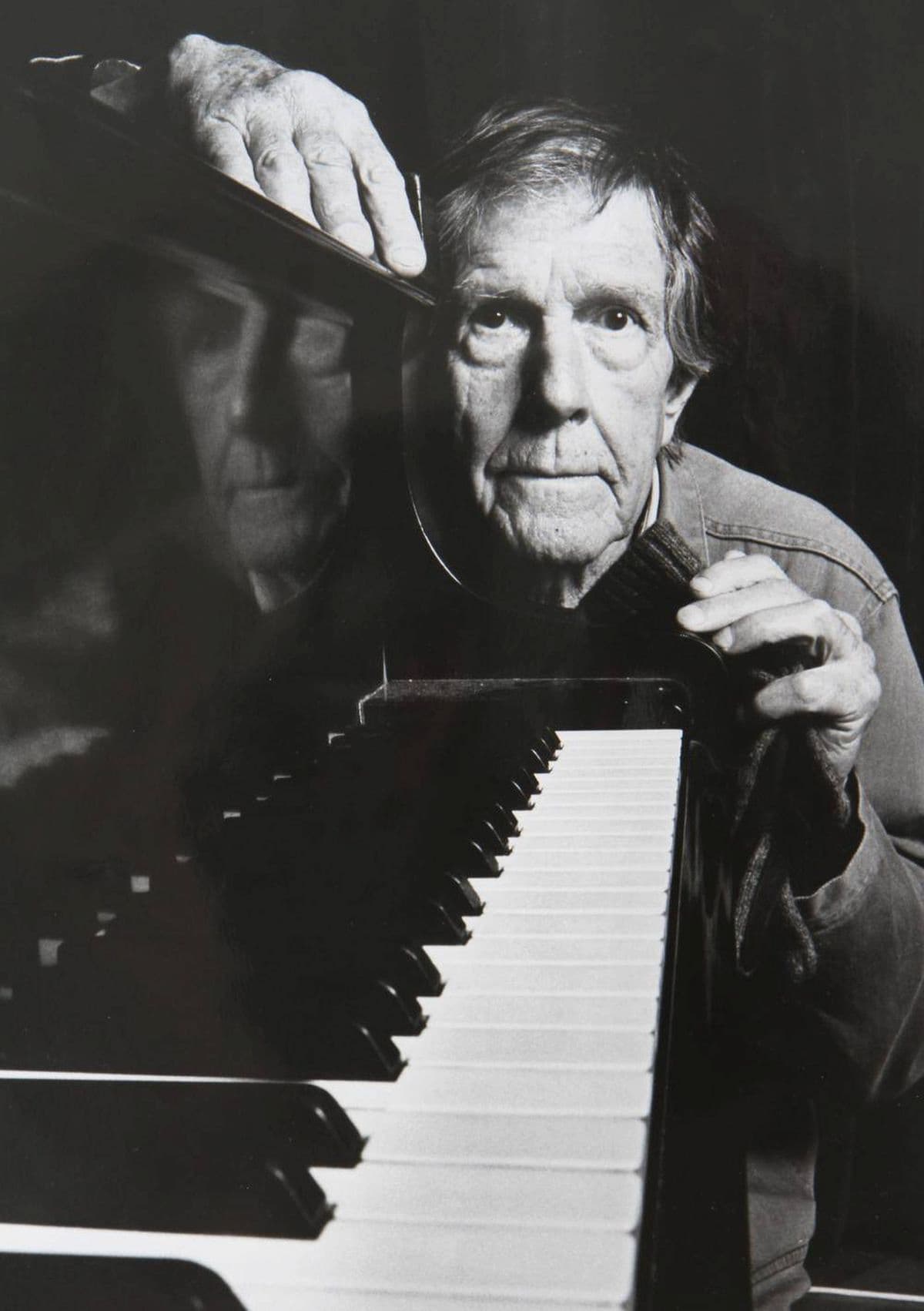
Cage in 1988
Born
John Milton Cage Jr.

September 5, 1912
Los Angeles, California, U.S.
DiedAugust 12, 1992 (aged 79)
New York City, U.S.
Alma materPomona College
Occupations
Spouse
(m. 1935; div. 1945)
PartnerMerce Cunningham
Signature


John Milton Cage Jr. (September 5, 1912 – August 12, 1992) was an American composer, artist, and music theorist. A pioneer of indeterminacy in music, electroacoustic music, and non-standard use of musical instruments, Cage was one of the leading figures of the post-war avant-garde. Critics have lauded him as one of the most influential composers of the 20th century.[1][2][3][4] He was also instrumental in the development of modern dance, mostly through his association with choreographer Merce Cunningham, who was also Cage's romantic partner for most of their lives.[5][6]


Cage's teachers included Henry Cowell (1933) and Arnold Schoenberg (1933–35), both known for their radical innovations in music, but Cage's major influences lay in various East and South Asian cultures. Through his studies of Indian philosophy and Zen Buddhism in the late 1940s, Cage came to the idea of aleatoric or chance-controlled music, which he started composing in 1951.[7] The I Ching, an ancient Chinese classic text and decision-making tool, became Cage's standard composition tool for the rest of his life.[8] In a 1957 lecture, "Experimental Music", he described music as "a purposeless play" which is "an affirmation of life – not an attempt to bring order out of chaos nor to suggest improvements in creation, but simply a way of waking up to the very life we're living".[9]


Cage's best known work is the 1952 composition 4′33″, a piece performed in the absence of deliberate sound; musicians who perform the work do nothing but be present for the duration specified by the title. The content of the composition is intended to be the sounds of the environment heard by the audience during performance.[10][11] The work's challenge to assumed definitions about musicianship and musical experience made it a popular and controversial topic both in musicology and the broader aesthetics of art and performance. Cage was also a pioneer of the prepared piano (a piano with its sound altered by objects placed between or on its strings or hammers), for which he wrote numerous dance-related works and a few concert pieces. These include Sonatas and Interludes (1946–48).[12]

Book Review: John Cage’s Silence


Most famous for his iconic – and polarising – composition 4’33”, John Cage was a composer, artist, and thinker whose explorations and experiments changed the course of classical composition. His compendium of lectures and writings, Silence, will be of interest to anyone who likes to think about musical organisation and value at a meta level, and those who are fascinated by people who live and think eccentrically, which is, I suspect, most of us with any investment or interest in the arts.
John Cage

John Cage

From the onset, this compendium paints a picture of a man who liked ambiguity, the frustration of expectations, and absurdity – a kind of contrariness of spirit reminiscent of Erik Satie. In the foreword he recounts an incident during his Lecture on Nothing delivered at the Artists’ Club on Eighth Street in New Yorkwhich involved the giving of the same six, randomly-selected, pre-prepared answers in response to whatever question was asked, where good friend and attendee Jeanne Reynal stood up and screamed, “John, I dearly love you, but I can’t bear another minute,” and promptly left. The anecdote is recounted not as a triumph at having irritated and frustrated another human being, but as a kind of soft acknowledgement that his way of thinking and making, his explanations of his own artistry, his music – all contain a challenging preoccupation with form, repetition, and meaning that are, in a myriad of ways, crazy-making. Later in the foreword, he acknowledges the influence that both Zen and Dadaism have had on his thinking, while also stating that he does not wish Zen to be “blamed” for his work, and that he wanted “to free Zen of any responsibility for [his] actions.” Instead of aligning himself fully with either school of thought, he gives two explicitly stated reasons or justifications for all of these lectures and writings. The first is that he sought above all else “poetry,” which he defines as “the allowing musical elements (time, sound) to be introduced into the world of words.” The other stated aim was to collapse content and message into form by communicating ideas via their embodiment rather than by abstract description or definition, such as delivering a lecture on repetition by the actual use of extensive repetition. By virtue of this latter aim, Cage’s Silence is a mixture of spatialised poetry, instructions for performance art, text scores, transcribed or written lectures, and everything evading definition in between – making for a varied and amusingly bumpy read.
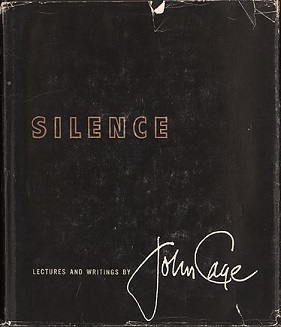
First edition of John Cage's Silence: Lectures and Writings

First edition of John Cage’s Silence: Lectures and Writings

Of real interest from the 21st-century perspective are Cage’s predictions about the future and purpose of composition. In his lecture ‘Future of Music: Credo’ given in 1958, Cage correctly forecasted the extent to which technology, electronic instruments, and recorded sound would come to dominate music-making, and the ways in which this would blur the lines between music and the “noise” that constantly surrounds us. Some of the conclusions he reaches from the new technologies being discovered in his lifetime – high fidelity recording, and the ability to manipulate those recordings along a continuous spectra like amplitude or overtone structure – are quite extreme. He makes the analogy that writing music with simple rhythms and twelve tones alone is discrete and traditional, like walking, whereas utilising technology to make music of infinite rhythmic and pitch complexity is like flying. The other compositional alternative he seems to endorse is to turn to the sounds of nature, “to give up the desire to control sound, clear [the] mind of music, and set about discovering means to let sounds be themselves rather than vehicles for man-made theories or expressions of human sentiments.” Having presented these two options – making complex noise-music using the outermost limits of technology, or creating sound-art out of randomness and the natural world – Cage then somewhat paradoxically says that nothing need change in music-making at all, that “the more things there are, the merrier.” He goes so far as to say we should embrace a dominant seventh chord every now and then. While none of this hangs together as the most coherent or well-defended musical philosophy, it’s certainly food for thought for anyone interested in the history of modern composition.
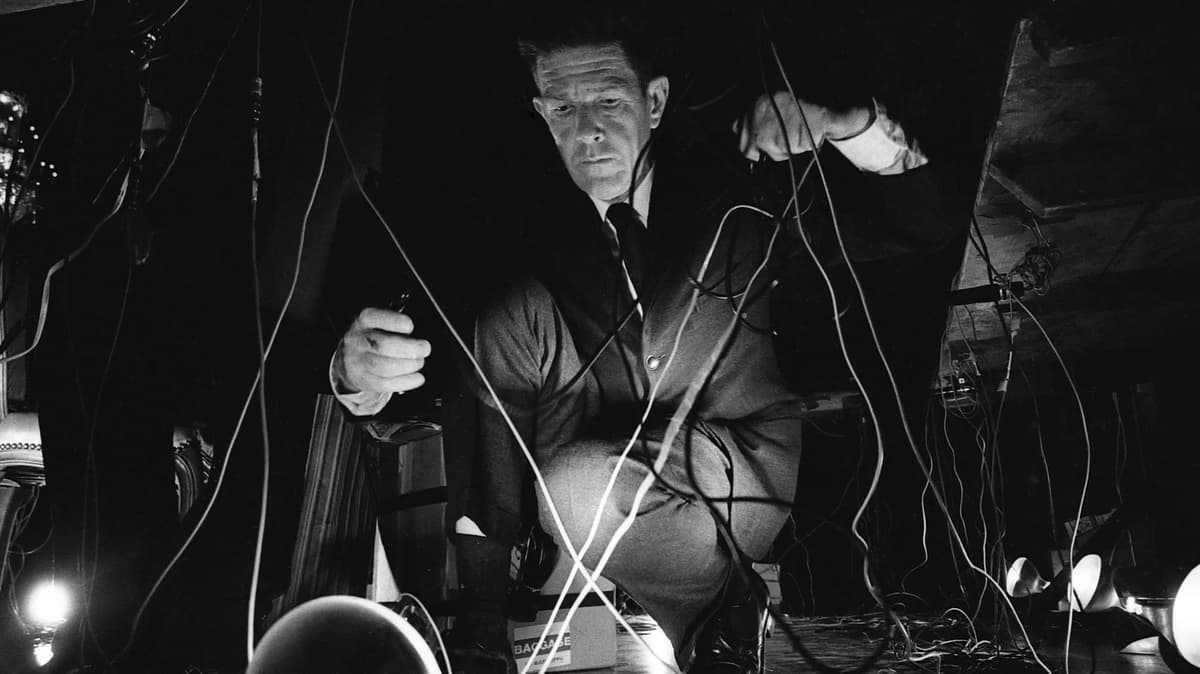
John Cage during his 1966 concert at the opening of the National Arts Foundation in Washington, D.C.

John Cage during his 1966 concert at the opening of the National Arts Foundation in Washington, D.C. © Rowland Scherman/Getty Images

Scattered throughout the book are strange anecdotes from Cage’s life and those of mentors and artist friends. In small italics, these surreal stories of submarines, travel, and mushroom-picking punctuate the ongoing conceptual wrestling, the never-ending tensions between noise and music, sound and silence, choice and non-choice. These serve as nice moments of levity from the dense, sometimes technical, and experimentally formatted meditations on process and musical form. On the whole, the earnestness of Cage’s desire to understand things deeply and well is always tempered with humour and a surrealist, interdisciplinary spirit. The spatialised poetry calls to mind André Breton, and Cage is as versed in theatre, philosophy, and the visual arts – with many mentions of Max Ernst and Gertrude Stein – as he is in music, perhaps more so.

Frustrating, enlightening, thought-provoking, and clever in equal measure, this is the kind of book anyone interested in music would do well to own and return to throughout their lifetime.