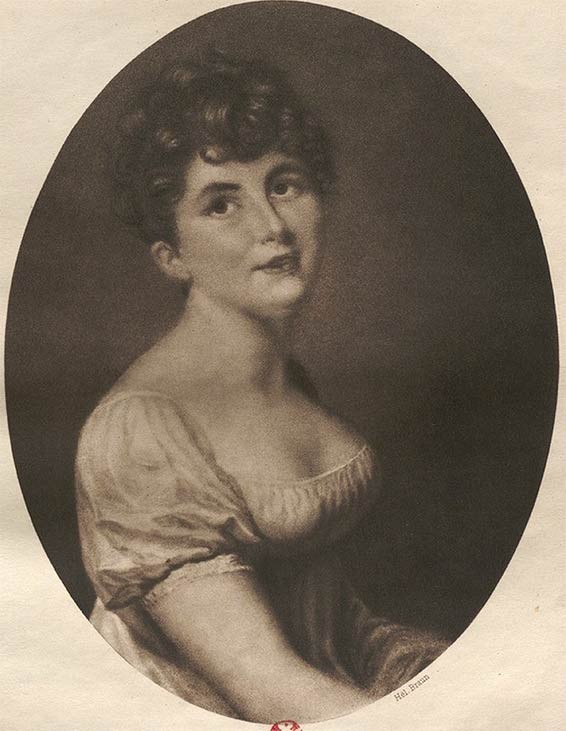
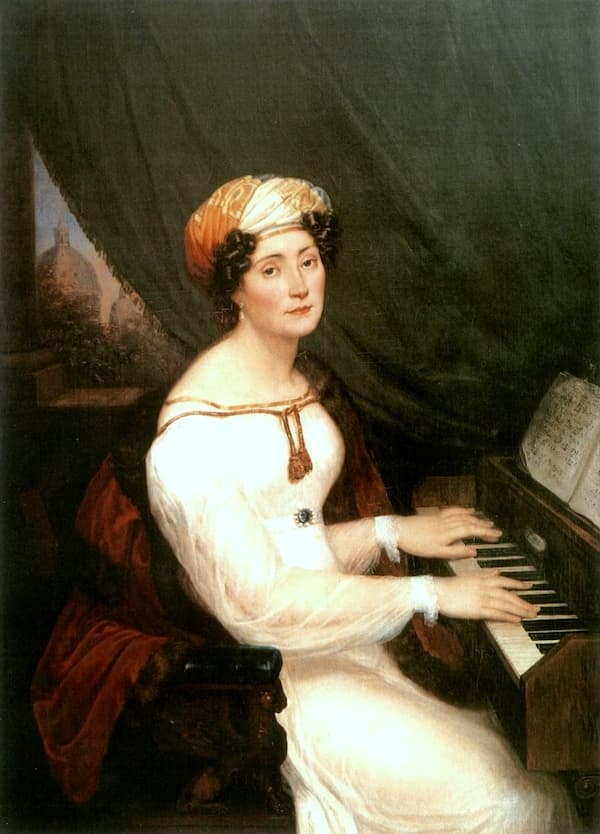
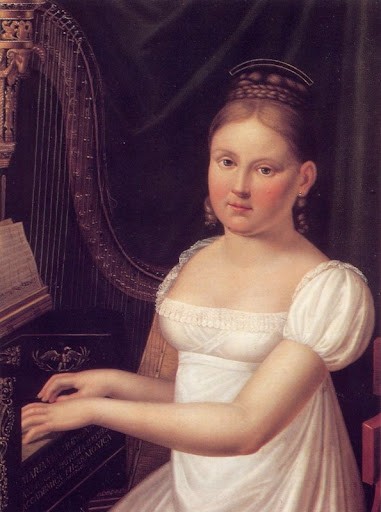
And yet. Looking at the historical record, it is clear that many great composers had emotionally and/or physically intimate relationships that didn’t fit into a traditional heterosexual mold, and it feels safe to categorize many of them as falling under the LGBTQ+ umbrella.
So here is a list of 27 composers who may have been queer, gay, or otherwise non-heterosexual.
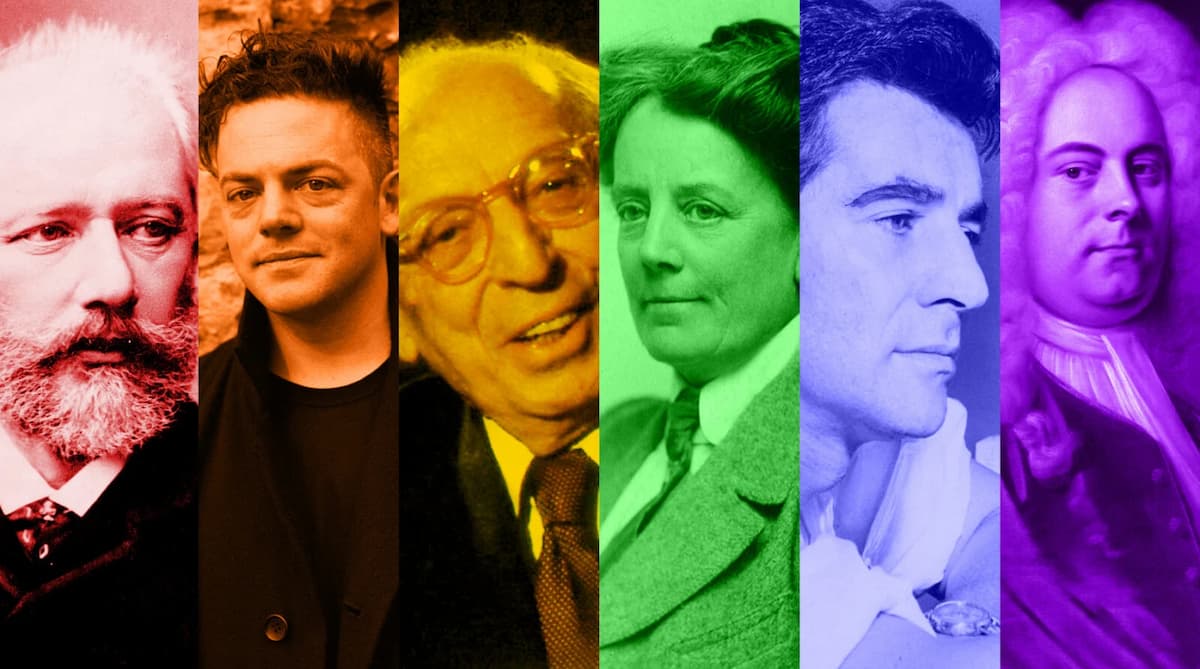
© wfmt.com
Jean-Baptiste Lully (1632-1687)
Lully was an Italian-born composer who worked at the extravagant court of Louis XIV. He was a renowned violinist, guitarist, and even dancer.
Lully had romantic relationships with both men and women. He and his wife had six children, and he had a mistress. But he also was attracted to men and became involved with a page at Versailles.
Same-sex relationships were grudgingly permitted at the Palace, as Louis’s brother Philippe, Duke of Orléans, openly preferred the company of men. But Lully’s affair did cause the King to distance himself from him, and the page was imprisoned.
Arcangelo Corelli (1653-1713)
Arcangelo Corelli was famous for his groundbreaking violin technique, as well as his hugely influential compositions.
In 1683 Corelli met a violinist named Matteo Fornari, and the two were inseparable for nearly twenty years.
One of their mutual composer friends actually dedicated two trio sonatas to the couple, and Fornari oversaw the publication of Corelli’s work after Corelli’s death.
George Frideric Handel (1685-1759)
Handel was one of the best-known composers of the Baroque era, especially famous for his smash-hit oratorios like The Messiah.
Some modern-day musicologists consider him to be LGBTQ+. However, unlike with some composers who never officially came out, we don’t have any record at all of who he might have had a relationship with. It’s possible that he was asexual – or merely deeply preoccupied with his work.
Franz Schubert (1797-1828)
Schubert was an incredibly prolific composer of piano sonatas, chamber works, and symphonies. When he was alive, he labored away in sickness, poverty, and obscurity. He was only fully appreciated after his death.
In 1989, musicologist Maynard Solomon advanced a theory that Schubert was not straight. The very idea caused a tumult.
However, Solomon might have had a point. Schubert wrote heated affectionate letters to several male friends, roomed with likely-queer friend and poet-collaborator Johann Mayrhofer, and spent most of his time in bohemian, male-centric social circles.
But the most recent research suggests that his queerness is not as clear-cut as with other composers.
Frédéric Chopin (1810-1849)
Chopin’s moody, melancholy music for piano has resonated with audiences for generations.
Chopin famously had a romantic relationship with authoress George Sand in the late 1830s and early 1840s. She was famous for challenging gender roles and assumptions about sexuality; she dressed like a man and had romantic relationships with both men and women.
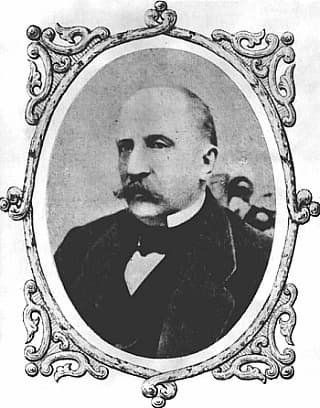
Tytus Woyciechowski © Wikipedia
However, the fact that Chopin dated George Sand doesn’t erase the fact that he also wrote passionate letters to several male friends, including the Polish activist Titus Woyciechowski, who boarded with the Chopin family as a young man.
Chopin wrote to him about kissing him and about “dirty” or “nasty” dreams that Woyciechowski inspired. For his part, Woyciechoewski named one of his children after Chopin.
If nothing else, the two clearly had a very deep emotional connection, and there’s certainly a homoerotic element to it.
Camille Saint-Saëns (1835-1921)
Saint-Saëns was one of the most famous figures in nineteenth-century French music and one of the most impressive musical child prodigies who ever lived.
When he was 40, he married a 19-year-old woman named Marie-Laure Truffot. They had two sons who died young. After their deaths, he walked out and never talked to his wife again.
He often disappeared for weeks at a time, giving no indication where he’d been afterward. He spent winters in Algeria, a haven for European gay men. He also dressed up in women’s clothes and gave satirical operatic performances in drag in his apartment.
Pyotr Ilyich Tchaikovsky (1840-1893)
Tchaikovsky wrote some of the most beloved Romantic Era masterworks of all time, and many have wondered if his death from cholera (reported to be caused by drinking an unboiled cup of water) was actually a kind of forced suicide to atone for his homosexuality.
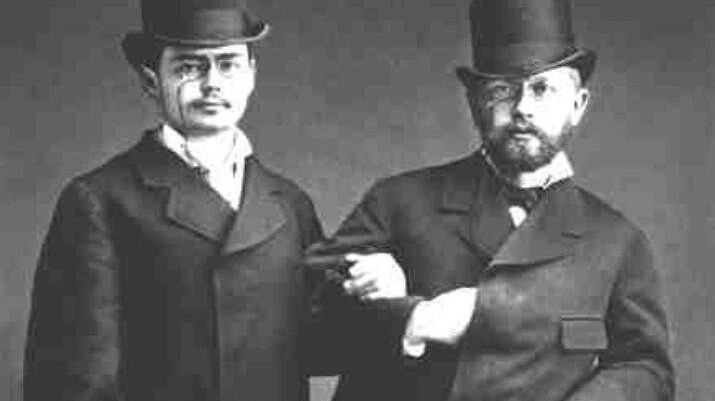
Pyotr Ilyich Tchaikovsky and Yosif Kotek
We don’t have enough evidence to endorse the forced suicide theory, but it is very clear that Tchaikovsky was very gay. Many letters exist to his brother Modest in which he shares his various dramatic infatuations and encounters with men he’s attracted to.
After his marriage, instead of going on a honeymoon, he had a nervous breakdown and fled to Switzerland. He wrote his violin concerto while recovering…and initially wanted to dedicate it to his infatuation, the queer violinist Yosif Kotek. (He eventually decided not to.)
“When he caresses me with his hand when he lies with his head on my chest and I play with his hair and secretly kiss it, when for hours on end I hold his hand in my own and tire in the battle against the urge to fall at his feet and kiss these little feet, passion rages with me with unimaginable force, my voice shakes like that of a youth, and I speak some kind of nonsense,” he wrote to his brother.
Adela Maddison (1862-1929)
As a young woman, British composer Adela Maddison married and had two children.
In the 1890s she fell in love with the music of Gabriel Fauré and began studying with him. She left her husband and children to study in Paris, and she may have had a romantic relationship with Fauré.
She later moved to Berlin and began a relationship with a woman named Martha Mundt, editor of a socialist journal. Historians believe that they had a lesbian relationship.
Siegfried Wagner (1869-1930)
Siegfried Wagner was the son of Richard Wagner. His father died when he was young and he spent much of his life overshadowed by his mother’s strong personality.
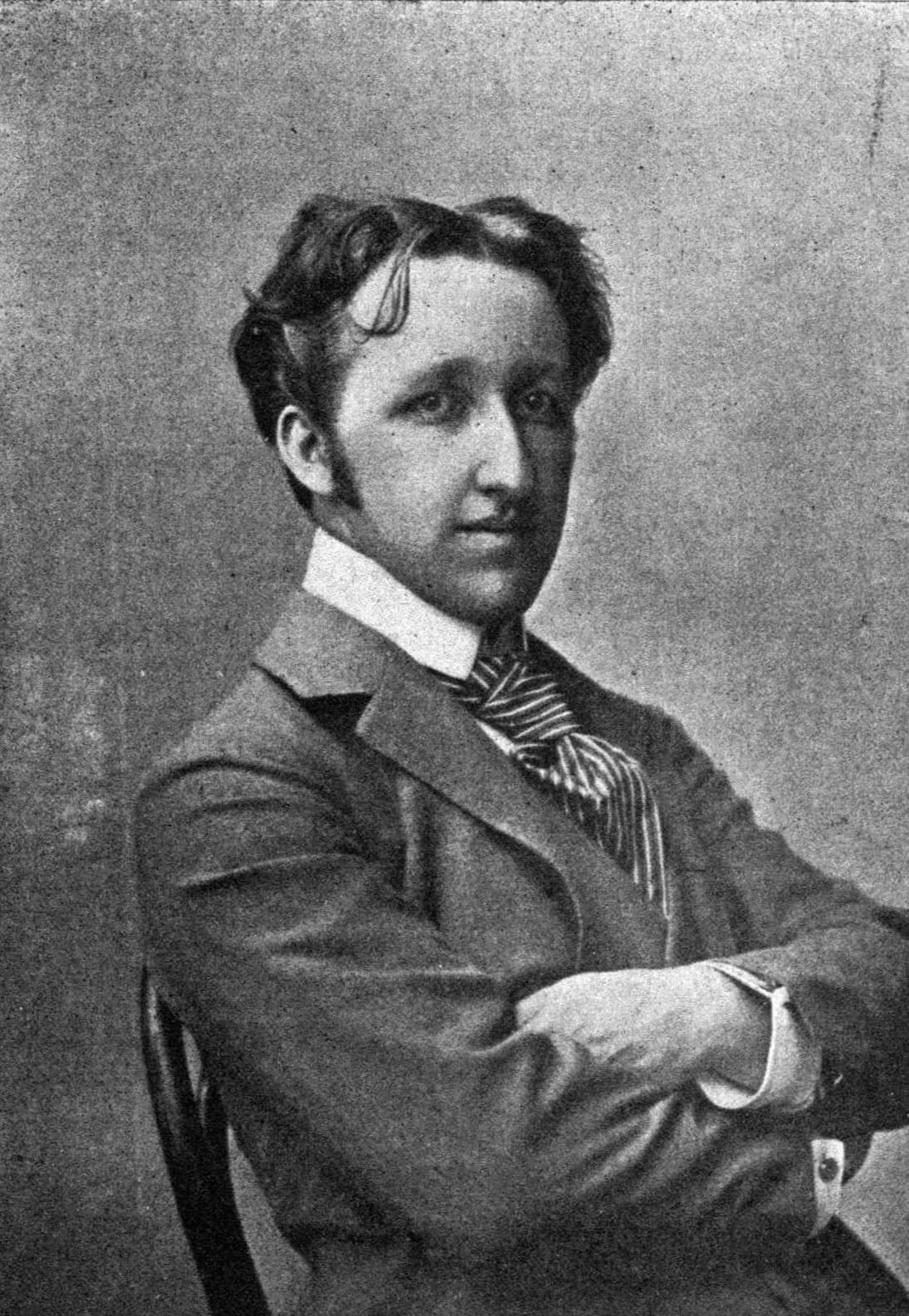
Siegfried Wagner in 1896 © Wikipedia
His first love was gay English composer Clement Harris. While they went on a long ocean voyage, he sketched out his tone poem Sehnsucht (“Longing”). The relationship didn’t last and Harris died young. But Wagner kept a picture of Harris for the rest of his life.
Wagner used his position of power at the Bayreuth Festival to attract queer men. Fearing scandal, when he was forty-five, his mother convinced him to marry a seventeen-year-old Englishwoman named Winifred Klindworth. They had four children between 1917 and 1920.
Winifred turned out to be one of Hitler’s best friends, and after her husband’s death, helped to cement a cultural connotation between Richard Wagner and anti-Semitism that has lasted into the present day.
Reynaldo Hahn (1874-1947)
French composer Reynaldo Hahn had warm feelings of friendship for several female superstars of the French Belle Epoque, extraordinary women like Cléo de Mérode and Liane de Pougy (who he bluntly told upon her marriage: “Goodbye Lianon. I hate married people”).
However, he was romantically attracted to men and had a relationship with Proust for two years. (This despite the fact that he was scornful of homosexuality in his private letters.) The two collaborated on the work Portraits de peintres together.
Later in life, his partner was an actor and singer named Guy Ferrant.
Dame Ethel Smyth (1858-1944)
English composer Ethel Smyth was always open about her many female crushes, an intense infatuation with Brahms’s married friend Elisabeth von Herzogenberg, and her adoration for poet Henry B. Brewster. She famously wrote to him, “I wonder why it is so much easier for me to love my own sex more passionately than yours.”
Smyth became a fixture in the British suffrage movement of the early twentieth century…and even, late in life, fell in love with Virginia Woolf!
Karol Szymanowski (1882-1937)
Composer Karol Szymanowski was so gay that he wrote a two-volume homoerotic novel called Efebos.
Pianist Arthur Rubinstein later remembered witnessing Szymanowski’s frank discussion of his sexual awakening: “Karol had changed; I had already begun to be aware of it before the war when a wealthy friend and admirer of his invited him twice to visit Sicily. After his return, he raved about Sicily, especially Taormina. ‘There,’ he said, ‘I saw a few young men bathing who could be models for Antinous. I couldn’t take my eyes off them.’ Now he was a confirmed homosexual. He told me all this with burning eyes.”
His third symphony, subtitled Song of the Night, is viewed as particularly homoerotic.
Lord Berners (1883-1950)
Lord Berners was an eccentric English composer, author, painter, and gentleman who was also gay.
In 1932 he fell in love with a daredevil eccentric named Robert Heber-Percy, and the two lived together at Lord Berners’s estate for decades…even, for a few years, with Heber-Percy’s wife and daughter.
Charles Tomlinson Griffes (1884-1920)
Charles Tomlinson Griffes was an American composer who studied in Berlin and, to pay the bills, worked as a teacher in Tarrytown, New York.
Although his sister destroyed some of his papers, surviving diaries written in German candidly discuss his gay life.
In Berlin, he had a relationship with a student named Emil Joèl. After he returned to America, he had a long-term relationship with a married New York City policeman named John Meyer.
Kaikhosru Shapurji Sorabji (1892-1988)
Sorabji is a fascinating figure: a wealthy English composer of Indian descent who was intensely private. He was one of the most prolific composers of his generation.
In 1920, while wrestling with his identity, he contacted sexuality expert Havelock Ellis, who helped him come to terms with his queerness. Sorabji dedicated his seventh piano concerto to him.
In the mid-1950s he settled down with Reginald Norman Best, the son of his mother’s friend. Sorabji called him “one of the two people on earth most precious to me”, and the couple’s ashes are buried together.
Henriëtte Bosmans (1895-1952)
Henriëtte Bosmans was a Dutch pianist and composer who, despite her bisexuality and Jewish ancestry, survived the Nazi occupation.
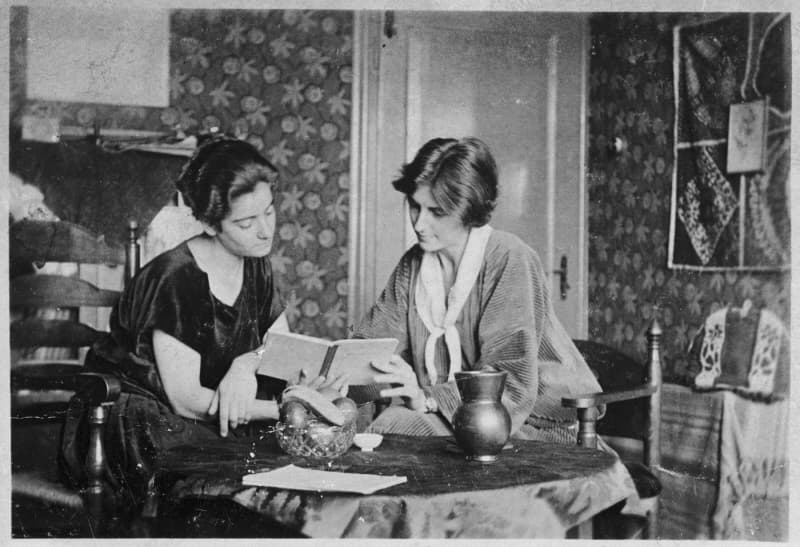
Henriëtte Bosmans and Frieda Belinfante
She had a relationship with lesbian cellist Frieda Belinfante in the 1920s and wrote works for her.
She later became engaged to a violinist named Francis Koene, but he died before their marriage.
Her last major relationship was with a singer named Noémie Pérugia, who inspired compositions.
Henry Cowell (1897-1965)
Henry Cowell was an exceptionally inventive American composer, but his career was interrupted by queer scandal.
In 1936 Cowell was arrested for having a sexual relationship with a 17-year-old boy. He made a full confession and was sentenced to fifteen years in prison.
Ultimately, thanks to good behavior and testimonials from his family and respected musicians, he got out four years later.
The prison experience was traumatic and seemed to suppress his earlier radical musical tendencies.
He married ethnomusicologist Sidney Robertson Cowell in 1941. She also helped to promote his musical legacy.
Francis Poulenc (1899-1963) relationships with men.
He sent a score of his work Concert champêtre to his lover, painter Richard Chanlaire, inscribed, “You have changed my life, you are the sunshine of my thirty years, a reason for living and working.”
He tried to marry his friend Raymonde Linossier, but she turned him down and then died in her early thirties, which devastated him. In 1946, a brief relationship with a woman named Fréderique Lebedeff led to a daughter.
Aaron Copland (1900-1990)
Aaron Copland single-handedly created a quintessentially American sound in works like Appalachian Spring, Rodeo, and Fanfare for the Common Man.
He kept his personal life intensely private, but those in the know were aware he had a series of younger boyfriends, usually artistically accomplished.
His deepest connection seems to have been with violin prodigy and photographer Victor Kraft. When Kraft later married and had a son, Copland became his godfather. He left a large amount of money for his godson in his will.
Samuel Barber (1910-1981)
The prodigiously talented composer Samuel Barber was studying at the Curtis Institute of Music when he met fellow student Gian Carlo Menotti, who was a year younger than him.
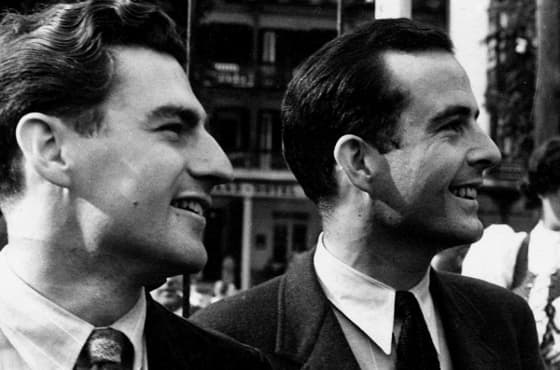
Samuel Barber and Gian Carlo Menotti © samuelbarberfilm.com
The two soon became inseparable. They bought a house together in Westchester County in New York, dubbing it Capricorn. It featured separate studios and a shared living and entertaining space.
They lived there together for forty years. When it was sold in 1973, Menotti decamped to Europe.
Gian Carlo Menotti (1911-2007)
Menotti was a talented composer in his own right, as well as a librettist and playwright. Although not many of his works are played today, his opera Amahl and the Night Visitors remains a Christmas classic.
Over the decades, his romantic interest wandered, to Barber’s displeasure and even humiliation.
In 1974, he began dating the much younger actor Francis Phelan. Presumably, to camouflage the true nature of the relationship, Menotti adopted Phelan as his son.
That said, Menotti still cared for Barber and was at his bedside when he died in 1981.
John Cage (1912-1992)
In the mid-1930s, experimental avant-garde composer John Cage met artist Xenia Kashevaroff. They married quickly and were together for ten years.
However, before his marriage, Cage had had same-sex relationships, and after his divorce, he returned to them.
He began dating choreographer Merce Cunningham, who became a creative collaborator as well as his life partner.
Benjamin Britten (1913-1976)
British composer Benjamin Britten was aware of his queerness as a young man and spoke about it to poet W. H. Auden, who encouraged him to embrace it.
Soon afterward, he met a tenor named Peter Pears. He was entranced. From that time on, the two spent their lives in a constant creative and romantic conversation.
In 1974, two years before his death, Britten wrote to Pears, “My darling heart (perhaps an unfortunate phrase, but I can’t use any other) … I do love you so terribly, not only glorious you, but your singing. … What have I done to deserve such an artist and man to write for? … I love you, I love you, I love you.”
Remarkably, upon Britten’s death, Queen Elizabeth II sent a letter of condolence to Pears.
David Diamond (1915-2005)
American composer David Diamond began his career as a violin prodigy.
He knew he was gay from an early age and never hid it.
He also had a tremendous temper. “I was a highly emotional young man, very honest in my behavior, and I would say things in public that would cause a scene between me and, for instance, a conductor,” he said.
His career hit a high point in the 1940s and 1950s but as modernism became more popular, he was eclipsed. Some also attribute the fading of his career to homophobia — others to his temper that made conductors disinclined to champion his work.
Lou Harrison (1917-2003)
Lou Harrison realized he was gay when he was in high school, and came out to his family in 1934.
In 1947 he had a nervous breakdown in New York City, in part from dealing with the homophobia of his colleagues. Fellow queer composer John Cage helped him find the mental health care he needed.
After getting back on his feet, Harrison moved to the West Coast and met his lifelong partner William Colvig, an electrician and amateur musician, in San Francisco in 1967.
Colvig helped him build a set of percussion instruments they called the “American gamelan.”
Harrison stayed with Colvig throughout the latter’s struggle with dementia and was at his bedside when he died.
Leonard Bernstein (1918-1990)
Leonard Bernstein is sometimes thought of as bisexual, given that he married actress Felicia Montealegre and had three children with her.
However, Montealegre thought differently. She wrote to him before their marriage, “You are a homosexual and may never change. I am willing to accept you as you are…”
His West Side Story colleague Arthur Laurents agreed with the terminology, calling Bernstein “a gay man who got married. He wasn’t conflicted about his sexual orientation at all. He was just gay.”
Pauline Oliveros (1932-2016)
Composer and accordionist Pauline Oliveros was openly lesbian. She had a romantic relationship with performance artist Linda Montano.
Conclusion
Some people believe it’s unfair to label composers who never publicly “came out” as a particular queer identity.
But keeping quiet about the people they loved does history a disservice, too. It makes generations of classical music seem straighter than it really is, especially since so much history was suppressed due to prejudice. Everyone interested in music history deserves to know what the historical record shows or suggests.
Hopefully seeing how many people in classical music history were or may have been LGBTQ+ will help people to have a fuller understanding of music history, and maybe even of themselves and the queer people in their own lives.