Total Pageviews

Tuesday, November 25, 2025

Music has the power to save the planet. Here’s how


Tom Service


Can music change our lives?

It’s the only question about music that really matters, even if it draws wildly different answers: can music change our lives? Yes, it can! It brings everything from social cohesion to harmony between nations; it improves maths scores, adds billions to the economy, and inspires our souls, spirits and intellects. Or… no it can’t! It’s auditory cheesecake of no evolutionary importance; it’s gloriously, aesthetically and emotionally powerful, but ultimately pointless, nothing more than an – admittedly engrossing – form of distraction.      

Mastering the Impossible: The Hardest Pieces of Classical Music
0 of 1 minute, 56 secondsVolume 0%
 

Music and the planet... flighting climate change and deforestation

But what if there was even more at stake: what if music could transform our relationship with the earth that sustains us? For composer Gabriella Smith, who also works as a climate restorer in her native California, a piece like her organ concerto, Breathing Forests, which had its British premiere at the BBC Proms this summer, isn’t just a metaphorical vision of the life-cycles of forests turned into musical form. For Smith, her music is a call to action.     

The shape of Breathing Forests, in which a forest grows, breathes and burns, is, she says, ‘a reflection on the complex relationship between humans, forests, climate change and fire’. Fire isn’t only the devastating, climate change-induced infernos of recent years; it’s also a vital, life-giving force of forest regeneration. The concerto ended with a breathtaking sound of hopefulness at the Proms, a gigantic, blazing radiance of major-key resolution; the forest of the orchestra and organ, and the physicality of the Royal Albert Hall, renewed.      

A connection with the planet... forged through music

The power of that moment, and the extremes of texture, volume and dissonance of organist James McVinnie’s performance with the BBC Symphony Orchestra were unforgettable. So what do we do with those memories and feelings, with that sense of connection to such powerful musical forces? They could become souvenirs of just another wonderful night at the Proms; they could open up journeys of exploration to hear more of Smith’s music; they could introduce you to repertoires of organ-inspired adventure that McVinnie has pioneered. 

But their power could go deeper. Maybe the sense of becoming part of these Breathing Forests of sound makes you think about the literal forests and elements of the earth that the instruments of the orchestra are made from. Perhaps you reflect on what that sense of being taken over by this music means: that it’s a revelation of our mutual interdependence, with each other as human beings and with every other species on earth, along with the planet’s climate and its geology.    

That means we have a responsibility to look after every aspect of the world’s biomes, whether ecological or musical. Maybe, just maybe, that’s how a piece of music could start to change the world – one consciousness at a time.      

Sunday, November 23, 2025

The New Solo Instrument: Bach’s Brandenburg No. 5

by 


The keyboard, however, has a dual role. It performs as part of the basso continuo for the full orchestral sections and is also a solo instrument with the violin and the flute. The first movement ends with a tremendous solo cadenza for the keyboard, leaving the other two solo instruments aside. Because of Bach’s own reputation as a keyboard virtuoso, it is thought that he was the soloist for the first performance. Bach, always the innovator, created in this work the model for what would become the solo keyboard concerto. He lifted the keyboard from its subordinate position as merely part of the basso continuo (which function it still holds here) into a leading role as a solo instrument.


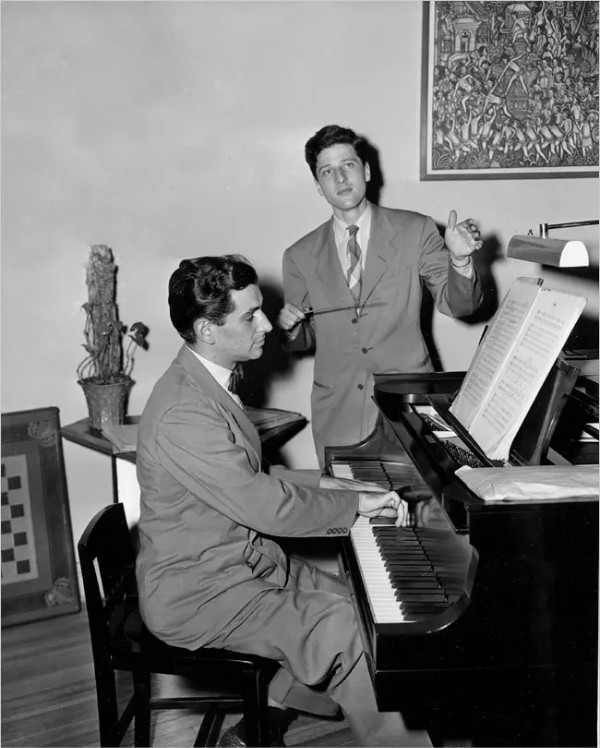
Lukas Foss with Leonard Bernstein at the piano, 1944

Lukas Foss with Leonard Bernstein at the piano, 1944

In this recording, made in 1957 in Boston’s Symphony Hall, The Zimbler Sinfonietta is under the direction of Lukas Foss, who is also the keyboard soloist. James Papoutzakis plays the flute, and George Zazofsky is the violin soloist.

Lukas Foss (1922–2009) was born in Germany and was quickly recognised as a child prodigy, beginning piano and music theory with Julius Goldstein in Berlin when he was only 6. With the rise of National Socialism, the family moved first to Paris and then, in 1937, to the US, where the family changed its name from Fuchs to Foss. He studied piano, composition, and conducting at the Curtis Institute and, in the summer, studied at Tanglewood with Serge Koussevitzky from 1939 to 1943, and also worked on composition with Paul Hindemith at Yale from 1939 to 1940. He was a lifelong friend of Leonard Bernstein, each conducting premieres of each other’s works. He followed Arnold Schoenberg as professor of Music at UCLA in 1953 and also taught at SUNY–Buffalo. As a conductor, he led the Buffalo Philharmonic Orchestra (1963–1970), the Brooklyn Philharmonic (1972–1976, the Jerusalem Symphony Orchestra (1972–1976), and the Milwaukee Symphony Orchestra (1981–1986). He taught at Boston University from 1991.

James Papoutzakis backstage with the BSO

James Papoutzakis backstage with the BSO

Flautist James Papoutzakis (1911–1979) played in the Boston Symphony Orchestra and Boston Pops, entering the orchestra in 1937 and remaining until 1978. He taught widely through the Boston area, including at all the major music schools.

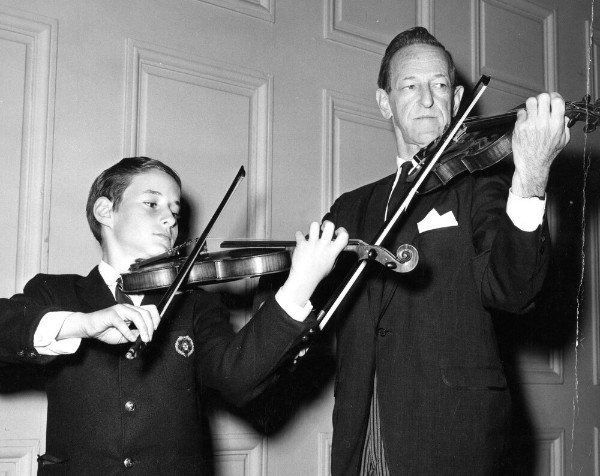
George Zazofsky and his son Peter

Zazofsky and his son Peter

George Zazofsky, a graduate of the Curtis Institute, joined the Boston Symphony upon graduation. As an activist, he founded the International Conference of Symphony and Opera Musicians (ICSOM), which became part of the American Federation of Musicians in 1969.

The Zimbler Sinfonietta was founded in 1947 by Joseph Zimbler, cellist of the Boston Symphony Orchestra. It held annual concerts in Boston at Jordan Hall, and Foss, Papoutzakis, and Zazofsky were all noted soloists with the ensemble. The ensemble was one of the first string groups to perform without a conductor.

Bach-Concerto Brandebourgeois n° 5, BWV 1050-Concerto pour piano, BWV 1052-Lukas Foss

Performed by

Lukas Foss
James Papoutzakis
George Zazofsky
The Zimbler Sinfonietta

Recorded in 1957

Official Website

8 Surprising Ways Classical Music Can Help You Focus and Study

by Emily E. Hogstad  November 20th, 2025


The right music selection can help you by boosting your mood, lowering your stress, and even improving your mental health.

What genre is the best for this purpose, though?

The science is still coming in, but classical music is an especially promising option.

classical music benefits for concentration

Here are eight surprising ways that classical music can help you focus and study.

1. Music can alter your brain chemicals in helpful ways.

Dopamine

© psychologistworld.com

When listening to music that you enjoy, your brain releases a neurotransmitter and hormone known as dopamine.

According to the Cleveland Clinic’s website:

Dopamine is known as the “feel-good” hormone. It gives you a sense of pleasure. It also gives you the motivation to do something when you’re feeling pleasure…

If you have the right balance of dopamine, you feel happy, motivated, alert, and focused.

In addition to encouraging the release of dopamine, listening to music can help suppress the production of the stress hormone cortisol. Cortisol spikes during stressful situations, and extended exposure to it can lead to anxiety, insomnia, and other symptoms.

Increasing dopamine levels and decreasing cortisol levels can help make it easier for your brain to focus.

2. Music helps us reach a balanced energy state.

Everyone knows how difficult it is to focus when you’re tired…or wired.

There’s a happy middle ground here, and the right kind of music can help you reach it.

Every classical music lover has listened to recordings that have calmed us down, and others that have pumped us up.

Using that fact to our advantage in our listening means that we can impact our energy levels as we’re trying to focus.

3. Music masks distractions.

Even if we manage to stay off our phones while working, there are still distractions all around us.

A dog might be barking down the street. Maybe you’re working in a coffee shop next to a loud espresso machine. Maybe you’re in your dorm or apartment, and you can hear your neighbours talking or fighting.

Even if you can work while these things are going on, just noticing them and anticipating them takes up a portion of your brain’s processing power.

Not only does listening to music help to obscure the most common distractions, it also creates a predictable kind of soundscape that frees up space to focus.

4. Genres with lyrics are distracting…and a lot of classical music doesn’t have them.

listening to music while studying

© theconversation.com

Many people claim that it’s difficult to concentrate on a task if they’re listening to music with lyrics.

Scientists are still learning about this phenomenon, but one 2023 study suggests that this might be true, depending on the task.

The abstract of “Should We Turn off the Music? Music with Lyrics Interferes with Cognitive Tasks” reads:

Music with lyrics hindered verbal memory, visual memory, and reading comprehension…whereas its negative effect on arithmetic was not credible.

The other genre the scientists tested – hip-hop lo-fi – was an instrumental one.

While listening to lo-fi didn’t improve participants’ performance, it also didn’t hinder it in the way music with lyrics did.

This is a preliminary study, and more research needs to be done about which genres and types of music might be helpful for specific kinds of tasks.

But it’s worth noting that a lot of classical music doesn’t employ singers or lyrics…making it an especially intriguing option for people who are experimenting with using music to improve their concentration.

5. Classical music can impact your brain waves. (Or at least some classical music can.)

According to one study:

The term “brain (or neural) oscillations” refers to the rhythmic and/or repetitive electrical activity generated spontaneously and in response to stimuli by neural tissue in the central nervous system.

(Another term for these oscillations is “brain waves.”)

Alpha waves are a type of brain wave associated with a relaxed but alert frame of mind: perfect for inducing focus.

Some music has been shown to encourage alpha waves.

One study in Rome was recently published in Consciousness and Cognition. It followed thirty participants who listened to Beethoven’s Für Elise and an excerpt from Mozart’s Sonata for Two Pianos in D-major, KV 448.   

According to the researchers:

The results of our study show an increase in the alpha power and MF frequency index of background activity in both adults and in the healthy elderly after listening to the Mozart sonata.

Interestingly, Beethoven’s Für Elise did not elicit the same response, suggesting that not all classical music might be equal when it comes to encouraging alpha waves.

6. The tempo of classical music can encourage a calm heart rate.

Healthy heart rate

© onlymyhealth.com

It can be hard to concentrate if you’re stressed out and have a fast pulse.

One technique to bring a pulse down to resting rate is to listen to music with the pulse rate you’re aiming for.

A healthy resting heart rate can vary widely depending on a person’s age, fitness, and gender, but a standard number to shoot for is around 60 beats per minute.

Interestingly, this is a common tempo for a wide variety of classical music. It’s especially common in slow movements from the Baroque era.   

7. The structure of a lot of classical music is very predictable, which enables our brains to focus more easily on other things.

A lot of classical music was composed by using formulas, especially in the Baroque era. These formulas and conventions have to do with tempo, dynamics, and structure generally.

The patterns that make up these formulas mean that the music is just predictable enough to give your brain something to latch onto, without distracting it.

8. Silence can be lonely. Classical music can provide companionship…and make tasks requiring concentration more appealing.

Many people prefer completing overwhelming tasks with supportive company.

Listening to classical music while completing a task can improve your working experience, especially if you are feeling isolated, overwhelmed, or unmotivated.

Most classical music is unamplified and non-electronic, enhancing its human qualities and making listeners feel especially close to the performer.   

Conclusion

There is a lot that scientists don’t know about how music affects people’s concentration. Hopefully, more studies will be undertaken in the years to come so that we can understand both its limitations and its power.

But until all of the science is in, one thing is for sure: classical music is one of the most promising genres to experiment with when you’re deciding what music will help you focus.