Total Pageviews

Showing posts with label Hector Berlioz. Show all posts

Friday, March 13, 2026

Hector Berlioz (Died on March 8, 1869): Mad Love, Music & Revolutionary Genius


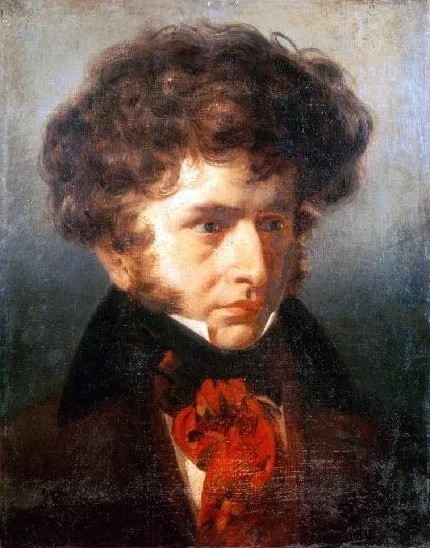
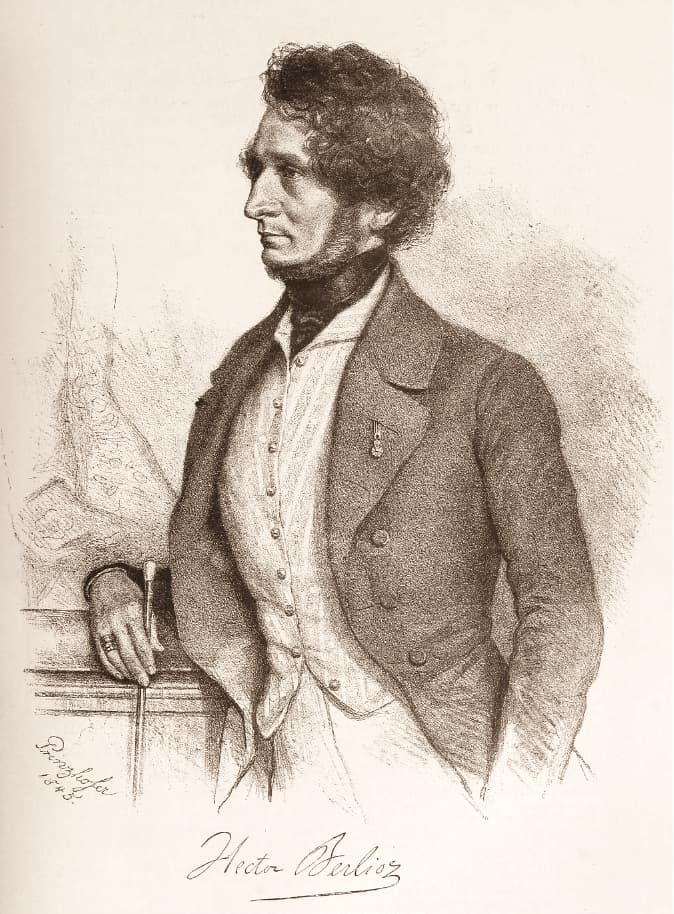
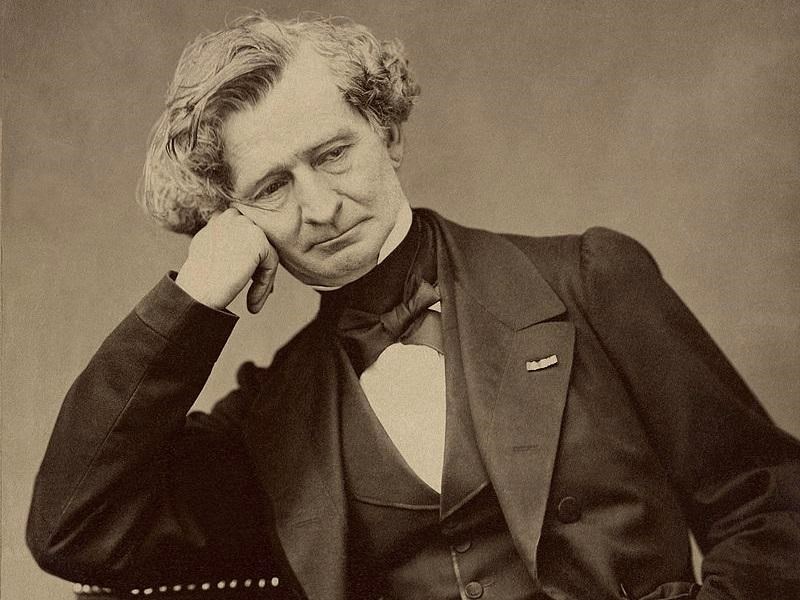
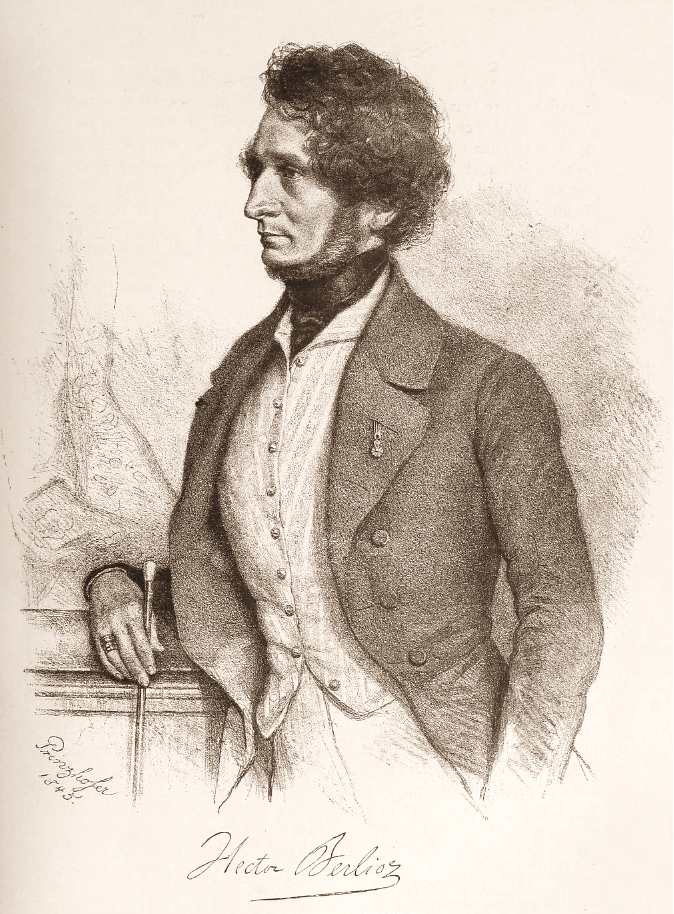
August Prinzhofer: Hector Berlioz, 1845

August Prinzhofer: Hector Berlioz, 1845

From this image, we can see so much about the man: his unruly head of hair, which so often figured in the caricatures of the time, his highly fashionable clothes, and the discrete medal worn on the lapel.

Berlioz was born in southwest France, in the département of Isère. His father was a doctor, and a medical career was planned for their sole surviving son. He was the eldest child and had two sisters, Nanci and Adèle, both of whom were close to their brother throughout their lives. He was educated at home by his father, and music had no important role but did have a place: he learned recorder (flageolet) and later took flute and guitar lessons. The major difference between Berlioz and his contemporaries is that he did not study keyboards and, later in life, he considered this to be one of his unique advantages, as he was not tied to ‘the tyranny of keyboard habits, so dangerous to thought, and from the lure of conventional harmonies.’

In 1821, Berlioz entered the School of Medicine at the University of Paris. His father gave him an ample allowance, and he used it to evade his hated anatomy lessons and attend the opera. Elements that would be important in his later career had the groundwork laid here: he admired Gluck’s use of the orchestra, he admired the staging and orchestral sound at the Paris Opèra, and so he set out to take formal music lessons. Accordingly, he became a private pupil of Jean-François Le Sueur, director of the Royal Chapel and professor at the Conservatoire.

In 1824, Berlioz graduated with his medical degree, which he promptly abandoned. His father suggested a law degree, which did not meet with his son’s favour. Father did not approve of a career in music and cut Hector’s allowance several times in an attempt to bend him to his will, but to no avail.

He started his composition career at the highest level with his first major composition, a Messe solennelle. This was followed by an opera, Les francs-juges. The mass was suppressed by Berlioz and only rediscovered in 1991. Les francs-juges was never performed and survives only in fragments, parts of it reused in other works.   

In 1826, Berlioz was admitted to the Paris Conservatoire, studying composition under Le Sueur and counterpoint and fugue with Anton Reicha. He immediately tried to win the Prix de Rome, which granted three to five years of study in Italy, funded by the state. His first three attempts at the Prix failed, and it was with his 1830 cantata, La mort de Sardanapale, that he was victorious.

In the meantime, Berlioz had been attending the theatre, and, despite not knowing any English, fell in love with Shakespeare and Harriet Smithson, the leading lady of Charles Kemble’s touring company. He pursued her for several years while she, wise one, refused to meet him.
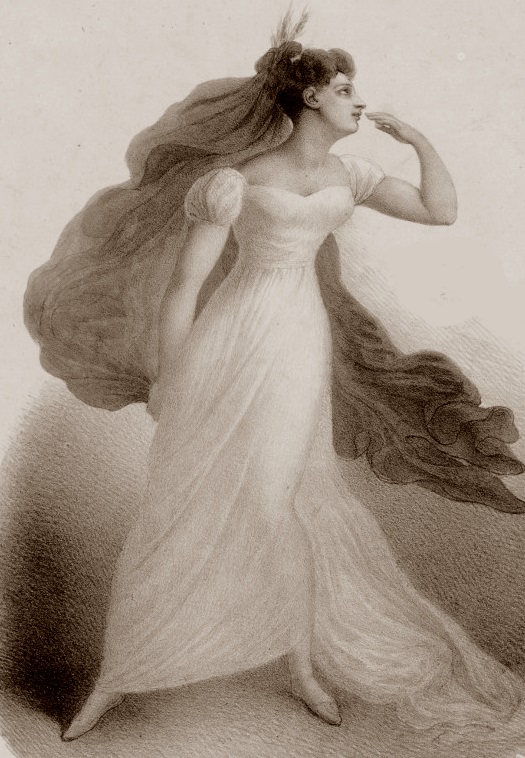
Martinet rue du Coq St Honoré: Harriet Smithson as Ophelia in Hamlet, 1827–1833 (Bibliothèque nationale de France, département Musique)

Martinet rue du Coq St Honoré: Harriet Smithson as Ophelia in Hamlet, 1827–1833
(Bibliothèque nationale de France, département Musique)

Turning aside from the unresponsive Smithson, Berlioz fell in love with a 19-year-old pianist, Marie Moke, known as Camille Moke, and they planned to wed.

In December 1830, was the premiere of the work for which he is best known today: Symphonie fantastique. This drug-dream of a work broke all of the traditional symphony rules and, in doing so, created a more dynamic symphonic world. Liszt was at the premiere and sought out this radical young composer. Their friendship would last for decades.

After settling in Italy with the Prix de Rome, Berlioz fled the city when he found out that Camille had broken off their engagement and was intending to marry a much better prospect than a music student. Her new intended was Camille Pleyel, the heir to the Pleyel piano manufacturing company. Berlioz rushed north, complete with plans to murder Marie and her mother, and collected poisons and a pistol (and a disguise) to accomplish this. After arriving in southern France, he reconsidered his plans and asked to return to Rome. This was granted, but while in Nice, he wrote his King Lear overture (more of the Shakespeare influence).  

Berlioz arrived back in Paris in November 1832 and, in December 1832, presented a concert of his works, including the overture of Les francs-juges, a revision of the Symphonie fantastique, and Le Retour à la vie (a sequel to the Symphonie fantastique), in which Bocage, a popular actor, declaimed the monologues. The room was full of celebrities, including Franz Liszt, Frédéric Chopin and Niccolò Paganini on the music side, and Alexandre Dumas, Théophile Gautier, Heinrich Heine, Victor Hugo and George Sand on the writers’ side. Also in attendance was Harriet Smithson, and so she was able to finally meet her long-time fan.

They not only met, but, 10 months later, married, the ceremony taking place at the British Embassy in Paris on 3 October 1833. On 14 August 1834, their only son, Louis-Clément-Thomas Berlioz, was born. Harriet could not return to the stage in Paris, mostly because of her inability to speak French fluently.

Berlioz’s time in Italy was instantly reflected in his music with works such as Harold in ItalyBenvenuto Cellini, Roméo et Juliette, Les Troyens, and Béatrice et Bénédict, all containing some of the sunshine and scenery of his visit.

Berlioz was commissioned by Niccolò Paganini for a viola work, and he responded with Harold in Italy, which Paganini turned down as there wasn’t enough viola, i.e., not enough Paganini, for the virtuoso’s taste. Paganini later regretted turning down the work. In one account, after a performance in Paganini’s presence, the great violinist, speechless due to his tuberculosis of the larynx, ‘…is said to have made clear to Berlioz his admiration of the work, kneeling before him and kissing his hand, and following this, the next day, by a present of 20,000 francs, brought to Berlioz by Paganini’s young son, Achille’.   

To make money, in addition to his music, he also took up music criticism. He hated the work but was very good at it. Although he complained that his time would be better spent on his own music and not that of others, he was able to express his hates and loves in the current music scene. These articles were collected from his books, such as Evenings with the Orchestra of 1854, and also formed the technical part of his Treatise on Ornamentation of 1844, still used today.

In the 1830s, Berlioz attempted to take on the Paris Opéra, as opera composers were much higher on the social scale than mere orchestral composers. Unfortunately, operas such as his Benvenuto Cellini (1838) were more difficult than current singers were willing to endure – a weak libretto and poor staging didn’t help.

This caricature gives some indication of how the work was regarded by critics for his attempt at ‘Grrrand Opéra’.
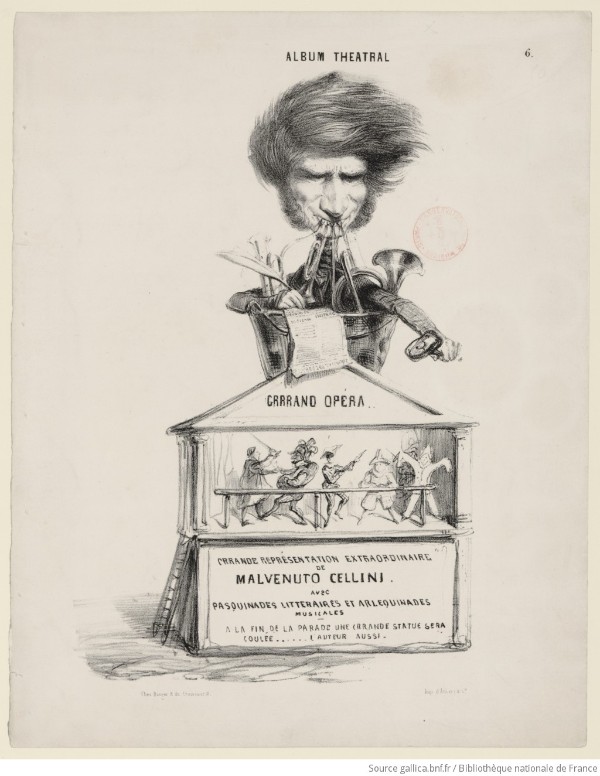
Banger: Hector Berlioz and Malvenuto Cellini, 1837 (Gallica, btv1b8415753f)

Banger: Hector Berlioz and Malvenuto Cellini, 1837 (Gallica, btv1b8415753f)

On the concert stage, however, his dramatic symphony Roméo et Juliette caught critics and composers’ ears alike. His huge instrumental and vocal forces impressed the young Richard Wagner, who used what he heard there to create his Tristan und Isolde.

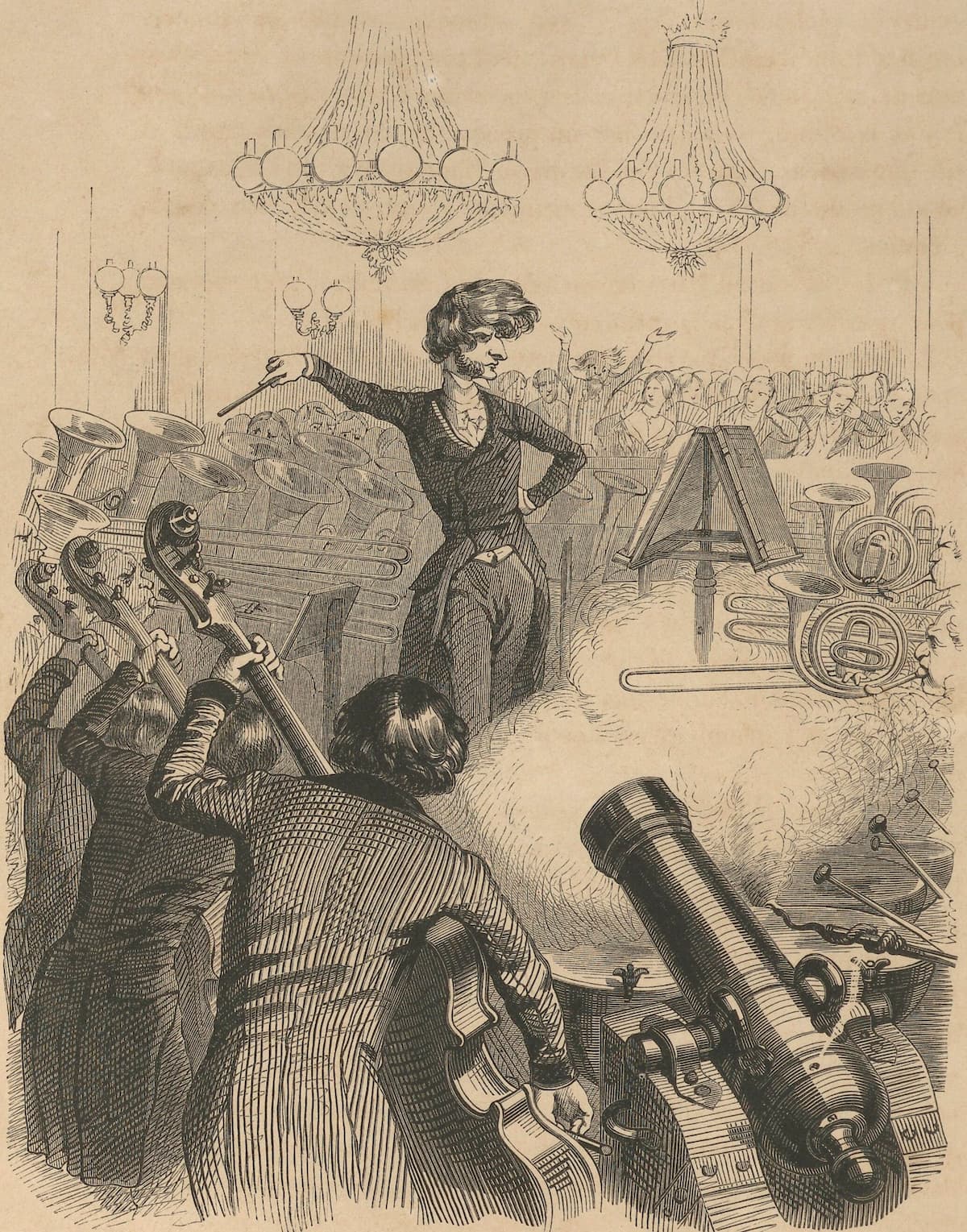
This caricature, where we will note the multitude of brass instruments and a cannon to add to the general uproar, as well as the audience, some of whom are shuddering away from the orchestra and covering their ears and others who are lifted to exult at the sound.
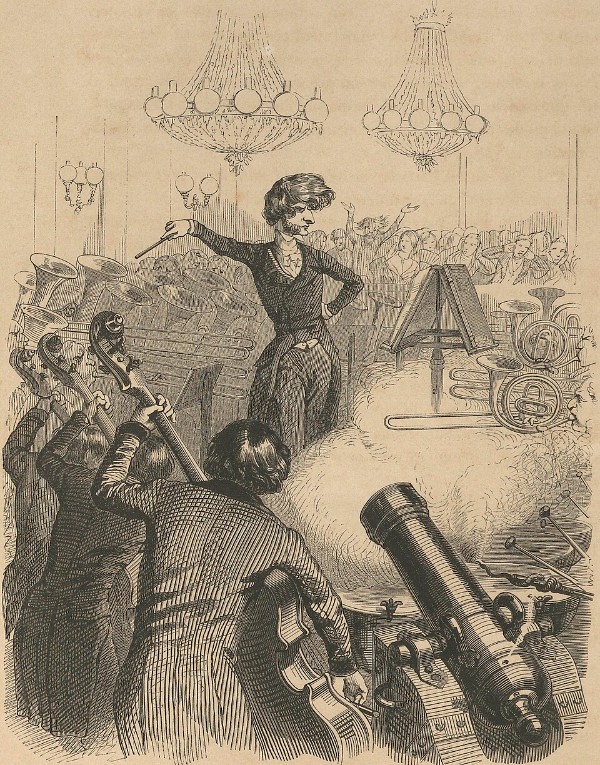
J.J. Grandville: Caricature of Berlioz from Louis Reybaud’s Jérôme Paturot à la recherche d'une position sociale, 1846 (National Library of Poland)

J.J. Grandville: Caricature of Berlioz from Louis Reybaud’s Jérôme Paturot à la recherche d’une position sociale, 1846 (National Library of Poland)

The 1840s saw some advancement in Berlioz’s career. The Paris Opéra hired him to update Weber’s Der Freischütz to a Paris standard; recitatives replaced the German dialogue, and the obligatory ballet was added, in this case, his orchestrations of Weber’s Introduction to the Dance. He wrote Les nuits d’été, based on the poetry of his friend Théophile Gautier. He started work on an opera to a libretto by Eugène Scribe, but never completed it. He published his influential Treatise on Instrumentation. He also discovered the joys of conducting his works on the international stage. The Germans were much more enthusiastic than his home audiences, and he could meet composers such as Mendelssohn and Schumann in Leipzig, Wagner in Dresden, and Meyerbeer in Berlin.

Unfortunately, his marriage with Harriet Smithson disintegrated due to both her jealousy over his success (and her sidelining) and her alcoholism, which became her comfort. He took a mistress, Marie Recio, and moved in with her in central Paris while Harriet kept their house in Montmartre.

His highly Romantic opera La Damnation de Faust hit the Paris stage in December 1846 but never brought full houses. Romantic operas were no longer the style of the day, and Berlioz hadn’t found the new key to the opera stage.

In mid-September 1848, Harriet suffered a series of strokes that paralysed her; Berlioz paid for the round-the-clock nursing and supported her until her death in 1854. That same year of 1854 saw his marriage to Maria Recio.

The summer of 1862, unfortunately, saw Marie Recio’s death. She was survived by her mother, who took care of the widower until his death.
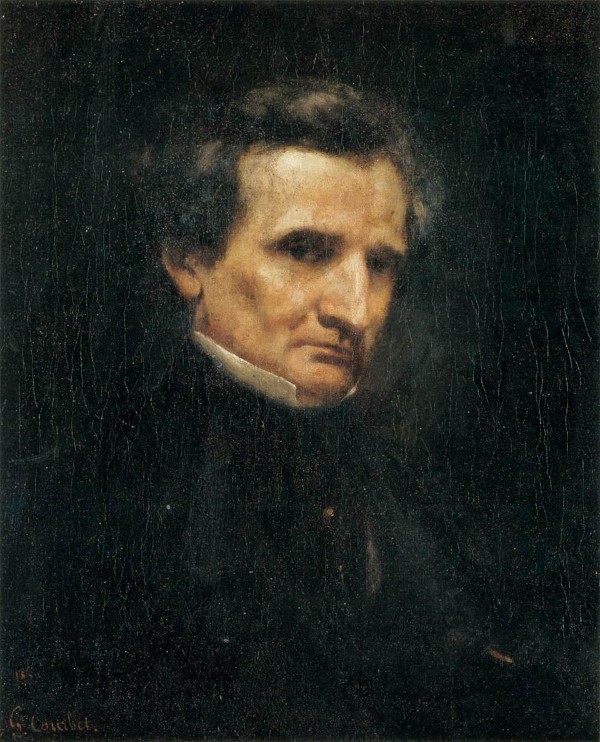
Gustave Courbet: Hector Berlioz, 1850 (Musée d’Orsay)

Gustave Courbet: Hector Berlioz, 1850 (Musée d’Orsay)

His last great opera came at the suggestion of Franz Liszt and Carolyne zu Sayn-Wittgenstein. They suggested he look to Homer’s Aeneid for inspiration. Thus was born the gigantic opera Les Troyens (The Trojans). Berlioz’s five-act, five-hour opera was too large for the Paris Opéra to consider, and he had to split the work over two nights: ‘The Fall of Troy’ and ‘The Trojans at Carthage’. The Trojans at Carthage received its premiere at the Théâtre‐Lyrique, Paris, in November 1863, but didn’t work. It had only 22 performances, and each night more and more was cut away. This so dispirited Berlioz that he wrote no more music after Les Troyens.   

Berlioz continued his conducting career but wore himself out during a tour to Russia and returned to Paris, never again to have his health. He died at home on 8 March 1869, at the age of 65. He’s buried in Montmartre Cemetery with Harriet and Marie.

In his life, Berlioz constantly took up arms against the normal, the calm, and called for the Romantic life of the heart. Mad love affairs were his norm, and even the pursuit of his first wife was more the actions of a fan than a responsible person. He pushed French music out from the shadow of the German school and created a style that definitely wore its heart on its sleeve. Works such as his Symphonie fantastique have no precedent and show a wild originality that no other composer matched.

His late arrival as a musician and composer, without the solid background of the keyboard that every other composer took for granted, produced a composer who had a wonderful melodic sense, matched with a flexible approach to musical rhythm. Above all, he was a master of orchestration and continues to lead through his writings on the subject.

March 8 sees the 157th anniversary of Berlioz’s death, and we should reflect on all the ways that, even now, we cannot match this most Romantic of composers.

Friday, February 20, 2026

6 of the Most Romantic Symphonies in Classical Music History


For one, a symphony can be stylistically of the Romantic Era – Romantic-with-a-capital-R, full of sweeping melodies, warm orchestral colour, and heart-tugging harmonies.

But a symphony can also be romantic in a more personal sense: when it springs from a composer’s love for someone – or even somewhere.

Today, we’re looking at six symphonies that are Romantic in both senses of the word: stylistically of the era, and emotionally rooted in a love story.

All six of these works remain among the most popular romantic symphonies in the classical repertoire.

Romantic classical symphonies

Berlioz – Symphonie fantastique (1830)

The Love Story

This symphony’s autobiographical program was directly inspired by Berlioz’s own tumultuous love life and romantic fixations.

In 1827, after seeing Irish actress Harriet Smithson perform the role of Ophelia in Shakespeare’s Hamlet, Berlioz became obsessively infatuated with her.

Although the production was in English, Smithson’s performance was so gripping that it electrified Parisian audiences.

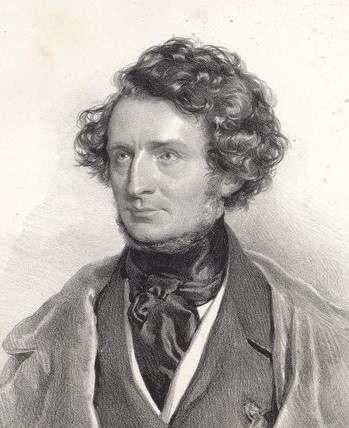
Hector Berlioz in 1832

Hector Berlioz in 1832

One audience member in particular was electrified: Hector Berlioz.

He fell in love not with Smithson as a person – he wouldn’t get to know her for quite some time – but rather with her talent and appearance, as well as the many Romantic Era ideals she represented.

While in the throes of this fixation, Berlioz channeled his infatuation into a symphony.   

The music is programmatic and, in Berlioz’s own words, follows a “young artist of morbidly sensitive temperament” (a not-so-subtle stand-in for himself) as he plunges from ardent passion into the depths of delusion.

The beloved’s tender theme (idée fixe) is first heard in the symphony’s opening movement, but it later curdles into a vulgar fiddle tune in the witches’ sabbath, symbolising how his idealised love has turned into a nightmare.

The orchestration here is noteworthy, featuring an expanded percussion section, new instruments like the English horn, and striking effects like col legno bowing, where string players tap the wood of their bows on the strings to create spooky sounds.

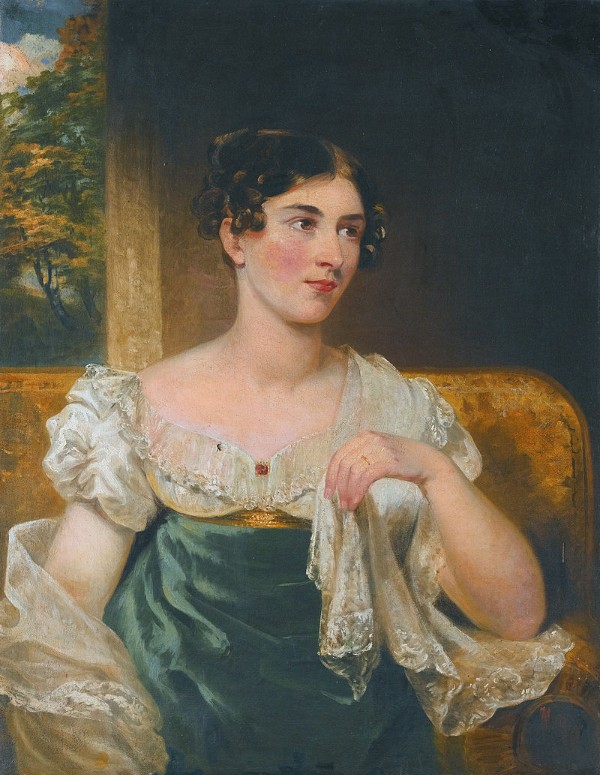
Harriet Smithson

Harriet Smithson

Berlioz kept trying to get Smithson’s attention. He sent her numerous letters and even went so far as to stalk her lodgings, to no avail. In fact, she didn’t even attend the symphony’s 1830 premiere.

However, two years later, she finally heard a performance. She was astonished that she had inspired such a work, and they soon began dating.

They married in 1833. The marriage collapsed within a matter of years. But this symphony, the spark of inspiration that signaled the start of their relationship, remains a revolutionary Romantic Era statement that out-survived their love – and them.

Mendelssohn – Symphony No. 4, “Italian” (1833)

The Love Story

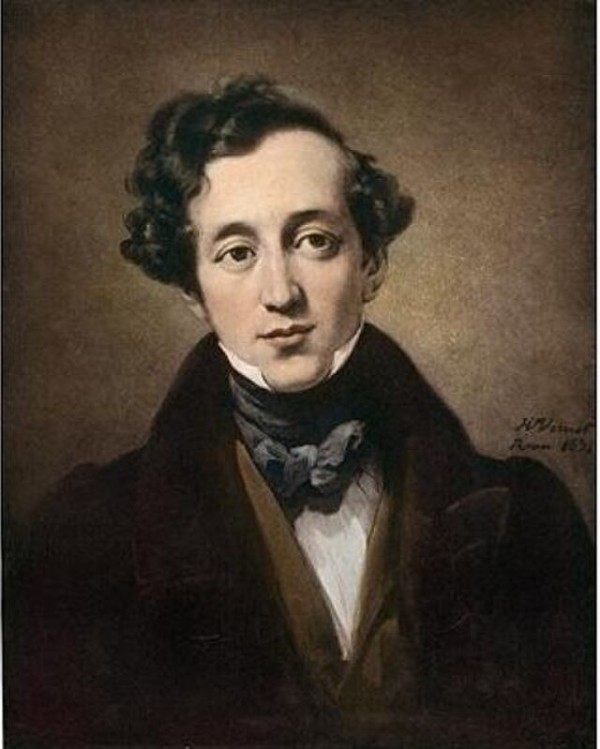
Horace Vernet: Felix Mendelssohn, 1831

Horace Vernet: Felix Mendelssohn, 1831

Felix Mendelssohn was not undergoing a tortured love affair while writing the Italian Symphony.

In fact, this work is more influenced by a place he loved than a person: the “romance” here is between the composer and Italy itself.

Mendelssohn’s letters from his 1830–31 Italian journey are ecstatic in their admiration.

“This is Italy! … the supreme joy in life. And I am loving it,” he wrote to his family.   

Each movement of the symphony takes on a different aspect of the life he observed in Italy. The joyful first movement is followed by a slow movement reflecting a religious procession he saw in Naples. The dance of the third movement is a standard minuet and trio, and the final movement incorporates two different Italian dances, the quick Roman saltarello (a jumping dance), and the Neapolitan tarantella.

Its joy makes it one of the most “Romantic” – if not overtly romantic – symphonies of the era. Read more about Mendelssohn’s Symphony No. 4.

Schumann – Symphony No. 1 “Spring” (1841)

The Love Story

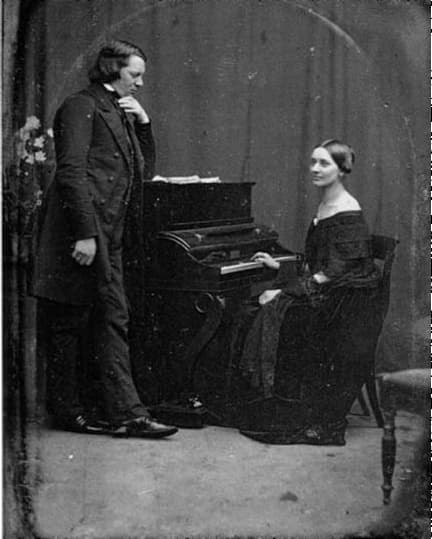
Robert and Clara Schumann

Robert and Clara Schumann

The “Spring” Symphony emerged from the happiest period of Robert Schumann’s life: his first year of marriage to pianist Clara Wieck.

After years of struggling to win the approval of Clara’s father, the star-crossed lovers were finally able to marry in September 1840.

This personal triumph sparked an extraordinary burst of creativity. 1840 had been Robert’s “Year of Song,” when he poured his love into over a hundred love songs.

But by 1841, with Clara’s encouragement, he had turned to the symphony.

She wrote in her diary:

“It would be best if he composed for orchestra; his imagination cannot find sufficient scope on the piano… His compositions are all orchestral in feeling… My highest wish is that he should compose for orchestra – that is his field! May I succeed in bringing him to it!”

As for his part, Robert later said that the work was inspired not just by spring’s external imagery but by his own “spring of love” (“Liebesfrühling”).   

Astonishingly, Schumann sketched this symphony out over just four days in January 1841. It exudes all of the exuberance you might expect from such an energetic start.

Schumann wanted the opening trumpet fanfare “to sound as if it came from on high, like a summons to awakening,” heralding spring’s (and love’s) arrival. This motto theme, bold and hopeful, recurs as a unifying idea.

He crafted music that somehow sounds like spring, featuring buoyant rhythms, anticipatory tremolo passages in the strings, and woodwind passages that resemble birdsong.

Throughout, the symphony’s tone is one of youthful hope, excitement, and, importantly, satisfaction. It’s very much in line with Romantic Era ideas and idealism about the rejuvenating power of both love and nature.

Tchaikovsky – Symphony No. 4 (1877)

The Love Story

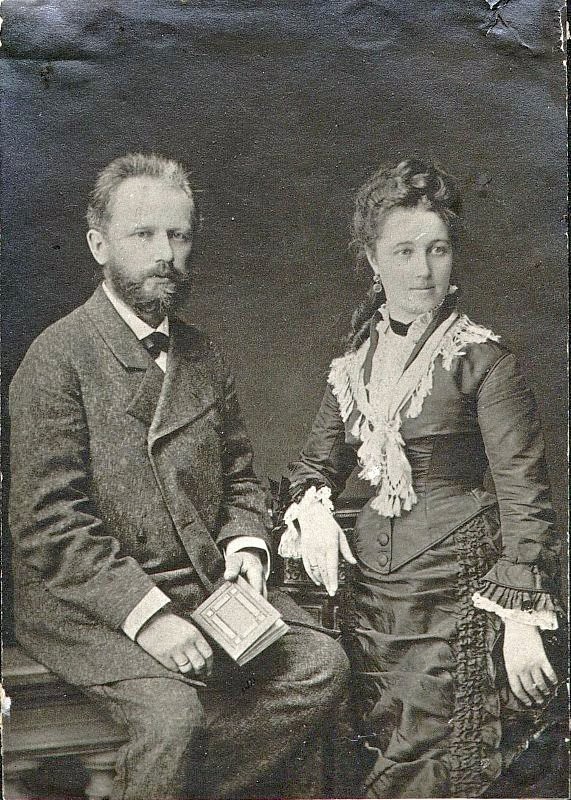
Tchaikovsky with his wife Antonina Milykova

Tchaikovsky with his wife Antonina Milykova

Few symphonies are as closely tied to a composer’s personal emotional life as Tchaikovsky’s Fourth.

Written in 1877, it coincided with a period of acute turmoil in Tchaikovsky’s romantic and emotional life.

That year, against his better judgment, Tchaikovsky entered into a hasty marriage with a young conservatory student, Antonina Miliukova – a marriage that proved disastrous and lasted only weeks before he fled her forever.

Tchaikovsky may have hoped marriage might quell rumours about his homosexuality, but the reality drove him to a nervous breakdown.   

During the aftermath of this catastrophic marriage, Tchaikovsky poured his inner despair and conflict into his fourth symphony.

He described the opening fanfare as the “Fate” that hangs over a person’s life: a concept that colored the entire symphony.

In a candid letter to his patroness and confidante, Nadezhda von Meck, Tchaikovsky admitted: “I was very depressed last winter when writing the symphony, and it is a faithful echo of what I was experiencing.”

Madame von Meck, who became Tchaikovsky’s benefactor in 1877, actually played a critical role in the symphony’s creation and the composer’s life at that particular time.

She provided financial support so he could quit teaching, along with an emotionally intimate – if strictly epistolary – friendship.

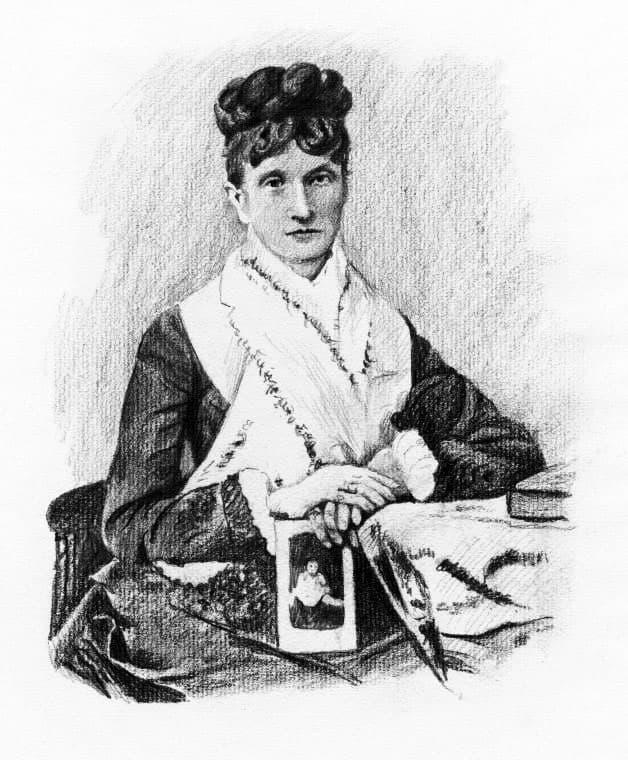
Nadezhda von Meck

Nadezhda von Meck

The dedication of the fourth symphony even reads “To my best friend”: Tchaikovsky’s tribute to von Meck, and a thank-you for helping to usher him through an especially trying time in his life.

It’s ironic that one of the most infamous marital breakdowns in classical music history inspired one of the standout symphonies of the Romantic Era.

Mahler – Symphony No. 5 (1901–02)

The Love Story

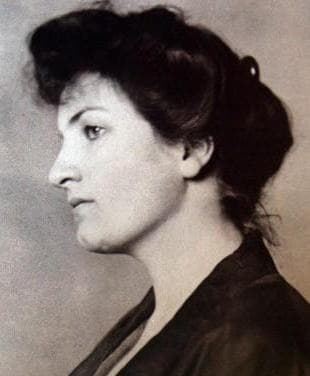
Alma Schindler in 1902

Alma Schindler, 1902

The years 1901–1902, when Mahler composed his Fifth Symphony, were momentous in his personal life, especially in terms of romantic love.

In November 1901, Gustav Mahler met Alma Schindler, a young composer and socialite from Vienna.

Their whirlwind courtship was intense; by March 1902, they were married. (Alma was pregnant at their wedding.)

This intense new love had a profound impact on Mahler, and we see its reflection most clearly in the symphony’s Adagietto.   

According to Alma’s testimony, the Fifth’s Adagietto (which starts at the 46:15 mark in the video above) was Mahler’s love song to her.

Historians have noted that Alma’s picturesque storytelling isn’t always strictly accurate, but the following story remains persuasive. Apparently, he left her a small poem with the Adagietto’s manuscript, saying: “How much I love you, my sun, I cannot tell you in words – only my longing and my love and my bliss.”

Today, the Adagietto is regarded as the wordless love letter from Mahler to his new wife, communicating in music what he felt he was unable to say in words.

It provides a transcendent counterbalance to the earthiness of the rest of the symphony, enhanced by its orchestration for strings and harp alone.

Rachmaninoff – Symphony No. 2 (1907)

The Love Story

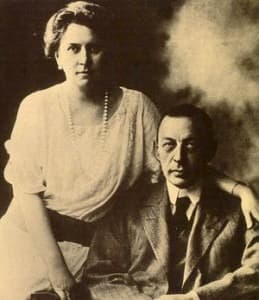
Sergei Rachmaninoff and Natalia Satina

Sergei Rachmaninoff and Natalia Satina

The creation of his Symphony No. 2 marked a particularly redemptive chapter in Rachmaninoff’s professional life: one shaped by the support and love he found in his marriage.

A decade earlier, in 1897, Rachmaninoff’s first symphony had premiered to disastrous reviews (one critic likened it to “a program symphony about the Ten Plagues of Egypt”).

The fiasco of that premiere sent the young composer into a deep depression and a creative block. He recovered only with the help of therapy and through composing his successful Second Piano Concerto (1901).

During that same period, he fell in love with and became engaged to Natalia Satina, his cousin and childhood sweetheart.

After overcoming significant obstacles (including family disapproval and Orthodox Church restrictions on cousin marriage), Sergei and Natalia married in 1902 on a rainy spring day.

By the time he was writing the second symphony in 1906, Rachmaninoff had been happily married for a few years and was a father. His first daughter, Irina, was born in 1903, and his second, Tatiana, was born in 1907.

Enjoying such a stable, loving home life provided Rachmaninoff with a foundation of emotional security that was crucial to his productivity after the turmoil of his earlier years.  

In late 1906, he and Natalia moved to Dresden specifically to escape the pressures of Moscow so that he could focus on composition in peace.

There, with his wife and daughter by his side, he worked on the symphony – though not without bouts of self-doubt.

At one point, he nearly abandoned the score, calling it “boring and repulsive” in a typical burst of self-criticism, before eventually returning to it.

It’s easy to imagine that the heartfelt outpouring of the symphony – especially its incandescent Adagio – was nurtured by the contentment and warmth of Rachmaninoff’s married life.

The triumphant premiere of the symphony in early 1908 in St. Petersburg was a vindication; the public and critics hailed it, and it earned Rachmaninoff a prestigious Glinka Award.

Today it remains one of the symphonic highlights of the late Romantic Era, beloved for its lush string writing and deeply felt, warmly expressed emotion.

Conclusion

Romanticism in symphonic music wasn’t just an artistic movement; it was also a way for composers to transform their private longing, devotion, and emotional crisis into publicly performed art.

From Berlioz’s hallucinatory passion in the Symphonie fantastique to Rachmaninoff’s newfound confidence in his Second, these six works reveal how love – fulfilled, frustrated, or otherwise – shaped some of the most powerful music of the Romantic Era.

Taken together, they show just how deeply composers’ love stories shaped their compositions, and why these pieces remain so easy to love even today.

Friday, December 12, 2025

Hector Berlioz (Born on December 11, 1803) and the Literary Muse


August Prinzhofer: Hector Berlioz, 1845

August Prinzhofer: Hector Berlioz, 1845

Berlioz’s music is dramatic, colourful, and intensely expressive, often telling stories or painting emotions so vividly they seem to leap off the page. What makes him truly fascinating is the way literature fuelled his imagination.

Writers like Goethe, Shakespeare, and Byron weren’t just influences; they were companions on his artistic journey, inspiring him to explore new forms of musical storytelling and to transform emotion into sound.

To celebrate his birthday on 11 December 1803, let’s explore how these three literary giants shaped his work, and why Berlioz’s music continues to captivate audiences nearly two centuries later.   

When Words Inspired Music

Hector Berlioz

Hector Berlioz

Berlioz grew up during a time when Romanticism was changing the way people thought about art, literature, and music. Romanticism celebrated emotion, imagination, individuality, and the dramatic aspects of life and nature. For Berlioz, literature wasn’t just something to read; it was the spark for musical ideas.

He devoured works from German, English, and French authors, letting their stories, characters, and emotions seep into his mind. In his music, he didn’t just set words to notes but translated the spirit of literature into sound.

Three writers stand out as especially important. Johann Wolfgang von Goethe, William Shakespeare, and Lord Byron each offered something unique. Goethe provided psychological insight, Shakespeare inspired dramatic spectacle, and Byron fuelled passionate intensity. These authors helped to shape Berlioz’s bold and innovative musical voice.   

Goethe’s Psychology

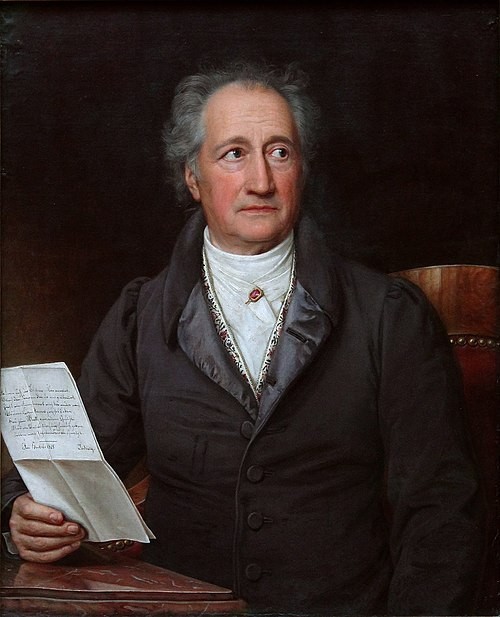
Joseph Karl Stieler: Johann Wolfgang von Goethe at age 79, 1828 (Neue Pinakothek)

Joseph Karl Stieler: Johann Wolfgang von Goethe at age 79, 1828 (Neue Pinakothek)

Johann Wolfgang von Goethe (1749–1832) fascinated Berlioz with his exploration of human emotion and inner conflict. Goethe’s works often delve into moral dilemmas, personal struggles, and the tension between desire and duty, topics that Berlioz found irresistible.

He was captivated by Goethe’s Faust, with its intense psychological depth and exploration of temptation, ambition, and redemption. In his dramatic legend La Damnation de Faust, the orchestra becomes an extension of Faust’s inner world.

From the brooding tension of Faust’s introspective moment to the fiery intensity of his devilish encounters, the music mirrors the constant struggle between desire and conscience. Melodic motifs reappear throughout the work as Berlioz transforms Goethe’s complex psychological landscape into a living and breathing musical experience.

Just as Goethe blended narrative, reflection, and dialogue in his plays, Berlioz created music where instruments, voices, and motifs interact like characters in a drama. His attention to detail, mood, and pacing reflects Goethe’s meticulous craftsmanship, proving that literature and music can be deeply intertwined.   

Shakespearean Drama

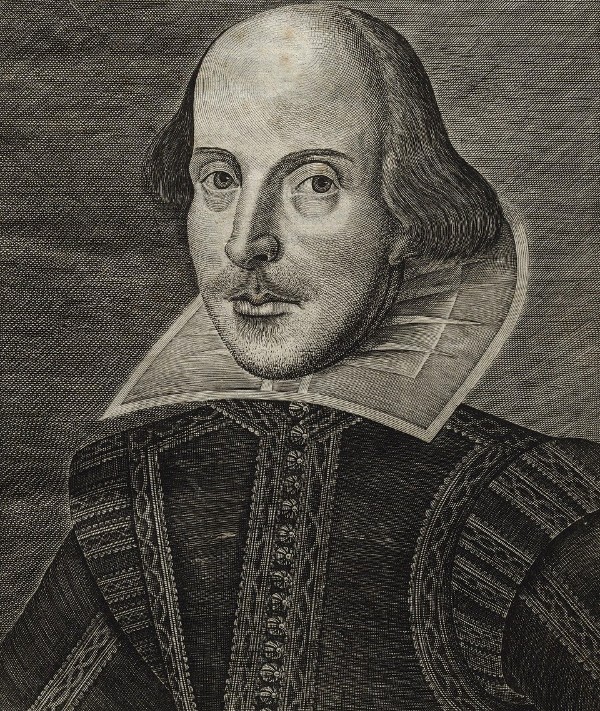
William Shakespeare

William Shakespeare

If Goethe shaped Berlioz’s inner emotional world, William Shakespeare (1564–1616) inspired his sense of drama and theatricality. Shakespeare’s plays are full of vivid characters, intense emotion, and unexpected twists, all qualities Berlioz sought to bring into music.

Berlioz’s opera Béatrice et Bénédict (1862), based on Much Ado About Nothing, puts the feisty, witty Béatrice and the clever Bénédict at its centre, showing how Shakespeare’s sharp characterisation and playful tension could be transformed into musical drama. Berlioz captures the characters’ personalities, their banter, and the slow-burning romance between them, turning Shakespeare’s comic brilliance into a vivid operatic experience.

In this opera, Berlioz also applies the pacing and tension of Shakespearean drama, making each scene feel like a self-contained story within the larger narrative. The characters are not simply singing; they are living, breathing, and reacting with all the emotional nuance Shakespeare endowed them with.

And just as Shakespeare occasionally introduced supernatural or fantastical elements into his plays, Berlioz infused his music with a sense of imagination and theatricality. In Béatrice et Bénédict, it is Shakespeare’s combination of clever wit, lively romance, and human depth that Berlioz channels to create an opera that feels both intimate and theatrically engaging.   

Byron’s Passion

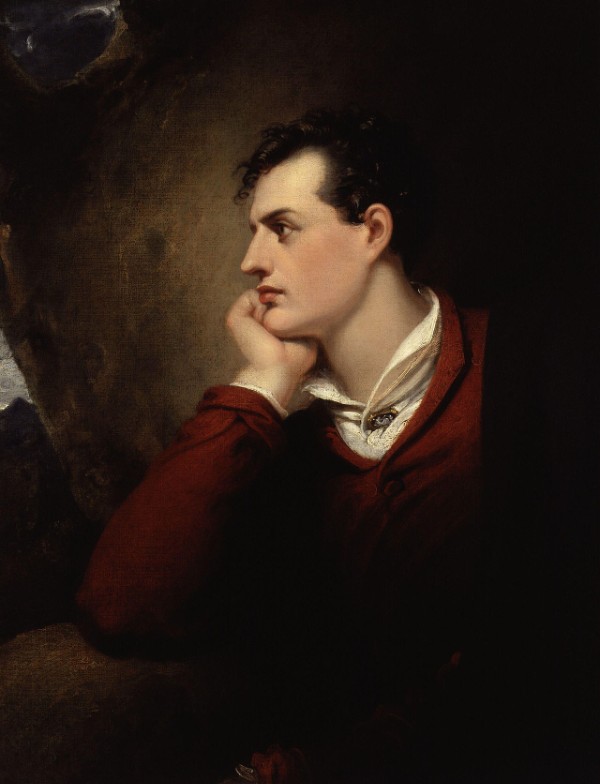
Lord Byron

Lord Byron

Lord Byron (1788–1824) added another layer to Berlioz’s artistic vision. Byron’s poetry was full of intense emotion, larger-than-life heroes, and struggles against fate or society. Berlioz, who was drawn to extreme emotions and dramatic narratives, found in Byron a perfect literary model.

Berlioz was particularly inspired by Byron’s Childe Harold’s Pilgrimage and Manfred. The brooding, tormented heroes in these works mirror the intensity found in Berlioz’s music.

The protagonist’s inner turmoil, moral struggles, and encounters with supernatural forces echo the Byronic hero’s emotional and existential battles.

Byron encouraged Berlioz to embrace boldness, not just in story but in music itself. The sweeping melodies, dramatic dynamics, and daring orchestration in Berlioz’s works can be seen as musical equivalents of Byron’s passionate poetry.    

Orchestra as Storyteller

Grandville: The Hall is Solid, It Can Take the Strain!

Caricature of Hector Berlioz conducting the orchestra

What makes Berlioz extraordinary is how he translated these literary influences into music. He didn’t simply set texts to notes; he absorbed the ideas and emotions from literature and expressed them through orchestration, harmony, and form.

The idée fixe, the recurring musical theme representing the beloved in the Symphonie fantastique, acts like a literary motif, threading through the narrative and expressing obsession, longing, and despair.

The music tells a story in a way only Berlioz could speak. In his operas and choral works, the orchestra itself becomes a storyteller, painting scenes and moods with remarkable clarity.

Berlioz’s engagement with literature also allowed him to challenge traditional musical structures. Rather than strictly following classical symphonic forms, he let the narrative and emotion dictate the music’s shape, creating works that feel organic, dynamic, and profoundly human.   

Crossing Disciplines

Berlioz’s deep literary connections helped redefine what music could do. He showed that orchestral and operatic works could not only entertain but also convey complex psychology, moral dilemmas, and vivid drama.

Later composers, from Wagner to Mahler, would build on this idea, but Berlioz was among the first to fully realise it in the Romantic era.

His example also demonstrates the power of artistic cross-pollination. Literature and music are often taught as separate disciplines, but for Berlioz, they were inseparable.

By translating the spirit of Goethe, Shakespeare, and Byron into sound, he created music that is intellectually stimulating, emotionally compelling, and endlessly imaginative.

Literature, Passion, and Musical Brilliance

As we approach Hector Berlioz’s birthday on December 11, it’s a perfect time to celebrate not only his genius but the literary forces that inspired it. Goethe offered insight into the human heart, Shakespeare brought drama and theatricality, and Byron fuelled passion and Romantic heroism.

Berlioz took these influences and transformed them into a musical language that speaks directly to our emotions, telling stories with a vividness that few composers have matched.

Nearly two centuries later, his music still surprises, excites, and moves audiences around the world. It is a testament to the power of literature, imagination, and the unique genius of a man who could hear the poetry of words and turn it into unforgettable sound.

Wednesday, April 9, 2025

Top 10 Romantic composers


Top 10 Romantic composers

Gramophone
Thursday, January 2, 2025

The Romantic period was one of the most innovative in music history, characterised by lyrical melodies, rich harmonies, and emotive expression. Here's our beginner's guide to the greatest composers of the Romantic period

Hector Berlioz (1803-69)

The arch-Romantic composer, Hector Berlioz’s life was all you’d expect – by turn turbulent and passionate, ecstatic and melancholic.

Key recording:

Les Troyens 

Sols incl DiDonato, Spyres, Lemieux; Strasbourg Philharmonic Orchestra / John Nelson (Gramophone's 2018 Recording of the Year) Read the review

Explore Berlioz:

Top 10 Berlioz albums – 10 great Berlioz recordings by Sir Colin Davis, John Nelson, Régine Crespin, Robin Ticciati and more


● Top 10 Baroque composers

● Top 10 Classical era composers

● Top 10 Renaissance composers


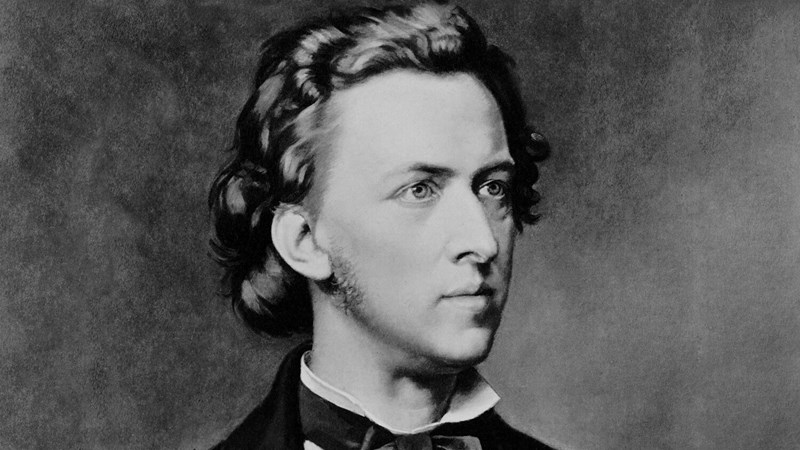
Fryderyck Chopin (1810-49)

Few composers command such universal love as Fryderyck Chopin; even fewer still have such a high proportion of all their music in the active repertoire. Yet he is the only great composer who wrote no symphonies, operas, ballets or choral works. His chief claim to immortality relies not on large scale works but on miniature forms.

Key recording:

Piano Concertos No 1 & 2 

Martha Argerich pf Montreal Symphony Orchestra / Charles Dutoit (winner of the Gramophone Concerto Award in 1999) Read the review

Explore Chopin:

The 10 greatest Chopin pianists – Stephen Plaistow recalls the illustrious recorded history of Chopin's oeuvre and offers a personal view of great Chopin interpreters.


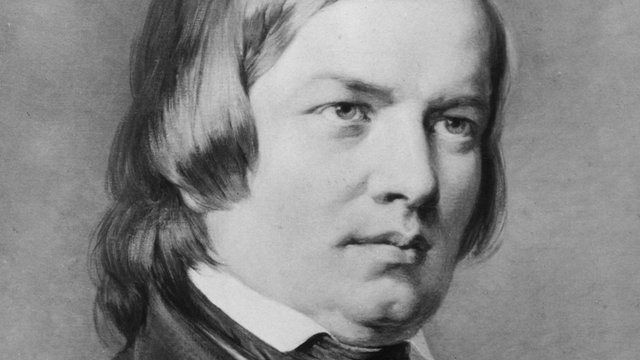
Robert Schumann (1810-56)

Robert Schumann is a key figure in the Romantic movement; none investigated the Romantic’s obsession with feeling and passion quite so thoroughly as him. Schumann died insane, but then some psychologists argue that madness is a necessary attribute of genius.

Key recording:

Symphonies Nos 1-4 

Chamber Orchestra of Europe / Yannick Nézet‑Séguin (Editor's Choice, May 2014) Read the review

Explore Schumann:

Robert Schumann: the story of his prolific ‘year of song’ – Richard Wigmore explores the music of and biography behind Robert Schumann’s miraculous year of song, 1840


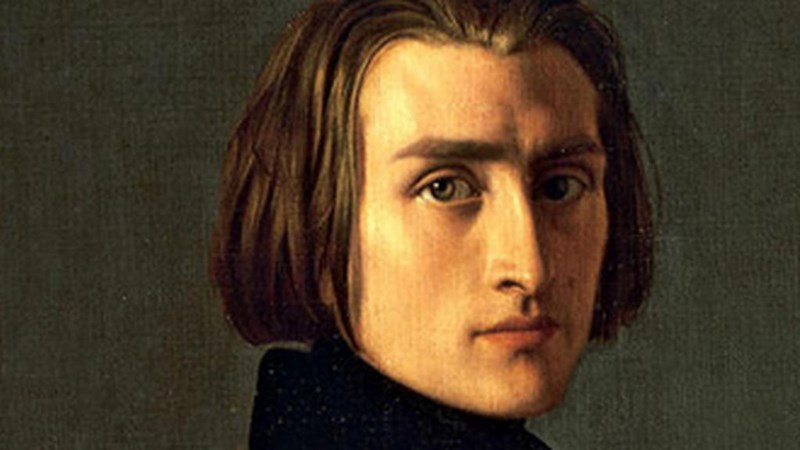
Franz Liszt (1811-86)

Composer, teacher, Abbé, Casanova, writer, sage, pioneer and champion of new music, philanthropist, philosopher and one of the greatest pianists in history, Franz Liszt was the very embodiment of the Romantic spirit. He worked in every field of music except ballet and opera and to each field he contributed a significant development.

Key recording:

'Transcendental: Daniil Trifonov plays Franz Liszt'

Daniil Trifonov pf (Recording of the Month, October 2016; shortlisted for Instrumental Award 2017) Read the review

Explore Liszt:

Podcast: exploring the music of Liszt – Editor Martin Cullingford is joined by Gramophone writer and expert on both Liszt and the piano, Jeremy Nicholas to discuss the composers's greatest works, and the greatest recordings of his music. 


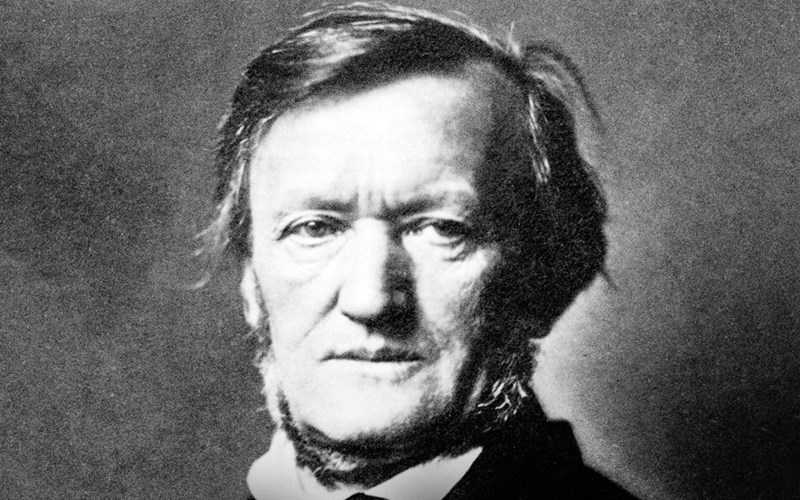
Richard Wagner (1813-83)

No composer has had so deep an influence on the course of his art, before or since. Entrepreneur, philosopher, poet, conductor, one of the key composers in history and most remarkable men of the 19th century, Richard Wagner knew he was a genius. He was also an unpleasant, egocentric and unscrupulous human being.

Key recording:

Parsifal

Sols incl Jess Thomas, George London, Hans Hotter; Bayreuth Festival Chorus & Orchestra / Hans Knappertsbusch Read the review

Explore Wagner:

The Gramophone Collection: Wagner's Ring – Mike Ashman visits the musical immortals and the younger gods of today to deliver his verdict on the complete Ring on record.


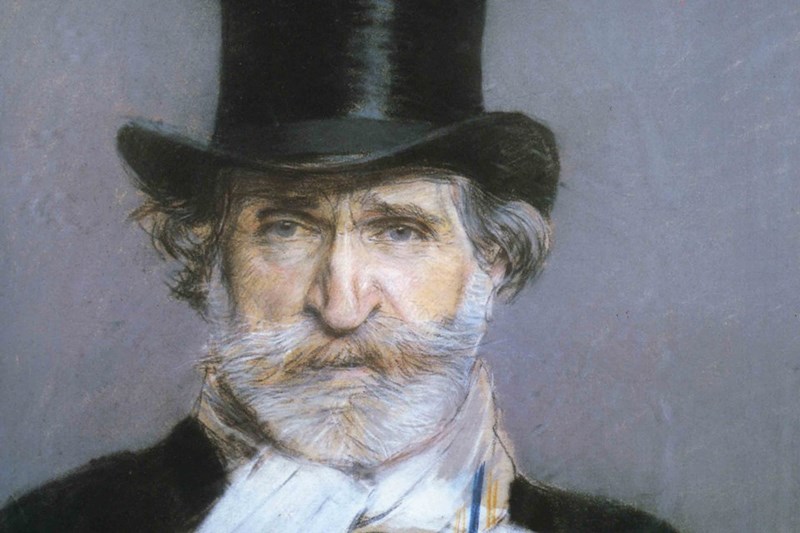
Giuseppe Verdi (1813-1901)

Giuseppe Verdi was never a theoretician or academic, though he was quite able to write a perfectly poised fugue if he felt inclined. What makes him, with Puccini, the most popular of all opera composers is the ability to dream up glorious melodies with an innate understanding of the human voice, to express himself directly, to understand how the theatre works, and to score with technical brilliance, colour and originality.

Key recording:

Aida

Sols incl Anja Harteros, Jonas Kaufmann, Ekaterina Semenchuk; Coro dell'Accademia Nazionale Di Santa Cecilia, Orchestra dell'Accademia Nazionale di Santa Cecilia / Antonio Pappano (winner of the 2016 Gramophone Opera Award; Recording of the Month, Awards issue 2015) Read the review

Explore Verdi:

Verdi's Otello: a guide to the best recordings – Richard Lawrence finds at least three very special Otellos, and some electric conducting.


Anton Bruckner (1824-96)

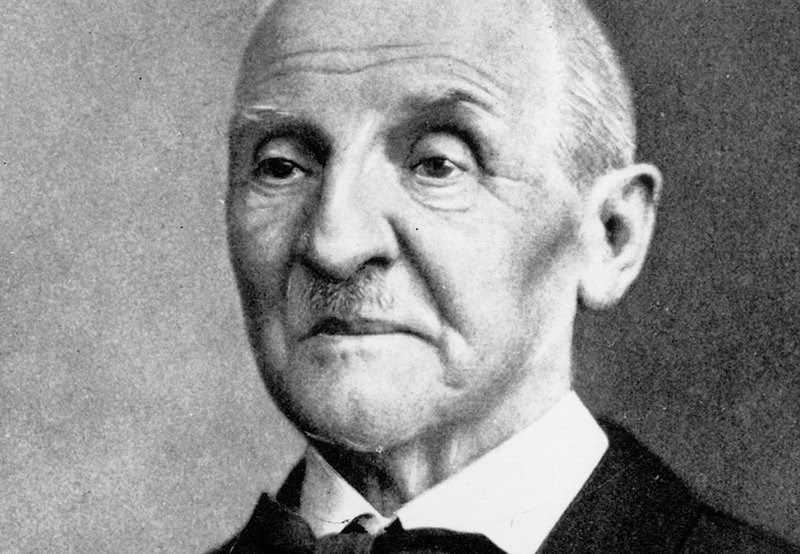
Anton Bruckner’s reputation rests almost entirely with his symphonies – the symphonies, someone said, that Wagner never wrote.

Key recording:

Symphony No 9

Lucerne Festival Orchestra / Claudio Abbado (Gramophone's 2015 Recording of the Year) Read the review

Explore Bruckner:

Top 10 Bruckner recordings – A beginner's guide to the music of one of the great symphonic composers.


Giacomo Puccini (1858-1924)

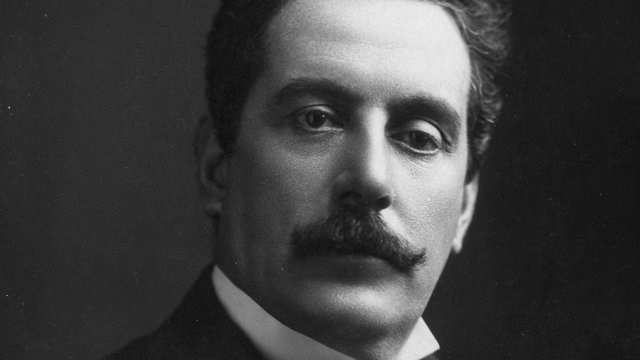
Whatever the atmosphere he wanted to create, Giacomo Puccini’s sound world is unique and unmistakeable with its opulent yet clear-cut orchestration and a miraculous fund of melodies with their bittersweet, tender lyricism. His masterly writing for the voice guarantees the survival of his music for many years to come.

Key recording:

Tosca

Sols incl Maria Callas, Giuseppe di Stefano, Tito Gobbi; Orchestra and Chorus of La Scala Milan / Victor de Sabata Read the review

Explore Puccini:

Maria Callas: the Tosca sessions – Maria Callas’s famous 1953 Tosca, as Christopher Cook reveals for the first time, was riven by tension and driven by a relentless quest for perfection.


Pyotr Il'yich Tchaikovsky (1840-93)

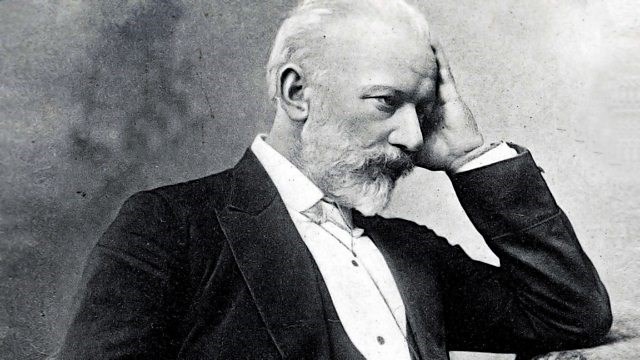
Tchaikovsky is the most popular of all Russian composers, his music combining some nationalist elements with a more cosmopolitan view, but it is music that could only have been written by a Russian. In every genre he shows himself to be one of the greatest melodic fountains who ever lived.

Key recording:

Symphony No 6, Pathétique

MusicAeterna / Teodor Currentzis (Recording of the Month, January 2018) Read the review

Explore Tchaikovsky:

Tchaikovsky's 1812 Overture: the complete guide – How audiences, performers and the composer himself have responded to this iconic and surprisingly controversial work, by Geoffrey Norris.


Johannes Brahms (1833-97)

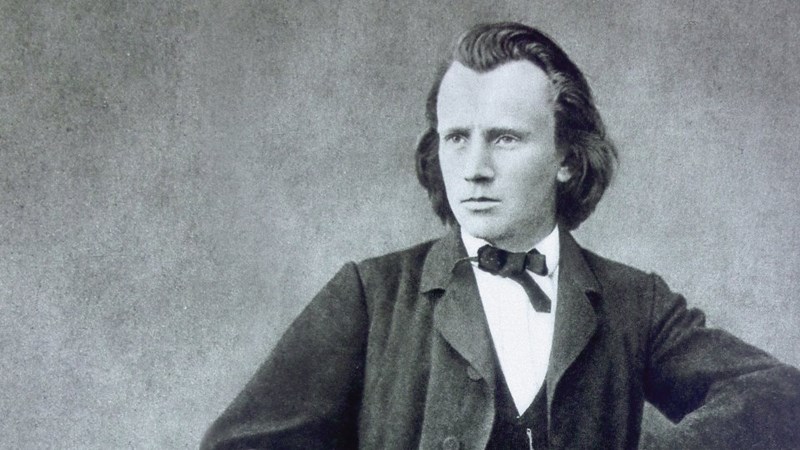
One of the giants of classical music, Johannes Brahms appeared to arrive fully armed, found a style in which he was comfortable – traditional structures and tonality in the German idiom – and stuck to it throughout his life. He was no innovator, preferring the logic of the symphony, sonata, fugue and variation forms.

Key recording:

Symphonies (Complete)

Gewandhaus Orchestra / Riccardo Chailly (Gramophone's 2014 Recording of the Year) Read the review

Explore Brahms:

Brahms's Symphony No 3: a guide to the best recordings – Richard Osborne surveys the finest recordings of the Third Symphony