Vistas de página en total

Mostrando entradas con la etiqueta Elgar. Mostrar todas las entradas

viernes, 20 de marzo de 2026

Why Can’t Classical Music Look Ahead


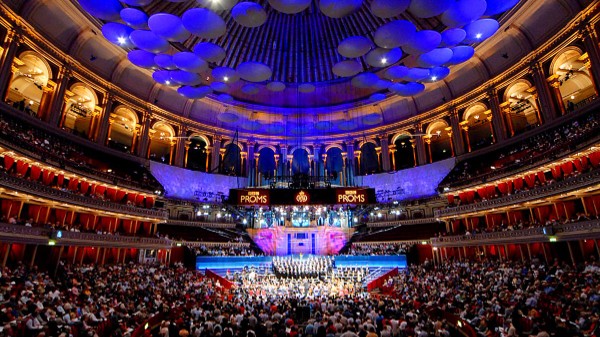
In the United Kingdom only, a quick skim through current musical programmes allows one to assess that most of the music performed in concert halls focuses on past composers. Surely, the amount of living composers has never been greater. Especially in the United Kingdom. Yet, all major events, such as the BBC Proms, focus on the past. The old sells. The last night of the Proms in 2025 will see Mussorgsky, Hummel, Gounod, Dukas and of course Britten and Elgar, and many others.

But it is not just in the United Kingdom, opera houses around the world often focus their seasons on a composer of choice, focusing on the catalogue and looking at less famous works. These are still the works of past composers. In 2025, it is Puccini and Handel who will take the frontline at the Paris Opéra.
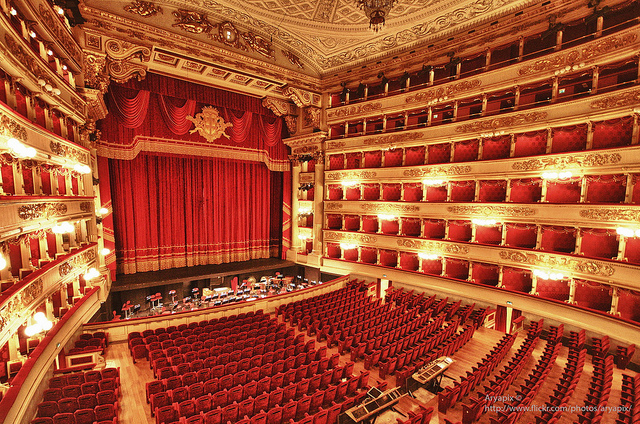
Opera house

© opera-diary.com

Out of all the currently living composers, very few are allowed the entrance to concert halls pre-mortem, it seems. They are, for most of them, only allowed in the smaller venues. And when they get the keys to the major houses, it is only after years of battling for a place with their ancestors.

However, this has not always been the case historically. Just like popular music today, classical music used to be focused on the new, on composers working towards getting commissions and progressing, on music that was being created in the moment.

Composers were not expected to live off the same material forever, but rather to come up with new and exciting music. The competition was tough too — each composer wanted to work for the finest patron, crown or church. The most important names, BachHandelMozartHaydnBeethoven, and so on, all performed like that.

As Western classical music grew out of Christianity, it was intended to accompany religious services, and coming up with new dedicated material was the daily expectation of the appointed composers. The repetition of the old was not advised either. Music was dedicated to God and a testament of dedication and discipline.
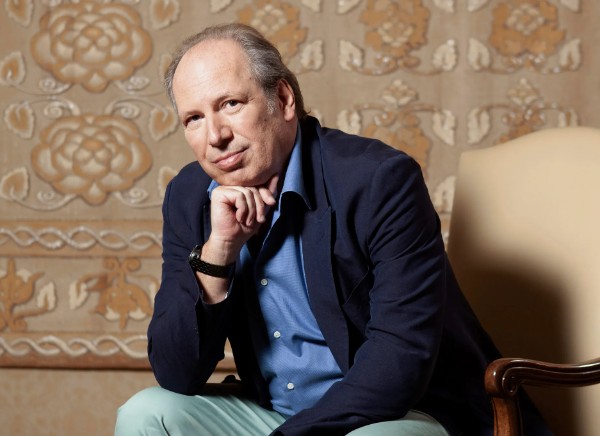
Hans Zimmer

Hans Zimmer

But then music, over the centuries and just like many things, became an industry… and entered the world of Hollywood. So much so that today some of the most successful composers are in fact film composers, such as Zimmer. The irony of it all is that now film music has entered the concert hall, and rather than taking up space in cinemas, it takes life in music venues. It is quite common to see listings of soundtracks being performed in their entirety, to the projected film, or not. What a three-hundred and sixty surprising twist; music for images, without the images.

Bach was not brought to the forefront before Mendelssohn exposed him again to the world, and most composers after their death would fall into oblivion. It was all about the new, until somehow, it shifted towards the old. Somehow, a fascination for the past, rather than the present, developed. But the promotion of old music in disfavour of new music is not a consequence of a lack of quality from existing composers. In fact, there are a plethora of immensely talented composers all over the world. Inventive, creative and curious musicians who perhaps deserve a better place in concert halls…

viernes, 18 de julio de 2025

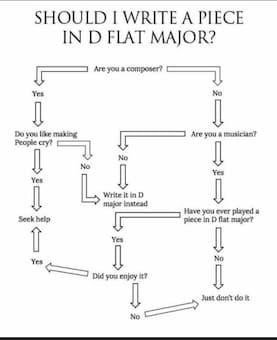
Why D-Flat Major Should Be One of Our Favorite Keys

 by Janet Horvath

D-flat Major“What? D-Flat Major?” Most string players wail, “that’s a key signature with FIVE FLATS!

I don’t blame them. It’s so much more difficult to play in tune on string instruments without the resonance of the open strings.

Pianists, though, will be elated. They get to play on all of the black keys. Numerous composers have used D-flat major to depict lush, dreamy sounds, and to explore the richness and depth of expression imaginable in this key.

Perhaps you know that many composers associated specific emotions with certain keys. The key of E-flat major is a case in point, a key that is considered heroic. Think Beethoven’s Symphony No. 3 The Eroica, Strauss’ Ein Heldenleben, a Hero’s Life, and dozens of string quartets and symphonies by Haydn, Sibelius, Elgar, Dvořák, Mozart, Bruckner, Shostakovich, Mahler.

Let’s explore the richness and depth of expression imaginable in this key

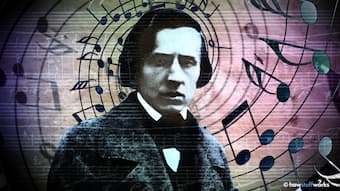
Frédéric Chopin © Getty Image

One of the most famous piece for piano in D-flat is the Chopin Prelude Op. 28 No. 15 “Raindrop.” Chopin did not ascribe the name to this prelude. It begins hushed and pensive, and the affecting melody leaves us in a subdued mood. It turns suspenseful, becoming more chordal and powerful. The right hand continues the inexorable rhythm and generates the feeling of inevitability with its repeated and steady A-flats that seem to imitate raindrops. But the opening melodic line returns reassuring us, and the piece resolves peacefully. Whatever you imagine when you hear it, there is no denying the emotions generated.

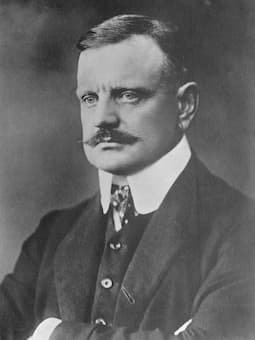
Jean Sibelius

Jean Sibelius

Romance in D-flat is an exquisite piece by Sibelius. Upon first hearing, you might think it’s a work of Chopin and I wouldn’t blame you. It’s amorous with flourishes and emotions you would associate with Chopin. Sibelius is not necessarily known as a solo piano composer. Ten pieces make up Sibelius’ Opus 24, composed between 1895 and 1903, and they are stunning. Diverging from his huge symphonic works puzzled Sibelius’ children too who asked him why he wrote these solo piano works, he responded, “In order for you to have bread and butter.”    

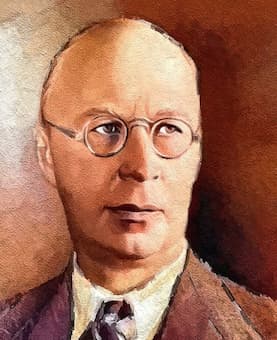
Sergei Prokofiev

Sergei Prokofiev © Esoterica Art Agency 2018

Written in 1901 as a birthday gift, the D-flat major Romance has been published and performed separately. The Andantino opens with a two-bar chordal introduction in the right hand with a lyrical cello-like melody entering in the left hand. It’s gorgeous. The middle section becomes vibrant and agitated with octaves and chords marked with accents on each note, and the instruction, “forte crescendo possible.” A cadenza with rapid notes, is breathtakingly dramatic. The magnificent resonance achieved in this piece is due in part to the pianist flying all over the black keys.

Prokofiev Piano Concerto No. 1, Op. 10 was composed in 1911, and is dedicated to the Russian composer, pianist, and conductor, the “dreaded Tcherepnin” with whom Prokofiev worked at the St. Petersburg Conservatory. Although the piano concerto is only fifteen minutes long, in one movement, Prokofiev marked eleven distinct sections of varying tempos and disposition. From charm to the grotesque, every mood is depicted. The piece begins as it ends with an expansive, yearning, and deliberate theme in D-flat major with heart-thumping punctuation in the timpani. Electrifying octaves in the piano bring the piece to a finish.

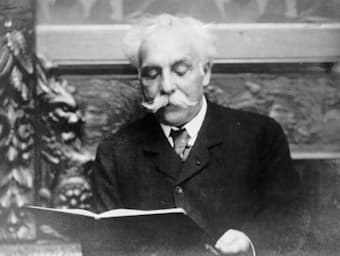
Gabriel Fauré

Gabriel Fauré

Gabriel Fauré Cantique de Jean Racine, Op. 11 is a work for mixed chorus and piano or organ, with lyrics by the 17th-century poet Racine. A version for strings and harp is breathtaking. The text “Verbe égal au Très-Haut” or Word One with the Highest, is from a Latin hymn “O Light of Light” attributed to the fourth century bishop of Milan, St. Ambrose. The refined and sublime piece hints at the music of the Requiem Fauré composed later in life. Only 20 years old when he composed this piece, we are assured of his position as one of the greatest composers of French choral music when we hear the Cantique. A dazzling lilting melody opens the piece. The chorus enters with the lowest voices first and gradually expands to include the higher voices. After another interlude of the instruments alone, Fauré continues this technique and we experience a ravishing series of colors, dynamics, and textures, enhanced by the resounding key of D-flat.

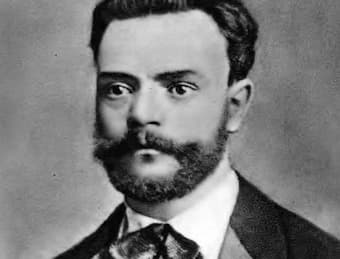
Antonín Dvořák

Antonín Dvořák

Dvořák Scherzo Capriccioso Op.66 B.131, is an orchestral work composed in 1883. The D-flat major key allows the composer to explore not only the Czech folk music we usually expect but a more dark, opaque, and restless mood. Featuring a full complement of instruments such as the harp, triangle, English horn, and bass clarinet, Dvořák achieves a brilliant variety of tone colors and wondrous melodies, his forte. The English horn solo is especially poignant.


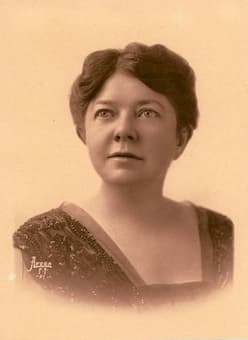
Amy Beach

Amy Beach © Amybeach.org

Some composers actually see colors when he or she hears certain keys or pitches, a condition called synesthesia, in other words the perception of one sense through another. Amy Beach was one of these composers and D-flat major, for Beach, represented the color violet, traditionally associated with wealth, royalty, and the divine. The first section of her 1925 work Canticle of the Sun a cantata for chorus, soloists, and orchestra Op. 123, sets a thirteenth century text by St. Francis of Assisi. The piece begins Lento con Maesta, with the feelings of searching, of hesitancy, and then bursts into the key of D-flat major—the strong D-flat major chord used on the word “God” imbuing the word with wonder and veneration. The use of the key here is powerful as well as opulent.

I’m convinced and I hope you are too. D-flat major should be considered one of our favorite keys!