Jumlah Paparan Halaman

Memaparkan catatan dengan label Clara Schumann. Papar semua catatan

Jumaat, 27 Mac 2026

10 of the Saddest Piano Pieces in Classical Music History

 by Emily E. Hogstad,  March 23rd, 2026


In addition to the inherent sadness of the music itself, we’re also going to look at what was happening in the lives of the composers around the time they wrote each of these pieces.

As you’ll see, many of the saddest piano pieces in classical music history were shaped by grief, upheaval, illness, exile, or personal crisis.

From Bach’s years in mourning, to Mozart’s frightening leap into independence, to Chopin’s terminal illness, to Brahms’s late-in-life loneliness, and to Rachmaninoff’s experience of the Russian Revolution, every piece on this list – whether deliberately or not – captures a composer’s reaction to a time when life got overwhelming.

J.S. Bach – Prelude in B-minor, arranged by Alexander Siloti (1722)   This piece has a unique background.

Nineteenth-century Russian pianist Alexander Siloti took Bach’s Prelude and Fugue in E-minor from the Well-Tempered Clavier and rearranged it in B-minor: a darker and more mysterious key.
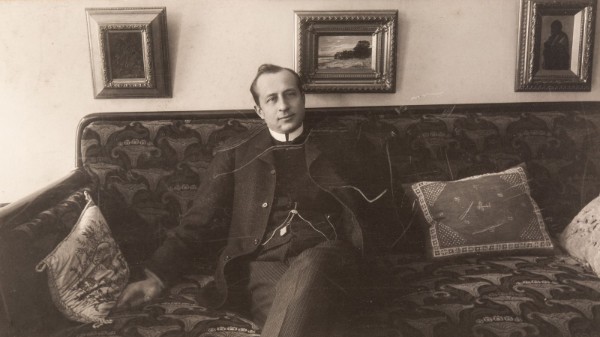
Alexander Siloti

Alexander Siloti

Bach wrote the Well-Tempered Clavier in 1722, a pivotal year in his life.

It’s hard to say exactly what he was feeling emotionally at this time, because none of his personal letters or diaries has survived.

But his wife Maria Barbara had died shortly before, in the summer of 1720. She was only 35 years old and had given birth to seven of his children.

Maybe he drew on his grief when writing this particular movement. We’ll never know. But it’s certainly one of the most melancholy piano pieces ever written.

Mozart – Fantasy in D-minor, K. 397 (1782)   

This unfinished fantasy comes from 1782, the year after Mozart disobeyed his loving but controlling father’s wishes and relocated to Vienna to start a hugely risky freelance career.

To help support himself, he taught aristocratic patrons and wrote works to play in glittering salons to entertain them. There was no guarantee his plan was going to work.
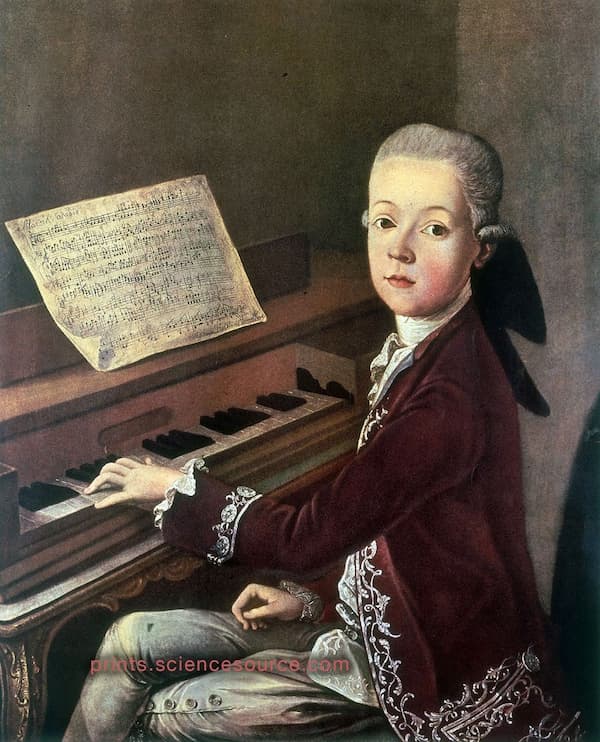
The D-minor Fantasy captures emotions one might feel in a moment of transition: worry, restlessness, and a willingness to improvise.

If it seems unfinished, that’s because it is. We don’t know why, but Mozart abandoned the piece before completing it.

Another composer tacked on ten measures after Mozart’s death, making the work playable in concert and bringing the work to a close – albeit an abrupt one.

The fragmentary quality that results mirrors the unsettled, transitional quality of Mozart’s life in 1782…and the unsettled quality of any listener going through a similar life change.

C.P.E. Bach – Fantasia in F-sharp-minor (c. 1787)   

The melancholic, virtuosic Fantasia in F-sharp-minor was written near the end of C.P.E. Bach’s career, while he was serving at the court of Frederick the Great.

By the mid-1780s, C.P.E. Bach had spent his entire career in the shadow of his father J.S. Bach, the greatest giant of the Baroque Era. (His mother, by the way, was the wife that Bach had lost in 1720.)
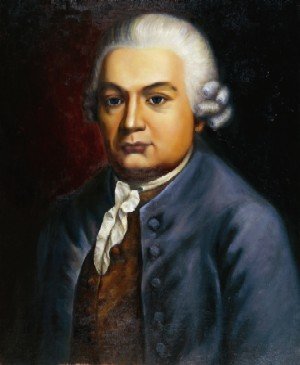
C.P.E. Bach

Carl Philipp Emanuel Bach

Meanwhile, his students would become well-known composers during the Classical Era.

He was one of the composers who had built a bridge between the two generations.

It’s very possible that he was reflecting on his life and legacy around the time he wrote this confessional fantasia, with its unpredictable surging sighs that ultimately all collapse into melancholy meanders.

Chopin – Nocturne No. 13 in C-minor, Op. 48, No. 1 (1841)  

In 1841, Chopin was at the height of his artistic maturity, but facing increasing physical frailty, thanks to his tuberculosis diagnosis.

He and his lover, authoress George Sand, had settled into a domestic rhythm in Paris and at her family home in rural France.
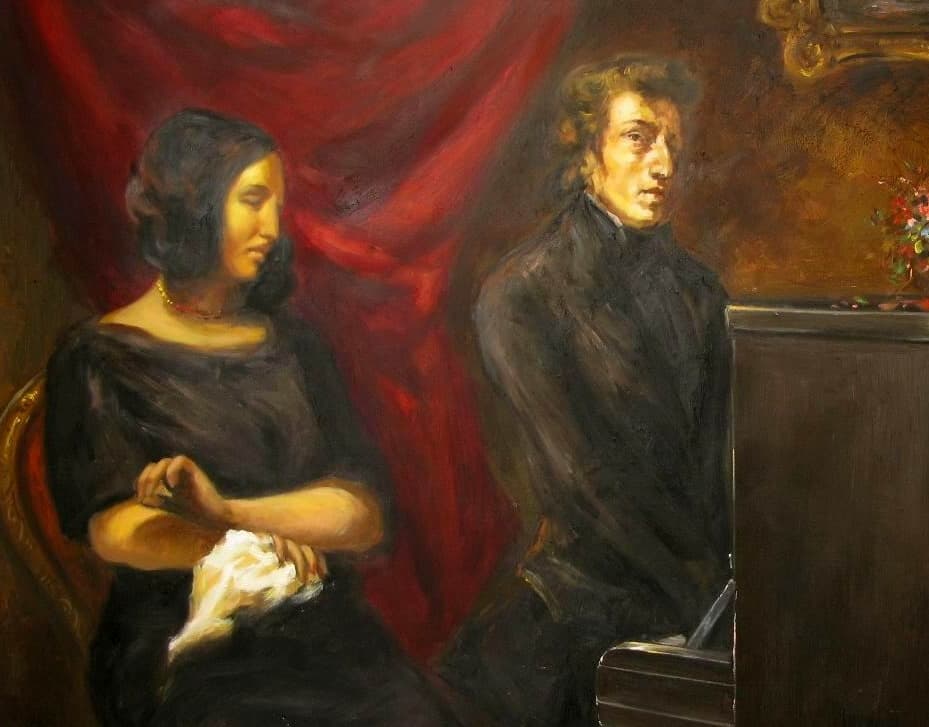
Portrait of Frédéric Chopin and George Sand by Eugène Delacroix

Portrait of Frédéric Chopin and George Sand by Eugène Delacroix

But their relationship, and the relationship between Sand and her two teenage children, were all starting to show cracks.

Chopin was also deeply homesick for his Polish homeland, continually distressed by Polish politics and his status as a permanent exile.

The C-minor Nocturne is one of his darker pieces for solo piano: elegant and melancholy, but bitterly so.

Its quiet, contrasting middle section is a cry from the heart of a man who was feeling increasingly sick, isolated, and vulnerable.

Grieg – Lyric Pieces, Book I, Op. 12, No. 1, “Arietta” (c. 1866)  

Over the course of his career, between 1867 and 1901, Edvard Grieg published 66 “Lyric Pieces” for solo piano.

This brief “Arietta” was the very first one, written around the time of his marriage to his wife, soprano Nina Hagerup.

In 1901, a few years before his death, he reused the theme in his very last Lyric Piece, “Efterklang” (“Remembrances”).

Edvard Grieg | “Remembrances” Op. 71 No. 7 from “Lyric pieces” (by Vadim Chaimovich)   

Was he remembering a sad thing in particular? It’s possible: in 1868, the year after the lullaby-like Arietta was written, he and his wife had their only surviving baby, Alexandra.

Alexandra died of meningitis when she was still an infant, and the couple never had any more children.

That was just one of the many struggles that he and Nina survived as a married couple.
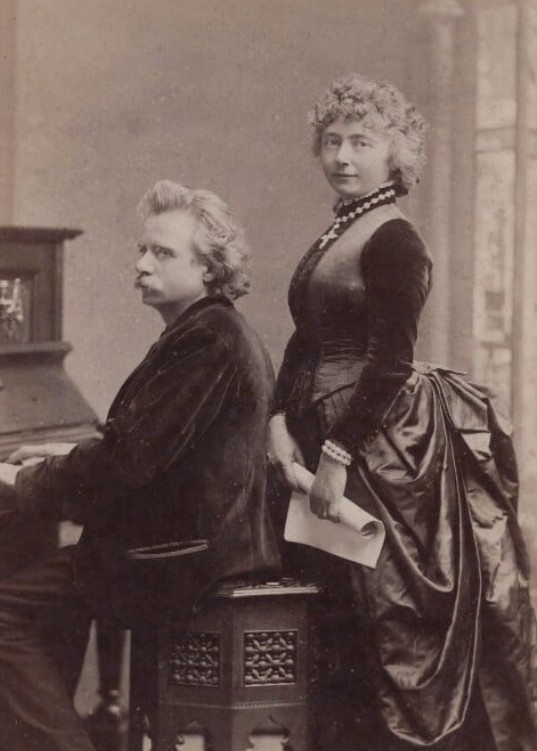
Edvard Grieg and Nina Hagerup Grieg

Edvard Grieg and Nina Hagerup Grieg

Although their relationship was occasionally rocky, they were married until he died.

Maybe turning a 35-year-old theme into a quiet waltz was his way of communicating that he – and they – had made it through decades of marriage, despite the troubles and tragedies they’d endured to get there.

Scriabin – Prelude in E minor, Op. 11, No. 4 (1888)   

Alexander Scriabin was born into a noble Russian family in 1871. His mother was a concert pianist but, tragically, died when he was just a year old.

After he was widowed, Scriabin’s father decided to follow his own family’s tradition of joining the military, leaving his baby son with his grandmother, great-aunt, and aunt.

His aunt played piano, which little Alexander loved. As a child, he begged to be played with. He grew up to play the piano himself, studying under Rachmaninoff’s infamously strict teacher Nikolai Zverev.
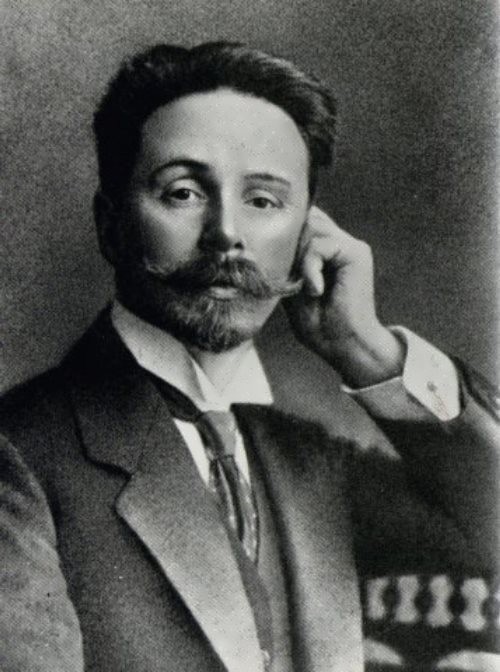
Alexander Scriabin

Alexander Scriabin

At one point, Alexander tried to assemble an orchestra of local children to try his hand at conducting, but the venture ultimately failed, leaving him in tears.

In short, he was a wounded loner during his childhood, and you can perhaps hear some of that in this early Chopin-inspired prelude, written in 1888, the year he turned seventeen.

Rarely has teen angst been so elegantly channeled.

Brahms – Intermezzo in E-flat-minor, Op. 118, No. 6 (1893)   

The Op. 118 set of piano pieces is a product of Brahms’s final years: a period in which he was preoccupied with nostalgia and mortality. By 1893, Brahms was nearing sixty and contemplating retirement.

To make matters worse, pianist Clara Schumann, his musical soulmate who was thirteen years his senior, was in failing health. And they’d found themselves in a quarrel.
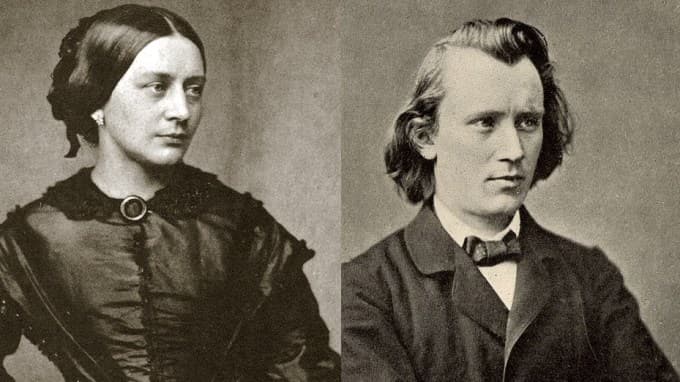
Black and white collage of composer Johannes Brahms and Clara Schumann

Clara Schumann and Johannes Brahms

Brahms wrote his Op. 118 and 119, in part, as a gruff but meaningful olive branch to her.

The E-flat-minor Intermezzo is one of his most despairing creations for solo piano. Many of Brahms’s works can feel emotionally subdued compared to more demonstrative contemporaries like Tchaikovsky or Dvořák, but this one is unusually frank about expressing sadness.

Happily, after receiving the scores for his Ops. 118 and 119, Clara Schumann wrote back to him, and they resolved their differences before their deaths, which would occur in 1896 and 1897, respectively.

Janáček – In the Mists: I. Andante (1912)   

Janáček composed In the Mists during an agonising period of professional stagnation.

He was 58 and felt deeply alone. His beloved daughter Olga had died in 1903, and his marriage had been deeply strained ever since.

He was also having trouble getting his work performed. He feared that his composing career was coming to a close and that he hadn’t fulfilled his potential.
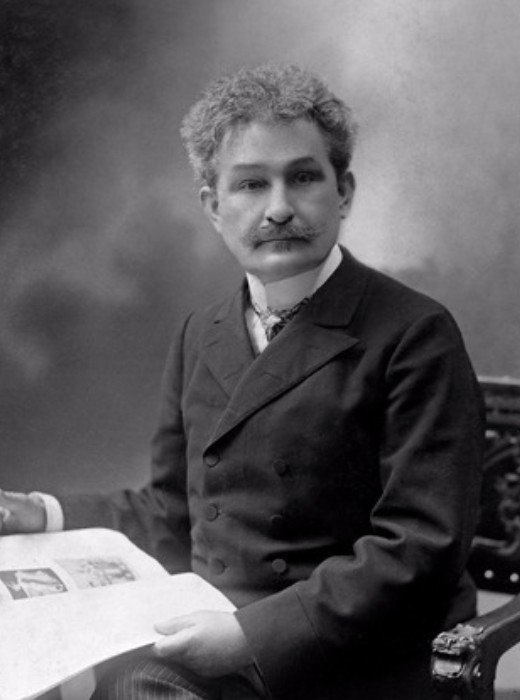
Leoš Janáček

Leoš Janáček

The first movement of In the Mists drifts through blurry, seemingly improvisatory harmonies.

It captures the emotions of a man facing professional disappointment and wandering through obscurity.

Rachmaninoff – Étude-tableau in E-minor, Op. 39, No. 5 (c. 1917)   

Rachmaninoff wrote his Op. 39 between 1916 and 1917, right as the world seemed to be collapsing around him.

World War I was ongoing, and revolution was coming. By 1917, it became clear to Rachmaninoff that the genteel aristocratic world he’d been born into was doomed – and never returning.

While writing this piece, he was struggling with fears about the safety of his family and friends, the necessity of exile and the loss of property and possessions, the end of his Russian career, and the fear of starting over in another country while in his mid-forties.

When he fled Russia later that year, he took these etudes with him. They are some of the last works he ever wrote on Russian soil, and they sound like an unhappy, unwilling goodbye.

Glass – Etudes: No. 5 (1994)   

Philip Glass’s official description of his first ten etudes is very matter-of-fact:

Book 1 (Etudes Nos. 1 through 10) had a twin objective – to explore a variety of tempi, textures, and piano techniques. At the same time, it was meant to serve as a pedagogical tool by which I would improve my piano playing. In these two ways, Book 1 succeeded very well. I learned a great deal about the piano, and in the course of learning the music, I became a better player.
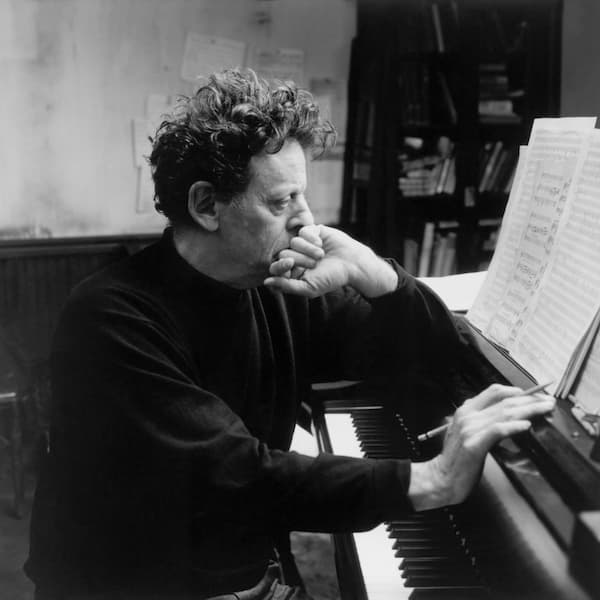
Philip Glass

Philip Glass

The first six etudes – including the fifth – were commissioned by conductor and pianist Dennis Russell Davies for his fiftieth birthday.

This piece was written during a difficult period in Glass’s life. His wife, artist Candy Jernigan, died of liver cancer in 1991, just weeks after being diagnosed. She was only 39.

“She was going to live forever, as far as I was concerned. It was a big shock for everybody, particularly the kids,” he told The Guardian in 2001.

It’s unclear whether Glass deliberately meant to portray this feeling in his fifth etude, but he captures the quiet repetitive numbness that a person can feel after the sudden death of a loved one.

Conclusion

Whether you’re searching for heartbreaking piano music, reflective pieces for difficult days, or just music to set a melancholy mood, these ten pieces stand apart. They are some of the saddest in the entire piano repertoire.

They all remind us of the humanity we share with the great composers, and testify to how music will always be one of the most powerful ways a person can process change, loss, disappointment, and grief.

Jumaat, 12 Julai 2024

At the Piano With Sir Edward Elgar

by Hermione Lai, Interlude

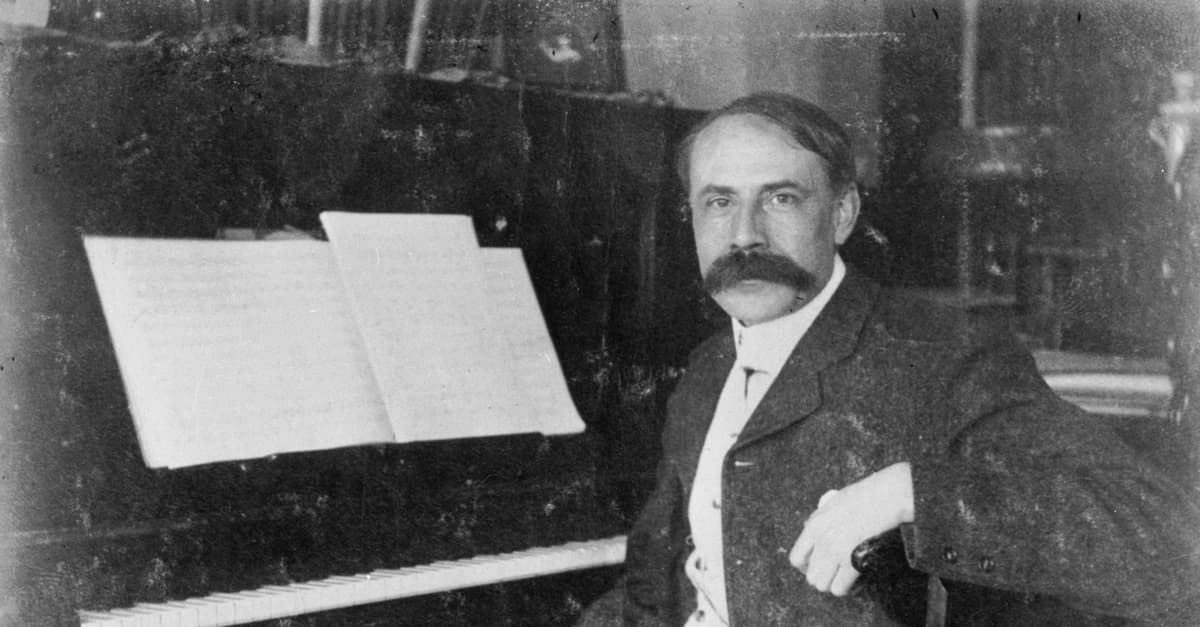
Edward Elgar

Edward Elgar

On the other hand, Elgar made his money from lighter and less significant works. He certainly received a steady income from royalties on short pieces composed for publication and sale in the form of sheet music for the home market. And not surprisingly, the most common instrument for home entertainment was for the upright piano. But before we get into the solo piano pieces, here is a delightful Romance for piano and violin, published as Elgar’s Op. 1. 

The majority of Elgar’s compositions for solo piano stem from the early part of his career, or the very end of his life. As a child, Elgar was praised for his piano improvisations, but he claimed “that playing the piano gave him no pleasure.” And while he did take some violin lessons, he was certainly a proficient pianist.

Edward Elgar: Chantant

Let’s not get distracted, the majority of Elgar’s works for solo piano were composed specifically with that instrument in mind. Take for example Chantant of 1872, a work written at the age of fifteen in the style of a Mazurka. It features all the rhythmic aspects of that particular dance, with Elgar repeating the principle theme with slight changes of colour. A rather interesting “chorale” serves as a type of interlude with the main theme rushing to a dramatic conclusion.

Edward Elgar: Douce Pensée

A good many of these early pieces were probably composed as musical gifts for friends and relatives. Although similar in style and simply in structure, they all contain a certain gaiety and rhapsodic charm. Just listen to Douce Pensée, composed during a visit to Yorkshire in 1882. Originally, the piece was written as a trio for Elgar, his friend Dr. Buck and his mother.

Elgar met Dr. Charles Buck, a member of the British Medical Association in Worcester in 1882, and that meeting became the start of a life-long friendship. Elgar was invited to Dr. Buck’s house in Giggleswick, Yorkshire, and since the good doctor was a competent amateur cellist and his mother played the piano, Elgar expanded a trio he had started the previous year. He later arranged the trio for solo piano and called it Douce Pensée (Gentle Thought). It eventually also became a piece for violin and piano renamed “Rosemary,” and carried the subtitle “That’s for Remembrance.” 

Edward Elgar: Presto

Isabel Fitton

Isabel Fitton

As a birthday present for the twenty-first birthday of Isabel Fitton, Elgar composed a delightful “Presto.” Isabel was the daughter of one of Elgar’s greatest friends, the splendid local pianist Harriet Fitton. Maybe you know that name from another context? Isabel was a viola player, and her name and instrument appears in the sixth Enigma variation dedicated to “Ysobel.” That variation begins with a viola figure that Edward had written for her earlier. The Presto, dating from 1889, however, is all Chopin. After a great opening flourish, we find a short Chopin-like episode, with both sections repeated. Elgar then writes one of his lovely sequential sections, and once the original theme is re-introduced it quietly sings to slightly different harmonies before the piece comes to a quiet close. 

Edward Elgar: Sonatina

Elgar in Turkey

Elgar in Turkey

Elgar was working on a Sonatina in 1889, originally composed for his 8-year old niece May Grafton. She was the daughter of Elgar’s favourite sister, Pollie. May was actually living in the Elgar household in Plas Gwyn, their Hereford home. She helped to run the household, and she was particularly important to Edward once Alice died. May was a keen photographer, and many of the images of the composer were taken by her.

Only in 1932 did Elgar work on these old piano sketches and he completed the Sonatina, which was published in the same year. The Sonatina is a short work in two movements. According to notes from the Elgar Society, “it contains a sentimental, gently rocking melody that gives way briefly to a tiny contrasting section before reverting to the repeated first section.” The second movement is a more cheerful movement that happily dashes to the finish. 

Edward Elgar: Minuet

Nicholas Kilburn

Nicholas Kilburn

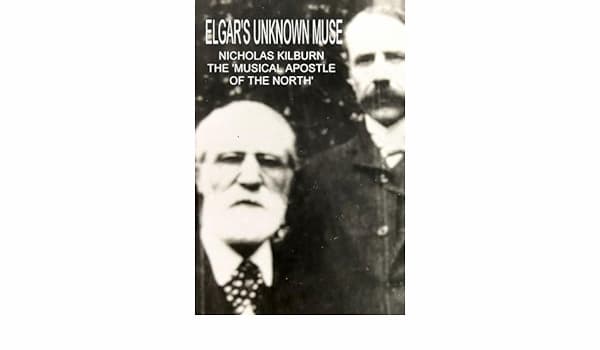
Nicholas Kilburn was an iron merchant in Sunderland who was also an amateur conductor and an early champion of Elgar’s work. In fact, he directed all of Elgar’s choral works after 1887 and Elgar referred to him as “The Saint.” Kilburn almost made it into the Enigma Variations, as there is a fragment of a variation that is headed “Kilburn.” In the event, it was Nicholas’ son Paul that the Minuet of 1897 was written for.

This charming piece of music unfold in the form of an arch, as the opening musical turn of phrase keeps returning in the form of a refrain, with a gentle and pastoral melody as the central pillar. Elgar later orchestrated the piece and it was published in its orchestral form in 1897. In the same year, it also appeared as a piano work in “The Dome Magazine,” a publication advertised as “An Illustrated Monthly Magazine and Review of Literature, Music, Architecture and the Graphic Arts.” 

Edward Elgar: Concert Allegro, Op. 46

Fanny Davies

Fanny Davies

The concert pianist Fanny Davies was a student of Clara Schuman and a friend of Johannes Brahms. For many years Elgar had been thinking of writing a piano concerto, but this project never went beyond some sketches. Davies wrote to Elgar in 1901, “I am so disappointed if you can’t let me have just a wee ‘little Elgar’ for my recital on Dec. 2nd … I could learn it very quickly if I had it – and the Concert is not till December 2nd.”

Elgar went to work and produced the Concert Allegro, originally titled “Concerto (without Orchestra) for pianoforte.” Critics were not enthusiastic, and there seems to be the suggestion that Davies played the piece as “anything down to half speed.” Publishers also didn’t want to take on the piece, and many adjustments and amendments were made, including pasting over some original ones. Fanny Davies did continue to perform it, and Richter exclaimed that the work was “as if Bach had married Liszt!” There was some talk of an orchestral arrangement, but the score disappeared and was only rediscovered in 1968. 

Edward Elgar: In Smyrna

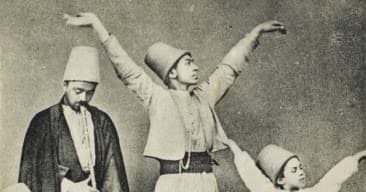
In the autumn of 1905, Elgar took his friend Frank Schuster on a Mediterranean cruise on the Royal Navy ship HMS Surprise. Elgar went as a guest of the Navy, and he was hosted by Vice-Admiral Beresford. In his diaries Elgar described the journey in great detail, and he was enthused by several places he visited. Among them was the ancient Greek city of Smyrna, currently the Turkish city of Izmir. Elgar noted in his diary, “drove to the Mosque of dancing dervishes … music by five or six people very strange & some of it quite beautiful – incessant drums and cymbals (small) thro’ the quick movements.”

Elgar’s music for “In Smyrna” does not reflect the dervish dances, but rather mirrors an earlier diary entry where he wrote, “Rose late. Very, very hot & sirocco blowing-peculiar feelings of intense heat and wind…” The shimmering qualities are beautifully transferred to the piano and since there are no major climaxes, the work ends quietly. Elgar used some of the materials in his “Crown of India Suite” in 1912. 

Edward Elgar: Dream Children, Op. 43

The two movements of “Dream Children” were written in 1902 for either piano or for orchestra. These pieces suggest a strong nostalgia for childhood, as the score is headed by a quotation from Charles Lamb’s Dream-Children, a Reverie. “And while I stood gazing, both the children gradually grew fainter to my view, receding, and still receding till nothing at last but two mournful features were seen in the uttermost distance.”

Capturing wistful innocence was one of the hallmarks of Elgar’s compositional style, and the composer’s DNA is readily found in these piano miniatures. Elgar did produce a piano arrangement of the famed Enigma Variations, but I decided to focus on smaller pieces instead. Of course, Elgar also wrote a number of songs for voice and piano. Would you be interested to have them featured? Please let us know in the comments.

Jumaat, 12 April 2024

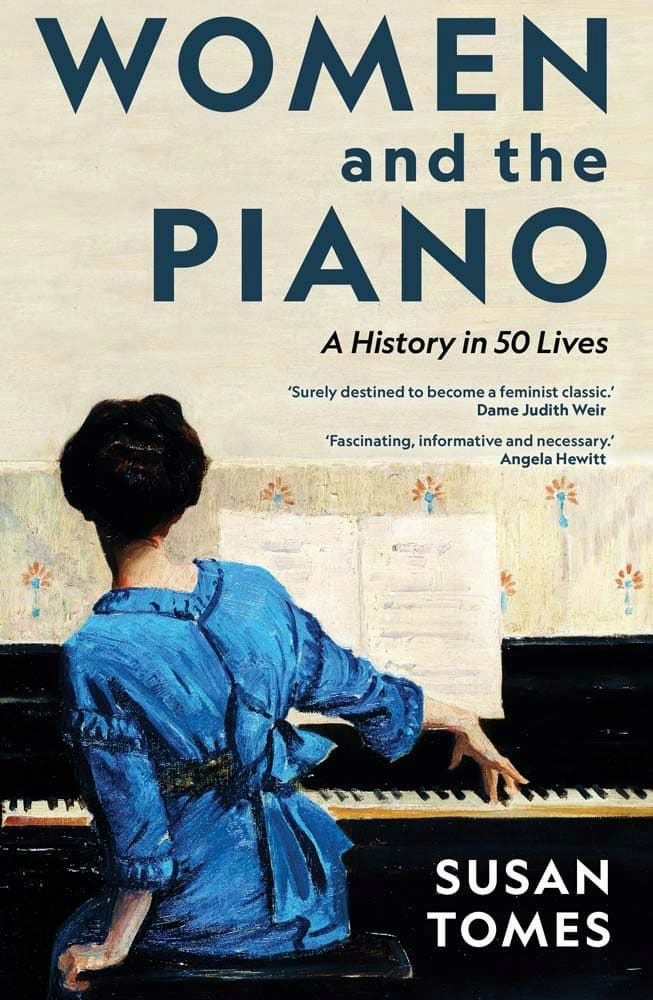
WOMEN AND THE PIANO: A History in 50 Lives - Susan Tomes

by Frances Wilson, Interlude

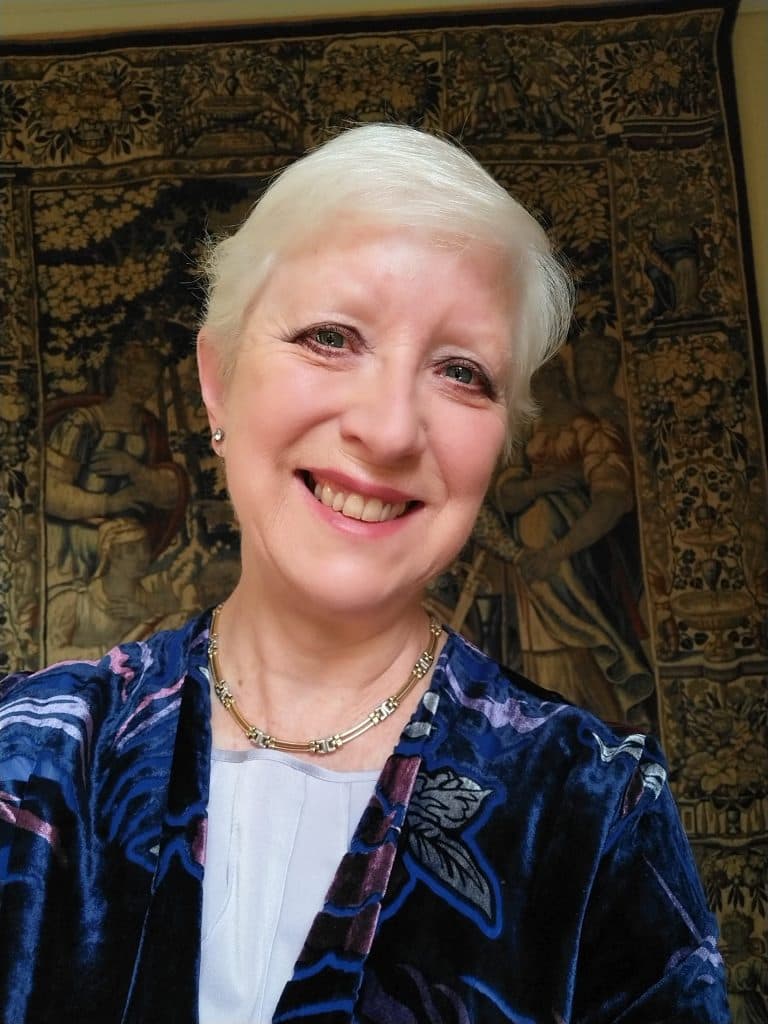
Susan Tomes

Susan Tomes

Focusing on 50 women pianists – some well-known (Louise Farrenc, Fanny Mendelssohn, Nadia Boulanger, Tatiana Nikolayeva, for example), others less so, or only recently discovered – Tomes traces the lives and music-making of these women across the piano’s history, from the development of the piano in the 18th century to the present day.

As Tomes points out in her introduction, the piano is “an instrument that anyone can play, irrespective of gender”, yet until fairly recently, women pianists and composer-pianists were overlooked, under-represented in concert programmes and recordings, and generally consigned to the background in classical music history.

In some ways, the reasons for this are simple: women pianists lacked access to formal music training, were excluded from performance opportunities, and were even at a disadvantage to men due to the size of the instrument, the piano’s keys being designed for men’s typically larger hands. Additionally, women often had significant obligations to the home and family. And yet, despite these limitations, women continued to play, perform, and compose their own music. 

Pioneers, in a number of ways, women pianists carved their own paths within a male-dominated profession. They travelled independently and helped to shape the modern piano concert as we know it today, including playing from memory (Clara Schumann), performing cycles of complete works (Wanda Landoswka/Bach’s Goldberg Variations), premiering new works and reviving historical works, bringing lesser-known and rare repertoire into concert programmes and recordings, and commissioning new music. They were involved in recording, broadcasting, presenting TV programmes about music, creating educational initiatives, devising concert series….and much more – all against a background of, at best half-hearted support, at worst, antagonism, resentment, and open sexism. 

WOMEN AND THE PIANO: A History in 50 Lives by Susan Tomes book cover

These enterprising women, 50 of whom are presented in this book, helped to expand and diversify the profession, gradually debunking the notion that the male approach to a career as a concert pianist was not the only way. These women were not imitators of male pianists but artists in their own right, with their own musical integrity, authority, and identity.

This highly readable, meticulously researched, and elegantly crafted book takes a chronological approach, beginning with French keyboard player Anne-Louise Boyvin d’Hardancourt Brillon de Jouy and ending with Nina Simone, jazz pianist, singer and civil rights activist. For each woman pianist featured, the author gives biographical details, notes their significant performances, recordings or compositions, and demonstrates how they have each contributed to the world of the piano.

The introductory chapters explore some of the reasons why women were sidelined, including social mores and prejudices, and how men became ascendent in the profession. The closing chapters examine where we are today with regard to female musicians, including the effect of equal rights legislation, the rise of piano competitions, shifting attitudes within the profession and audience perceptions, and the influence of teachers. For this section of the book, Susan Tomes spoke to a number of female pianists working today to reveal some surprising insights, and the barriers and limitations which women still face today in a highly competitive global profession. 

At a time when the current discourse in classical music – and indeed in society in general – is focused on equality and inclusion, this book is an important, valuable contribution to the debate and a rich celebration of the essential role of women in the history of classical music and the piano in particular.

Rabu, 15 Februari 2023

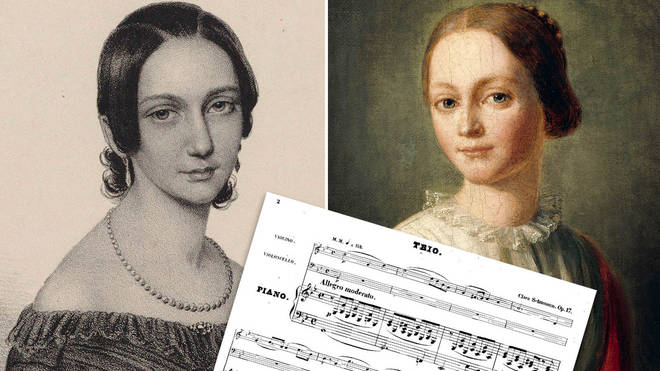
9 of Clara Schumann’s all-time best pieces of music

9 of Clara Schumann’s all-time best pieces of music

9 of Clara Schumann’s all-time best pieces of music. Picture: Getty

By Maddy Shaw Roberts,  ClassicFM

We explore the musical canon of one of the Romantic period’s most unsung composers.

A virtuosic pianist and brilliant composer, Clara Schumann was one of the stars of the Romantic era – but her music hasn’t always been given the credit it deserves.

Working in a field overwhelmingly dominated by men, the 19th-century musician is quoted as saying sometime in her later years: “I once believed that I possessed creative talent, but I have given up this idea; a woman must not desire to compose – there has never yet been one able to do it. Should I expect to be the one?”

Despite the obstacles she faced, Clara Schumann’s canon includes 30 Lieder, choral music, solo piano pieces, one piano concerto, plus chamber and orchestral works. Here are the most memorable among them.


  1. Piano Concerto in A minor

    Clara Schumann was one of the most acclaimed pianists of her time and wrote exquisitely and extensively for the instrument. This beautiful piano concerto gives us more than a hint of her incredible pianism and musical imagination.

  2. Piano Trio in G minor

    This gorgeous chamber composition for violin, piano and cello has been called a “masterpiece” among Clara Schumann’s works.

    She wrote it in the summer of 1846, during a traumatic period of her somewhat turbulent life. Her husband, Robert Schumann, was extremely ill and the couple had travelled to Nordeney in an attempt to improve his health condition. Clara, who had recently fallen pregnant, suffered a miscarriage during their stay on the island.

    Clara’s trio is said to have greatly influenced her husband’s first piano trio, Op. 63, which was written a year later.


  3. 6 Lieder, Op.13

    After her marriage Clara turned, to some extent, away from writing for the piano, and towards lieder and choral works. These Sechs Lieder, or Six Songs, are a setting of the romantic poems of Herine, Geibel and Rckert. Written in the first weeks of her nuptials, the songs convey the intimacy of the first, blissful season of marriage.

  4. Variations on a theme by Robert Schumann

    The Schumanns had a close relationship, emotionally and musically, and their works were frequently paired at concerts.

    These Variations are almost a love letter to the couple’s passion for music-making, the seven moments gradually developing Robert Schumann’s simple theme into an intricate, expansive work for the keyboard.

  5. Three Romances

    Romances were one of Clara Schumann’s favourite forms to compose in, and these are some of her most exquisite. She toured the piece and played it before royalty with its dedicatee, her close friend and violin virtuoso, Joseph Joachim.

    One critic said at the time: “All three pieces display an individual character conceived in a truly sincere manner and written in a delicate and fragrant hand.”

  6. Scherzo No. 2 in C minor

    A pianist herself, Clara Schumann loved to write flourishing works for the piano that showed the virtuosity of the performer.

    Her Scherzo No. 2 is fiery and beautifully nuanced – hear it played below by the brilliant young piano star Isata Kanneh-Mason, a 21st-century champion for Clara’s music.

  7. 4 Pièces caractéristiques

    Clara frequently performed this piece during her early career. And at one performance, who should be in the crowd but her contemporary, Polish piano virtuoso and composer Frédéric Chopin, who found himself captivated by Clara’s work.

    Its lively opening, marked ‘Allegro furioso’, is delightfully contrasted by its plaintive third movement, marked ‘Andante con sentimento’.

  8. Impromptu in E major

    A largely forgotten work, the ‘Impromptu’ is bliss in a bottle for lovers of Romantic piano music. Composed in 1844, it was not published until 1885, when Schumann was well into her 60s and still delighting concert audiences.

  9. Soirées Musicales

    The Soirées Musicales comprise six miniatures – a Toccatina, a Notturno, two Mazurkas, a Ballade and a rhythmic Polonaise, all familiar-sounding titles for fans of Chopin’s music. The ‘Polonaise’, in particular, gently nods to the Polish giant’s form.

Want to vote for Clara Schumann’s music in the world’s biggest survey of classical music tastes? Cast your vote before 22 March 2023 in the Classic FM Hall of Fame.

Isnin, 5 April 2021

Clara Schumann - Her Music and Her Life


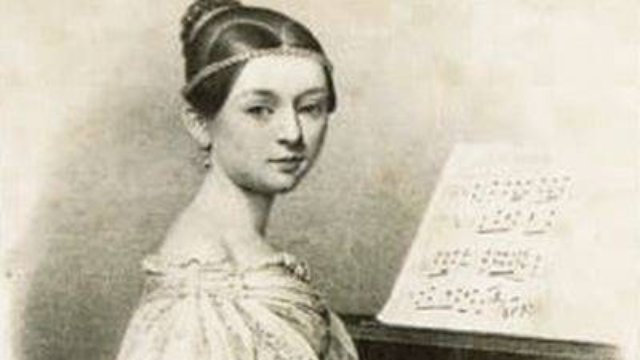
Clara Schumann née Clara Wieck (1819 – 1896)